Email List Verification Free: What You Actually Get in 2026
Free email list verification is real, but every provider draws the line somewhere. Here's exactly how many credits you get, what gets checked, and when free stops being enough.

TL;DR
- Free email list verification exists at almost every vendor, but "free" usually means 25–100 credits a month, not an unlimited list cleaner. Tomba's free tier gives you 25 searches/month; most rivals sit in the same band.
- The syntax + MX + SMTP checks are commoditized. What separates tools is catch-all handling, and that's the feature free tiers gate hardest.
- A 5,000-contact list will not be verified free anywhere credible. Expect to pay roughly $0.002–$0.01 per email once you cross the free ceiling.
- Free browser tools (single-address checkers, extractors, permutators) are genuinely unlimited and worth wiring into your workflow before you spend anything.
- The real math: one bounce costs you more in sender reputation than 1,000 verified emails cost in credits. Verify before you send, always.
What does "email list verification free" actually mean?#
It means one of three very different things, and vendors deliberately blur them.
1. A free single-address checker. You paste one email, you get a verdict. No signup, no credits, unlimited use in practice. Tools like Tomba's free email checker live here. Useful for spot-checking a prospect before a manual send; useless for a 4,000-row CSV.
2. A free tier inside a paid product. You create an account and get a monthly credit allowance — typically 25 to 100 verifications. This is where most "free email list verification" search traffic lands. It resets monthly, it's real, and it's small.
3. A free trial dressed up as a free tier. One-time 100 credits, then a paywall. The pricing page says "free," the fine print says "trial." Check whether the allowance resets — that single word is the difference between an ongoing free workflow and a 20-minute demo.
The practical implication: if your list is under ~50 addresses per month, free tiers genuinely cover you and you should stack two or three of them. If your list is over 1,000, stop reading vendor free-tier marketing and go straight to per-credit pricing, because that's the number that will actually govern your cost.

How does email verification work under the hood?#
Four checks run in sequence. Understanding them tells you exactly which free tools are cutting corners.
- Syntax validation — Does the string match RFC 5322? Catches
john@@acmeandjane.doe@acme(missing TLD). Costs nothing to run, which is why every free tool includes it. Filters maybe 1–2% of a scraped list. - Domain and MX record lookup — Does
acme.comresolve, and does it publish mail exchanger records? A domain with no MX record cannot receive mail, period. This catches dead companies and typo'd domains. Also cheap, also universally included. - Disposable and role-account detection — Flags
mailinator.comthrowaways andinfo@,sales@,support@shared inboxes. Role accounts aren't invalid, they're just terrible outreach targets with a high complaint rate. Some free tiers skip this classification entirely. - SMTP handshake — The tool opens a connection to the receiving mail server, issues
RCPT TO, and reads the response code without ever delivering a message. A250means the mailbox exists. This is the expensive step — it needs clean IPs, rate limiting, and retry logic — and it's the step that separates a real verifier from a regex script.
Then there's the fifth problem, which is not a step but a wall: catch-all domains. Roughly 15–20% of B2B domains are configured to accept mail at any address, so the SMTP handshake returns 250 for ceo@acme.com and asdfgh@acme.com alike. A basic verifier marks these "unknown" and hands the risk back to you. A good one runs pattern inference, historical-response data, and secondary signals to give an actual probability. Tomba's catch-all verifier exists specifically for this class, and it's almost never in a free tier — at any vendor.
Which free email verification tiers are worth using in 2026?#
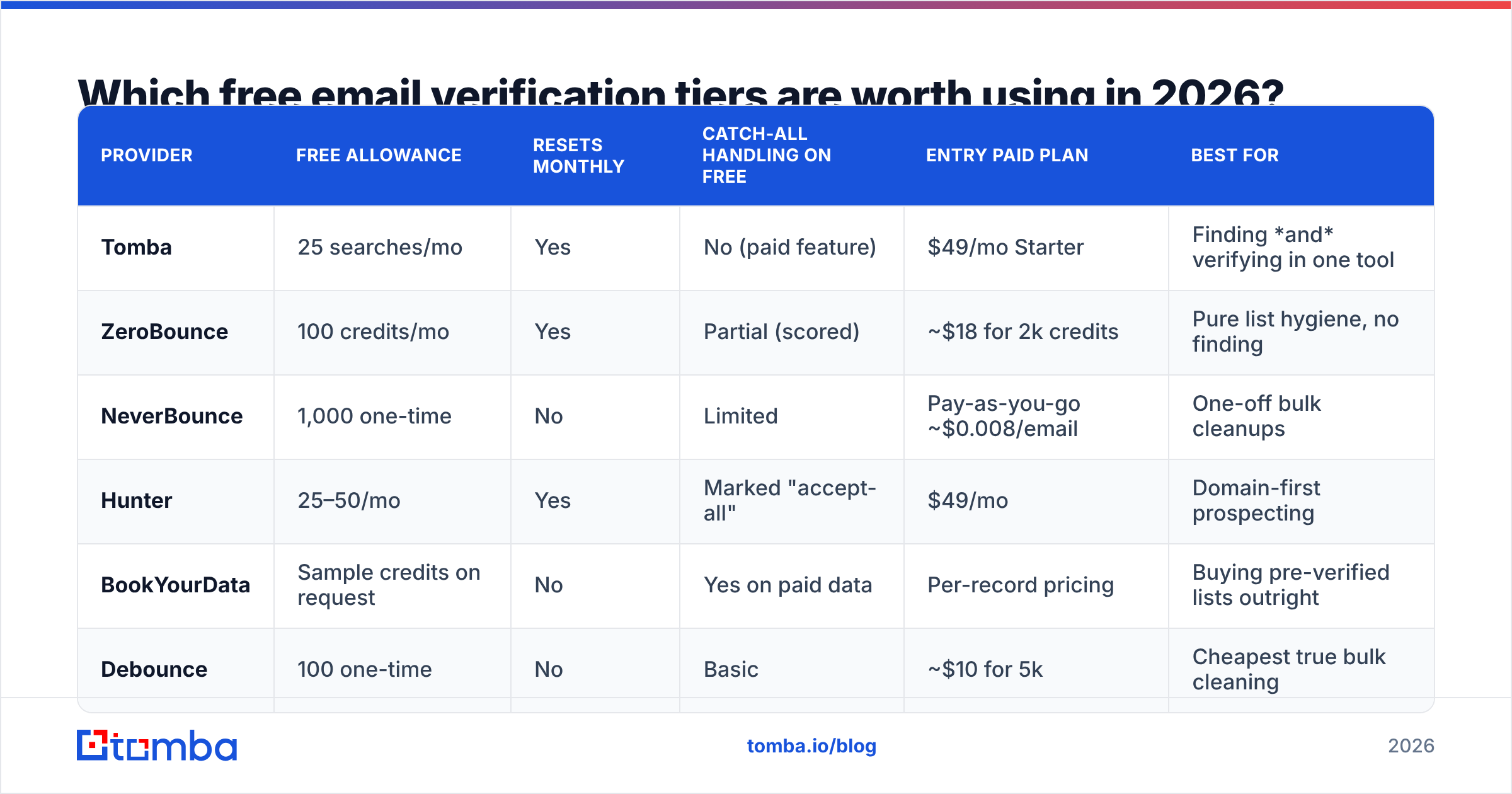
Here's the comparison that matters. Numbers are monthly free allowances and list prices as published by each vendor; always re-check before you commit, since credit bundles change quarterly.
| Provider | Free allowance | Resets monthly | Catch-all handling on free | Entry paid plan | Best for |
|---|---|---|---|---|---|
| Tomba | 25 searches/mo | Yes | No (paid feature) | $49/mo Starter | Finding and verifying in one tool |
| ZeroBounce | 100 credits/mo | Yes | Partial (scored) | ~$18 for 2k credits | Pure list hygiene, no finding |
| NeverBounce | 1,000 one-time | No | Limited | Pay-as-you-go ~$0.008/email | One-off bulk cleanups |
| Hunter | 25–50/mo | Yes | Marked "accept-all" | $49/mo | Domain-first prospecting |
| BookYourData | Sample credits on request | No | Yes on paid data | Per-record pricing | Buying pre-verified lists outright |
| Debounce | 100 one-time | No | Basic | ~$10 for 5k | Cheapest true bulk cleaning |
Read that table twice. The column that decides your workflow isn't "free allowance" — it's resets monthly. A 1,000-credit one-time grant looks generous until month two, when it's zero. A 25/month allowance that resets is an ongoing tool.
The second thing to notice: pure verifiers (ZeroBounce, Debounce, NeverBounce) and finder-plus-verifier platforms (Tomba, Hunter) are not competing for the same job. If you already own a list, a pure verifier is cheaper per email. If you're building the list, paying twice — once to find, once to verify — is worse economics than one platform that does both. Tomba's email verifier runs inside the same credit pool as the email finder, which is why the per-contact cost lands lower than the sticker comparison suggests.
BookYourData sits in a third category worth naming: instead of verifying a list you assembled, you buy records that arrive pre-verified with an accuracy guarantee. That's a legitimately different purchase — higher upfront cost, near-zero verification labor — and for teams without a data engineer it often wins on total cost.
What do the genuinely free tools cover?#
More than people expect. These aren't credit-metered, and they solve real steps in the pipeline:
- Email extractor — pull addresses out of pasted text, scraped HTML, or a conference agenda. Free, unlimited, no account.
- Email permutator — generate the 20-ish likely formats for
first.last@domainwhen you know the name and company but not the pattern. Feed the output into a verifier and you've reconstructed an address for zero finder credits. - Company email pattern — check which format a given domain actually uses. One lookup here can save you a dozen permutation guesses.
- Remove duplicates — dedupe your CSV before you spend a single verification credit. On a merged multi-source list this alone typically cuts 8–15% of rows.
- SPF checker and blacklist checker — these verify your sending setup, not the recipient. Both matter more to inbox placement than list hygiene does.
The workflow that costs nothing: dedupe → check pattern → permutate → verify the shortlist with your 25 free credits. You've turned a 25-credit allowance into meaningful coverage by spending credits only on the addresses you couldn't resolve for free.
Is free email list verification accurate enough to send from?#
Depends entirely on whether the free tier gates the SMTP step and the catch-all logic.
Independent testing across providers consistently lands in the same range: syntax and MX checks catch 20–30% of the garbage in a scraped list, SMTP verification catches most of the rest, and catch-all domains remain the residual 15–20% where no tool is certain. If a free tier does syntax + MX only, you're throwing away three-quarters of the value and will still bounce at 6–10%. That's above the ~2% threshold where email deliverability starts degrading and mailbox providers begin throttling you.
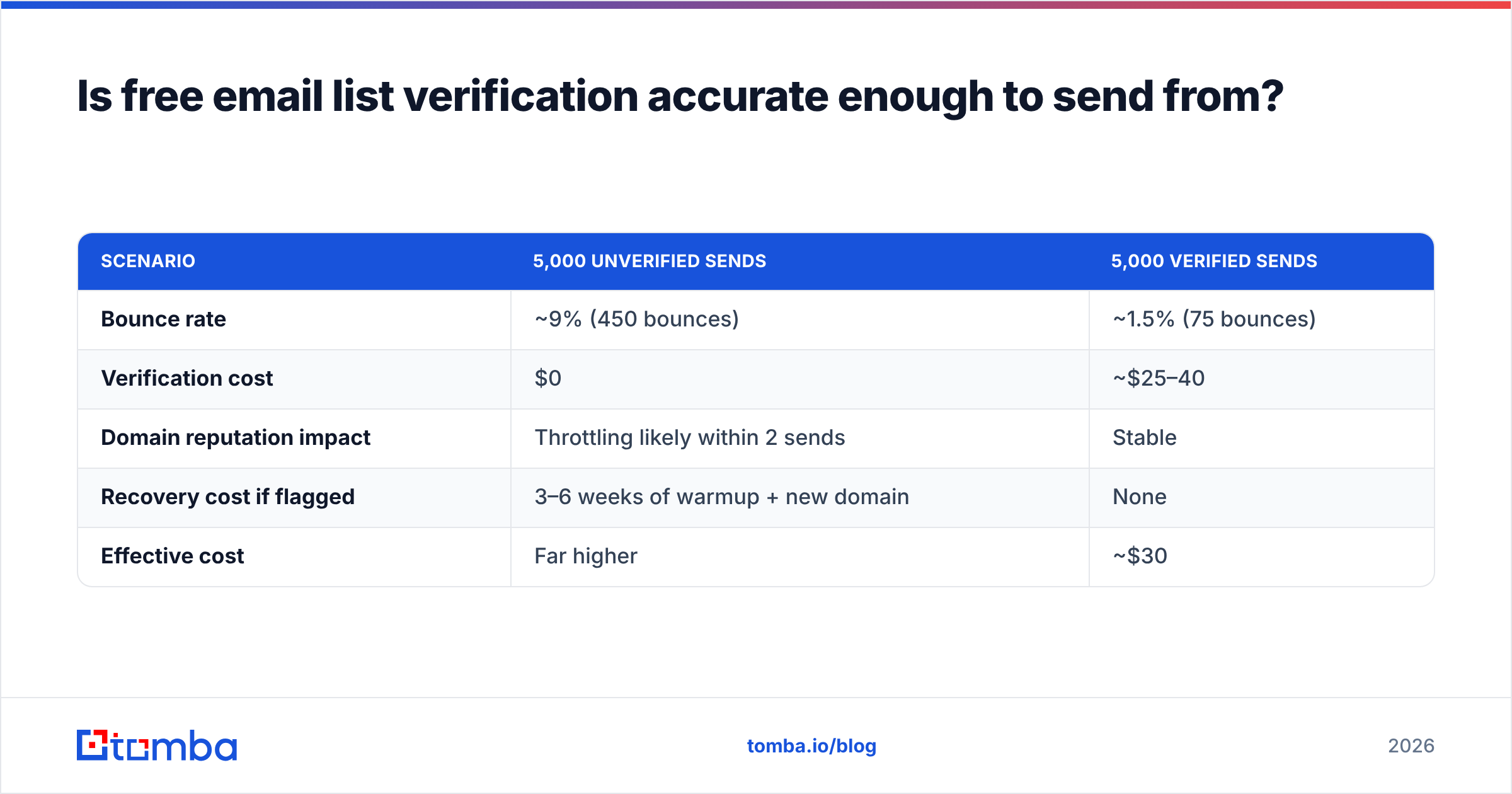
Here's the cost calculation nobody runs before choosing "free":
| Scenario | 5,000 unverified sends | 5,000 verified sends |
|---|---|---|
| Bounce rate | ~9% (450 bounces) | ~1.5% (75 bounces) |
| Verification cost | $0 | ~$25–40 |
| Domain reputation impact | Throttling likely within 2 sends | Stable |
| Recovery cost if flagged | 3–6 weeks of warmup + new domain | None |
| Effective cost | Far higher | ~$30 |
The $30 is not the expensive line item. Six weeks of a burned sending domain is. Google and Microsoft both tightened bulk-sender requirements in 2024 and have kept tightening — Google's published sender guidelines now treat a sustained bounce rate as a hard signal, not a soft one. Free verification that skips SMTP does not protect you from that.

When should you stop using free tiers?#
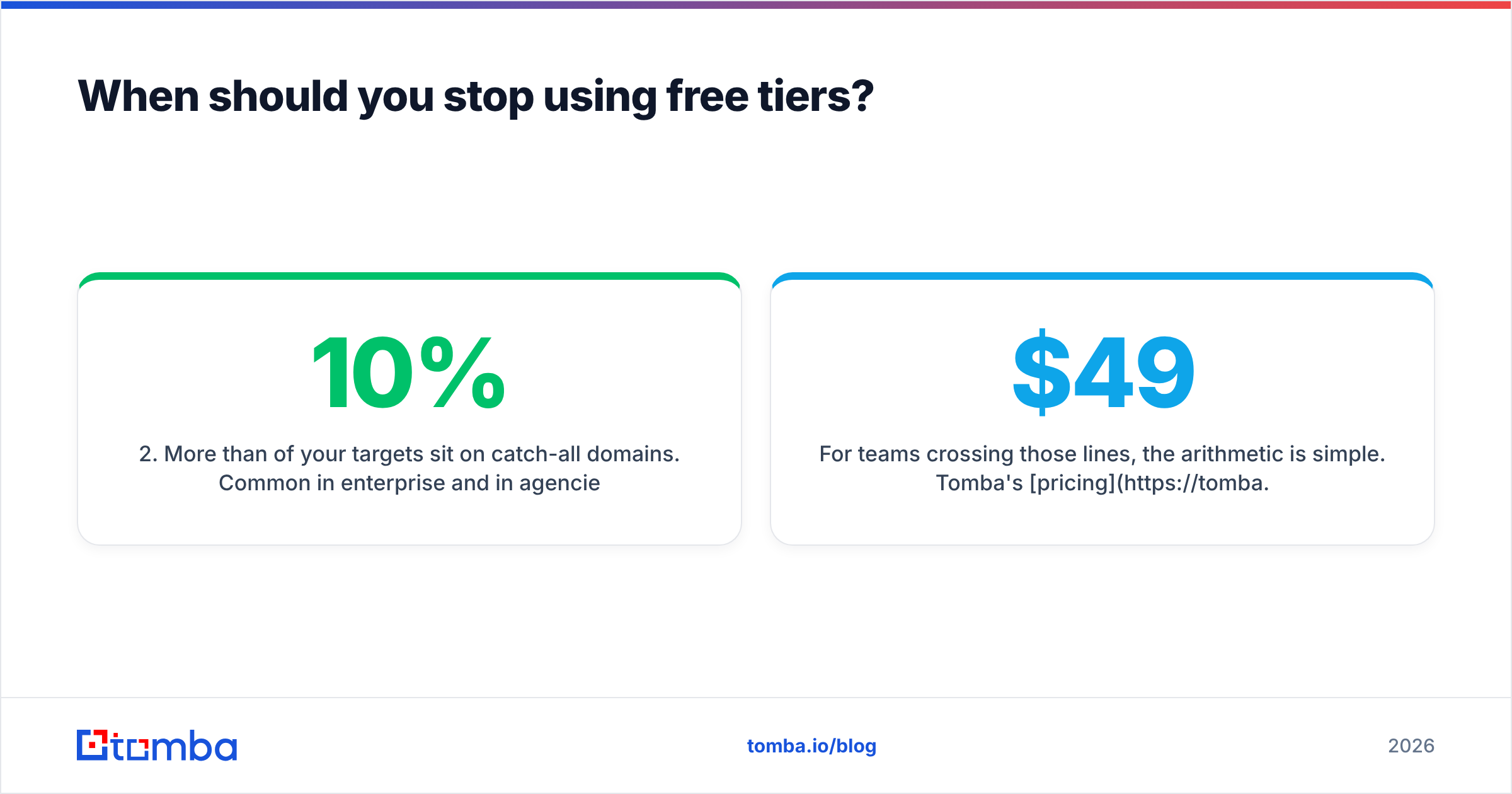
Three concrete triggers. Hit any one and free is costing you more than it saves.
- Your list exceeds 500 addresses per month. At 25–100 free credits, you'd need 5–20 accounts to cover it. Account juggling is unpaid labor, and most vendors' terms prohibit it anyway.
- More than 10% of your targets sit on catch-all domains. Common in enterprise and in agencies. Free tiers hand these back as "unknown," which means you either don't send (losing pipeline) or send blind (risking reputation). A catch-all finder resolves the ambiguity — and it's a paid capability everywhere.
- You need it in the pipeline, not in a browser tab. The moment verification has to happen on form submit, on CRM import, or inside an enrichment job, you need an email verification API with a rate limit and an SLA. No free tier ships either.
For teams crossing those lines, the arithmetic is simple. Tomba's pricing runs Free (25 searches/mo), Starter at $49/mo, Growth at $99/mo, and Pro at $249/mo, with Enterprise custom. At Growth, per-contact cost drops well under a cent when you're finding and verifying in the same pool — and finding is the expensive half of that pair elsewhere. Compare that against buying a standalone finder plus a standalone verifier and the consolidated bill usually wins by 30–40%.
How do you build a verification workflow that scales?#
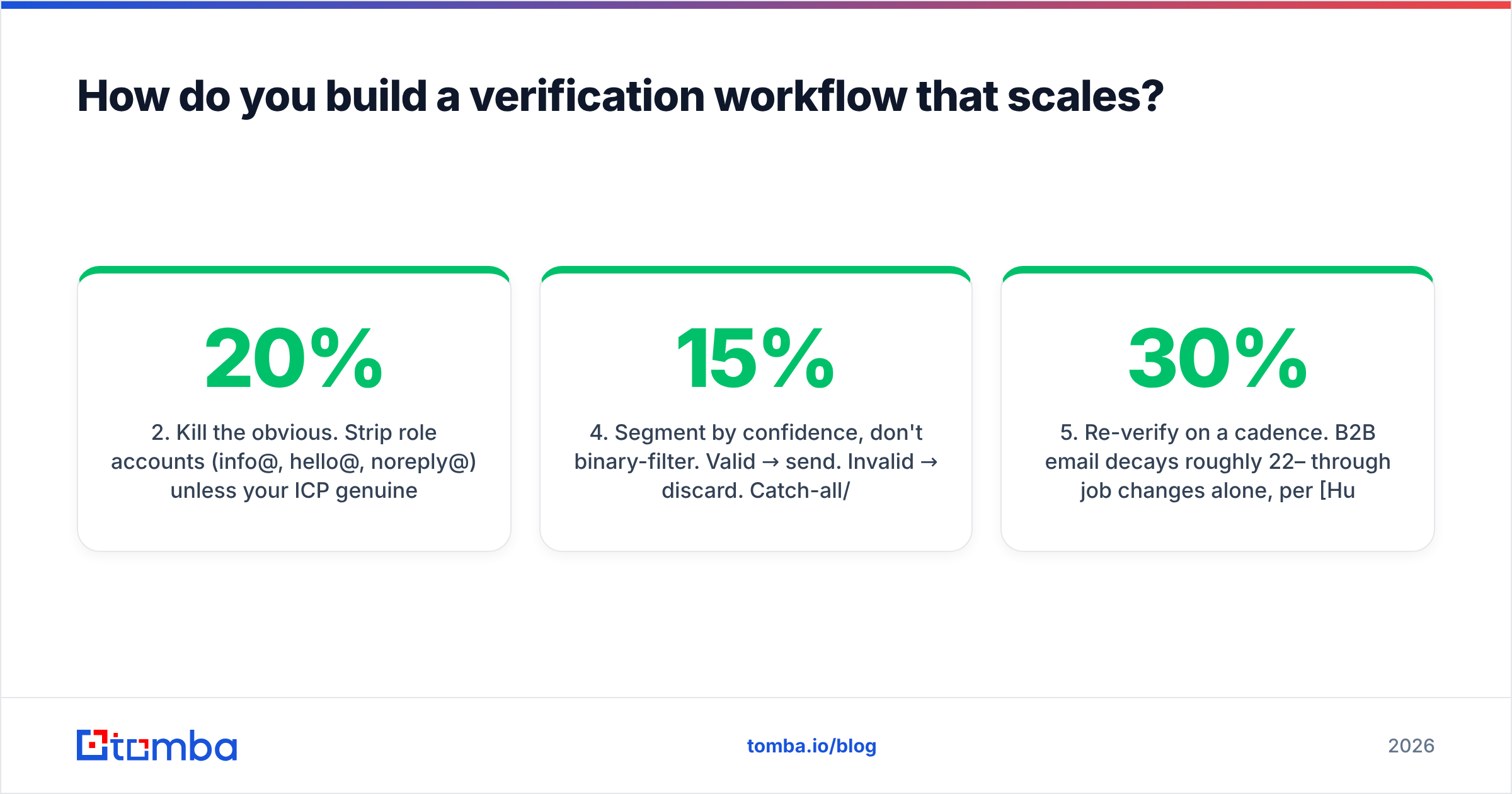
Six steps, in order, whether you're on free or paid:
- Dedupe first. Never spend a credit on a row you already have. Free tools handle this.
- Kill the obvious. Strip role accounts (
info@,hello@,noreply@) unless your ICP genuinely lives there. Strip disposable domains. Strip anything with a malformed syntax. This is free and cuts 10–20%. - Verify the remainder in bulk. Use a bulk verify job rather than one-at-a-time API calls — it's cheaper per credit at every vendor and gives you a single downloadable result.
- Segment by confidence, don't binary-filter. Valid → send. Invalid → discard. Catch-all/unknown → put in a separate, slower, lower-volume sequence from a secondary domain. Most teams delete this bucket and lose 15% of their addressable market for no reason.
- Re-verify on a cadence. B2B email decays roughly 22–30% per year through job changes alone, per HubSpot's database-decay research. A list verified in January is materially wrong by July. Quarterly re-verification on active segments is the standard.
- Verify at capture, not just at send. Wire the API into your form and CRM import so bad data never enters the database. Cheapest possible point of intervention.
Step 4 is the one most teams skip, and it's where the money is. Free tiers force a binary decision because they don't give you confidence scores — which is, quietly, the strongest argument for upgrading.
What's the honest verdict on free email verification?#
Free email list verification is real and worth using — within a clearly defined ceiling.
Use free for: spot-checking individual addresses, cleaning lists under ~50/month, testing a vendor's accuracy before you buy, and every non-metered utility (dedupe, extract, permutate, pattern lookup, SPF check). That's a genuinely useful stack that costs nothing.
Don't use free for: anything over 500 addresses, catch-all-heavy target lists, API-driven pipelines, or any campaign where a bounce spike would hurt. In those cases the free tier isn't a cheaper version of the paid product — it's a demo, and treating it as production tooling is how sending domains get throttled.
The test that settles it: run the same 25 addresses through two or three free tiers and compare verdicts against reality. Whichever tool disagrees least with what actually happens when you send is the one worth paying. Vendors' published accuracy numbers are marketing; your own 25-address sample is data. Cross-reference with third-party review data on G2 if you want a sanity check on support quality and billing behavior, which are the two things accuracy tests never reveal.
Start with the free tier, then scale when the math says to. Tomba's Email Finder gives you 25 free searches a month with verification built into the same workflow — so you're not paying one tool to find an address and a second tool to confirm it exists. When your list outgrows 25, Starter is $49/mo and the catch-all verifier, bulk jobs, and API unlock with it. Test it on your real target accounts, not a demo list, and see whether the verdicts hold up when you hit send.
Related guides#
Ready to find emails that actually work?
Join 150,000+ professionals who stopped guessing and started sending. Free credits on signup — no credit card required.
Get the Tomba newsletter
Practical outbound tactics and product updates — once every two weeks.
About the author