Email List vs Email Leads: What's the Real Difference?
An email list is a pile of addresses. An email lead is a person with a reason to reply. The gap between them is where most outbound budgets quietly die — here's how to tell them apart and what each actually costs.
TL;DR
- An email list is a set of addresses. An email lead is a person who matches your ICP, has a plausible reason to buy, and whose address has been verified. Volume vs. intent.
- Lists are cheap per row and expensive per meeting. Leads cost more up front and convert 5–15x better on reply rate.
- Bounce rate is the fastest diagnostic: a healthy targeted lead set lands under 3%. Aged, unverified lists routinely bounce 20–40% and torch your sending domain.
- Buying data is not automatically wrong — buying unverified, unfiltered, untargeted data is. Reputable vendors and verification layers change the math.
- The practical answer for most teams in 2026 is neither/both: build a narrow list from firmographic filters, then enrich and verify it into leads before a single send.
What is the difference between an email list and email leads?#
An email list is inventory. Email leads are qualified inventory.
Think of it like a phone book versus a referral. The phone book has 40,000 numbers and no context — technically correct data, zero signal about who wants to hear from you. A referral is one number with a reason attached: "she's rebuilding their data stack this quarter, mention Kyle." One is a volume asset. The other is a pipeline asset.
Technically:
- An email list is a collection of email addresses, usually assembled by scraping, exporting, purchasing, or importing from a form. It may or may not be verified, may or may not match your ideal customer profile, and typically carries no buying context.
- An email lead is a specific contact who (a) sits inside your target segment, (b) shows some fit or intent signal, and (c) has a deliverable, verified address tied to a real mailbox at a real company.
The confusion is expensive because the two are priced and sold like the same thing. Vendors quote "$0.02 per contact" and buyers assume they're buying leads. They're buying rows. Rows become leads only after filtering, enrichment, and verification — three steps that most teams skip and then blame the copy.

Why does the list-vs-lead distinction cost you money?#
Because the cost of a bad address is not zero — it's negative.
Sending to unverified list data does four things at once, and only the first one is obvious:
- Hard bounces spike. Mailbox providers read bounce rate as a proxy for consent. Cross ~5% and Gmail and Outlook start throttling.
- Spam-trap hits accumulate. Recycled traps sit in old, purchased lists specifically to catch senders who don't clean data. One hit can blacklist a domain.
- Your good prospects stop seeing you. Reputation damage isn't segmented. The 200 contacts you actually wanted land in spam alongside the 8,000 you never should have emailed.
- Rep time evaporates. SDRs work replies, and a list with a 0.4% reply rate produces almost none — so they stop trusting the queue.
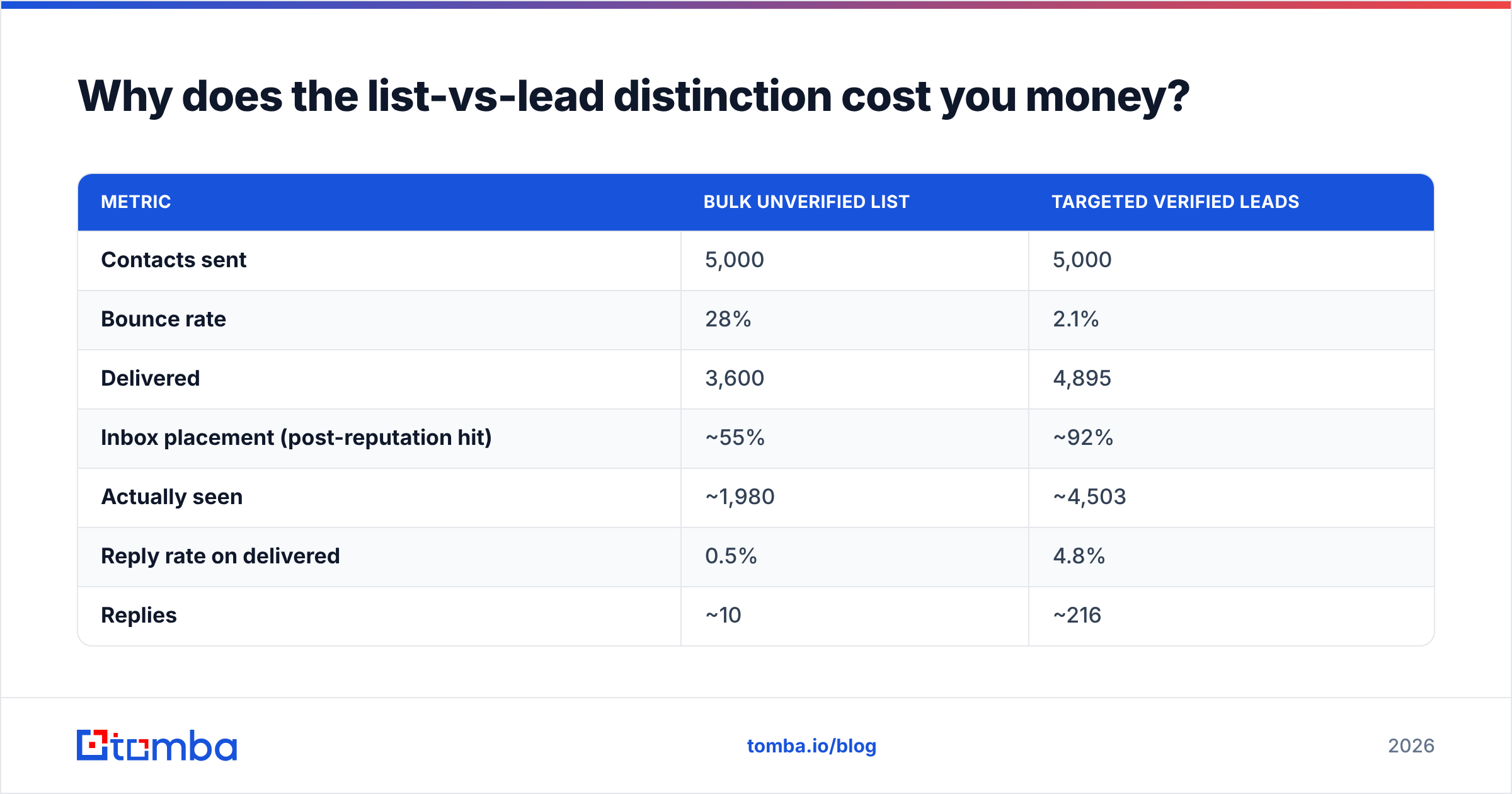
Here's the arithmetic most teams never run. Two campaigns, same copy, same sender, 5,000 sends each:
| Metric | Bulk unverified list | Targeted verified leads |
|---|---|---|
| Contacts sent | 5,000 | 5,000 |
| Bounce rate | 28% | 2.1% |
| Delivered | 3,600 | 4,895 |
| Inbox placement (post-reputation hit) | ~55% | ~92% |
| Actually seen | ~1,980 | ~4,503 |
| Reply rate on delivered | 0.5% | 4.8% |
| Replies | ~10 | ~216 |
| Positive replies (25%) | 2–3 | ~54 |
Same send volume. Roughly 20x the meetings. The difference isn't the copy — it's whether the rows were leads or just addresses. If you want the underlying mechanics, our primer on email deliverability covers how providers score senders.
What does a raw email list actually give you?#
Reach, and nothing else. That's not worthless — it's just narrow.
A list is genuinely useful when:
- You're sizing a market ("how many Series B fintechs in DACH have a Head of RevOps?")
- You're building a retargeting or lookalike audience where the address is a matching key, not a message destination
- You're feeding an enrichment pipeline that will do the qualification work downstream
- You're running a legitimate opt-in newsletter where subscribers actively requested contact
A list is a liability when you treat it as a send-ready audience. The tell: nobody on your team can explain why any specific person on it should care about your product.
There's a legitimate market for purchased B2B data, and dismissing all of it is lazy analysis. Vendors like BookYourData sell pre-verified, filterable B2B contacts with bounce guarantees, which is a materially different product from a $99 "10 million emails" torrent. The question is never "bought vs. built" — it's "verified and targeted, or not."
What makes an email lead a lead?#
Four attributes, and you need all four. Miss one and you're back to holding a list.
- Firmographic fit — the company matches your ICP on size, industry, geography, and tech stack. A 12-person agency is not a lead for an enterprise data platform, no matter how valid the address is.
- Role relevance — the person can influence or approve the purchase. Director of Demand Gen, not the marketing intern whose address happened to be public.
- A trigger or signal — new funding, a new hire in a relevant role, a tech-stack change, a job posting, a published article, recent site visit. Something that answers "why now?"
- A verified, deliverable address — SMTP-checked, not pattern-guessed. Guessing
first.last@company.comand hoping is how you get to a 30% bounce rate.
Miss #4 and you burn your domain. Miss #1–3 and you burn your reply rate. Both failures look like "cold email doesn't work."
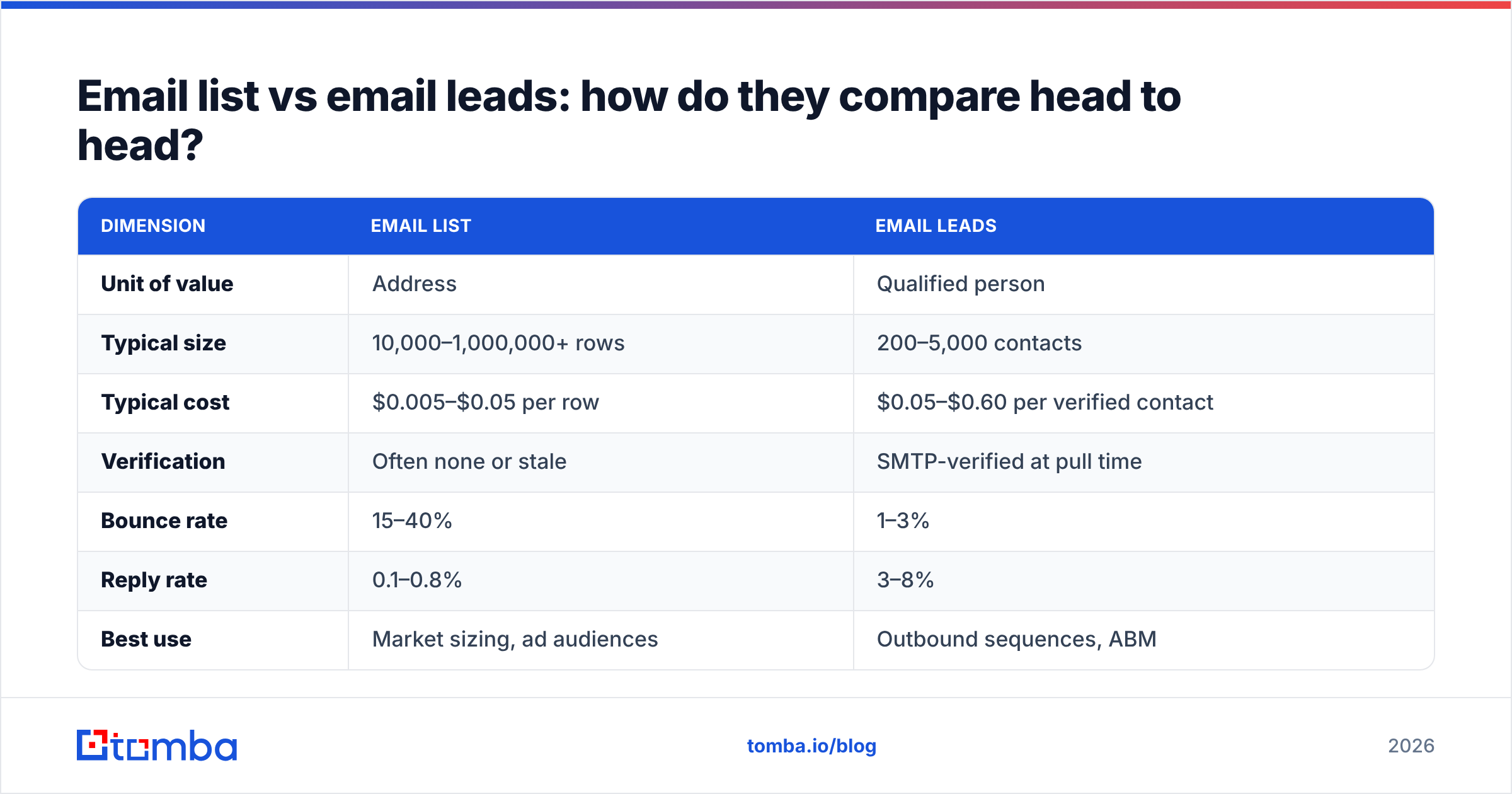
Email list vs email leads: how do they compare head to head?#
| Dimension | Email list | Email leads |
|---|---|---|
| Unit of value | Address | Qualified person |
| Typical size | 10,000–1,000,000+ rows | 200–5,000 contacts |
| Typical cost | $0.005–$0.05 per row | $0.05–$0.60 per verified contact |
| Verification | Often none or stale | SMTP-verified at pull time |
| Bounce rate | 15–40% | 1–3% |
| Reply rate | 0.1–0.8% | 3–8% |
| Best use | Market sizing, ad audiences | Outbound sequences, ABM |
| Deliverability risk | High — traps, blacklists | Low with proper warmup |
| Compliance exposure | High (unclear provenance) | Lower (documented sourcing) |
| Time to first meeting | Weeks, if ever | 5–15 days |
| Rep morale | Poor — mostly bounces | Good — real conversations |
The cost-per-row comparison flatters lists and misleads buyers. Price the outcome, not the row: a $500 list producing three meetings costs $167 per meeting before rep time. A $900 set of enriched leads producing 40 meetings costs $23.
Is buying an email list ever the right move?#
Sometimes — under three conditions.
Condition 1: The vendor verifies at delivery, not at collection. Data decays roughly 22–30% per year as people change jobs. A list verified in 2024 and sold in 2026 is fiction. Ask when each record was last SMTP-checked, and re-run the file through an email verifier yourself before you trust the answer.
Condition 2: You can filter hard before you pay. If the vendor can't slice by headcount, revenue band, tech stack, and seniority, you're buying volume you'll throw away.
Condition 3: You understand the legal frame in your target geography. In the US, B2B cold email is legal under the CAN-SPAM Act provided you identify yourself, don't deceive in headers or subject lines, and honor opt-outs. In the EU and UK, GDPR's legitimate-interest basis is narrower and requires documented reasoning and a clear opt-out. "I bought the list" is not a lawful basis by itself. This is not legal advice — check with counsel for your markets.
If all three hold, purchased data is a reasonable input. It's still an input, not a campaign.

How do you turn a raw list into real leads?#
Five steps. None optional. This is the entire arbitrage between the two columns in that table.
- Define the ICP tightly enough to exclude things. If your ICP doesn't disqualify at least 80% of the market, it isn't an ICP — it's a wish. Write down headcount range, industry codes, geography, and one disqualifying trait.
- Filter the list mechanically before any human looks at it. Drop role-based addresses (
info@,sales@,support@), free-mail domains for B2B plays, and companies outside your size band. Then remove duplicates — deduped files routinely shrink 8–15%. - Enrich to fill the gaps. Company size, funding stage, tech stack, LinkedIn profile, direct phone. A row with only name plus email cannot be personalized, and unpersonalized sends are why the reply rate column looks the way it does. Run it through data enrichment or pull fresh contacts by domain with domain search.
- Verify every address, including the catch-alls. Catch-all domains accept everything at the SMTP layer and then silently discard, which is why they inflate "valid" counts and deflate reply rates. Use a dedicated catch-all verifier rather than trusting a generic valid/invalid flag.
- Segment into sequences of 50–200. One message per segment, one specific trigger per message. If a segment is big enough that you can't name why those people share a problem, split it again.
Steps 3 and 4 are where a list becomes leads. Everything before is hygiene; everything after is execution.
What does each approach cost in 2026?#
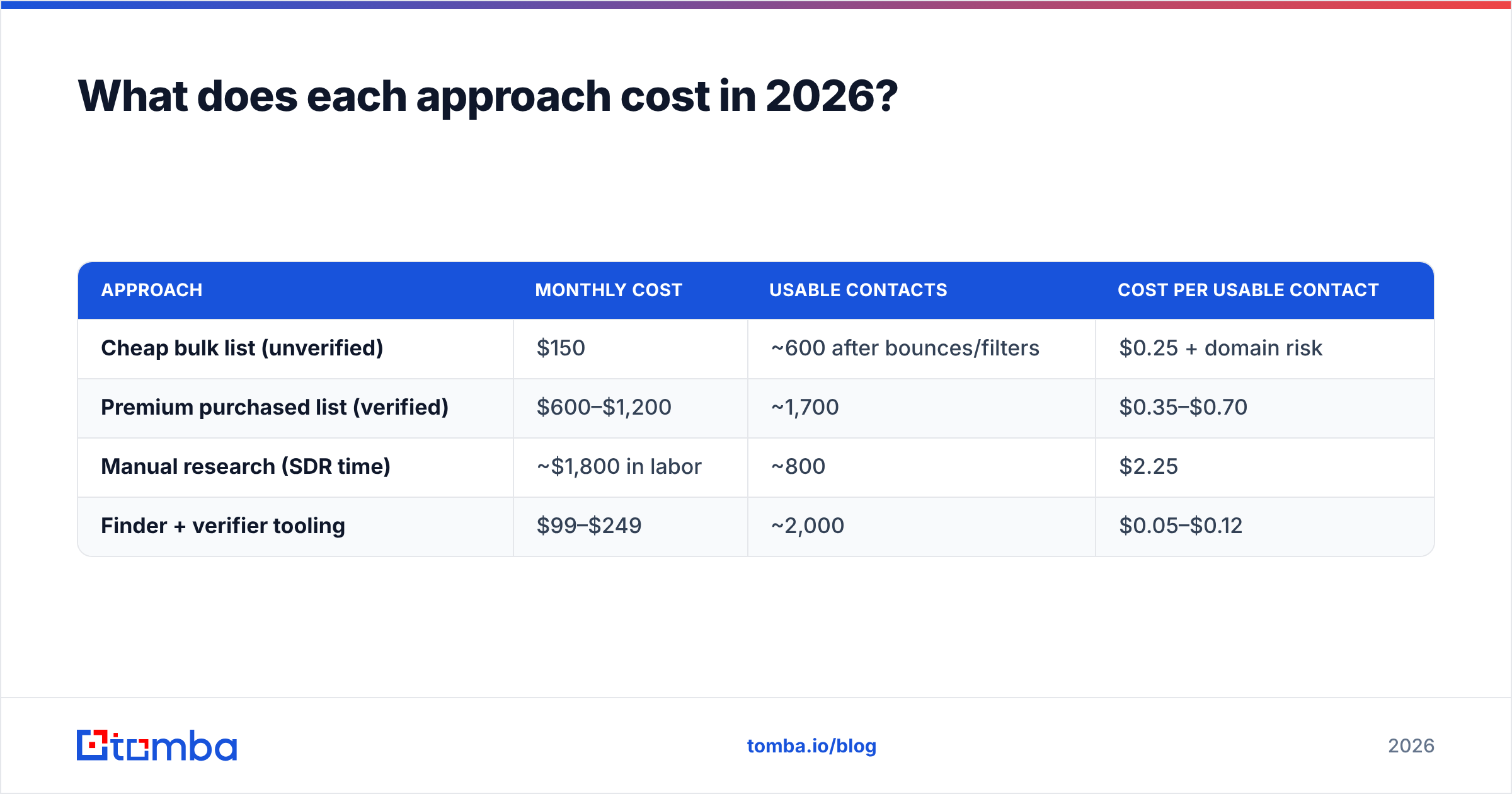
Real numbers, for a team targeting 2,000 qualified contacts per month.
| Approach | Monthly cost | Usable contacts | Cost per usable contact |
|---|---|---|---|
| Cheap bulk list (unverified) | $150 | ~600 after bounces/filters | $0.25 + domain risk |
| Premium purchased list (verified) | $600–$1,200 | ~1,700 | $0.35–$0.70 |
| Manual research (SDR time) | ~$1,800 in labor | ~800 | $2.25 |
| Finder + verifier tooling | $99–$249 | ~2,000 | $0.05–$0.12 |
The tooling row wins on unit economics because you only pay for contacts you actually requested and that actually resolved. On Tomba pricing, the Free tier gives you 25 searches a month to sanity-check quality before committing, Starter runs $49/mo, Growth $99/mo, and Pro $249/mo for teams running multi-thousand-contact months. Compare vendor claims yourself on G2 rather than trusting any single blog — including this one.
One caveat on the manual-research row: it produces the highest-context leads by a wide margin. For a 20-account ABM push where each deal is worth six figures, $2.25 per contact is trivially worth it. Cost per contact is the wrong metric when contract values are large — as Salesforce and most enterprise sales orgs will tell you, account selection beats volume every time above a certain deal size.
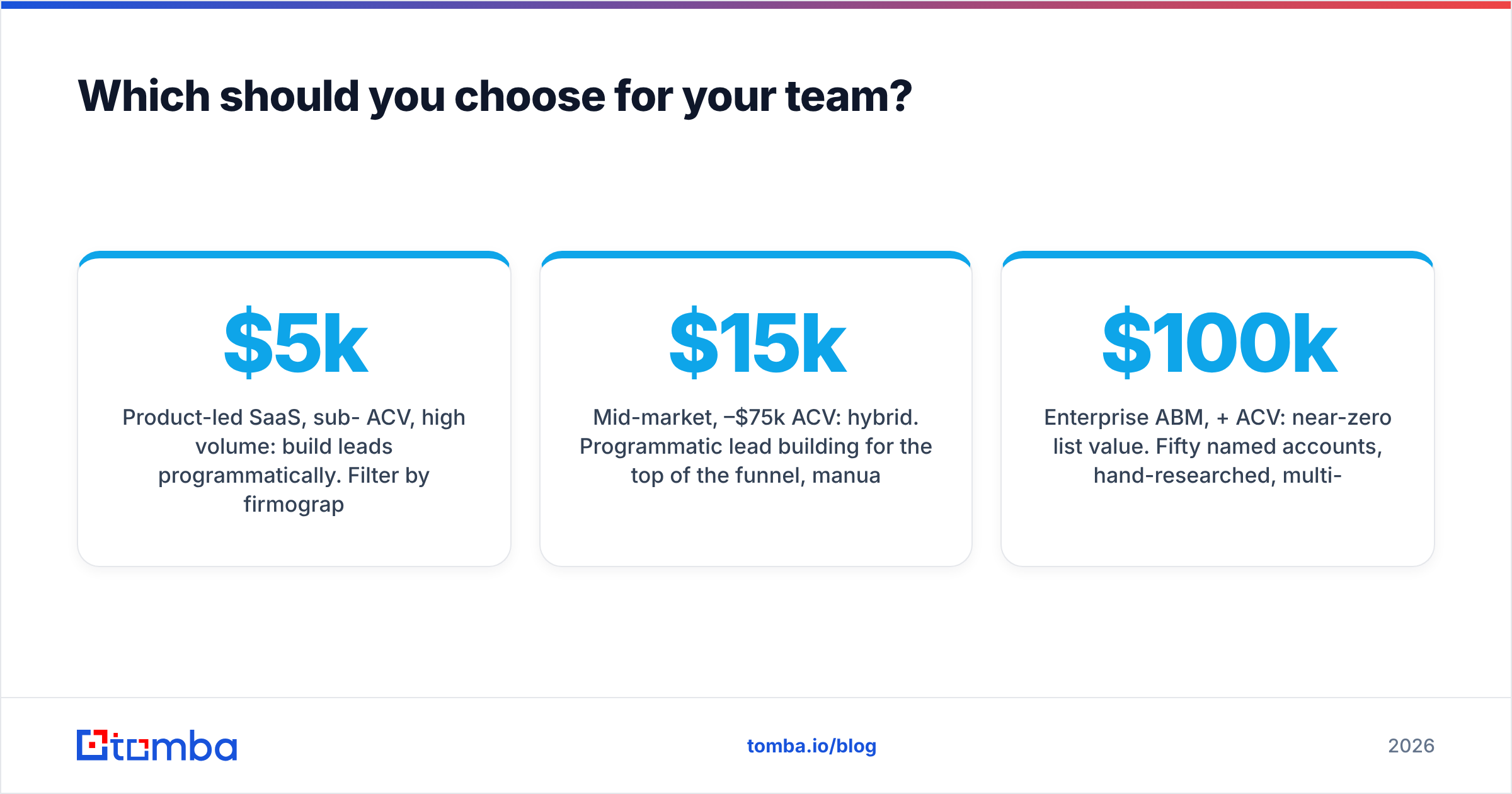
Which should you choose for your team?#
Pick by motion, not by budget.
- Product-led SaaS, sub-$5k ACV, high volume: build leads programmatically. Filter by firmographics, enrich, verify, send in tight segments. Volume matters, but only verified volume.
- Mid-market, $15k–$75k ACV: hybrid. Programmatic lead building for the top of the funnel, manual research on the top 10% of accounts.
- Enterprise ABM, $100k+ ACV: near-zero list value. Fifty named accounts, hand-researched, multi-threaded. A purchased list here is actively harmful because it creates the illusion of coverage.
- Newsletter or content business: neither. Build opt-in subscribers. Purchased data destroys the engagement metrics your entire distribution depends on. HubSpot has written extensively on why bought lists poison marketing-automation deliverability, and the argument holds.
What mistakes do teams make most often?#
Treating "valid" as "worth emailing." A verified address at a company outside your ICP is a verified waste of a send.
Sending to the whole file on day one. Ramp new domains. Even perfect data fails if you go from 0 to 3,000 sends overnight — a warmup calculator will give you a realistic schedule.
Never re-verifying. Data decays continuously. Re-verify anything older than 90 days before it enters a sequence.
Measuring open rate. Since Apple Mail Privacy Protection, open rate is noise. Measure replies, meetings booked, and pipeline created.
Optimizing copy on bad data. If your bounce rate is 22%, your subject line is not the problem. Fix the input before you A/B test the message.
Where should you start?#
Start with a 200-contact test set built the right way, and compare it against whatever you're using now. Same sequence, same sender, two weeks. The reply-rate gap will make the decision for you — and it'll be larger than you expect.
If you want to build that test set without buying a file you can't inspect, run it through the Tomba Email Finder. You give it a domain or a name plus company, it returns verified professional addresses with a confidence score and the sources behind each one, so you can see why a contact resolved before you send. The free tier covers 25 searches — enough to build a pilot segment, measure the bounce rate against your current list, and decide with data instead of vendor claims.
Related guides#
Ready to find emails that actually work?
Join 150,000+ professionals who stopped guessing and started sending. Free credits on signup — no credit card required.
Get the Tomba newsletter
Practical outbound tactics and product updates — once every two weeks.
About the author