Email Marketing to Generate Leads: The 2026 Playbook
Email still beats paid social on cost per qualified lead — but only when the list, the data hygiene, and the sequence timing all hold. Here's the full 2026 playbook, with benchmarks and a tool cost comparison.
TL;DR
- Email marketing to generate leads still delivers the lowest cost per qualified lead of any scalable B2B channel — but the median result is mediocre because most teams optimise copy and ignore data.
- There are four distinct motions (opt-in nurture, cold outbound, lifecycle re-activation, and partner/newsletter co-marketing). They need different lists, different tools, and different success metrics. Mixing them on one sending domain is how you get blocked.
- Bounce rate is the leading indicator that predicts everything downstream. Above 3%, Google and Microsoft start throttling you before your copy ever gets read.
- A realistic 2026 stack costs $150–$400/month for a team sending 20–50k emails: a data/verification layer, a sending platform, and a warmup tool.
- Measure qualified pipeline per 1,000 sends, not open rate. Apple Mail Privacy Protection made open rate a vanity metric years ago and it has not recovered.
What does "email marketing to generate leads" actually mean in 2026?#
It means two very different things depending on who you ask, and conflating them is the single most common strategic mistake.
To a demand-gen marketer, it means nurturing a permission-based list: someone downloaded a report, joined a webinar, or subscribed to your newsletter, and you send them sequenced content until they raise a hand. To an SDR leader, it means cold outbound: you identify accounts that fit an ICP, find the right contact, and send a targeted first-touch email to someone who has never heard of you.
Both are "email marketing to generate leads." Both are legitimate. But they have almost nothing in common operationally. One runs on a marketing automation platform with a shared IP pool and a subscribe-confirm flow. The other runs on secondary sending domains, per-mailbox volume caps, and a data pipeline that has to be right or nothing else matters.
If you take one thing from this guide: decide which motion you are running before you buy a tool. Nearly every horror story about "email doesn't work anymore" traces back to someone running cold outbound through a newsletter platform, or blasting a nurture list like it was cold.
Why does email still outperform most lead gen channels?#
Because it is the only channel where you own the distribution.
Paid social CPMs have climbed every year since 2020, and organic reach on LinkedIn and X keeps compressing. Search is being reshaped by AI overviews that answer the query without a click. Email is the last channel where a contact you acquired in 2023 can still be reached in 2026 without paying a platform for the privilege.
The economics bear it out. HubSpot's marketing statistics roundup consistently shows email returning multiples on spend that paid channels struggle to match at comparable volume, and Mailchimp's benchmark data puts average B2B open rates in the low-to-mid 20s and click rates around 2–3% — numbers that have been remarkably stable while every other channel's metrics eroded.
The caveat: those are averages across everyone, including senders with immaculate lists and senders with garbage. Your result is not the average. It is a function of how good your data is.
What are the four email lead-gen motions, and which one fits you?#
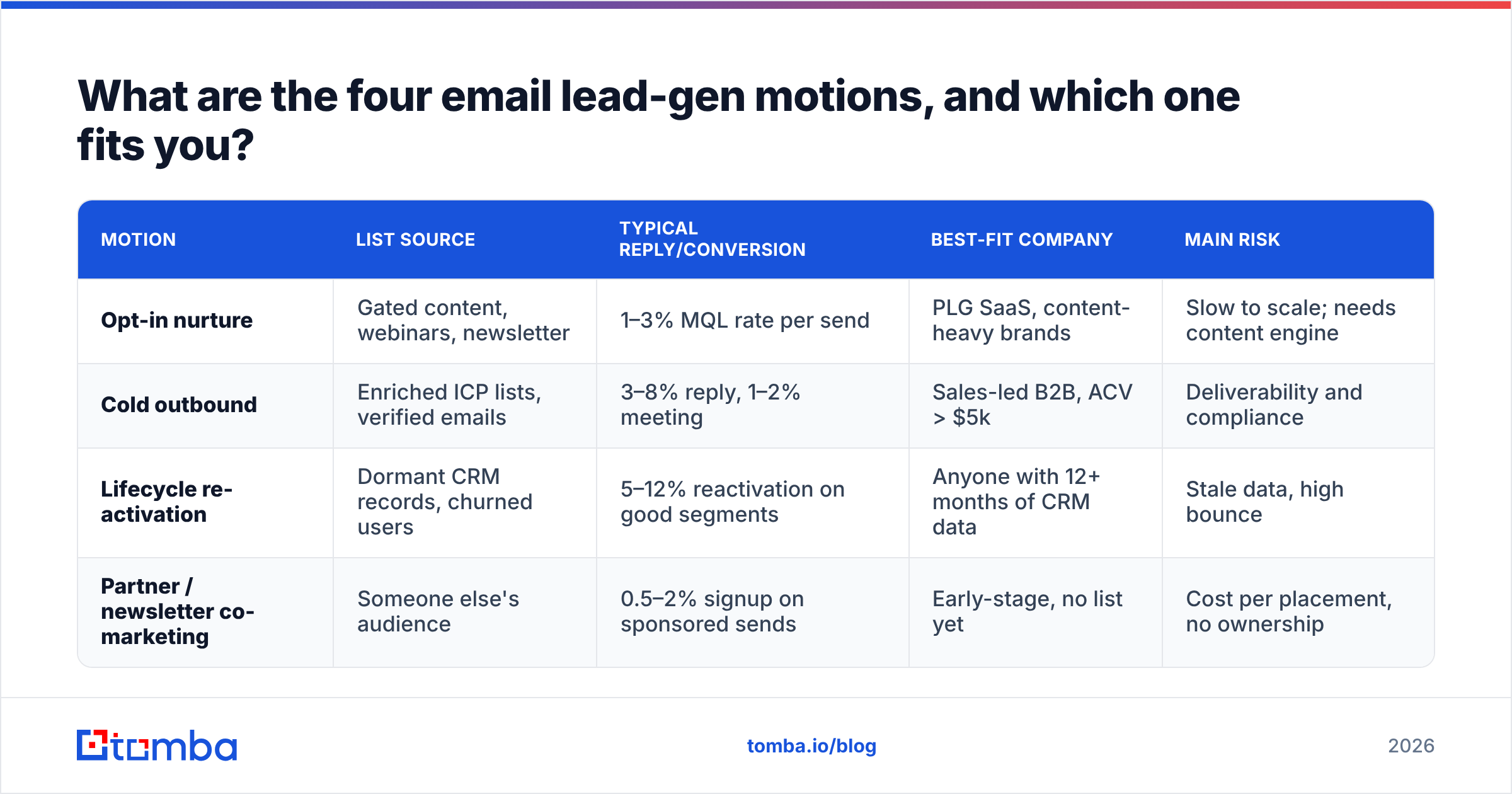
| Motion | List source | Typical reply/conversion | Best-fit company | Main risk |
|---|---|---|---|---|
| Opt-in nurture | Gated content, webinars, newsletter | 1–3% MQL rate per send | PLG SaaS, content-heavy brands | Slow to scale; needs content engine |
| Cold outbound | Enriched ICP lists, verified emails | 3–8% reply, 1–2% meeting | Sales-led B2B, ACV > $5k | Deliverability and compliance |
| Lifecycle re-activation | Dormant CRM records, churned users | 5–12% reactivation on good segments | Anyone with 12+ months of CRM data | Stale data, high bounce |
| Partner / newsletter co-marketing | Someone else's audience | 0.5–2% signup on sponsored sends | Early-stage, no list yet | Cost per placement, no ownership |
Most teams should run exactly two of these at once — usually opt-in nurture plus one other. Running all four with a team of three is how you end up doing none of them well.
The re-activation motion is the most underrated. If you have a CRM with two years of closed-lost and never-responded records, you are sitting on a list that costs nothing to reach and converts better than cold. The problem is that roughly 22–30% of B2B contact data goes stale every year — people change jobs, companies rebrand, domains migrate. Which is why step one is not writing copy. It is re-verifying.
How do you build a list that actually converts?#
Here is the sequence that works, in order. Skipping steps here is where campaigns die.
- Define the ICP in filterable terms. Not "mid-market SaaS companies." Rather: 50–500 employees, uses HubSpot or Salesforce, hiring for sales roles, US or UK. Every one of those is a filter you can actually apply against a B2B database or a firmographic provider. If you can't filter on it, it isn't an ICP — it's a vibe.
- Pick the person, then find the address. Job-title targeting beats department targeting by a wide margin. Once you have named contacts, resolve their work email with an email finder rather than guessing patterns. Permutation guessing produces 20–40% invalid addresses, and invalid addresses are what get your domain throttled.
- Verify before you send — every time. Run the full list through an email verifier, including addresses you sourced last quarter. Drop everything marked invalid. Segment catch-all domains into a separate, lower-volume campaign instead of deleting them; catch-alls are often perfectly deliverable, they just can't be confirmed by SMTP handshake.
- Enrich for personalisation variables. You need at least two non-obvious merge fields per contact — recent funding, a job posting, a tech-stack signal, a published article. Generic "I saw you're the VP of Sales at {{company}}" openers now underperform no personalisation at all, because recipients pattern-match them to spam instantly.
- Suppress aggressively. Existing customers, open opportunities, competitors, anyone who unsubscribed from any list, anyone who bounced twice. Build the suppression list before the send list.
- Cap volume per mailbox. 30–50 cold sends per mailbox per day in 2026, not the 200 that worked in 2019. Scale by adding mailboxes and domains, not by raising per-mailbox volume.

What does a lead-generating email sequence look like?#
Four to six touches over 18–21 business days, and the first email does almost all the work.
Email 1 — the relevance proof. Two to four sentences. One specific observation about their business, one sentence on the outcome you produce for companies like theirs, one soft question. No attachments, no images, no links if you can avoid it on the very first touch. Under 90 words.
Email 2 (day 4) — the angle shift. Same thread. Do not say "just following up." Introduce a different problem framing or a different persona benefit. If email 1 pitched efficiency, email 2 pitches risk.
Email 3 (day 9) — social proof. A one-line customer result with a real number, plus an offer of something asynchronous — a teardown, a benchmark, a short Loom. Lower the ask.
Email 4 (day 14) — the resource. Give something away with no meeting attached. This is where your gated content earns its keep, and where cold outbound quietly converts into opt-in nurture.
Email 5 (day 21) — the close-the-loop. "Should I close the file?" still works because it's honest and easy to answer. Expect 20–30% of your total replies to land here.
Then stop. Move non-responders to a quarterly nurture cadence. The teams with 14-step sequences are not getting more meetings; they are getting more spam complaints, and complaints are permanent.
On subject lines: lowercase, three to five words, no punctuation, no brackets. If you want to pressure-test variants before you send, a subject line tester will catch the obvious spam triggers, but the bigger lever is that the subject should read like it came from a colleague, not a campaign.
How do you keep deliverability from killing your lead flow?#
Deliverability is not a marketing problem you fix after the fact. It is infrastructure you set up before the first send.
The non-negotiables in 2026:
- SPF, DKIM, and DMARC on every sending domain. Google and Yahoo made DMARC mandatory for bulk senders in 2024 and enforcement has only tightened. A missing DMARC record isn't a warning anymore, it's a rejection. Check yours with an SPF checker before you do anything else.
- Separate domains for cold and marketing sends. Never risk your primary corporate domain on outbound experiments. Buy lookalike domains, warm them, and treat them as expendable infrastructure.
- Warmup for 3–4 weeks minimum on any new domain or mailbox, ramping gradually rather than jumping to full volume. A warmup calculator will give you a realistic ramp schedule for your target volume.
- Keep bounce rate under 2% and spam complaints under 0.1%. Cross either threshold and providers start silently routing you to spam — you won't see an error, you'll just see replies stop.
- Monitor placement, not just sends. Seed-list testing and Google Postmaster Tools tell you where you're landing. Your ESP's "delivered" number does not.
If you want the deeper mechanics, the email deliverability fundamentals haven't changed much — authentication, reputation, engagement, list hygiene — but the tolerances have tightened dramatically. What passed in 2021 gets filtered now.
Which metrics prove email marketing is generating leads?#
Stop reporting open rate. Apple Mail Privacy Protection pre-fetches images, which inflates opens for a large share of your list and makes the number close to meaningless for B2B.
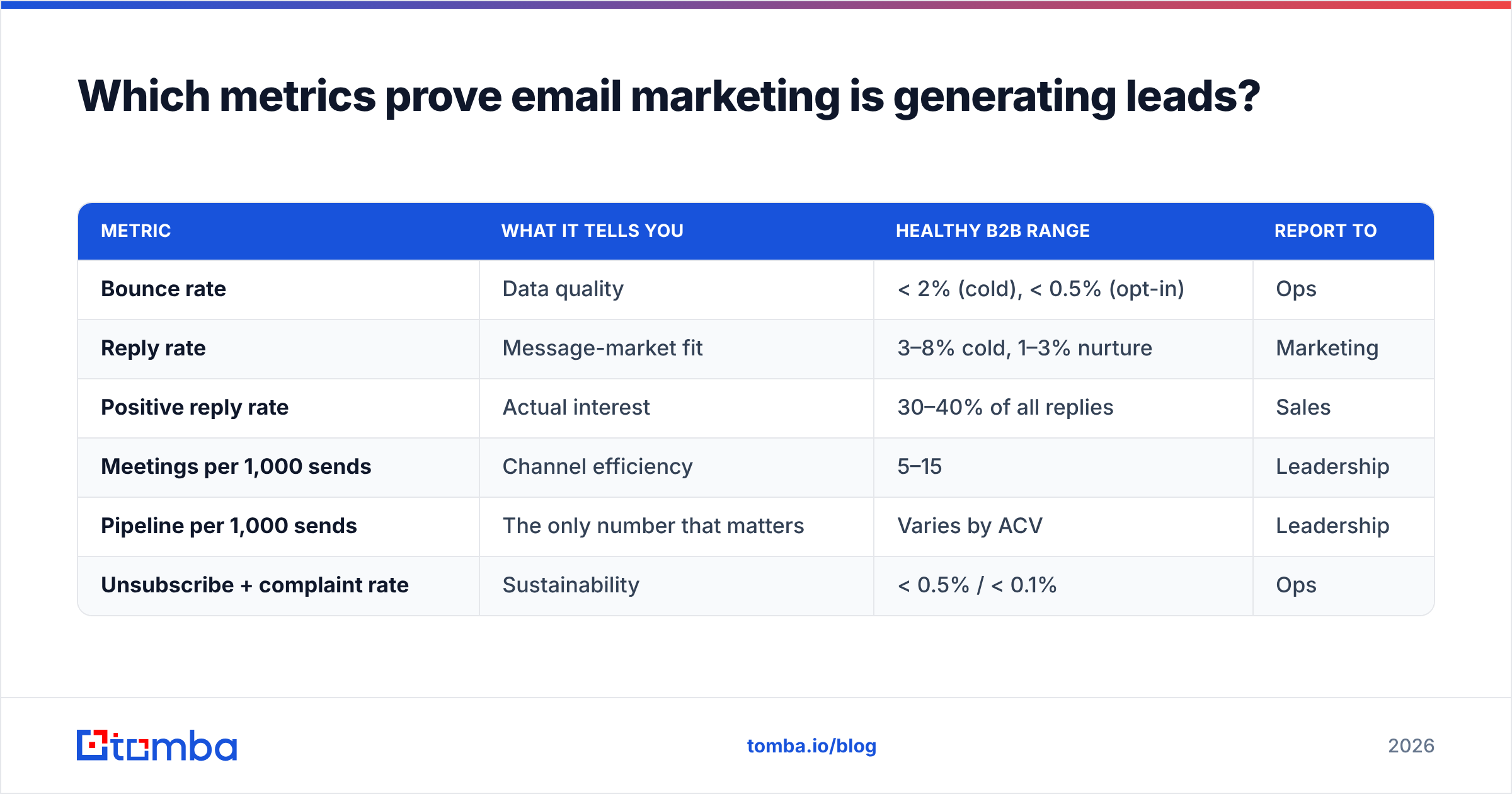
| Metric | What it tells you | Healthy B2B range | Report to |
|---|---|---|---|
| Bounce rate | Data quality | < 2% (cold), < 0.5% (opt-in) | Ops |
| Reply rate | Message-market fit | 3–8% cold, 1–3% nurture | Marketing |
| Positive reply rate | Actual interest | 30–40% of all replies | Sales |
| Meetings per 1,000 sends | Channel efficiency | 5–15 | Leadership |
| Pipeline per 1,000 sends | The only number that matters | Varies by ACV | Leadership |
| Unsubscribe + complaint rate | Sustainability | < 0.5% / < 0.1% | Ops |
Track pipeline per 1,000 sends monthly and you will notice something uncomfortable but useful: adding volume usually degrades it. The teams that grow email-sourced pipeline sustainably do it by improving the numerator — better targeting, better data, tighter ICP — not by pushing the denominator up.

What tools do you need, and what do they cost?#
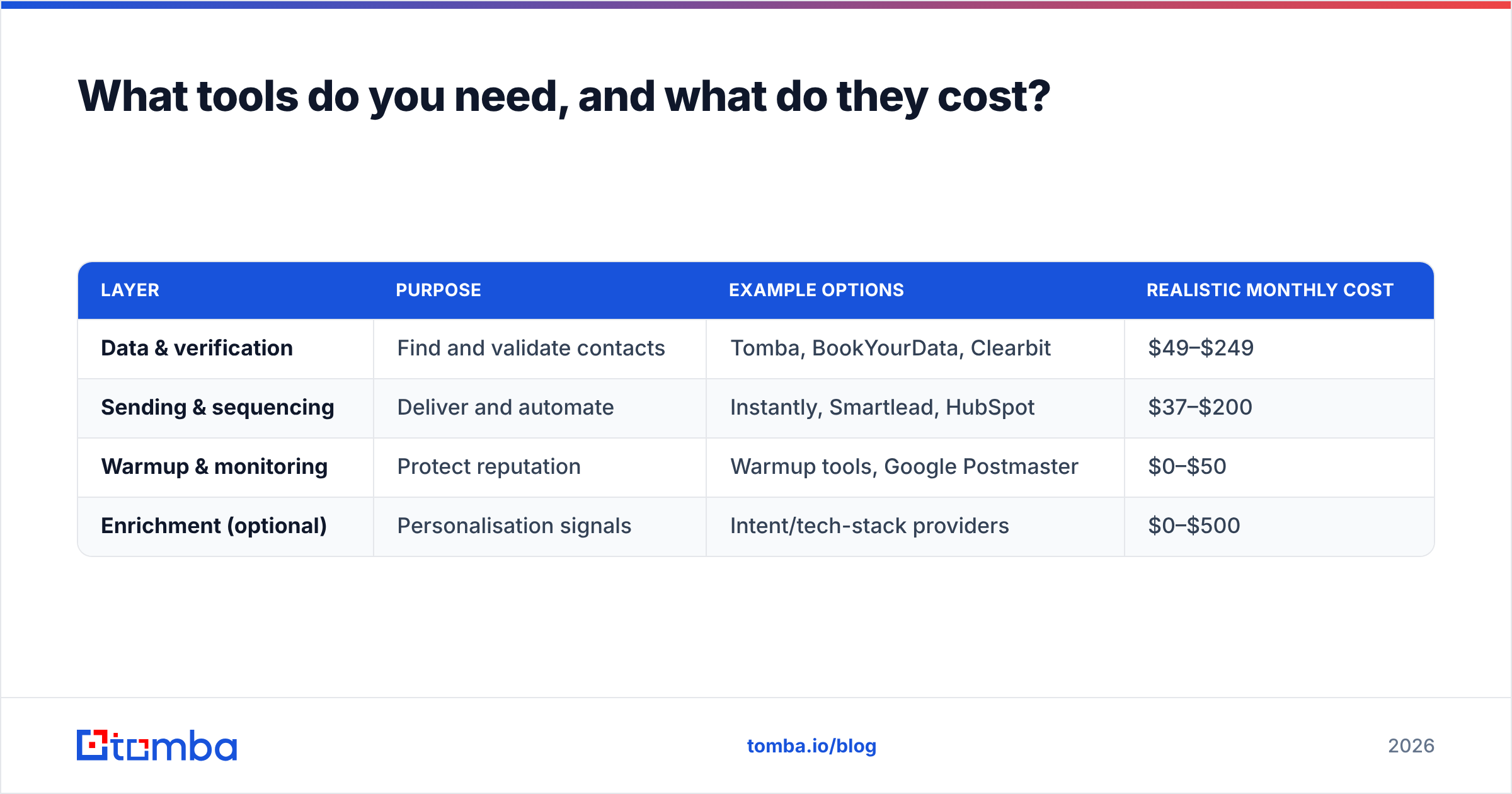
Three layers. You can substitute vendors within each, but you cannot skip a layer.
| Layer | Purpose | Example options | Realistic monthly cost |
|---|---|---|---|
| Data & verification | Find and validate contacts | Tomba, BookYourData, Clearbit | $49–$249 |
| Sending & sequencing | Deliver and automate | Instantly, Smartlead, HubSpot | $37–$200 |
| Warmup & monitoring | Protect reputation | Warmup tools, Google Postmaster | $0–$50 |
| Enrichment (optional) | Personalisation signals | Intent/tech-stack providers | $0–$500 |
On the data layer specifically: Tomba pricing starts with a free tier at 25 searches/month, then $49/mo for Starter, $99/mo for Growth, and $249/mo for Pro. BookYourData takes a different approach with pay-as-you-go prepaid credits and a strong accuracy guarantee, which suits teams doing occasional large list builds rather than continuous enrichment. Both are reasonable — pick based on whether your usage is spiky or steady.
Whatever you choose, check current reviews on G2 rather than trusting any vendor's own accuracy claim, including this one. Accuracy varies enormously by geography and company size, and the only number that matters is your bounce rate on your list.
What mistakes kill email lead generation?#
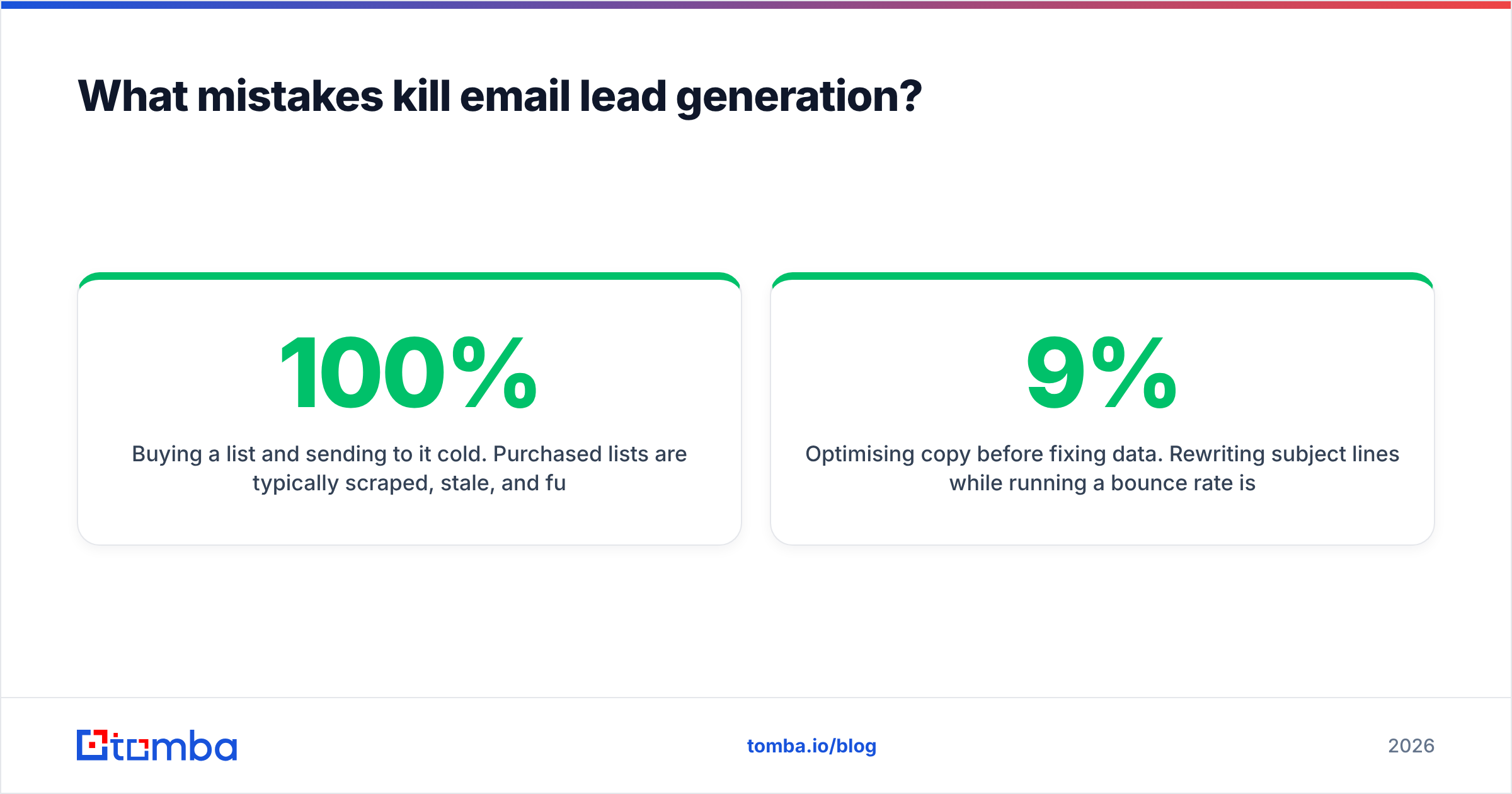
Buying a list and sending to it cold. Purchased lists are typically scraped, stale, and full of spam traps. One spam trap hit can tank a domain's reputation for months. If you must use a purchased file, re-verify 100% of it and mail the cleanest 40% only.
Sending from the primary domain. Your @company.com domain is what your invoices, support tickets, and contract negotiations ride on. Do not gamble it on a cold campaign.
Optimising copy before fixing data. Rewriting subject lines while running a 9% bounce rate is rearranging deck chairs. Fix the list, then test the copy.
Ignoring the unsubscribe and consent layer. GDPR, CAN-SPAM, CASL, and their equivalents all require a working opt-out and accurate sender identification. A one-click unsubscribe costs you a fraction of a percent of contacts and protects everything else.
Treating replies as a marketing metric. A reply that sales never follows up on within an hour is worth roughly nothing. The handoff is part of the campaign, not an afterthought.
Never sunsetting. Contacts who have not engaged in 12 months are dragging your engagement signals down. Suppress them, or run one clean re-permission campaign and then suppress them.
Where should you start this week?#
Pick one motion. Pull 500 ICP-matching contacts. Verify every address. Write five emails. Send 40 a day from a warmed secondary domain. Measure replies and meetings, not opens. Review after 500 sends and adjust one variable.
That's it. The teams generating real pipeline from email are not doing anything exotic — they are doing the boring parts correctly and consistently.
If the bottleneck is the data layer — and for most teams it is — start there. Tomba Email Finder resolves verified work emails by name, domain, or company, with bulk processing and an API when you're ready to wire it into your sequencing stack. The free tier gives you 25 searches to test accuracy against your own ICP before you spend anything, and Starter is $49/mo once you're ready to scale. Verify first, then send — everything downstream gets easier.
Related guides#
Ready to find emails that actually work?
Join 150,000+ professionals who stopped guessing and started sending. Free credits on signup — no credit card required.
Get the Tomba newsletter
Practical outbound tactics and product updates — once every two weeks.
About the author