Email Templates For Startups: 12 That Actually Get Replies
Most startup email templates are recycled agency scripts that stopped working years ago. Here are 12 templates that still earn replies in 2026, plus the structural rules that make them work.
TL;DR
- Templates don't fail because of wording — they fail because the list behind them is stale. A 12% bounce rate kills a campaign faster than a weak subject line ever will.
- The four startup email jobs are different animals: cold sales, investor outreach, hiring, and customer follow-up. Reusing one template shape across all four is the most common founder mistake.
- Every template below follows the same skeleton: one specific trigger, one claim, one ask. Anything else you add is noise.
- Personalization at scale means variable research, not variable first names. Merge fields alone stopped moving reply rates years ago.
- Verify before you send. A clean 200-contact list beats a raw 5,000-contact list on both replies and domain health.
Why do most email templates for startups stop working?#
Because they were written for a market that no longer exists. The "Hi {{FirstName}}, I noticed you're the {{Title}} at {{Company}}" opener was novel in 2016. By 2026 every buyer with an inbox has seen that exact string a few thousand times, and pattern-matching kicks in before they finish the first line.
There's a second, less obvious failure: templates get judged on copy when the actual bottleneck is data. If 15% of your addresses bounce, mailbox providers throttle you regardless of how sharp the copy is. Google and Yahoo's bulk-sender requirements formalised this — you need authentication, a working unsubscribe path, and spam complaints under 0.3%. You can read the current rules straight from Google's sender guidelines. A template can't rescue a list that's failing those checks.
So treat the templates below as the last 20% of the work. The first 80% is picking the right 200 people and confirming their addresses exist.

What are the four email jobs a startup actually has?#
Founders tend to write one "outreach template" and reuse it everywhere. That's like using the same knife for bread, steak, and butter — it technically works and it's technically wrong every time.
- Cold sales outreach. Goal: a 15-minute call with someone who has never heard of you. The reader owes you nothing, so the entire email has to earn attention in the first sentence.
- Investor outreach. Goal: a meeting or a warm forward. The reader is drowning in decks. Traction numbers do the persuading, not adjectives.
- Recruiting and hiring. Goal: a reply from someone who is probably not looking. Flattery is expected and therefore ignored; specificity about their work is not.
- Customer lifecycle. Goal: activation, expansion, or churn-save. The reader already knows you, so the rules invert — brevity matters less than relevance to their actual usage.
Each job needs a different length, a different proof type, and a different ask. Mixing them is why a founder's "great" investor template gets zero replies when repurposed for sales.
What does a template that works actually look like structurally?#
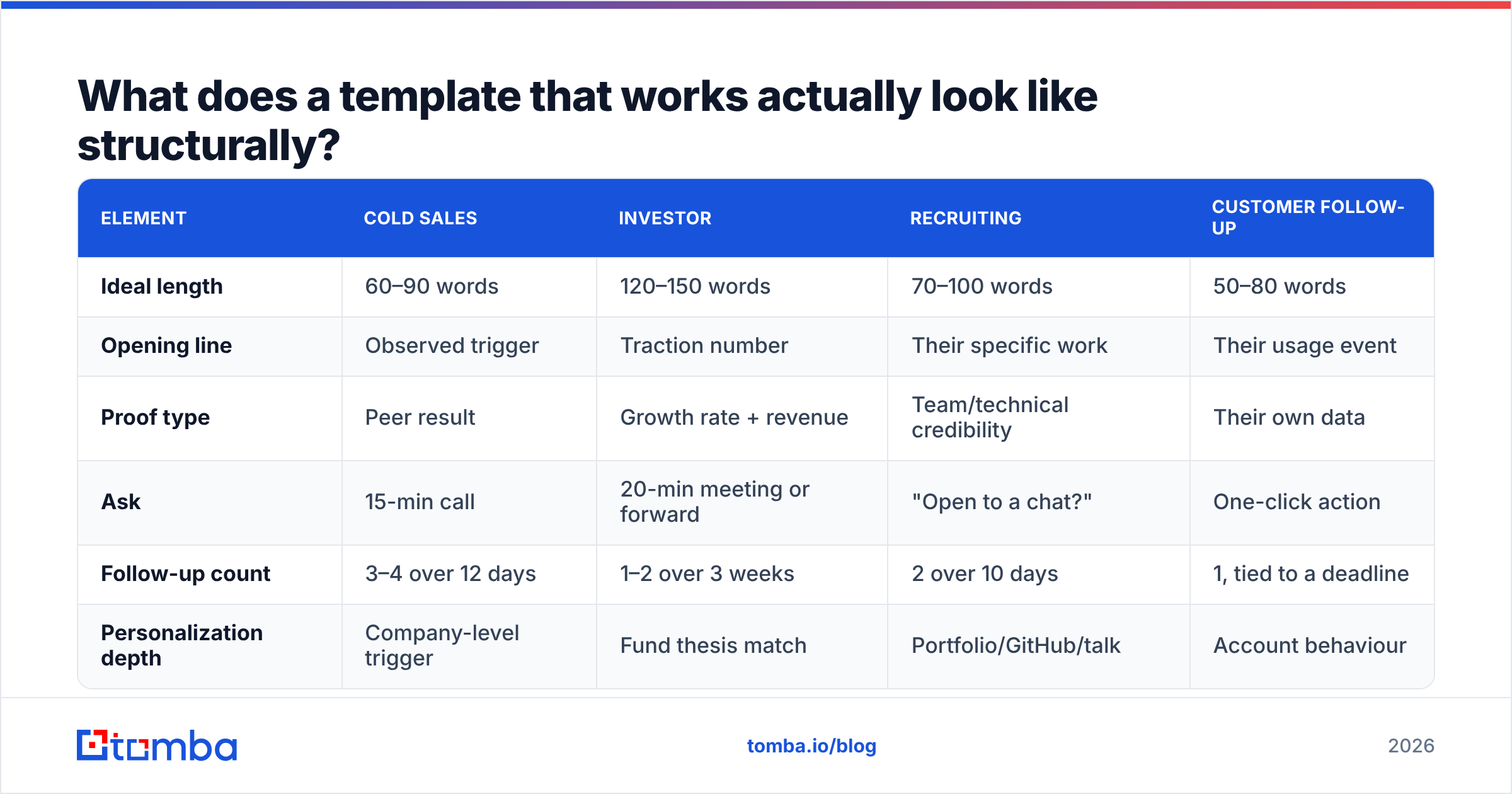
| Element | Cold sales | Investor | Recruiting | Customer follow-up |
|---|---|---|---|---|
| Ideal length | 60–90 words | 120–150 words | 70–100 words | 50–80 words |
| Opening line | Observed trigger | Traction number | Their specific work | Their usage event |
| Proof type | Peer result | Growth rate + revenue | Team/technical credibility | Their own data |
| Ask | 15-min call | 20-min meeting or forward | "Open to a chat?" | One-click action |
| Follow-up count | 3–4 over 12 days | 1–2 over 3 weeks | 2 over 10 days | 1, tied to a deadline |
| Personalization depth | Company-level trigger | Fund thesis match | Portfolio/GitHub/talk | Account behaviour |
Read the column that matches your job and ignore the rest. A 150-word cold sales email loses. A 60-word investor email reads like it's hiding something.
What are the cold sales templates worth copying?#
Template 1 — The trigger email
Subject: your Series A + support headcount
Hi Dana,
Saw the Series A last week — congrats. Usually the next six months means support tickets outrunning the team hired to handle them.
We cut first-response time by 40% for Linear and Rippling by routing tier-1 tickets before a human sees them. No rip-and-replace; it sits on top of Zendesk.
Worth 15 minutes next week?
— Sam
Why it works: the trigger is real and dated, the claim is numeric, and the objection ("we'd have to migrate") is pre-answered in six words.
Template 2 — The problem-agitate-offer
Subject: manual invoice matching at Northwind?
Hi Priya,
Most finance teams your size match invoices in a spreadsheet because the ERP module costs more than the headcount it saves.
That usually shows up as a 3–4 day close delay and one person who can never take vacation.
We automate the matching layer only — $400/month, live in a week. Two similar teams closed 2 days faster in month one.
Want the 5-minute walkthrough video instead of a call?
— Alex
The video offer converts better than a call ask on first contact, because it costs the reader less.
Template 3 — The permission opener
Subject: quick question, Marcus
Marcus — are you the right person to talk to about how the SDR team sources contact data, or should I be asking someone else?
Asking because we replaced a manual LinkedIn workflow for two teams in your space and got about 6 hours a week back per rep.
— Nina
Short, easy to answer, and a "no, talk to X" reply is still a win.
Template 4 — The break-up
Subject: closing the file
Hi Dana — I'll stop here. If invoice matching moves up the list in Q3, reply "later" and I'll ping you then. Otherwise I'll leave you alone.
— Alex
Break-ups reliably outperform the third pitch email. They work because they remove pressure, not because they create urgency.
How do investor and hiring templates differ?#
Investor template
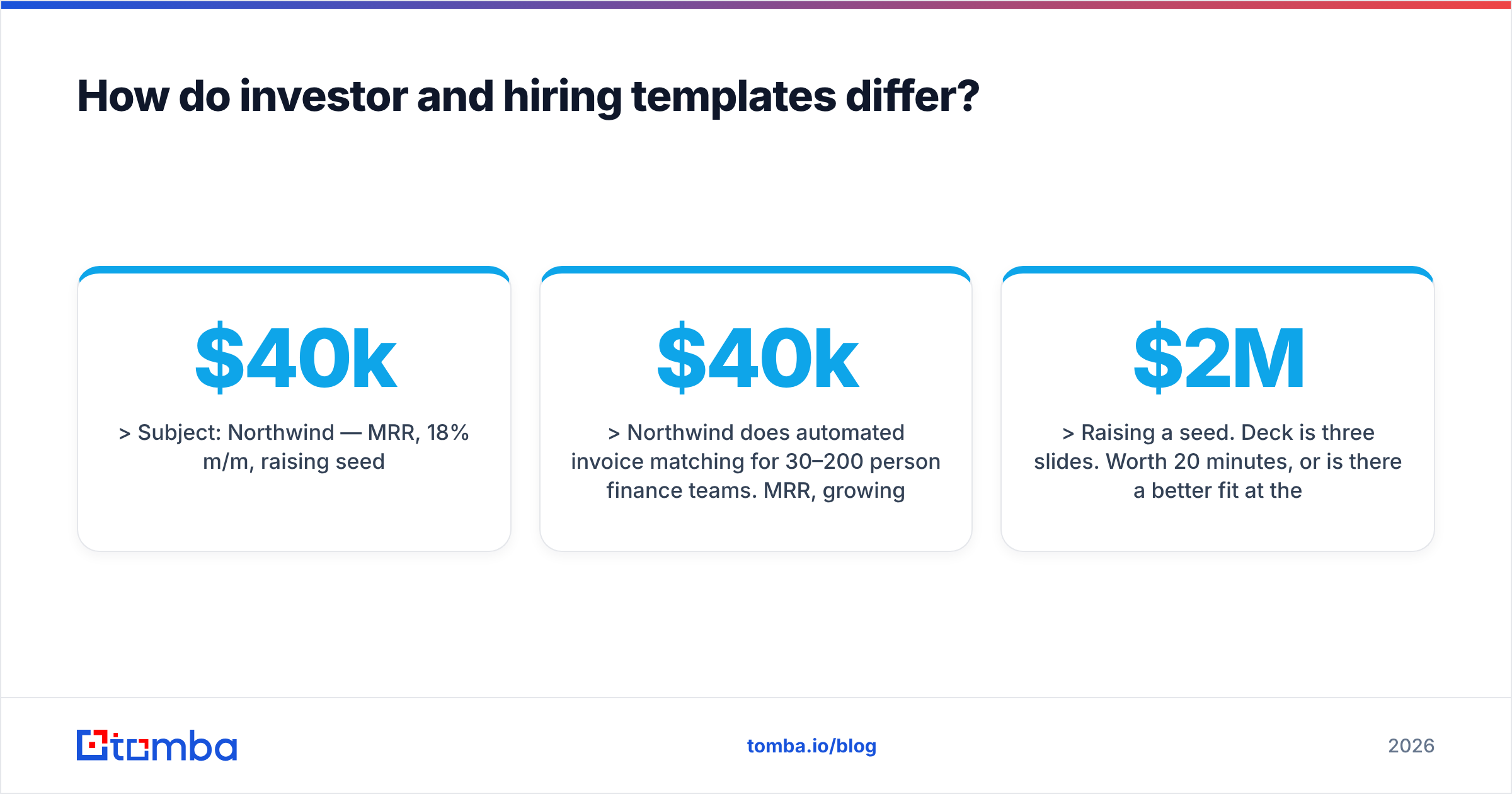
Subject: Northwind — $40k MRR, 18% m/m, raising seed
Hi Tomás,
Northwind does automated invoice matching for 30–200 person finance teams. $40k MRR, growing 18% month over month for 7 months, 4% annual logo churn.
I'm reaching out because you led the Series A at Ramp and wrote the piece on back-office automation last year — the thesis overlaps almost exactly.
Raising a $2M seed. Deck is three slides. Worth 20 minutes, or is there a better fit at the fund?
— Priya, founder
Numbers first, thesis match second, ask third. No adjectives, no "revolutionary." If your numbers aren't strong yet, lead with an unusual insight instead — never with vague enthusiasm.
Recruiting template
Subject: your Postgres partitioning talk
Hi Jules,
Your talk on partitioning at scale — the part about avoiding a rewrite by moving to declarative partitions — matched a problem we hit last quarter almost line for line.
We're 14 people, building billing infra, backed by [investor]. Two engineers own the whole data path, which would be you and one other person.
Not asking you to leave anything. Open to a 20-minute conversation about what we're doing?
— Sam, CTO
Cite one specific artifact of their work. Anyone can say "impressed by your background"; only someone who actually watched the talk can name the segment.
Does personalization at scale still beat volume in 2026?#
Yes, but only if "personalization" means research rather than merge fields. A study-backed way to think about it: buyers reward relevance and punish familiarity-faking. HubSpot's sales research has been consistent for years that specificity beats frequency, and every practitioner survey on G2 points the same direction.
Practical version — three tiers of personalization, ranked by effort-to-return:
- Tier 1 (cheap, weak): first name, company name, job title. Assume zero lift. Include it anyway because absence is conspicuous.
- Tier 2 (moderate, strong): a company-level trigger — funding round, new office, job posting, product launch, tech-stack change. One sentence, and it's usually where the reply comes from.
- Tier 3 (expensive, strongest): a person-level artifact — a talk, a post, a repo, a podcast comment. Reserve for accounts worth a real meeting.
Run Tier 2 across your whole list and Tier 3 on your top 10%. Trying to do Tier 3 on 2,000 contacts is how founders burn a month and send nothing.
How do you build the list these templates get sent to?#
This is where most template guides go quiet, and it's the part that decides your results.
Your sequence: define the ICP tightly enough that you could name 50 companies by hand → pull the right role at each company → find and verify the address → enrich with the trigger data your Tier 2 line needs.
For the finding step, a domain search gives you every public address pattern at a company in one call, which is faster than guessing formats one contact at a time. When you already have names, an email finder resolves them against the company's actual pattern. Then run the whole list through an email verifier before a single send — this is non-negotiable, not a nice-to-have.
Catch-all domains deserve a specific mention. A catch-all server accepts every address, so a standard SMTP check returns "valid" for addresses that don't exist. If your list skews enterprise, you'll hit a lot of these, and a catch-all verifier is the difference between a real 2% bounce rate and a fake one.
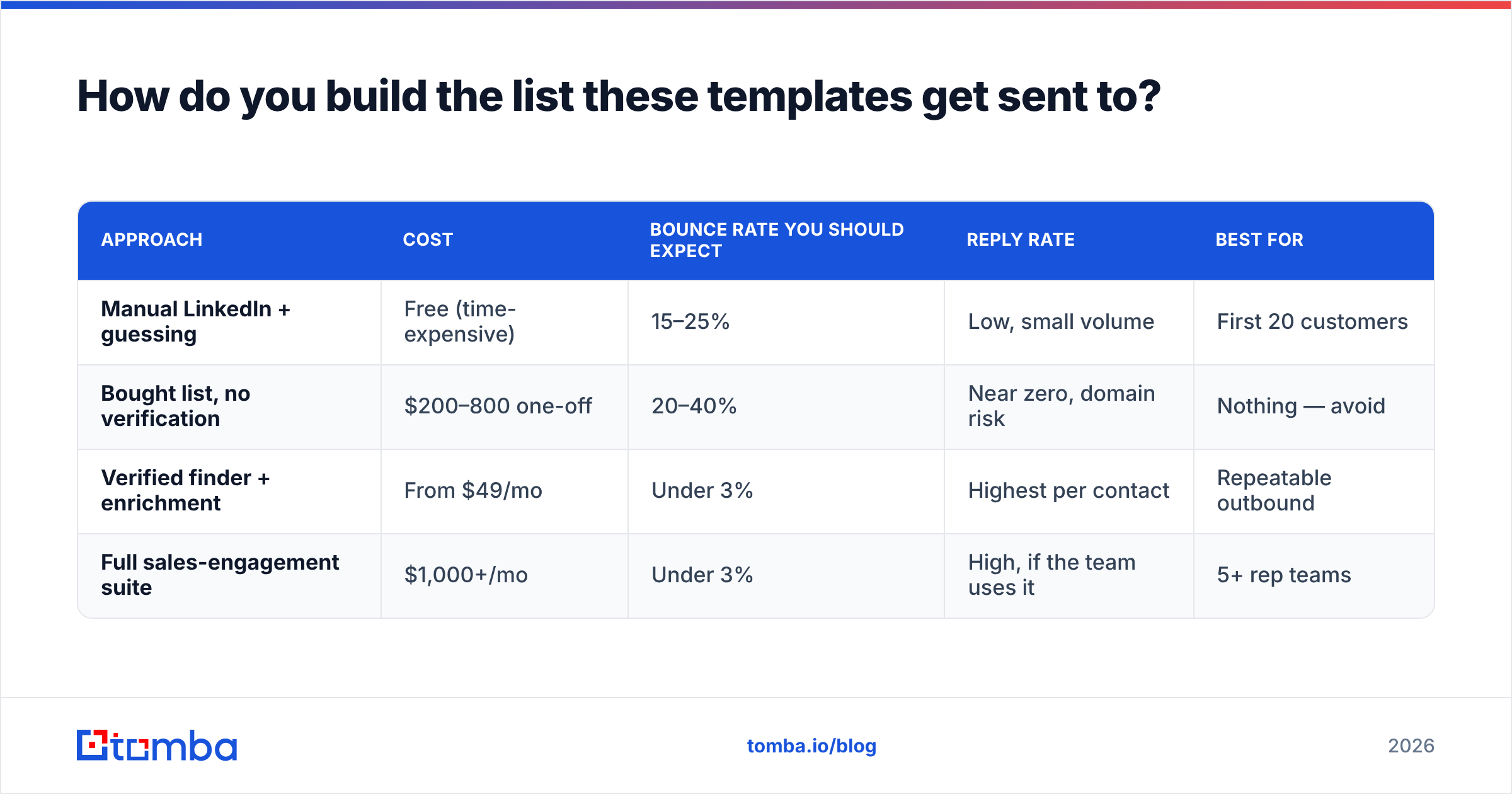
| Approach | Cost | Bounce rate you should expect | Reply rate | Best for |
|---|---|---|---|---|
| Manual LinkedIn + guessing | Free (time-expensive) | 15–25% | Low, small volume | First 20 customers |
| Bought list, no verification | $200–800 one-off | 20–40% | Near zero, domain risk | Nothing — avoid |
| Verified finder + enrichment | From $49/mo | Under 3% | Highest per contact | Repeatable outbound |
| Full sales-engagement suite | $1,000+/mo | Under 3% | High, if the team uses it | 5+ rep teams |
Tomba's pricing starts with a free tier at 25 searches per month, then Starter at $49/mo, Growth at $99/mo, and Pro at $249/mo — enough to test whether verified data actually moves your reply rate before committing budget. Bulk-focused vendors like BookYourData take a different angle, selling pre-built, pay-as-you-go lists; that suits a team that wants volume immediately rather than building lists continuously. Both models are legitimate — pick based on whether your ICP is stable or still moving.

What follow-up cadence should a startup use?#
Most replies to cold email arrive on messages two through four, not message one. But cadence rules differ per job:
- Cold sales: 4 touches over 12 days. Day 1 pitch, day 3 short bump with a new angle, day 7 case study or resource, day 12 break-up. Never send "just following up" with no new information.
- Investor: 2 touches over 3 weeks. The second one should carry a new number — new MRR, new logo, new hire. Investors respond to momentum, not persistence.
- Recruiting: 2 touches over 10 days. The second adds one concrete detail about the role (comp band, ownership scope) that the first withheld.
- Customer follow-up: 1 touch, tied to a real deadline or usage event. More than that reads as nagging to someone who already pays you.
Keep every follow-up in the same thread for sales and customers. For investors, start a fresh thread with an updated subject line — it signals a new data point rather than a nag.
What kills these templates even when the copy is good?#
- Sending from your primary domain before it's warmed. New domains need weeks of gradual ramp. The warmup calculator will tell you how long your target volume actually requires.
- Missing authentication. No SPF, DKIM, or DMARC means bulk mailbox providers won't deliver you at all. Check your SPF record first, then DKIM and DMARC.
- Spam-trigger formatting. Images in the first email, three links, tracking pixels on a cold send — each one raises risk. Plain text with one link performs best. Run a draft through a spam checker if you're unsure.
- One mailbox, too much volume. Past roughly 50 cold sends a day per mailbox, you're inviting throttling. Add mailboxes, don't add volume per mailbox.
- No unsubscribe path. Even for one-to-one-looking cold email, give people an easy out. It protects your email deliverability and it's the law in most jurisdictions.
How do you know if a template is working?#
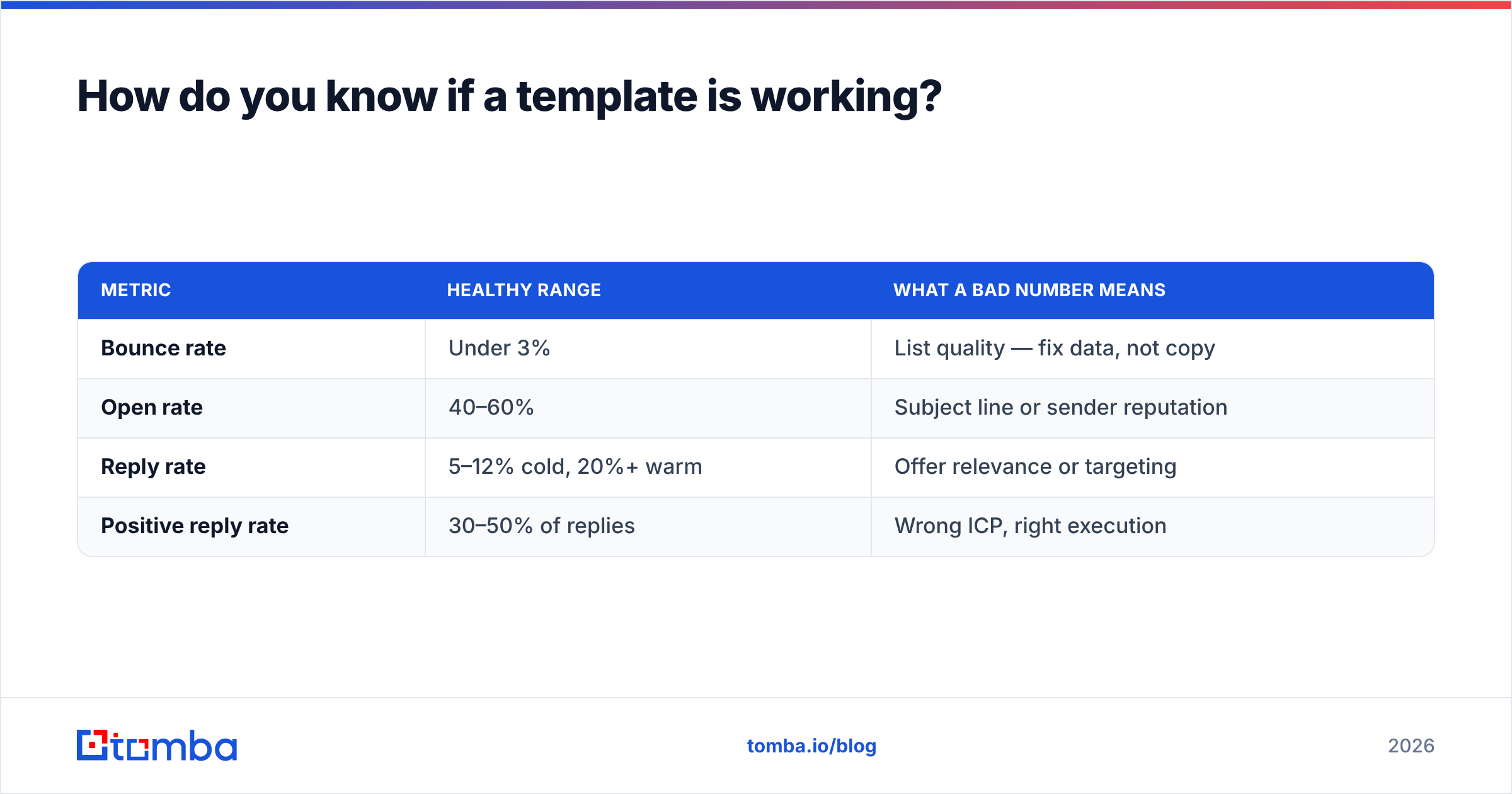
Track four numbers per template, not one:
| Metric | Healthy range | What a bad number means |
|---|---|---|
| Bounce rate | Under 3% | List quality — fix data, not copy |
| Open rate | 40–60% | Subject line or sender reputation |
| Reply rate | 5–12% cold, 20%+ warm | Offer relevance or targeting |
| Positive reply rate | 30–50% of replies | Wrong ICP, right execution |
The order matters. Don't rewrite a subject line while your bounce rate sits at 12% — you'll be optimising a variable that isn't the constraint. Fix the list, then the subject, then the body, then the ask.
Run one variable at a time and give each version at least 100 sends before you judge it. Below that, you're reading noise.
Where should you start this week?#
Pick one job — probably cold sales — and one segment of 100 companies. Build the list properly, verify it, write Template 1 with a real trigger for each account, and send in batches of 25 a day across two mailboxes. You'll have signal in ten days.
The templates aren't the hard part. Getting 100 correct, deliverable addresses for the exact people who have your problem is the hard part, and it's the part that compounds. When you're ready to build that list, start with the Tomba Email Finder — the free tier gives you 25 searches a month to test whether verified data changes your reply rate before you spend anything.
Related guides#
Ready to find emails that actually work?
Join 150,000+ professionals who stopped guessing and started sending. Free credits on signup — no credit card required.
Get the Tomba newsletter
Practical outbound tactics and product updates — once every two weeks.
About the author