Email Validity Checker: How to Verify Any Address in 2026
Most email validity checkers agree on the easy addresses and disagree on the ones that matter. Here is how syntax, MX, SMTP and catch-all checks actually work, and how the main tools compare on accuracy and price.
TL;DR
- An email validity checker runs four layers of tests — syntax, domain/MX, mailbox (SMTP), and risk classification. Tools that stop at layer one are little more than a regex and will not protect your sender reputation.
- On clean, mainstream domains almost every vendor scores 95%+. The gap only shows up on catch-all domains, Microsoft 365 tenants, and disposable addresses — that is where you should benchmark.
- Expect 1-3% of any verified list to bounce anyway. Any vendor promising 99.9% accuracy on a cold list is selling you a number, not a result.
- Single-address checks should be free. Bulk verification runs roughly $0.004-$0.01 per email depending on volume and vendor.
- The cheapest fix is not verifying harder — it is sourcing better. Addresses found and validated at collection time bounce far less than scraped lists cleaned after the fact.
What is an email validity checker?#
An email validity checker is a tool that answers one question before you hit send: does this mailbox exist and will it accept mail?
Think of it like a courier checking an address before loading the van. The postcode can be formatted correctly, the street can exist, and the house can still be empty. Each of those is a separate check, and a good checker runs all of them in order, stopping early when one fails.
That layering matters because the failures cost different amounts. A typo caught at layer one costs you nothing. A dead mailbox that slips through to your sending platform costs you a hard bounce, and enough hard bounces cost you inbox placement across your entire domain. Mailbox providers treat bounce rate as a signal of list hygiene, and list hygiene as a proxy for whether you are a legitimate sender.
The terminology is inconsistent across vendors. "Email validation", "email verification", "email checker", and "email validity checker" all describe the same category. Some tools also fold in typo correction (suggesting gmail.com when you typed gmial.com) and role-account detection. Treat the labels as marketing and judge the actual checks.
How does an email validity checker actually work?#
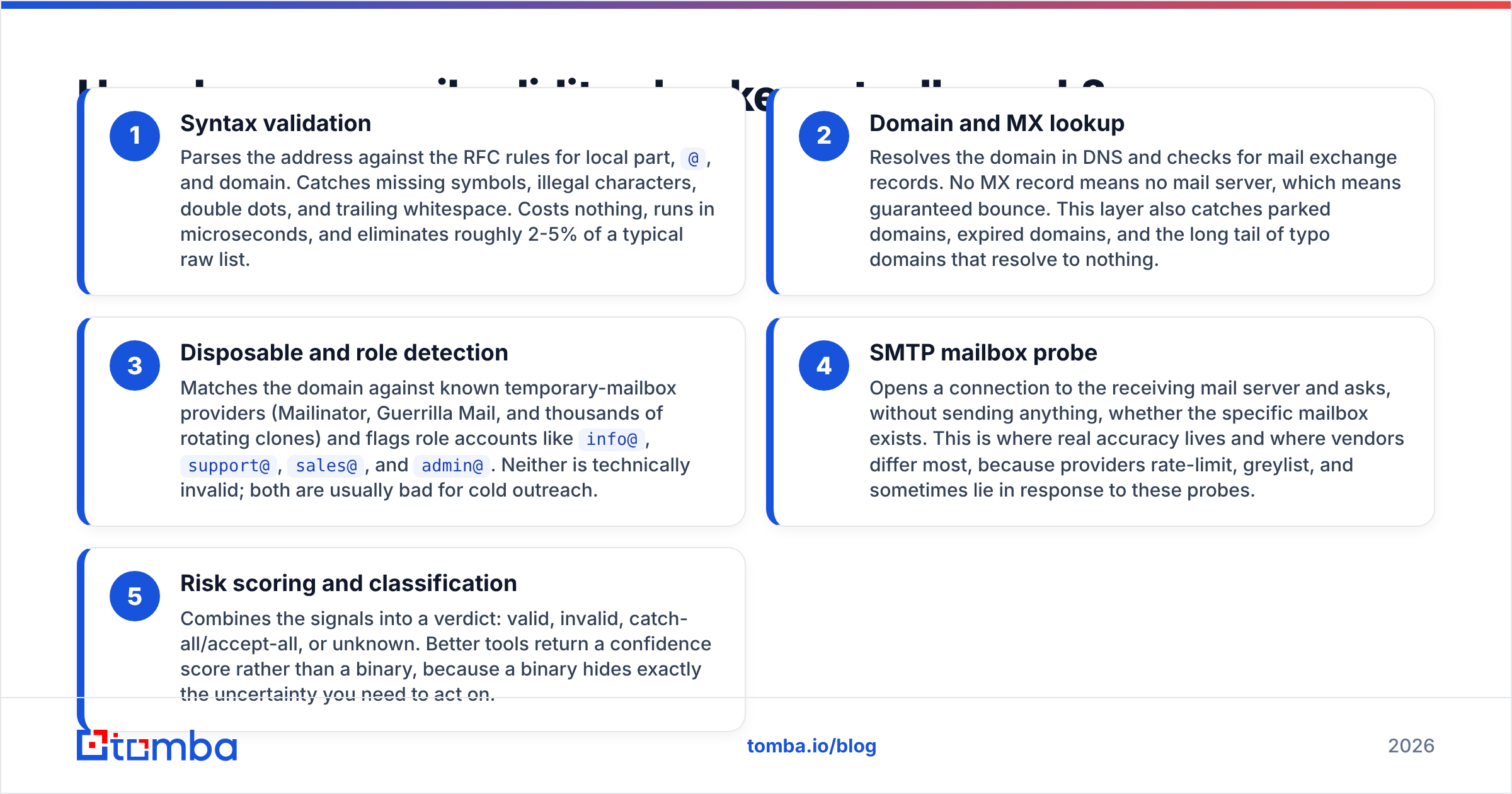
Five stages, in order of cost. Each one is cheaper and faster than the next, so any well-built checker short-circuits as soon as it can return a verdict.
- Syntax validation — Parses the address against the RFC rules for local part,
@, and domain. Catches missing symbols, illegal characters, double dots, and trailing whitespace. Costs nothing, runs in microseconds, and eliminates roughly 2-5% of a typical raw list. - Domain and MX lookup — Resolves the domain in DNS and checks for mail exchange records. No MX record means no mail server, which means guaranteed bounce. This layer also catches parked domains, expired domains, and the long tail of typo domains that resolve to nothing.
- Disposable and role detection — Matches the domain against known temporary-mailbox providers (Mailinator, Guerrilla Mail, and thousands of rotating clones) and flags role accounts like
info@,support@,sales@, andadmin@. Neither is technically invalid; both are usually bad for cold outreach. - SMTP mailbox probe — Opens a connection to the receiving mail server and asks, without sending anything, whether the specific mailbox exists. This is where real accuracy lives and where vendors differ most, because providers rate-limit, greylist, and sometimes lie in response to these probes.
- Risk scoring and classification — Combines the signals into a verdict: valid, invalid, catch-all/accept-all, or unknown. Better tools return a confidence score rather than a binary, because a binary hides exactly the uncertainty you need to act on.
Stage four is the reason free browser-based checkers underperform. Running SMTP probes at scale requires a rotating pool of IPs with clean reputation, careful throttling per receiving domain, and retry logic for greylisting. A free tool with one server behind it gets throttled within a few hundred requests and starts returning "unknown" — which it may quietly report as "valid".
What can an email validity checker not tell you?#
Four blind spots, and every vendor has them regardless of what the marketing page claims.
Catch-all domains. A catch-all (or accept-all) server accepts mail for every address at the domain, real or not, and sorts it out later. The SMTP probe returns "accepted" for ceo@company.com and asdfgh@company.com alike. Roughly 15-25% of B2B domains are configured this way, weighted heavily toward larger enterprises. No probe resolves this. The only honest answers are pattern-based inference and historical engagement data, which is why a dedicated catch-all verifier exists as a separate product category.
Microsoft 365 tenants. Microsoft largely stopped honouring mailbox-existence probes years ago, returning uniform responses to reduce enumeration attacks. Vendors work around this with tenant-level heuristics and cached results, with varying success. If your ICP is mid-market and up, a meaningful slice of your list sits behind this wall.
Whether the person still works there. A mailbox can be perfectly valid and route straight to an auto-forward, a shared inbox, or nobody at all. Validity is a technical property. Reachability is a data-freshness property, and it decays at roughly 2-3% per month in B2B.
Whether you should send at all. Spam traps are usually valid mailboxes by design. Verification does not detect them. Only sourcing discipline does.
How accurate are email validity checkers in 2026?#
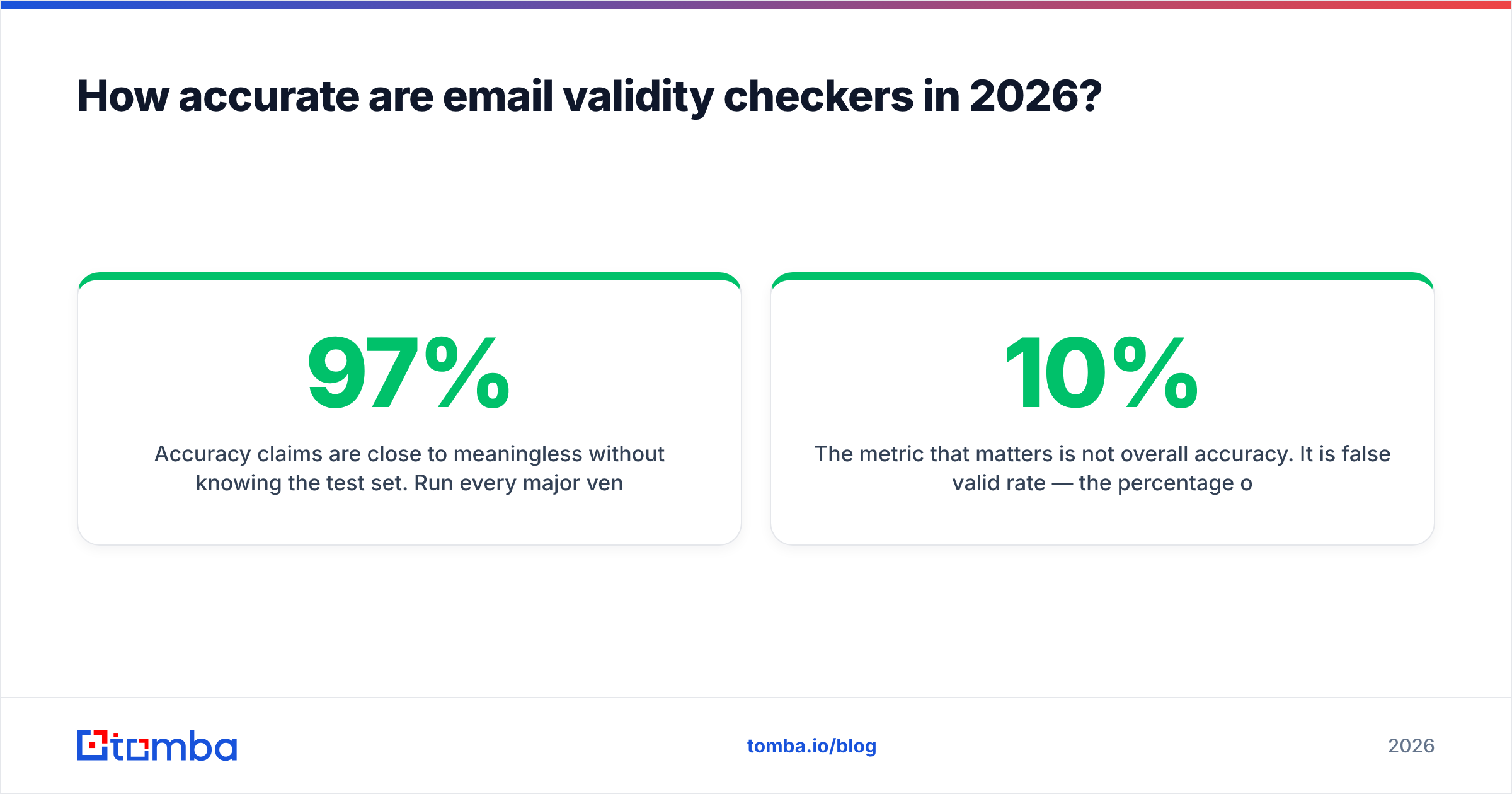
Accuracy claims are close to meaningless without knowing the test set. Run every major vendor against 1,000 Gmail addresses and they will all score above 97%. Run them against 1,000 addresses at Fortune 500 domains with mixed catch-all configuration and the spread opens to 20 points or more.

When you benchmark, build a test set that mirrors your actual pipeline:
- 200 addresses you have already sent to successfully (should return valid)
- 200 addresses that hard-bounced in the last 90 days (should return invalid)
- 200 addresses at known catch-all domains (should be flagged as catch-all, not silently marked valid)
- 200 addresses at Microsoft 365 tenants
- 100 deliberately malformed and disposable addresses
The metric that matters is not overall accuracy. It is false valid rate — the percentage of dead mailboxes a tool waves through. A tool that marks 10% of your list "unknown" and gets zero false valids is far more useful than one that confidently marks everything valid and lands you a 6% bounce rate. Ask vendors for that number specifically; most publish only the flattering aggregate.
Independent review sites are a reasonable sanity check on vendor claims. G2's email verification category aggregates enough reviews to surface consistent complaints about throughput and support, though it will not tell you anything about false valid rates.
Which email validity checker should you use?#
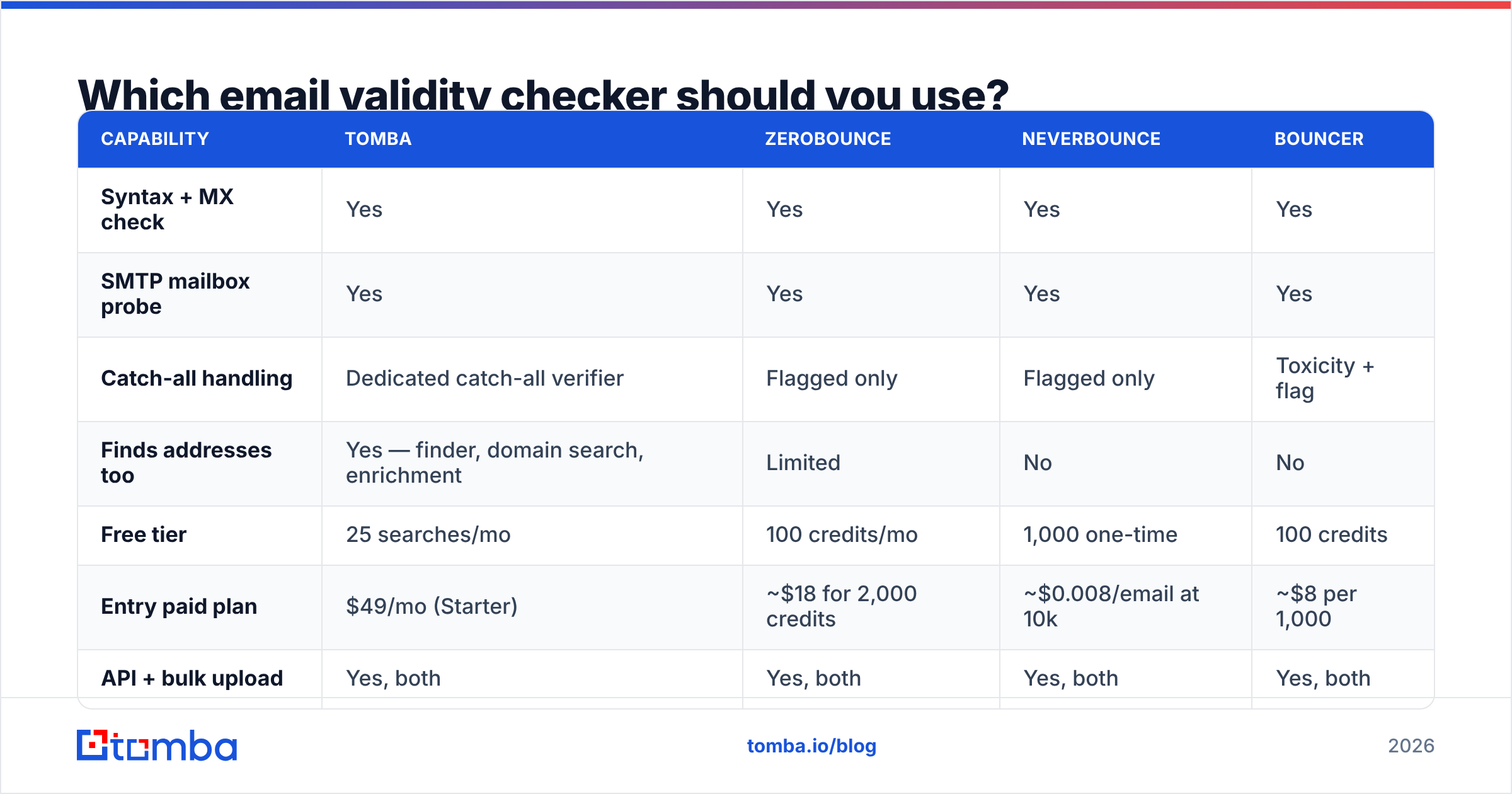
Here is how the main options compare on the checks that matter. Pricing is list pricing at the time of writing and vendors change it often — verify on their pages before you commit.

| Capability | Tomba | ZeroBounce | NeverBounce | Bouncer |
|---|---|---|---|---|
| Syntax + MX check | Yes | Yes | Yes | Yes |
| SMTP mailbox probe | Yes | Yes | Yes | Yes |
| Catch-all handling | Dedicated catch-all verifier | Flagged only | Flagged only | Toxicity + flag |
| Finds addresses too | Yes — finder, domain search, enrichment | Limited | No | No |
| Free tier | 25 searches/mo | 100 credits/mo | 1,000 one-time | 100 credits |
| Entry paid plan | $49/mo (Starter) | ~$18 for 2,000 credits | ~$0.008/email at 10k | ~$8 per 1,000 |
| API + bulk upload | Yes, both | Yes, both | Yes, both | Yes, both |
| Native spreadsheet add-ons | Sheets, Excel, Airtable | Limited | Limited | Limited |
Two structural differences are worth calling out.
First, pure verifiers price per credit and finders price per subscription. If you already have a list and just need it cleaned once a quarter, a pay-as-you-go verifier is cheaper. If you are building lists continuously, a combined finder-plus-verifier subscription costs less per usable contact because you are not paying twice for the same record.
Second, verification-only tools cannot fix a bad address — they can only reject it. A platform that also runs domain search can replace a dead j.smith@acme.com with the current pattern-correct address at the same company, which is the outcome you actually wanted.
For teams that would rather buy pre-verified records than build them, providers like BookYourData sell contact lists with verification built into the delivery guarantee — a different model that suits one-off campaigns better than continuous prospecting.
How do you check a single email address for free?#
For one-off checks, paying is unnecessary. Use a browser-based free email checker, paste the address, and read the verdict. It runs the same syntax, MX, and SMTP layers as the paid API, just without batching or an audit trail.
Three practical notes:
- Do not trust "unknown" as "probably fine." Unknown usually means the receiving server greylisted the probe. Retry in an hour before deciding.
- Check the domain, not just the address. If you are unsure whether the whole company is catch-all, run one obviously fake address at that domain. If it comes back valid, the domain is catch-all and every result from it is unreliable.
- Free tiers exist to be used. Tomba's free plan includes 25 searches per month, ZeroBounce gives 100 monthly credits, and NeverBounce hands out 1,000 one-time. That is enough to benchmark all three on a sample before you buy anything.

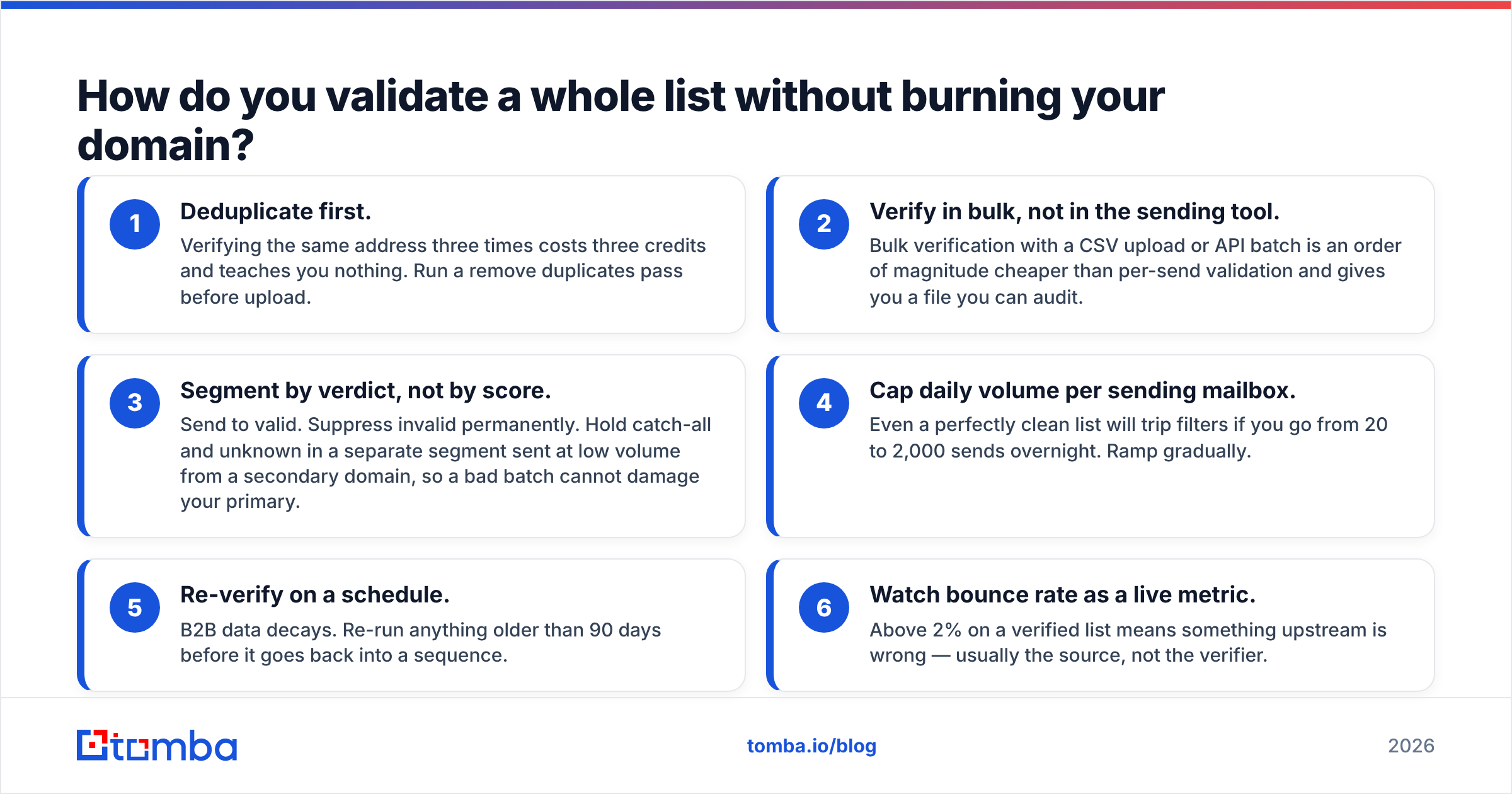
How do you validate a whole list without burning your domain?#
Verification is only half of list hygiene. The other half is sending discipline, and skipping it undoes the verification.
- Deduplicate first. Verifying the same address three times costs three credits and teaches you nothing. Run a remove duplicates pass before upload.
- Verify in bulk, not in the sending tool. Bulk verification with a CSV upload or API batch is an order of magnitude cheaper than per-send validation and gives you a file you can audit.
- Segment by verdict, not by score. Send to valid. Suppress invalid permanently. Hold catch-all and unknown in a separate segment sent at low volume from a secondary domain, so a bad batch cannot damage your primary.
- Cap daily volume per sending mailbox. Even a perfectly clean list will trip filters if you go from 20 to 2,000 sends overnight. Ramp gradually.
- Re-verify on a schedule. B2B data decays. Re-run anything older than 90 days before it goes back into a sequence.
- Watch bounce rate as a live metric. Above 2% on a verified list means something upstream is wrong — usually the source, not the verifier.
If verification is a step in a larger workflow, wire it in through the email verification API rather than exporting CSVs by hand. Validating at the point of capture — form submission, CRM import, scraped record — stops bad data entering the system at all, which is always cheaper than cleaning it later.
Does verifying emails actually improve deliverability?#
Yes, but indirectly, and it is worth being precise about the mechanism.
Mailbox providers do not read your verification report. They observe your sending behaviour: how many messages bounce, how many recipients mark you as spam, how many engage. A high hard-bounce rate signals that you are mailing a list you did not earn, and providers throttle or filter accordingly. Verification lowers the bounce signal. It does nothing for the complaint or engagement signals, which are driven by targeting and copy.
So the realistic framing is: verification is necessary but not sufficient. It removes one failure mode. Authentication removes another — if you have not confirmed your DNS records, run an SPF checker and make sure DKIM and DMARC are aligned, because SMTP itself has no built-in sender verification and providers lean hard on those records instead. Relevance removes the third, and no tool does that for you.
A reasonable target for a cold B2B campaign in 2026: under 2% bounce, under 0.1% complaint rate. If you are hitting the first and missing the second, stop tuning your verifier and rewrite the email.
What should you actually do next?#
If you have an existing list, verify a 500-address sample across two vendors and compare the disagreements — that is where you learn which one is guessing. If you are building lists from scratch, skip the clean-up cycle entirely and validate at collection.
That is the case for using a combined tool. The Tomba Email Finder returns addresses with a confidence score and verification status attached, so records enter your CRM already checked rather than arriving raw and needing a second paid pass. Pair it with the email verifier for periodic re-validation of older records, and check Tomba pricing — the free tier covers 25 searches a month, which is enough to run the benchmark described above before you spend anything.
Verify because bounces are expensive. Source well because verification cannot fix data that was wrong when you collected it.
Related guides#
Ready to find emails that actually work?
Join 150,000+ professionals who stopped guessing and started sending. Free credits on signup — no credit card required.
Get the Tomba newsletter
Practical outbound tactics and product updates — once every two weeks.
About the author