Email Writer AI in 2026: What Actually Works for Cold Outreach
AI email writers promise personalization at scale. Most deliver generic filler that tanks reply rates. Here's what separates the tools that lift replies from the ones that just fill your sent folder.
TL;DR
- An email writer AI is only as good as the data you feed it. Give it a name and a company URL and you get filler; give it verified contact data plus a real trigger and you get a draft worth sending.
- The measurable win is speed, not persuasion. Teams report cutting draft time from 8-12 minutes per sequence to under 2 — reply-rate lift only shows up when personalization inputs are real.
- Generic AI copy is now a deliverability risk, not just a conversion problem. Google and Yahoo's bulk-sender rules punish high complaint rates, and templated AI blasts generate them.
- Pricing splits into three tiers: free general-purpose LLMs, $30-80/mo dedicated writers, and $99-250/mo full outbound platforms that bundle writing with data and sending.
- The highest-ROI stack is boring: accurate contact data first, a writing layer second. Reverse that order and you scale bad emails faster.
What is an email writer AI, and what does it actually do?#
An email writer AI is a tool that generates outbound or reply email copy from structured inputs — a prospect's name, title, company, industry, a trigger event, and your offer. Some are thin wrappers over GPT-class models with a sales-specific prompt. Others are full platforms that pull CRM records, enrich them, generate a sequence, and schedule the sends.
Think of it like a line cook. A great cook with wilted vegetables produces a mediocre dish. The same cook with fresh ingredients produces something good. The model is the cook; your data is the ingredients. Most teams who complain that "AI email copy doesn't work" are running a good cook on bad produce.
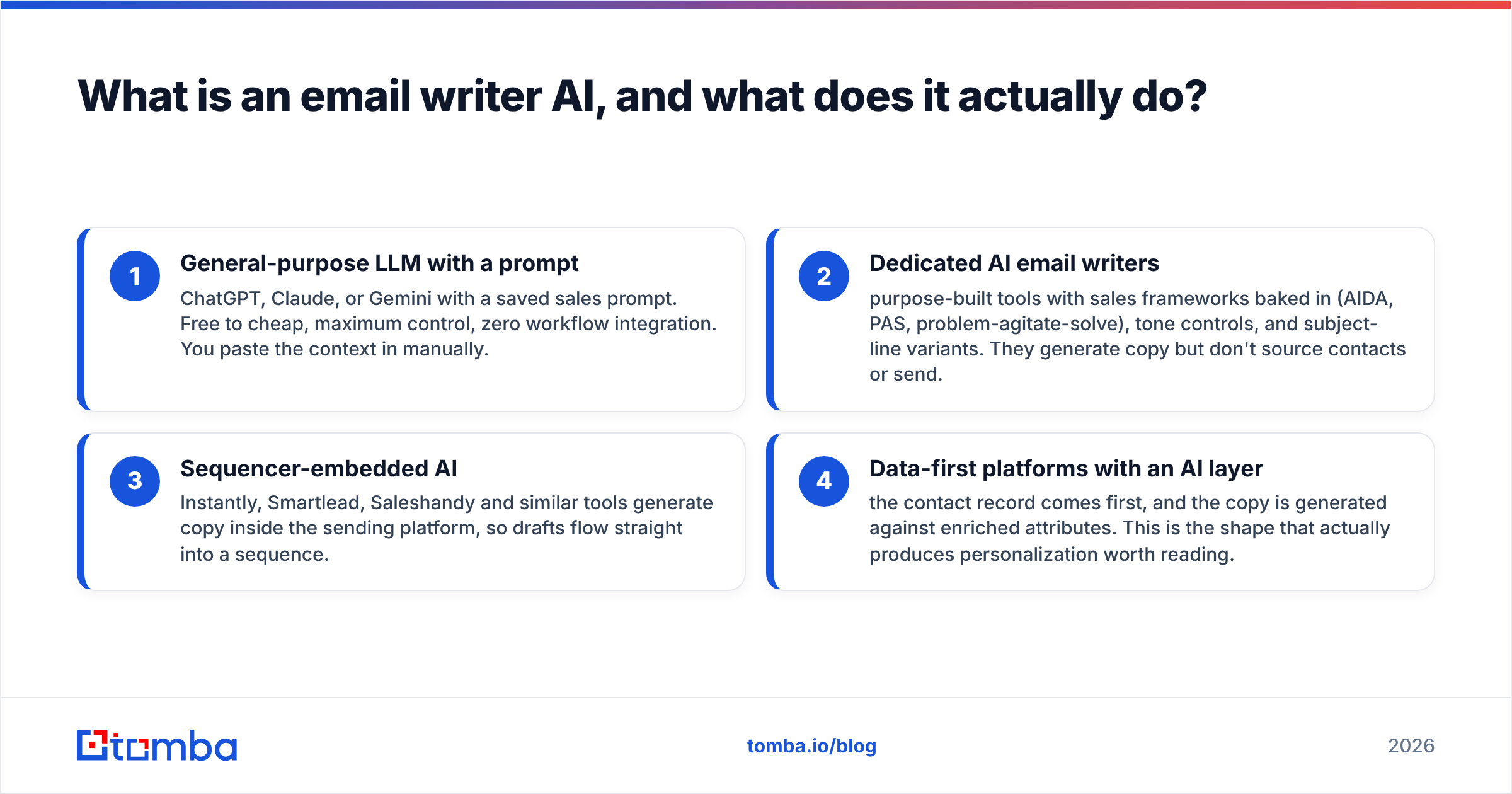
The category breaks into four functional types:
- General-purpose LLM with a prompt — ChatGPT, Claude, or Gemini with a saved sales prompt. Free to cheap, maximum control, zero workflow integration. You paste the context in manually.
- Dedicated AI email writers — purpose-built tools with sales frameworks baked in (AIDA, PAS, problem-agitate-solve), tone controls, and subject-line variants. They generate copy but don't source contacts or send.
- Sequencer-embedded AI — Instantly, Smartlead, Saleshandy and similar tools generate copy inside the sending platform, so drafts flow straight into a sequence.
- Data-first platforms with an AI layer — the contact record comes first, and the copy is generated against enriched attributes. This is the shape that actually produces personalization worth reading.
The fourth category matters most because it inverts the usual failure mode. When copy generation comes first, the AI invents plausible-sounding personalization ("I noticed your team is scaling fast"). When data comes first, it references something real.
Why do most AI-written cold emails fail?#
They fail for a reason that has nothing to do with the writing quality. The copy is usually grammatically fine, structurally reasonable, and completely interchangeable with the other forty AI emails that prospect received this week.
Here are the four failure modes, in order of how much damage they do:
1. Hallucinated personalization. Ask an AI to personalize based on a company name alone and it will confabulate. "Congrats on the recent expansion" sent to a company that just did layoffs is worse than no personalization at all. If the model wasn't given a verified fact, it will manufacture one.
2. Pattern-matched openers. LLMs converge. Prompt ten different tools with "write a cold email to a VP of Sales at a SaaS company" and you'll get near-identical structures: a flattering observation, a pivot to a pain point, a soft ask. Prospects have learned to pattern-match and delete.
3. Length inflation. Default AI output runs 150-220 words. Cold email data consistently favors 50-125 words. You have to explicitly constrain length, and most people don't.
4. Sending to unverified addresses. This one is invisible until it isn't. An AI writer with no verification layer will happily generate perfect copy for an address that bounces. Bounce rates above 2-3% degrade sender reputation fast, and once your domain is flagged, the quality of your copy stops mattering entirely. Google's bulk sender requirements make this explicit — spam complaint rates above 0.3% get you throttled regardless of what your email says.
The third and fourth points are why the writing layer should never be the first purchase. Run your list through an email verifier before you generate a single draft.
How do the main email writer AI tools compare in 2026?#
The honest comparison isn't "which writes best prose" — they're all competent at prose. It's which one fits into a workflow that produces sent, delivered, replied-to email.
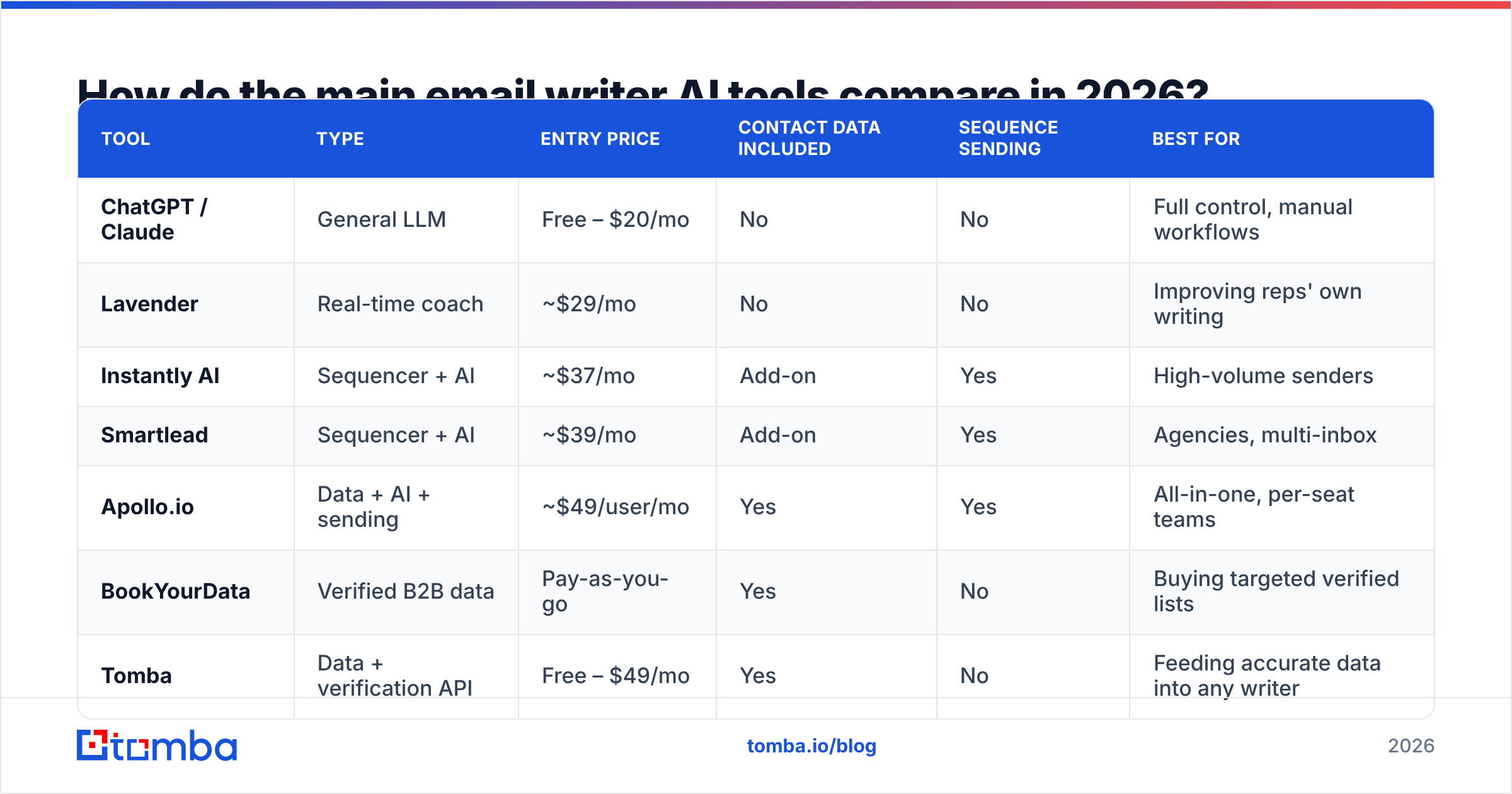
| Tool | Type | Entry price | Contact data included | Sequence sending | Best for |
|---|---|---|---|---|---|
| ChatGPT / Claude | General LLM | Free – $20/mo | No | No | Full control, manual workflows |
| Lavender | Real-time coach | ~$29/mo | No | No | Improving reps' own writing |
| Instantly AI | Sequencer + AI | ~$37/mo | Add-on | Yes | High-volume senders |
| Smartlead | Sequencer + AI | ~$39/mo | Add-on | Yes | Agencies, multi-inbox |
| Apollo.io | Data + AI + sending | ~$49/user/mo | Yes | Yes | All-in-one, per-seat teams |
| BookYourData | Verified B2B data | Pay-as-you-go | Yes | No | Buying targeted verified lists |
| Tomba | Data + verification API | Free – $49/mo | Yes | No | Feeding accurate data into any writer |
A few notes on that table, because a grid flattens real differences.
Lavender isn't a writer — it's a scoring layer that critiques your draft in Gmail or Outlook as you type. If your problem is that your reps write badly, this fixes the underlying skill rather than automating around it.
Instantly and Smartlead are sending infrastructure first. Their AI writing features are convenient but not their differentiator; you're paying for inbox rotation, warmup, and deliverability tooling. Compare them properly before committing — our breakdowns of the Instantly alternative and Saleshandy alternative landscape cover where each fits.
BookYourData takes a different route entirely — you buy verified contact lists on a pay-as-you-go basis rather than subscribing. For teams that run campaigns in bursts rather than continuously, that model is often cheaper than a seat-based platform, and the verification guarantee removes the bounce problem before the writing step ever happens.
Apollo bundles everything, which is either the appeal or the problem depending on your team size. Per-seat pricing compounds fast; at ten reps you're well past $500/mo. Teams that only need the data layer often find an Apollo alternative with usage-based pricing works out considerably cheaper.
Tomba sits deliberately upstream. It doesn't write your email — it finds and verifies the address, returns the company's email pattern, and enriches the record so whatever writer you use has real inputs. Tomba pricing starts with a free tier at 25 searches/month, then Starter at $49/mo, Growth at $99/mo, and Pro at $249/mo.
What separates AI copy that gets replies from copy that gets deleted?#
Three variables, ranked by impact.
Input specificity. Compare these two prompts:
"Write a cold email to Sarah, VP of Marketing at Acme Corp."
versus
"Write a 70-word cold email to Sarah Chen, VP Marketing at Acme Corp (B2B fintech, 200 employees, Series B in March 2026). They just posted three demand-gen roles. Our product cuts campaign setup time by 40%. Ask for 15 minutes. No flattery, no 'I noticed', one specific question at the end."
The second produces something sendable. The first produces spam. Everything about AI email quality reduces to how much verified context you hand over — which means your enrichment layer, not your prompt library, is the bottleneck.
Constraint discipline. Set hard limits: word count under 100, one call to action, no adjective stacking, no "I hope this finds you well." AI defaults toward padding because padded text scores as more complete. You have to fight it explicitly in the prompt.
Human final pass. Every team that reports good numbers from AI-written email describes the same workflow: AI drafts, human edits the first line and the ask, then sends. The edit takes 30 seconds and it's what keeps the email from reading like the other AI emails.
Does AI-generated email hurt deliverability?#
Indirectly, yes — and the mechanism is worth understanding because it's not what most people assume.
Mailbox providers don't detect "AI writing" and penalize it. There's no classifier watching for GPT-shaped prose. What they detect is behavior: complaint rates, bounce rates, engagement, and content similarity across many messages hitting the same infrastructure.
AI writers hurt deliverability through second-order effects:
- Volume without quality control. The main thing AI unlocks is throughput. If you were sending 200 emails a week and now send 2,000 with the same targeting, your complaint rate rises proportionally and your domain reputation drops.
- Near-duplicate content at scale. Poorly prompted AI produces variations that are structurally identical. Filters that cluster on message similarity treat this the way they treat template blasts.
- No verification step. Generated copy sent to scraped, unverified addresses produces hard bounces. This is the fastest way to damage email deliverability, and it has nothing to do with what you wrote.
The fixes are mechanical. Verify every address before it enters a sequence. Check your SPF record and DMARC alignment. Run drafts through a spam checker before launching. Keep daily volume per inbox under 50 for new domains and ramp slowly with an email warmup schedule.
None of that is glamorous, and all of it matters more than the copy.
How should you build an email writer AI workflow?#
The order of operations decides your outcome. Here's the sequence that works:
- Define the segment before you touch a writing tool. Job title, company size, industry, and one qualifying signal. Vague segments produce vague copy no matter how good the model is.
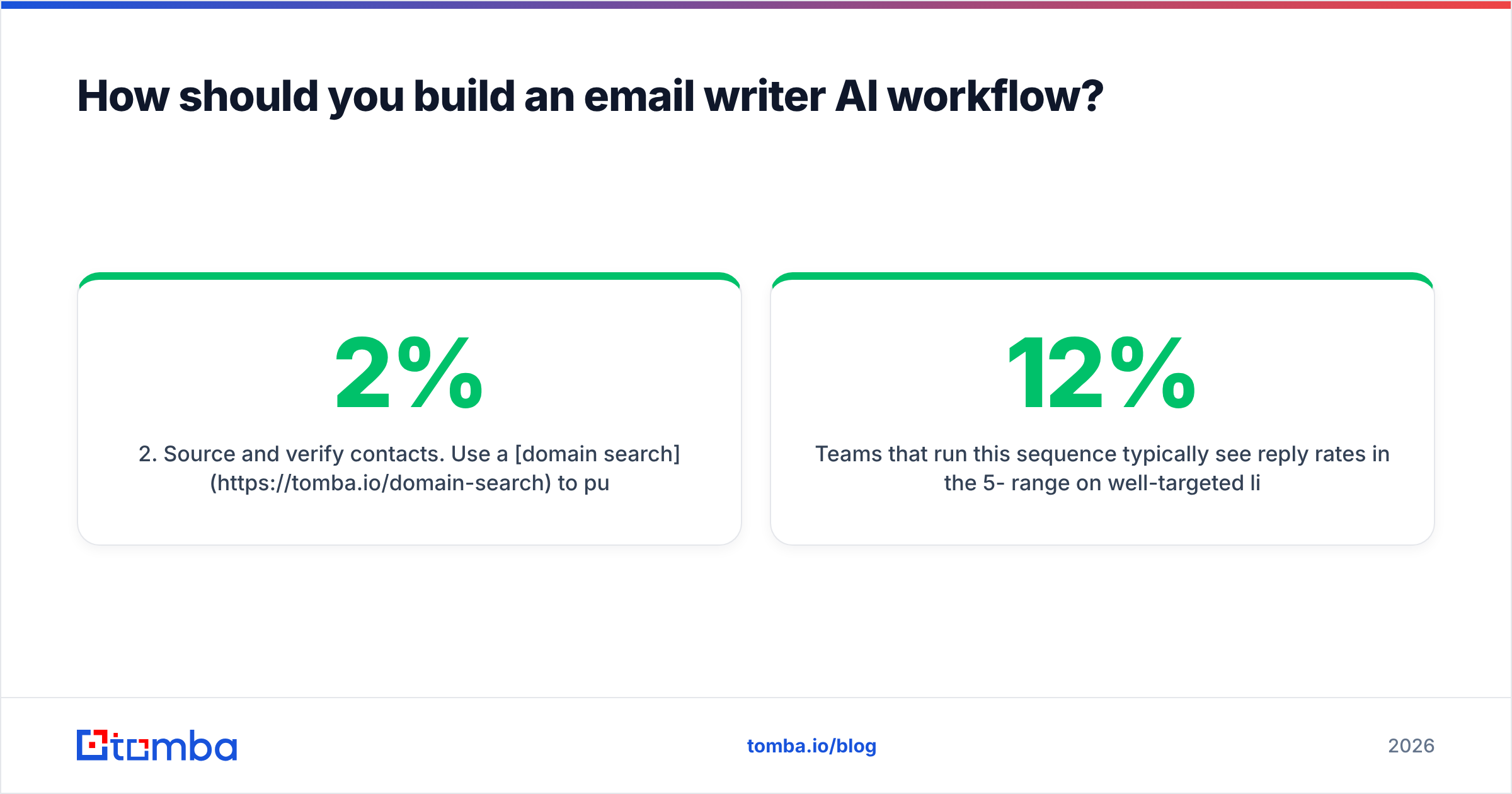
- Source and verify contacts. Use a domain search to pull the right people at target accounts, then verify every address. Aim for a bounce rate under 2%.
- Enrich for context. Pull the attributes your copy will reference — recent funding, headcount changes, tech stack, published content. Data enrichment at this step is what makes personalization real instead of invented.
- Generate with hard constraints. Feed the enriched record plus explicit rules: word count, tone, one CTA, banned phrases. Generate three variants and pick, don't accept the first output.
- Human-edit the first line and the ask. Thirty seconds per email. This is non-negotiable if you want replies rather than sends.
- Measure reply rate, not open rate. Apple Mail Privacy Protection made open rates unreliable years ago. Track replies and meetings booked; those are the only numbers that survive contact with reality.
Teams that run this sequence typically see reply rates in the 5-12% range on well-targeted lists. Teams that skip steps 2 and 3 and lead with the writing tool land closer to 1-2% — the same range as untargeted templates, which tells you the AI added nothing.
What does an email writer AI cost, realistically?#
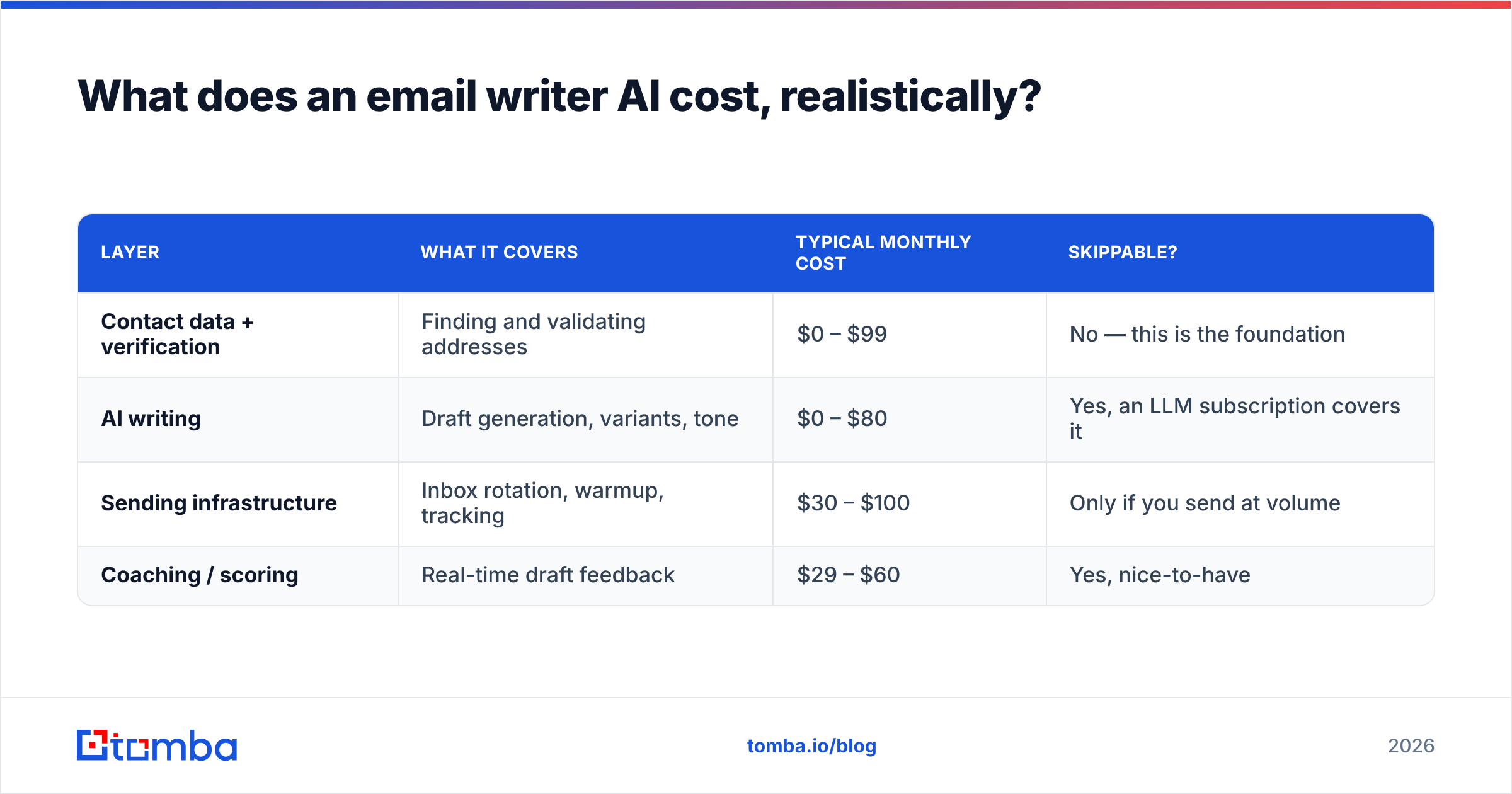
Budget across three layers rather than looking for one tool that does everything.
| Layer | What it covers | Typical monthly cost | Skippable? |
|---|---|---|---|
| Contact data + verification | Finding and validating addresses | $0 – $99 | No — this is the foundation |
| AI writing | Draft generation, variants, tone | $0 – $80 | Yes, an LLM subscription covers it |
| Sending infrastructure | Inbox rotation, warmup, tracking | $30 – $100 | Only if you send at volume |
| Coaching / scoring | Real-time draft feedback | $29 – $60 | Yes, nice-to-have |
A two-person team running 1,000 emails/month can cover data and verification on Tomba's Starter plan at $49/mo, use ChatGPT Plus at $20/mo for drafting, and Instantly at roughly $37/mo for sending — about $106/mo total. The same workload on a bundled per-seat platform typically runs $100-200/mo for two seats, so the difference is smaller than vendors imply. The real gap shows at scale, where usage-based data pricing stays flat while per-seat pricing compounds with headcount.
Where the money is genuinely wasted: buying a premium writing tool while running on unverified data. That's paying for a better cook and giving them the same wilted vegetables.
Which email writer AI should you pick?#
Match the tool to the actual constraint you're facing:
- Your reps write badly → a coaching layer like Lavender, which improves the skill rather than replacing it.
- You can't draft fast enough → a general LLM with a well-built prompt library. Cheapest option, works fine, requires manual context-pasting.
- Your emails bounce or land in spam → this isn't a writing problem. Fix data quality and authentication first.
- You need volume across many inboxes → a sequencer with built-in AI, plus a separate data source.
- Your personalization is generic → an enrichment layer. No prompt engineering fixes missing data.
- You buy lists in bursts rather than subscribing → a pay-as-you-go verified data provider like BookYourData, then any writing layer on top.
Independent review sites like G2 and Capterra are useful for checking whether a vendor's support and onboarding hold up, though review volume skews toward whoever runs the most aggressive review-collection campaigns. HubSpot's sales research is a reasonable neutral source on outreach benchmarks.
The bottom line#
An email writer AI is a multiplier, and multipliers work in both directions. Point one at a verified, well-segmented list with real enrichment attributes and it saves your team hours per week while holding reply rates steady or better. Point one at a scraped list with invented personalization and it multiplies a bad process — faster bounces, faster complaints, faster domain damage.
The sequencing is what most teams get backwards. The writing was never the hard part.
Start where the leverage actually is. Tomba's Email Finder gives your AI writer something true to work with — verified addresses, confirmed company email patterns, and enriched contact attributes, with a free tier at 25 searches/month to test against your own target list before you commit. Feed it good ingredients, and whatever writer you layer on top gets noticeably better.
Related guides#
Ready to find emails that actually work?
Join 150,000+ professionals who stopped guessing and started sending. Free credits on signup — no credit card required.
Get the Tomba newsletter
Practical outbound tactics and product updates — once every two weeks.
About the author