Emailable vs Apollo.io: Verification vs Prospecting Data
Emailable verifies the emails you already have. Apollo.io hands you millions you don't. We break down accuracy, pricing, and which one actually belongs in your outbound stack in 2026.
Emailable vs Apollo.io — TL;DR
- Emailable vs Apollo.io is a slightly unfair matchup. Emailable is a verification specialist. Apollo.io is a prospecting database with a sales engagement layer bolted on. The comparison only matters when you're deciding where your data budget goes.
- Pick Emailable if you already have lists (from a CRM, a scrape, a webinar, a partner) and your only problem is bounce rate.
- Pick Apollo.io if you have no contacts at all and need volume plus sequencing in one seat.
- Apollo's per-seat model gets expensive fast for teams. Its export credits — not its features — are usually what forces the upgrade.
- If you want find + verify without a seat tax, a dedicated finder like Tomba starts at $49/mo with a free 25-search tier. Its API works the same whether one person or ten pull from it.
What are Emailable and Apollo.io actually built for?#
They solve different halves of the same problem.
Emailable is an email verification service. You give it addresses, it tells you which ones will bounce. It runs syntax checks, MX record lookups, SMTP handshakes, disposable-domain detection, role-account flagging (info@, sales@), and catch-all scoring. That's the product. There's a bulk uploader, a real-time API, and integrations with the usual ESPs. It does not find you new contacts.
Apollo.io is a go-to-market platform. It runs on a contact database that it says holds hundreds of millions of profiles. You filter by title, headcount, tech stack, funding, and intent signals, then export contacts, then sequence them from inside the same tool. Verification exists inside Apollo, but it's a quality gate on Apollo's own data. It is not a service you'd point at an external list.
So the honest framing: Emailable is a filter, Apollo.io is a faucet. If your pipeline problem is "my sends bounce," you need a filter. If it's "I have nobody to send to," you need a faucet. Most teams need both in the end. So the real question is which one you buy first, and what you pair it with.
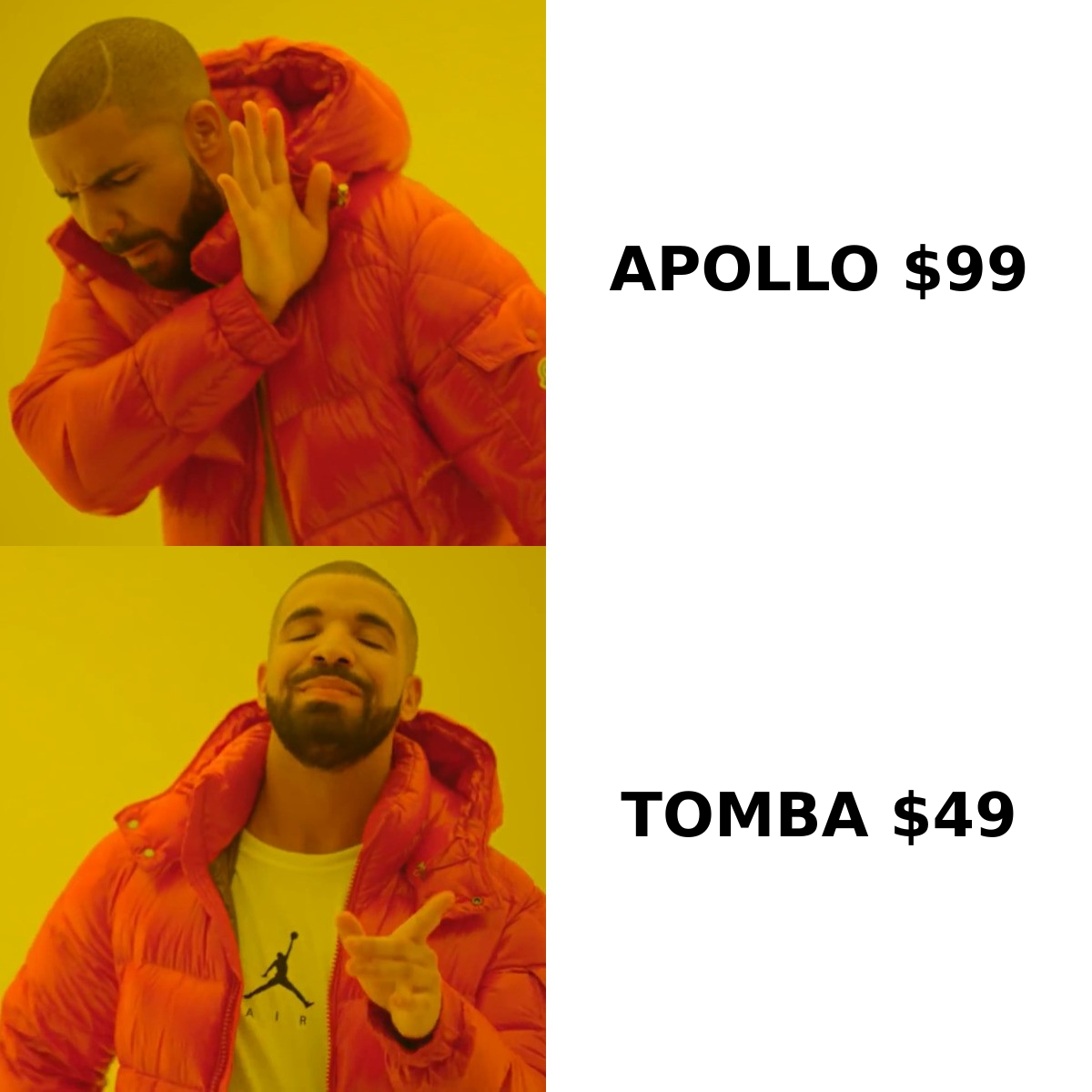
Emailable vs Apollo.io: how do they compare feature by feature?#
Here's the side-by-side. Pricing moves — treat these as directional and confirm on the vendor pages before you sign anything.
| Capability | Emailable | Apollo.io | Tomba |
|---|---|---|---|
| Core job | Email verification | Prospect database + sequencing | Email finding + verification |
| Contact database | No | Yes (hundreds of millions of profiles) | Yes (B2B database) |
| Email finder | No | Yes (inside database export) | Yes (email finder) |
| Bulk verification | Yes — core strength | Yes, on own data | Yes (bulk verify) |
| Catch-all handling | Scored, flagged | Flagged, limited depth | Dedicated catch-all verifier |
| Phone numbers | No | Yes (credit-gated) | Yes (phone finder) |
| Email sequencing | No | Yes, built in | No — integrates out |
| Pricing model | Credits / monthly volume | Per seat + credit tiers | Flat monthly, seat-agnostic |
| Entry price | Low-volume credit packs | Free tier, paid from ~$49/user/mo | Free 25 searches, then $49/mo |
| API | Yes | Yes | Yes (Tomba API) |
| Best for | Cleaning lists you own | Building lists from scratch | Find + verify without seat tax |
One pattern jumps out. Apollo covers the most surface area, but it charges per seat for that surface area. Emailable covers a narrow slice extremely well and charges by volume. That difference drives your total cost more than any feature checkbox.
Which one is more accurate — and accurate at what?#
Split "accuracy" into two questions. The two tools are graded on different exams.
Verification accuracy means: when the tool says "deliverable," does it actually deliver? This is Emailable's home turf. A verification specialist usually beats the verification module bundled inside a prospecting suite. The specialist has to be good at it, or it has no product. Independent tests show a gap of several percentage points on the same seed list. That gap sounds small. At 50,000 sends, it is not.
Discovery accuracy means: of the contacts the tool hands you, how many are real, current, and correctly attributed? This is where Apollo takes criticism. A scraped and crowd-sourced database at Apollo's scale carries stale rows — people who changed jobs, emails that were valid two years ago, titles that no longer exist. Apollo's own "verified" tag helps. Even so, plenty of G2 reviewers flag data decay and patchy international coverage as the recurring complaint. That's not unique to Apollo. It's the tax on any database that optimizes for breadth.

The practical takeaway: do not treat a database's "verified" badge as a verification step. Export from your database of choice, then run the list through a real verifier before it touches your sending domain. Teams that skip that step file deliverability tickets three weeks later. For the underlying mechanics, our note on where Tomba gets data covers how source diversity affects freshness.
How does the pricing actually shake out?#
This is where Emailable vs Apollo.io gets decisive, and where most buyers get surprised.
Emailable prices on volume. You buy credits or a monthly verification allowance, and the cost per email drops as you scale. One person or twelve, the price is the same. You pay for throughput, not headcount. It's predictable, easy to model, and it drops to near-zero in months where you're not sending.
Apollo.io prices per seat, then meters exports on top. The free plan exists and is genuinely usable for testing. Paid tiers start around $49 per user per month. From there they climb through the $79–$119 per user per month range, depending on the plan and on whether you commit annually. Now add the export credit ceilings. A five-person SDR team on a mid tier becomes a four-figure annual line item, before anyone exports an unusual volume of contacts.
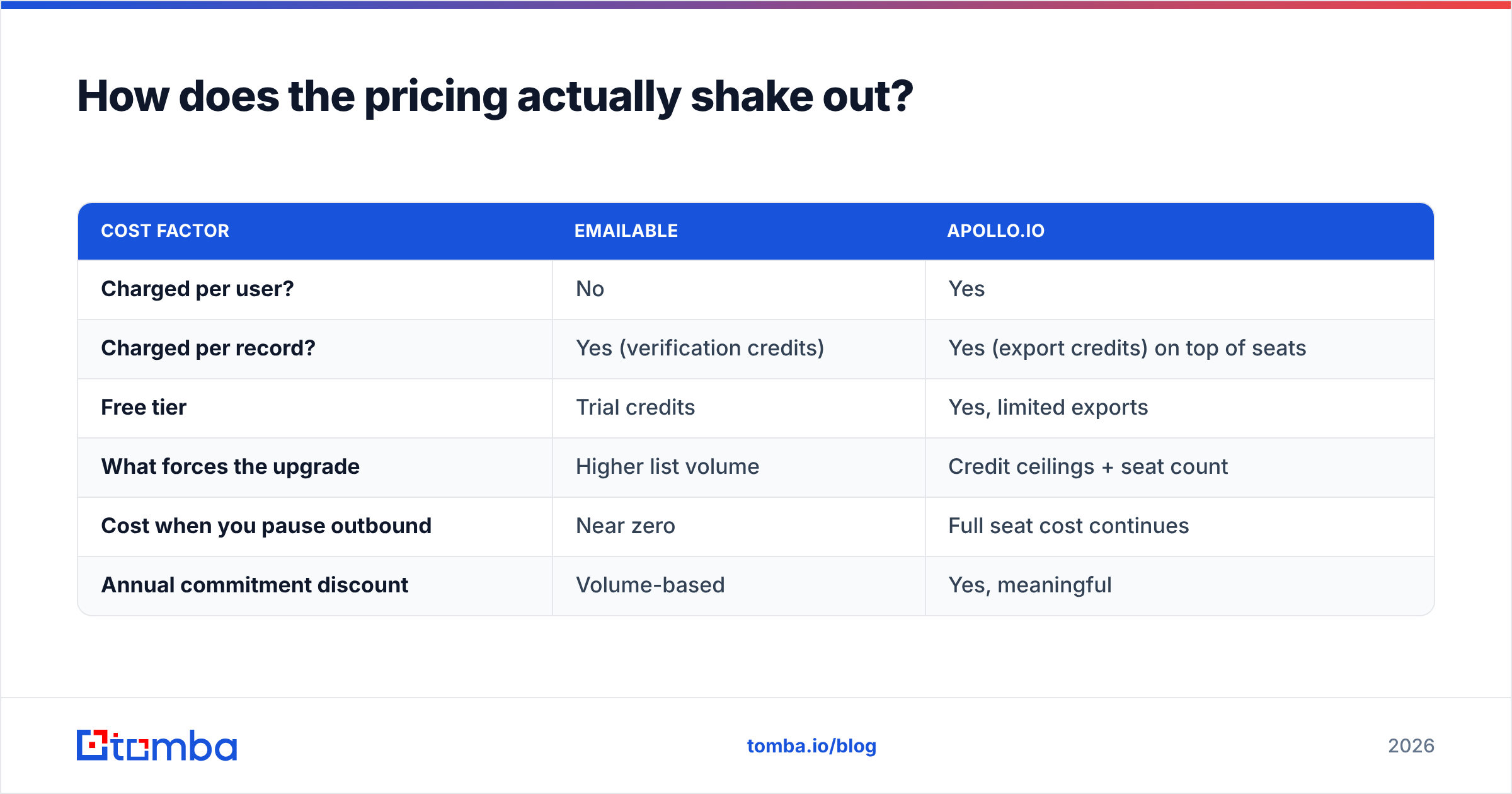
| Cost factor | Emailable | Apollo.io |
|---|---|---|
| Charged per user? | No | Yes |
| Charged per record? | Yes (verification credits) | Yes (export credits) on top of seats |
| Free tier | Trial credits | Yes, limited exports |
| What forces the upgrade | Higher list volume | Credit ceilings + seat count |
| Cost when you pause outbound | Near zero | Full seat cost continues |
| Annual commitment discount | Volume-based | Yes, meaningful |
Two things are worth saying plainly. First, per-seat pricing punishes the exact team shape that gains most from a shared data layer: a small pod where one ops person pulls lists for everyone. Second, credit ceilings are the real lever. Vendors set feature gates loosely and credit gates tightly, because credits scale with your success.
If seat-based pricing is your sticking point, look at Tomba pricing: Free at 25 searches/mo, Starter $49/mo, Growth $99/mo, Pro $249/mo, Enterprise custom. It's priced on volume, not headcount, and the Tomba API is available across paid tiers, so your whole team can pull from one key. Peers like BookYourData take a different and equally defensible route — prepaid, list-based purchasing with no subscription at all. That suits teams who buy data in occasional batches rather than continuously.
What happens with catch-all domains?#
Catch-all domains are the biggest source of disagreement between verification tools, so they deserve their own answer.
A catch-all (or accept-all) server accepts mail for every address at a domain, whether or not the mailbox exists. That means an SMTP handshake tells you nothing definitive. Roughly a fifth to a quarter of B2B domains work this way. Most of them are mid-market and enterprise — the accounts you care about most.
Vendors handle this three ways:
- Flag and skip. The tool marks the address "unknown" and hands the decision back to you. That's safe. But if 22% of your list comes back unknown, you've paid to learn nothing.
- Score probabilistically. The tool uses pattern data, historical engagement signals, and domain-level heuristics to grade the address. Emailable sits here, and it's a reasonable place to sit.
- Resolve with an extra layer. The tool runs more checks — pattern confirmation against known-good addresses at the same domain, plus secondary source cross-reference — to turn unknowns into decisions. Tomba's catch-all finder is built for exactly this bucket.
Apollo is database-first, so for external data it lands closer to option one. That's not a flaw. It's just not what the product is for.

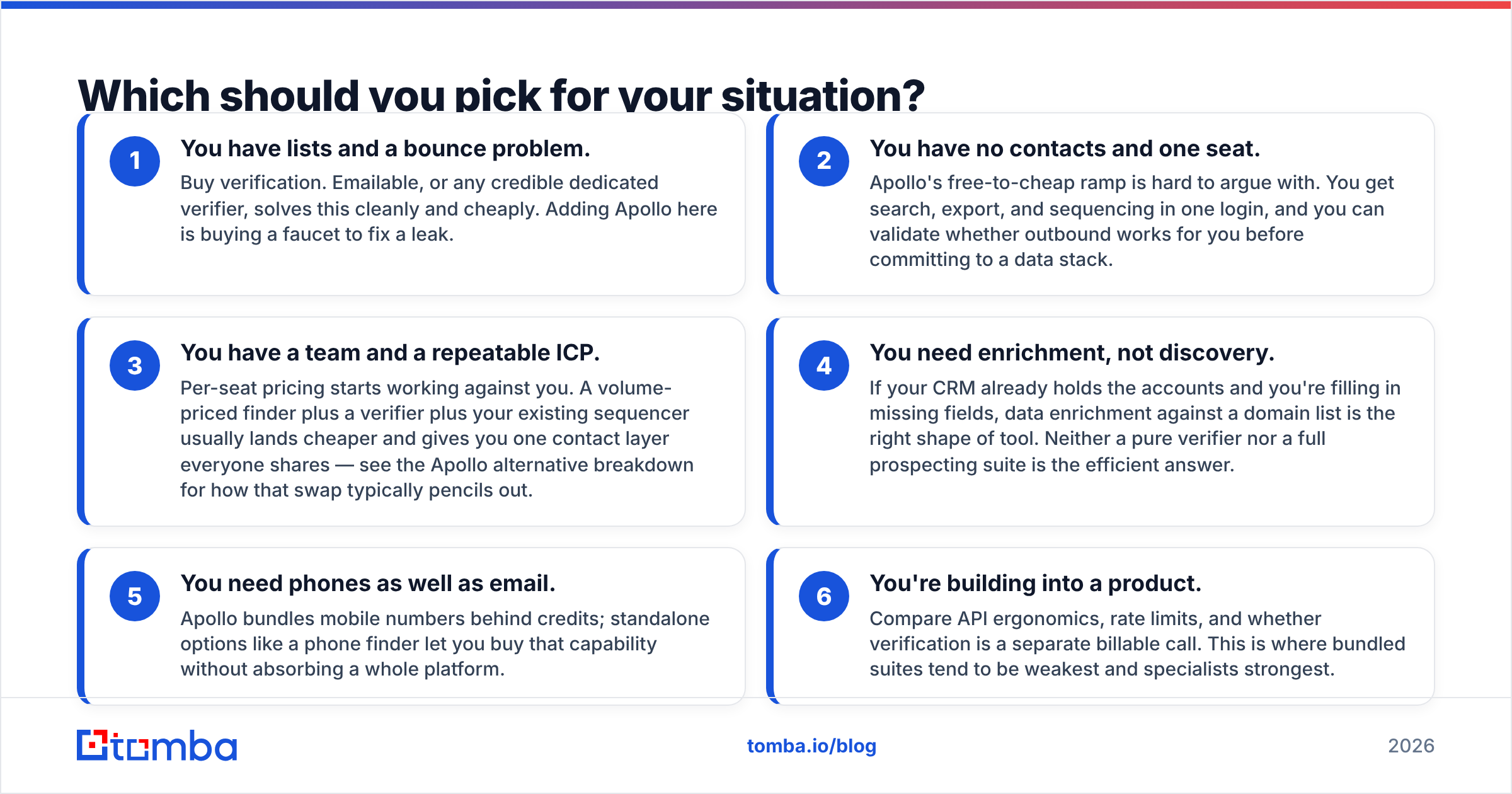
Which should you pick for your situation?#
Match the tool to the constraint you actually have. Start with these three cases:
- You have lists and a bounce problem. Buy verification. Emailable, or any credible dedicated verifier, solves this cleanly and cheaply. Adding Apollo here is buying a faucet to fix a leak.
- You have no contacts and one seat. Apollo's free-to-cheap ramp is hard to argue with. You get search, export, and sequencing in one login. You can test whether outbound works for you before you commit to a data stack.
- You have a team and a repeatable ICP. Per-seat pricing starts working against you. A volume-priced finder, a verifier, and your existing sequencer usually land cheaper together. You also get one contact layer everyone shares — see the Apollo alternative breakdown for how that swap pencils out.
The next three cases are narrower, but they come up often:
- You need enrichment, not discovery. Your CRM already holds the accounts and you're filling in missing fields. Data enrichment against a domain list is the right shape of tool here. Neither a pure verifier nor a full prospecting suite is efficient.
- You need phones as well as email. Apollo bundles mobile numbers behind credits. A standalone phone finder lets you buy that capability without absorbing a whole platform.
- You're building into a product. Compare API ergonomics, rate limits, and whether verification is a separate billable call. Bundled suites tend to be weakest here, and specialists strongest.

Can you just use both?#
Yes, and plenty of teams do. It's arguably the correct architecture.
The stack that works: source contacts from a database, verify with a specialist before import, then sequence. Three tools, three clear jobs, and no single vendor owning your whole funnel. The all-in-one approach fails in a subtler way. When data quality dips, you have no independent check, because the tool grading the homework also wrote it.
The stack that doesn't work: export from a database, trust the built-in "verified" flag, and send. Bounce rates above roughly 2% start dragging on sender reputation. Reputation damage takes weeks to repair, and your reply rate quietly halves while you wait. Mailbox providers publish their thresholds — Google's sender guidelines are worth reading once, properly, before you scale volume.
One more thing to budget for: overlap. If you run Apollo and a separate finder, you'll pay twice for some of the same contacts. Dedupe before you verify, not after. You're paying per record either way, and a remove duplicates pass costs nothing.
What's the verdict?#
Here's the Emailable vs Apollo.io verdict in three lines.
Emailable wins on verification depth and pricing predictability. It's a specialist that stays a specialist. It doesn't charge you per seat, and it costs almost nothing in a slow month. If verification is the problem, it's a straightforward yes.
Apollo.io wins on breadth and time-to-first-email. One tool, one login, from empty CRM to sent sequence in an afternoon. For a solo founder or a first SDR hire, that consolidation is worth real money. For a team of five, model the per-seat math carefully before you sign an annual deal.
Neither is the cheapest path to verified contacts at volume. One doesn't find. The other charges by headcount for the privilege.
If your actual requirement is "give me accurate work emails for a defined list of companies, priced by volume, without a seat tax," start with the Tomba Email Finder. Search by domain, name, or company. Every result comes back with a confidence score and passes through the same verification engine as the standalone email verifier, catch-all domains included. The free tier gives you 25 searches a month to test against contacts you can independently confirm. Run your own accuracy check on 50 known addresses before you spend anything, on us or anyone else. That single test will tell you more than any comparison post, including this one.
Related guides#
Ready to find emails that actually work?
Join 150,000+ professionals who stopped guessing and started sending. Free credits on signup — no credit card required.
Get the Tomba newsletter
Practical outbound tactics and product updates — once every two weeks.
About the author