EmailBison vs Apollo.io: Full 2026 Comparison and Verdict
EmailBison vs Apollo.io: one sends cold email at scale, the other sells the data. Here is which half you actually need, what each one really costs, and the gap neither tool fills.
EmailBison vs Apollo.io is a common matchup, but it is not a fair fight. The two tools do different jobs. EmailBison sends cold email. Apollo.io sells contact data. This guide compares EmailBison vs Apollo.io on price, deliverability, and data quality. Then it shows the stack most teams end up with.
TL;DR
- EmailBison is a sending platform. Apollo.io is a data platform. A head-to-head only makes sense if you want one tool to run your whole outbound motion. For most teams, neither one is enough alone.
- EmailBison wins on sending. Higher tiers allow unlimited mailboxes. You also get white-label agency access and one workspace per client. It ships with zero contact data.
- Apollo.io wins on breadth. One seat buys a 210M+ contact database, a sequencer, a dialer, and a Chrome extension. Reviewers complain most about data quality.
- The pricing models do not line up. EmailBison charges per workspace and per sending volume. Apollo charges per user seat. A 10-rep team gets very different bills.
- Most teams end up with a mix. One source for data, EmailBison (or similar) for sending, and a verifier in between. Skip the verifier and you get the 40% bounce rate horror stories.
What is EmailBison and what is Apollo.io?#
The two products sit in different categories. Pretending otherwise is how people buy the wrong one.
EmailBison is cold email sending infrastructure. You bring your own domains, mailboxes, and lead lists. EmailBison handles inbox rotation, warmup, sequencing, spintax, a shared inbox, and reporting.
Lead-gen agencies like it for two reasons: white-label reselling and workspace isolation. One agency can run 40 clients, and no client can damage another client's sending reputation. The pitch is volume without a seat tax. Check the current feature set at emailbison.com.
Apollo.io is a sales intelligence platform that also sends email. The database is the core: a self-reported 210M+ contacts and 35M+ companies. Around it sit filters, intent signals, a Chrome extension, a sequencer, a dialer, and CRM sync.
You pay per user and get a credit allowance. You can prospect and send from the same screen. Details at apollo.io.
This split matters when a tool underperforms. If EmailBison underperforms, your copy or your list is wrong. If Apollo underperforms, the data is usually at fault. And you cannot fix Apollo's data from inside Apollo.
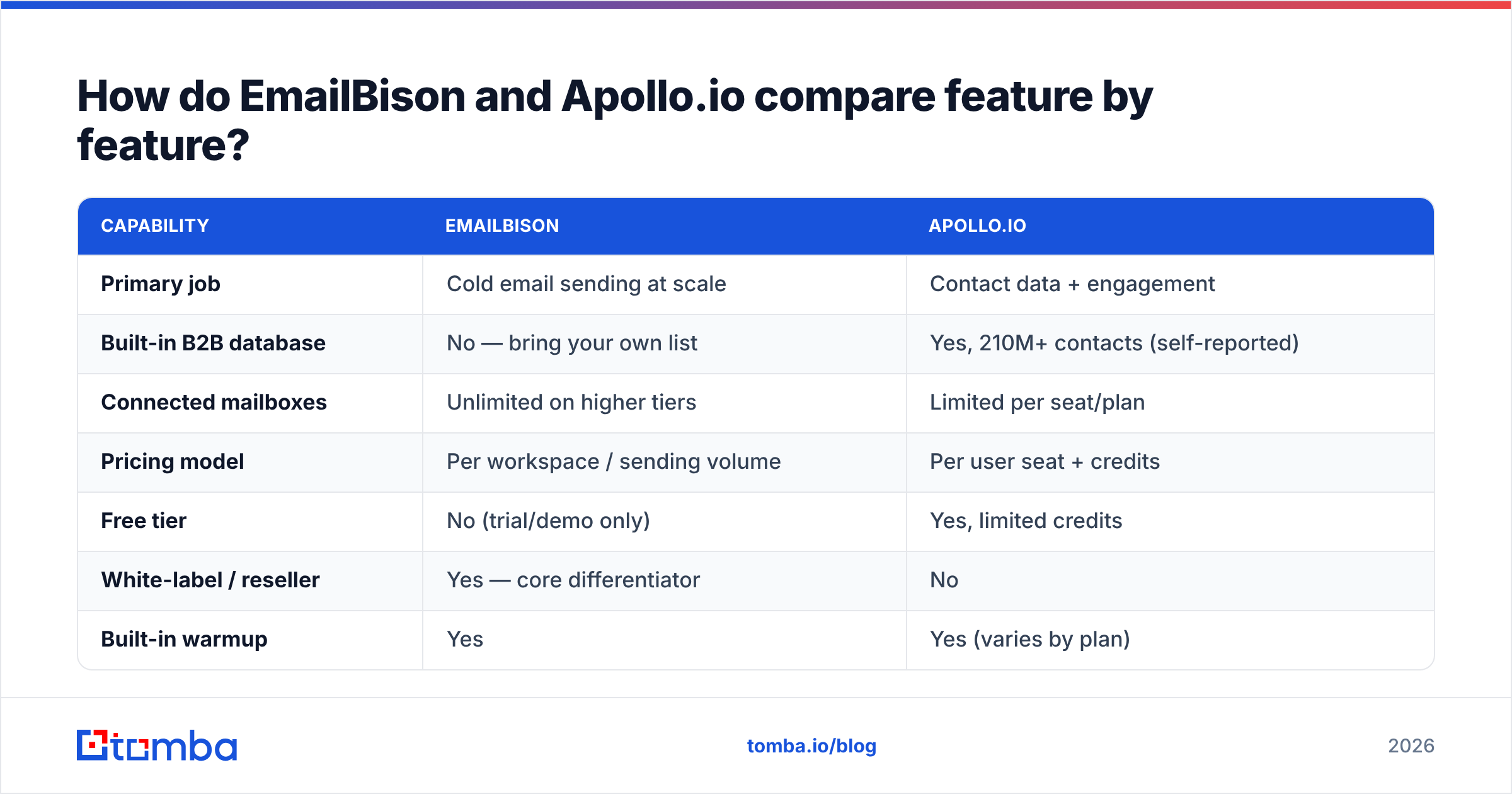
How do EmailBison vs Apollo.io compare feature by feature?#
| Capability | EmailBison | Apollo.io |
|---|---|---|
| Primary job | Cold email sending at scale | Contact data + engagement |
| Built-in B2B database | No — bring your own list | Yes, 210M+ contacts (self-reported) |
| Connected mailboxes | Unlimited on higher tiers | Limited per seat/plan |
| Pricing model | Per workspace / sending volume | Per user seat + credits |
| Free tier | No (trial/demo only) | Yes, limited credits |
| White-label / reseller | Yes — core differentiator | No |
| Built-in warmup | Yes | Yes (varies by plan) |
| Dialer / phone | No | Yes on higher tiers |
| LinkedIn steps | Manual tasks | Manual tasks |
| CRM sync | Via integrations/API | Native HubSpot & Salesforce |
| Email verification | Basic / integration-dependent | Included, quality debated |
| Best fit | Agencies, high-volume senders | SMB sales teams wanting one tool |
Two rows matter more than the rest.
Unlimited mailboxes vs per-seat limits. Serious cold email in 2026 means 30–50 emails per mailbox per day. You spread that across dozens of mailboxes on backup domains. EmailBison is built for it. You pay for the workspace and the volume, then connect as many inboxes as you need. Apollo ties mailboxes to seats, so the same plan gets costly fast.
Database vs bring-your-own. Apollo's database is why most people sign up. It is also why most people leave. Reviews on G2 flag old job titles, wrong companies after a job move, and catch-all addresses marked as verified. That does not make Apollo useless. It does mean you need your own checking layer before anything hits a sequence.

What is the real cost of each platform?#
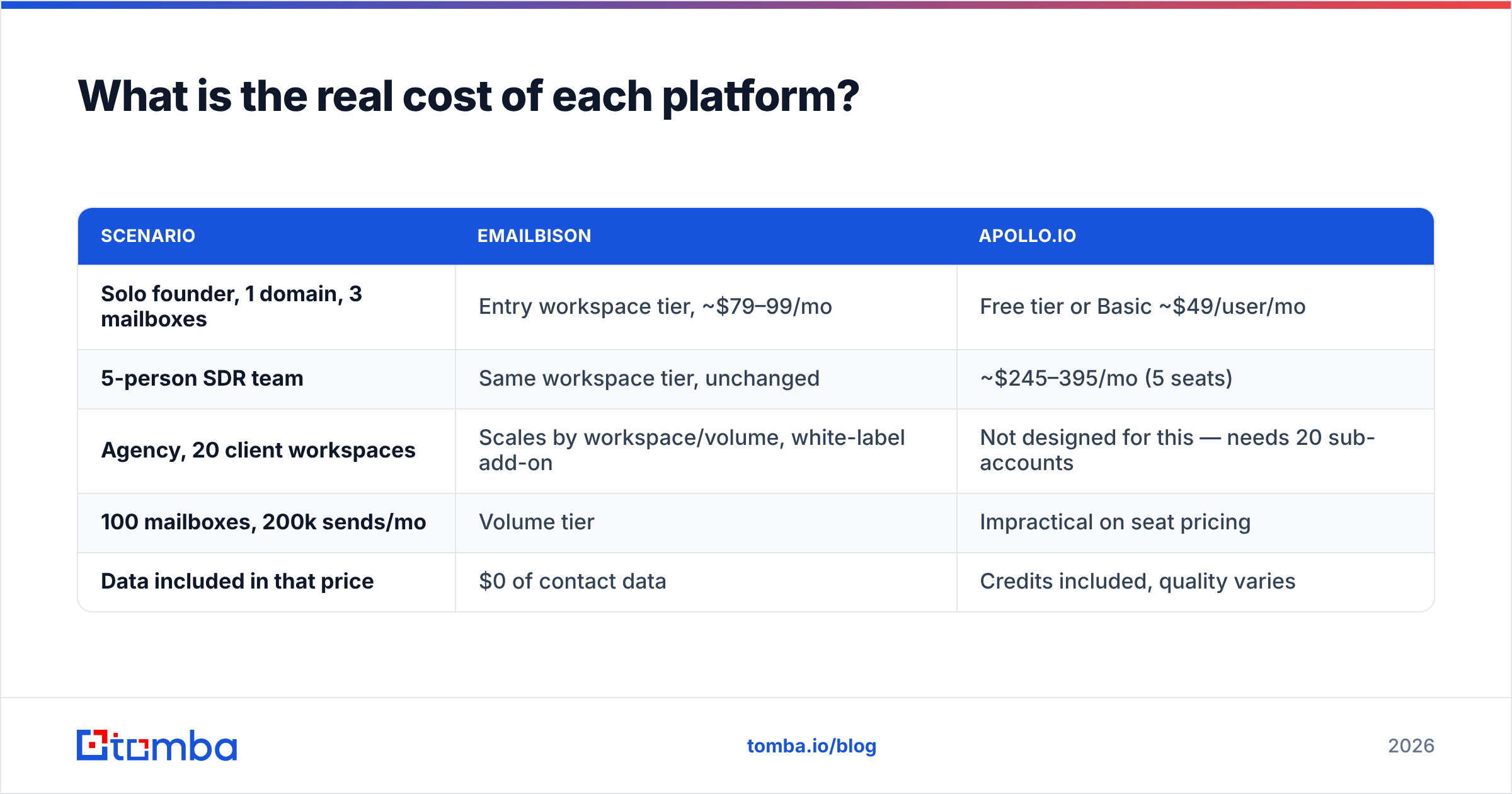
Prices change. Check both vendor pages before you buy. In early 2026 the shapes look like this:
| Scenario | EmailBison | Apollo.io |
|---|---|---|
| Solo founder, 1 domain, 3 mailboxes | Entry workspace tier, ~$79–99/mo | Free tier or Basic ~$49/user/mo |
| 5-person SDR team | Same workspace tier, unchanged | ~$245–395/mo (5 seats) |
| Agency, 20 client workspaces | Scales by workspace/volume, white-label add-on | Not designed for this — needs 20 sub-accounts |
| 100 mailboxes, 200k sends/mo | Volume tier | Impractical on seat pricing |
| Data included in that price | $0 of contact data | Credits included, quality varies |
The trap in EmailBison vs Apollo.io pricing is the sticker price. Apollo looks cheap at one seat because the data is bundled. EmailBison looks costly at one seat because you still buy contacts elsewhere.
At five seats the math flips. EmailBison's price barely moves. Apollo's price multiplies.
Then there is the cost nobody plans for. It shows up as a burned domain, not as a line item.

Which one has better deliverability?#
EmailBison, on structure alone. Deliverability is its entire job.
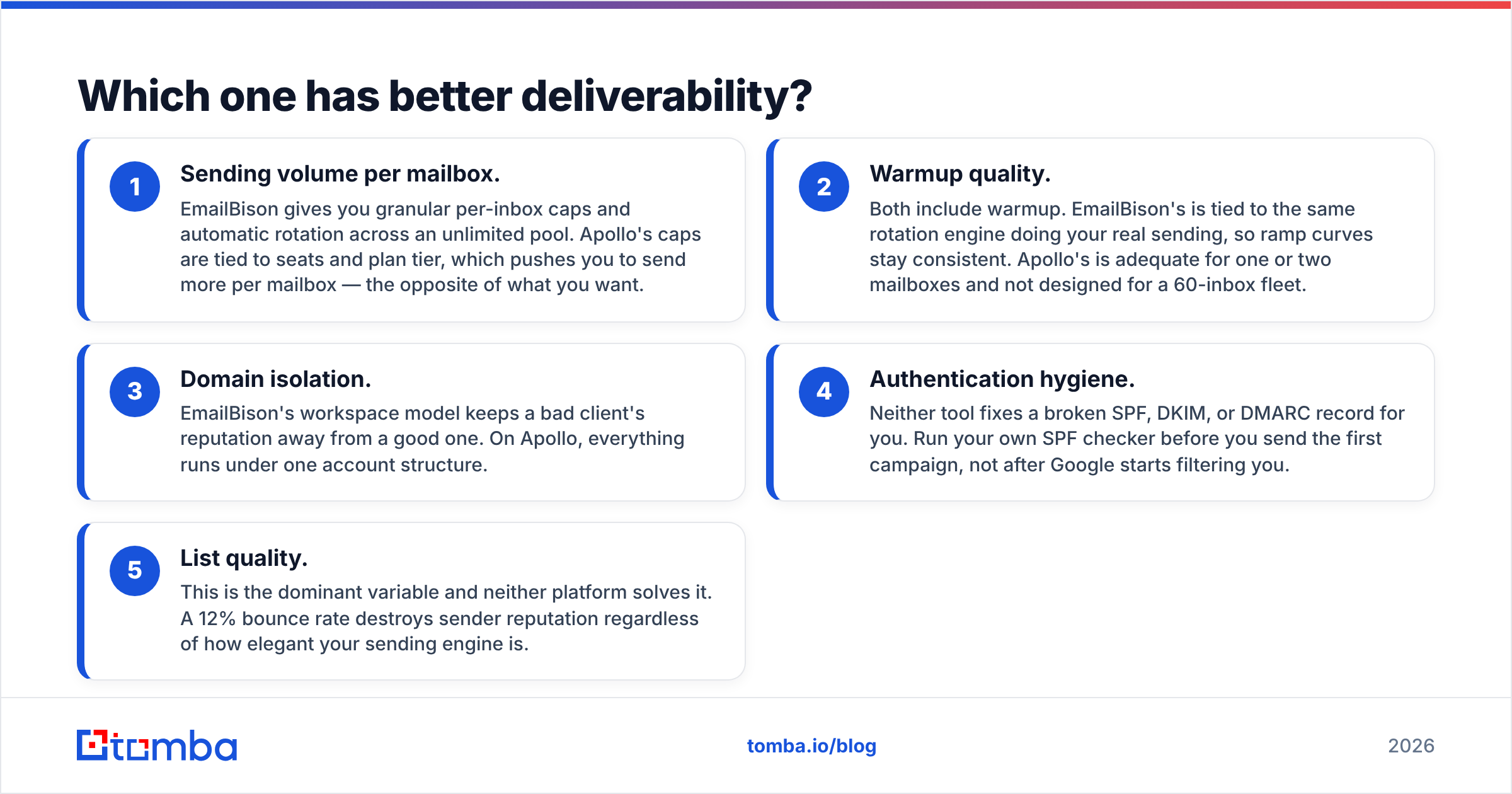
You do not buy deliverability. It is the result of five things you control. Here is how EmailBison vs Apollo.io maps onto each one:
- Volume per mailbox. EmailBison caps each inbox and rotates across an unlimited pool. Apollo ties caps to seats and plan tier. That pushes you to send more per mailbox, which is the opposite of what you want.
- Warmup quality. Both include warmup. EmailBison runs warmup through the same engine that does your real sending, so the ramp stays steady. Apollo's warmup is fine for one or two mailboxes. It was not built for a 60-inbox fleet.
- Domain isolation. EmailBison keeps each client in a separate workspace. One bad sender cannot drag down a good one. On Apollo, everything runs under one account.
- Authentication hygiene. Neither tool fixes a broken SPF, DKIM, or DMARC record. Run your own SPF checker before the first campaign, not after Google starts filtering you.
- List quality. This is the biggest variable, and neither platform solves it. A 12% bounce rate ruins sender reputation no matter how good your sending engine is.
Point five is where most EmailBison vs Apollo.io debates fall apart. Teams argue about sequencer design while they mail lists where a quarter of the addresses are dead.
Run every list through an email verifier before import. It costs a fraction of a cent per record. It also prevents the most expensive failure in outbound.
Catch-all domains make this harder. Many large companies accept every address at the SMTP layer. A basic verifier marks those "unknown". You then either drop real buyers or send blind. A catch-all verifier resolves a good share of them. That is the gap between a usable enterprise list and a coin flip.
Where does the contact data actually come from?#
Apollo's data comes from its own users. They sync their mailboxes and contact books, and the pooled result becomes the database. Coverage is huge. Decay is just as steady.
B2B contact data goes stale at 25–30% per year from job changes alone. Pooled data also lags, because a record only updates when some user syncs it.
EmailBison has no data at all. That sounds like a weakness, and it is often a strength. You pick the source, you control freshness, and you are not tied to one vendor's decay curve. This is the quiet trade-off in EmailBison vs Apollo.io.
If you source data yourself, these are the common patterns:
- Domain-first: you know the target accounts and need the people. Use domain search to pull the contact map for each company, then filter by role.
- Name-first: you have names and companies from an event or a CRM export, but no emails. An email finder turns those into deliverable addresses.
- LinkedIn-first: your buyers live in Sales Navigator. A LinkedIn finder turns profile URLs into work emails.
- Bulk backfill: you have 40,000 rows and a deadline. Bulk lead generation processes the file and returns scored results.
- Enrichment pass: your CRM has emails but no titles, headcount, or tech stack. Contact enrichment fills the gaps that make personalization work.
No single source beats Apollo on every record. The point is separation. If your data layer and your sending layer are different vendors, a bad month at one does not take your pipeline with it.
Who should choose EmailBison?#
Pick EmailBison if any of these describe you:
- You run a lead-gen agency. White-labelling and per-client workspaces are not available in Apollo at any price. This is the clearest verdict in the EmailBison vs Apollo.io comparison.
- You send high volume across many domains. Fifty or more mailboxes on seat pricing makes no financial sense. Volume pricing is the only sane model at that scale.
- You already trust your data source. If your list problem is solved, do not pay Apollo for a database you will not use.
- Your team is small but your sending is large. Two operators running 200k sends a month fit EmailBison's pricing well.
Skip EmailBison if you need a dialer, native Salesforce sync, or a database you can filter by intent signals on demand. It does not do those things, and it is not trying to.
Who should choose Apollo.io?#
Pick Apollo if:
- You want one login for the whole motion. Prospect, enrich, sequence, call, and log to the CRM in one place. For a five-rep team with no ops person, that is worth real money.
- Your reps prospect ad hoc. The Chrome extension turns a LinkedIn profile into a sequenced contact in two clicks. The workflow is genuinely good.
- You need phone alongside email. Apollo's dialer saves you from buying a separate calling tool.
- Volume is modest. Under about 10k sends a month, seat pricing with bundled credits is competitive.
Skip Apollo if your business runs on sending volume, if you need white-labelling, or if bad data has already burned you. If that last one sounds familiar, the Apollo alternative breakdown shows what an unbundled stack looks like.
Can you run both — and should you?#
Yes. Many strong outbound teams already do, which is why EmailBison vs Apollo.io is often the wrong question.
The pattern that holds up: Apollo (or another database) for discovery → an independent finder and verifier for accuracy → EmailBison for sending.
Here is the flow:
- Build the account list where your filters work best. Apollo's company and intent filters are strong for this.
- Export the accounts, not the contacts. Company data ages much slower than people data.
- Look up contacts again at send time, by domain or by name. You then work from fresh records instead of an old snapshot.
- Verify everything, catch-alls included, before import.
- Push the clean list into EmailBison. Split it across mailboxes with careful daily caps.
- Send replies to your CRM through the HubSpot integration or a similar one, so attribution survives.
That is more moving parts than one subscription. It also means a price hike, an outage, or a data slide at one vendor costs you a swap, not a rebuild. For background on how enrichment vendors source and score records, HubSpot's research on data decay is a fair neutral start.
What's the verdict on EmailBison vs Apollo.io?#
If you must pick one: agencies and high-volume senders take EmailBison. Small in-house teams that need data and a dialer take Apollo.io.
But the question itself is the real problem. EmailBison vs Apollo.io is not a choice between substitutes. They are two thirds of a stack, and the missing third is accuracy. Neither one handles that part well.
The teams with the best reply rates in 2026 did not pick a winner in a versus post. They stopped treating the list as a solved problem.
Before your next campaign, take 200 records from your current source and verify them. If more than 5% bounce, your platform choice was never the bottleneck.
Start with the data layer. Tomba's Email Finder turns names and domains into deliverable, scored work emails. Verification and catch-all handling are built in, so whatever you send with, you send to real people. The free tier includes 25 searches a month. Starter is $49/mo and Growth is $99/mo. Full Tomba pricing is public, per credit, and never per seat.
Related guides#
Ready to find emails that actually work?
Join 150,000+ professionals who stopped guessing and started sending. Free credits on signup — no credit card required.
Get the Tomba newsletter
Practical outbound tactics and product updates — once every two weeks.
About the author