Emailchaser vs Kipplo: Which Cold Email Tool Wins in 2026?
Emailchaser and Kipplo both promise simple, affordable cold email at a fraction of Outreach pricing. We break down deliverability, pricing, data, and which one actually fits your team.
Emailchaser vs Kipplo comes down to one question: do you want a clean sequencer, or a bundle? Both are low-cost cold email tools. Both send from real inboxes. Neither will fix a bad list. Here is how they differ, and which one fits your team.
TL;DR
- Emailchaser is a light Gmail/Outlook-native cold email sequencer. It suits small teams and agencies who want sending, follow-ups, and a shared inbox without the bulk of a sales-engagement platform.
- Kipplo chases the same buyer but leans all-in-one. One plan covers sending plus built-in lead data, warmup, and multi-inbox rotation.
- Neither tool is a real data provider. If your list is bad, both will burn your domain just as fast.
- Pick Emailchaser if you want a clean sequencer bolted onto the mailbox you already use. Pick Kipplo if you'd rather pay one vendor for sending plus a starter contact database.
- Either way, source and verify contacts on their own. A dedicated email finder plus email verification does more for reply rates than any sequencer feature.
Emailchaser vs Kipplo: what are these tools?#
Both exist because Outreach and Salesloft priced out the bottom 80% of the market. A three-person agency does not need call analysis, forecasting, and a $1,500/month floor. It needs to send 200 personal emails a week, follow up four times, and stop when someone replies.
Emailchaser (emailchaser.com) is the simpler of the two. It links to Gmail or Outlook through OAuth and sends from your real mailbox. On top of that it adds sequences, a shared team inbox, and reply detection. There is no separate sending setup. Your emails go out the same way a typed email would. That is a deliberate deliverability choice, and it is the tool's main argument.
Kipplo (kipplo.com) sells itself as the all-in-one option. A single plan covers sequencing, mailbox rotation, warmup, and a bundled B2B contact database. The pitch is fewer subscriptions. The catch is that each bundled part is thinner than the standalone tool it stands in for.
Neither is an enterprise platform, and neither pretends to be. So the real question is not "which is better" in the abstract. It is which failure mode you can live with.
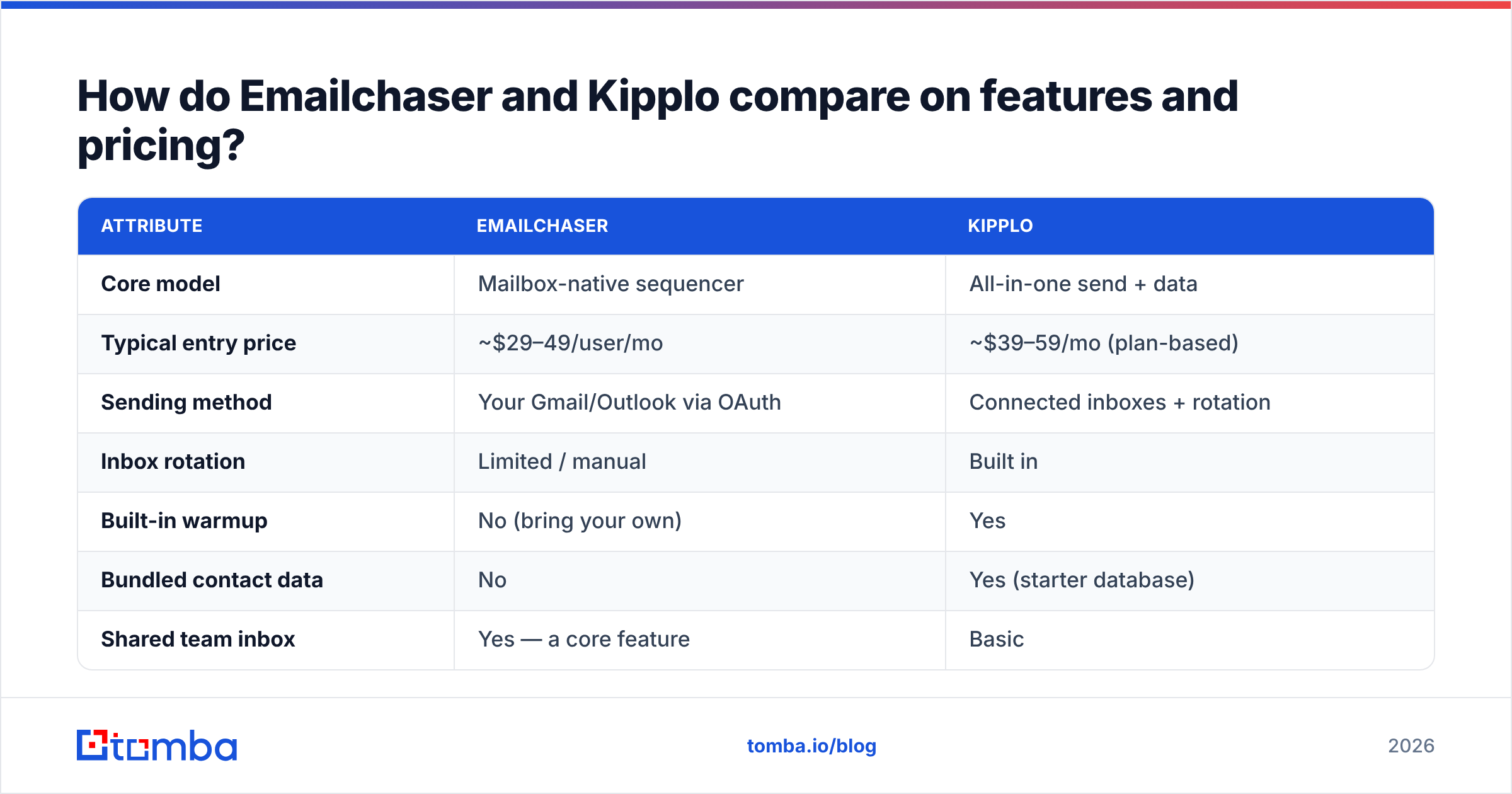
How do Emailchaser and Kipplo compare on features and pricing?#
Prices in this category move every quarter. Treat the numbers below as directional, and check each vendor's page before you buy. The shape of the pricing matters more than the exact figure — per seat, per inbox, or per credit — because it decides what happens when you scale.
| Attribute | Emailchaser | Kipplo |
|---|---|---|
| Core model | Mailbox-native sequencer | All-in-one send + data |
| Typical entry price | ~$29–49/user/mo | ~$39–59/mo (plan-based) |
| Sending method | Your Gmail/Outlook via OAuth | Connected inboxes + rotation |
| Inbox rotation | Limited / manual | Built in |
| Built-in warmup | No (bring your own) | Yes |
| Bundled contact data | No | Yes (starter database) |
| Shared team inbox | Yes — a core feature | Basic |
| Email verification | Third-party required | Basic, bundled |
| API access | Limited | Limited |
| Best for | Agencies, 2–10 seat teams | Solo founders, lean SDR teams |
| Weakest point | No native data or warmup | Shallow data coverage |
Read that table for the pattern, not the rows. Emailchaser charges per user and expects you to bring your own data and warmup. Kipplo charges per plan and bundles more. On paper your cost is lower — until the bundled database misses your ICP and you buy a data tool anyway.
That is the most common budget mistake here. You buy an all-in-one for the bundled data, then pay for real data three months later. The bundle saved you nothing.
Which one has better deliverability?#
Emailchaser has the structural edge, but only because it does less.
It sends through your real Gmail or Outlook mailbox using the provider's API. Your messages inherit the reputation of a mailbox a human already uses. There is no third-party relay IP, no odd sending pattern, and no SMTP box in the middle. For low-volume, high-intent outbound — 30 to 80 emails a day per mailbox — that is close to ideal.
Kipplo's inbox rotation takes the opposite path. It spreads volume across many spare mailboxes so no single one trips a limit. It works, and it is how most high-volume outbound runs in 2026. But rotation across brand-new domains is exactly the pattern Google's October 2023 bulk-sender rules were built to catch. Rotation buys you volume. It does not buy you reputation.
Here is what actually moves deliverability, in rough order of impact:
- List quality. Invalid addresses drive hard bounces. Cross a 2–3% bounce rate and inbox providers filter you, whatever sequencer you use. Run every list through an email verifier first.
- Authentication. Set up SPF, DKIM, and DMARC on every sending domain. Google and Yahoo made DMARC table stakes for bulk senders, and Google's sender guidelines list the current limits. Check yours with an SPF checker.
- Volume ramp. A new domain that sends 300 emails on day one looks like spam. Model the ramp with a warmup calculator.
- Complaint rate. Keep spam complaints under 0.3%. That is a targeting problem, not a copy problem.
- Reply signal. Real engagement is the strongest counter to filtering. Relevance beats volume.
Notice how little of that your sequencer controls. Both tools can send a clean email. Neither can save a list of guessed addresses.
What about lead data — should you trust the bundled database?#
No. This is where most buyers of either tool get burned.
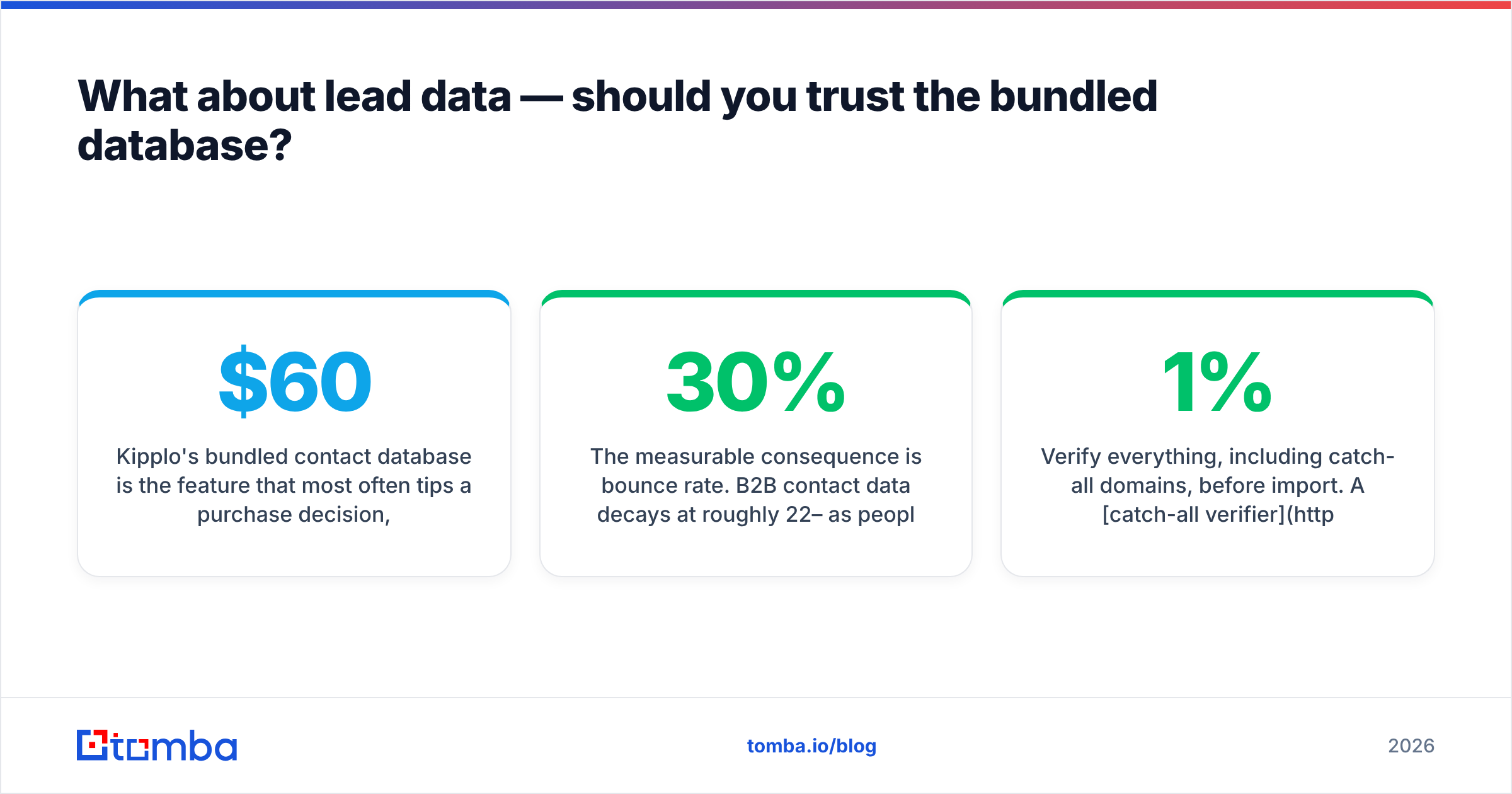
Kipplo's bundled database often tips the purchase, so it deserves a close look. Bundled databases in sub-$60/month tools are usually licensed or pulled from third parties. They refresh rarely and thin out fast outside US tech. That is not a knock on Kipplo. It is the economics of the segment. A truly fresh B2B dataset costs more to maintain than the whole subscription price.
The cost shows up in your bounce rate. B2B contact data decays by roughly 22–30% a year as people change jobs, a figure HubSpot has tracked for years. A database refreshed once a year is, on average, a quarter wrong the day you use it.
Emailchaser is honest here by omission. It has no database, so you know you need one.
The stack that actually works looks like this:
- Find contacts at the target account with a real domain search or an email finder that verifies at lookup time.
- Verify everything before import, catch-all domains included. A catch-all verifier is what separates a 1% bounce rate from a 6% one. Catch-all domains accept every address at SMTP and tell you nothing.
- Enrich with firmographics so your personalization has something to work with. Data enrichment turns an email address into a reason to write.
- Send with whichever sequencer you picked. This step is the commodity.
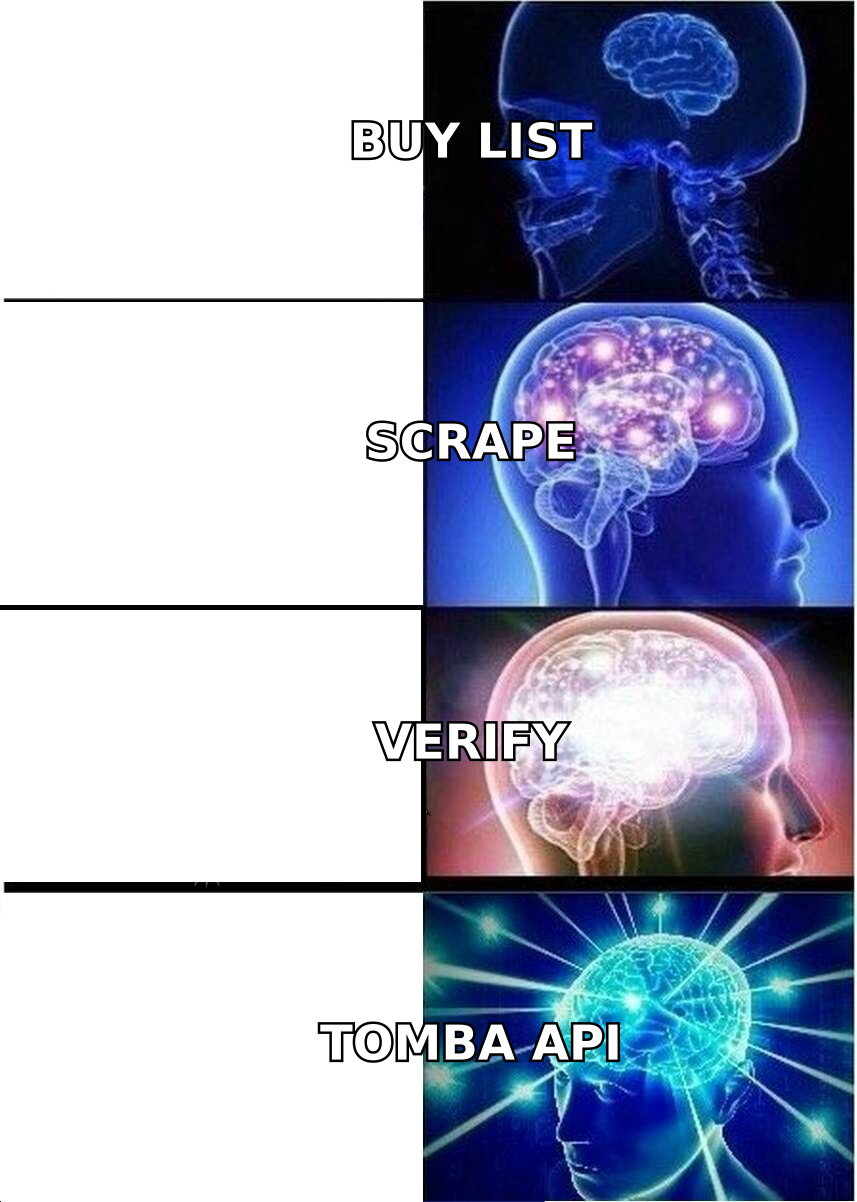
Teams that get this order right find the sequencer choice barely matters. Teams that get it wrong blame the sequencer.
Is Emailchaser better than Kipplo for agencies?#
Yes, in most cases — because of the shared inbox and client separation.
Agencies run outbound for many clients across many domains. The pain is not sending. It is knowing which teammate replied to which prospect for which client, so three people do not email the same lead.
Emailchaser's shared team inbox is built for that. One view of every conversation, plus assignment and reply ownership. It is the closest thing the tool has to a moat.
Kipplo's multi-inbox setup aims at volume instead. It rotates sends across mailboxes rather than helping people work together. For a solo operator, that is the more useful direction. For a five-person agency, it is not.
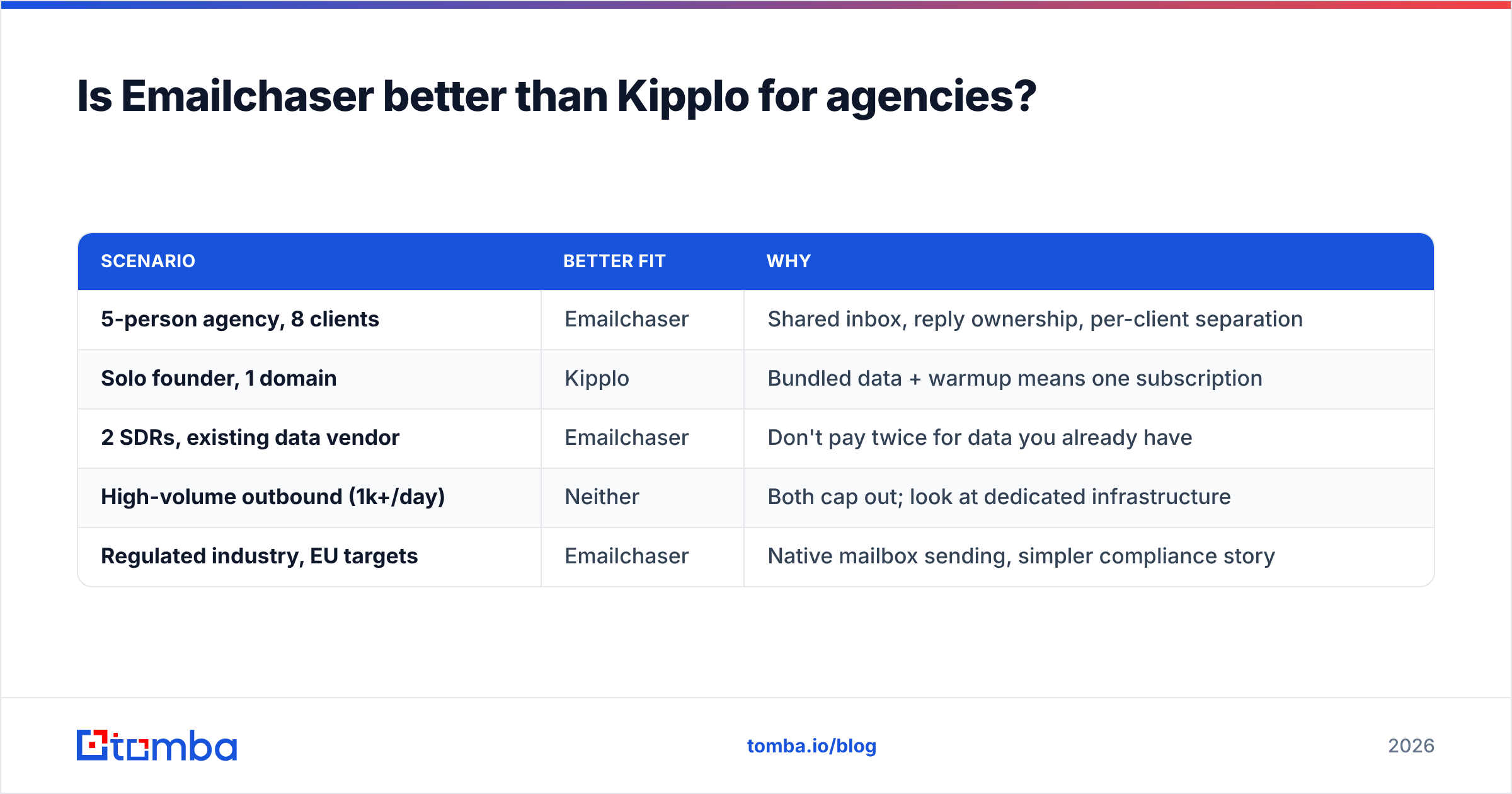
| Scenario | Better fit | Why |
|---|---|---|
| 5-person agency, 8 clients | Emailchaser | Shared inbox, reply ownership, per-client separation |
| Solo founder, 1 domain | Kipplo | Bundled data + warmup means one subscription |
| 2 SDRs, existing data vendor | Emailchaser | Don't pay twice for data you already have |
| High-volume outbound (1k+/day) | Neither | Both cap out; look at dedicated infrastructure |
| Regulated industry, EU targets | Emailchaser | Native mailbox sending, simpler compliance story |
If you are leaving a heavier platform, weigh Emailchaser vs Kipplo against the tier above as well. Our breakdowns of Instantly alternatives and Outreach alternatives cover that ground.
What do real users say?#
Review-site sentiment on Emailchaser vs Kipplo lands on the same themes. On G2 and Capterra, sub-$60 sequencers score high on ease of setup and low on reporting depth. That is the trade you are buying.
Praise for Emailchaser: setup in under 20 minutes, no learning curve, and deliverability that "just works" because it is your normal mailbox. Complaints: thin reporting, no native data, and manual work once you pass a handful of mailboxes.
Praise for Kipplo: one subscription covers more ground, warmup is included, and it is a good start from zero. Complaints: patchy database coverage outside North America, and higher bounce rates on bundled lists than users expect.
Treat both patterns as signal. They match what the pricing implies.
How should you actually decide?#
Run a two-week test on both with the same list. Judge outcomes, not features. That is the only way to settle Emailchaser vs Kipplo for your own market.
- Build one clean list of 200 contacts. Same ICP, same source, verified. Split it 100/100.
- Write one sequence. Same copy, same timing, same CTA. Any copy change invalidates the test.
- Send from matched mailboxes. Same domain age, same warmup state. People skip this step, and it ruins the comparison.
- Measure bounce, reply, and positive-reply rate. Open rate is unreliable after MPP. Ignore it.
- Log the daily friction. How long was setup? How many clicks to see who replied? That is what you pay every day.
If bounce rates split sharply between the two halves, your data source is the variable, not the tool. Fix that before you sign an annual contract with either.
Check the CRM path early too. Both tools sync to the major CRMs, but depth varies. A HubSpot integration that writes verified contacts straight into your pipeline cuts a manual step from every campaign.
What's the verdict?#
Emailchaser for teams, Kipplo for solos — and buy your data separately either way.
Emailchaser wins on deliverability design and teamwork. Choose it if more than two people touch outbound, if you already pay for contact data, or if compliance favors sending from your real mailbox.
Kipplo wins on consolidation. If you work alone, start from nothing, and the other option is four subscriptions, the bundle gets you sending sooner. Just plan to replace the bundled database once you are past validation.
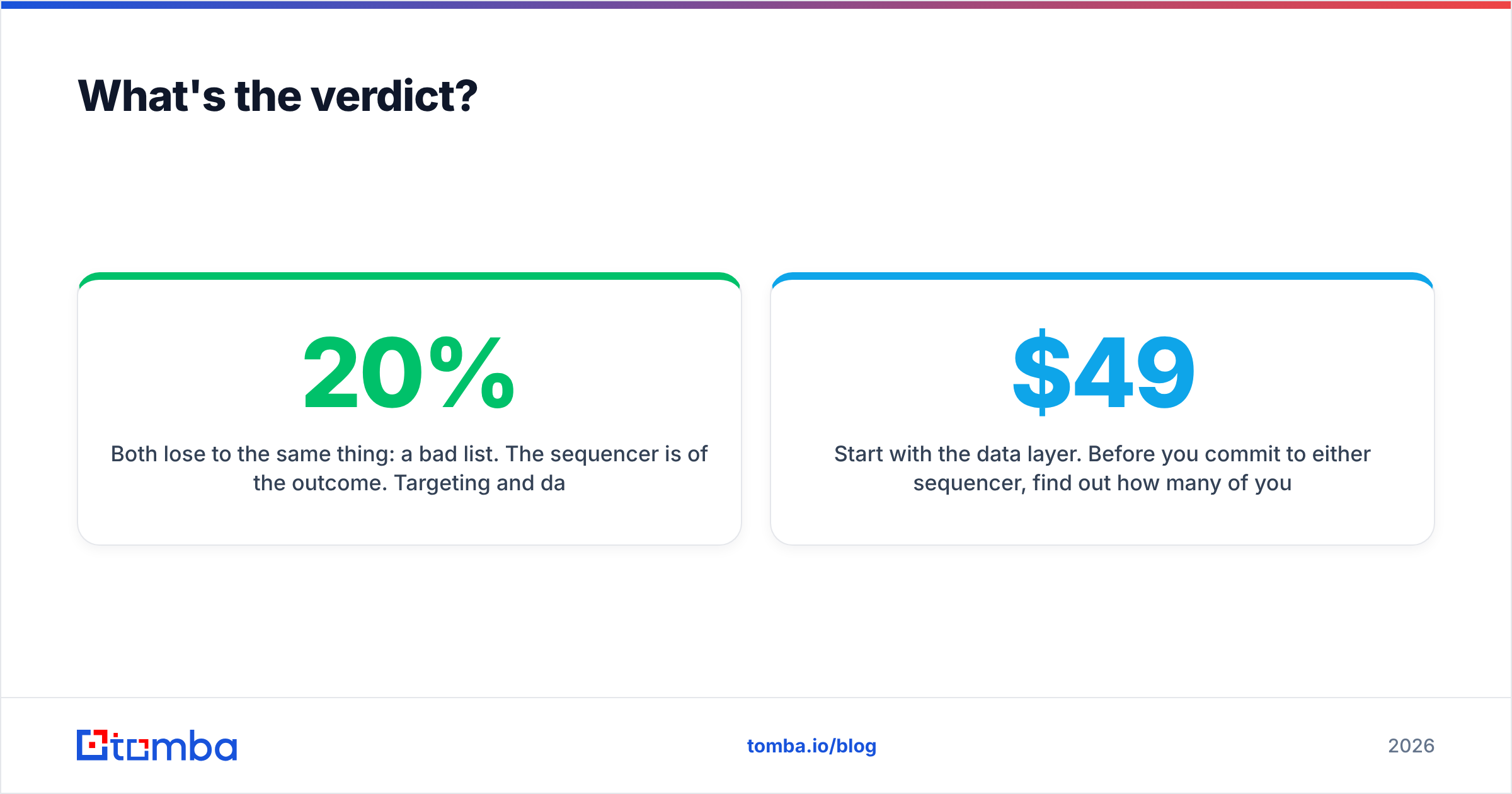
Both lose to the same thing: a bad list. In truth, Emailchaser vs Kipplo decides maybe 20% of the outcome. Targeting and data quality are the other 80%. If you take one action after reading this, audit your bounce rate. Do not switch tools.
Start with the data layer. Before you commit to either sequencer, find out how many of your contacts are still deliverable. Tomba's Email Finder returns verified professional emails by domain, name, or company, and it scores the confidence of every result. Your sequence lands in inboxes instead of bouncing. The free tier includes 25 searches a month, and paid plans start at $49/mo on Tomba pricing. Run your next 100-contact list through it. Then compare the bounce rate against your current tool. That one test will tell you more than another week of feature charts.
Related guides#
Ready to find emails that actually work?
Join 150,000+ professionals who stopped guessing and started sending. Free credits on signup — no credit card required.
Get the Tomba newsletter
Practical outbound tactics and product updates — once every two weeks.
About the author