EmailValidation.io vs LeadZen.ai: Which Tool Wins in 2026?
One tool cleans lists at fractions of a cent. The other finds contacts you don't have yet. Here's what EmailValidation.io vs LeadZen.ai actually costs you, and which one your pipeline needs first.
EmailValidation.io vs LeadZen.ai is not really a head-to-head fight. One tool cleans the list you already own. The other builds a list you don't have yet. Your job is to work out which half of the problem is hurting you today.
TL;DR
- EmailValidation.io and LeadZen.ai don't compete. One verifies email addresses you already have; the other finds contact data you don't. Comparing them head-to-head only makes sense if you're deciding which problem to solve first.
- Pick EmailValidation.io if you already own a list — a CRM export, a scraped set, a purchased file — and your bounce rate is the thing killing deliverability.
- Pick LeadZen.ai if you have zero contacts and need to build a prospect list from company or role criteria, especially with India-heavy target markets where its data density is strongest.
- Neither covers the full loop. A discovery tool that doesn't verify hands you bounces; a verifier with no finder leaves you list-shopping. Consolidated platforms like Tomba, Apollo, or BookYourData bundle both.
- Cost reality: verification runs roughly $0.0004–$0.004 per email. Discovery runs $0.02–$0.30 per contact. Budget accordingly — they are not the same line item.
What are EmailValidation.io and LeadZen.ai?#
They solve opposite halves of the same problem. Miss that split, and you buy the wrong tool.
EmailValidation.io is a single-purpose email verification API. You send it an address. It sends back a verdict: valid syntax, working mail server, reachable mailbox, throwaway domain, free provider, role-based address, and a quality score. There is a REST endpoint, a batch endpoint, and a free tier for testing. It does not find emails. It never has. It grades the ones you bring.
LeadZen.ai sits on the other side. It is a B2B lead database you can search. You get a Chrome extension for LinkedIn profiles, filters for industry, location, company size and job title, and results that include emails and phone numbers. Its strongest coverage is the Indian market — it started there, and the database still reflects that. It does run a basic check on what it returns. But verification is a side feature, not the product.
So the honest framing: this is not "Tool A vs Tool B." It is "which stage of the pipeline is broken right now?"

EmailValidation.io vs LeadZen.ai: which one do you need first?#
Answer three questions and the decision usually makes itself.
- Do you have contacts already? If yes — CRM records, a trade-show list, a scraped export — start with verification. Sending to an unverified 18-month-old list is the fastest way to burn a sending domain.
- What's your current bounce rate? Above 3%, verification is urgent. Google and Microsoft both tightened their bulk-sender rules. Google's sender guidelines cap spam complaints at 0.3%, and bounces make the damage worse.
- Is your total addressable list smaller than your quota? If you can only name 200 target accounts and you need 2,000 contacts, no verifier fixes that. You need discovery.
The common failure pattern looks like this. Teams buy a discovery tool, export 10,000 contacts, blast them unverified, and land in spam by week two. Then they buy a verifier to clean up the mess. Run it the other way round — or buy one platform that does both — and you skip a domain reputation rebuild that takes six to eight weeks.
How do EmailValidation.io and LeadZen.ai compare on features?#
| Capability | EmailValidation.io | LeadZen.ai | Tomba |
|---|---|---|---|
| Primary function | Email verification API | Lead discovery + enrichment | Email finding + verification |
| Finds new emails | No | Yes | Yes |
| Verifies existing emails | Yes (core product) | Basic check on output | Yes (dedicated verifier) |
| Catch-all detection | Flagged, not resolved | Limited | Dedicated catch-all verifier |
| Phone numbers | No | Yes | Yes |
| Domain-wide search | No | Partial (company filters) | Yes |
| Chrome extension | No | Yes | Yes |
| Native API | Yes | Yes (higher tiers) | Yes |
| Bulk processing | Yes (batch endpoint) | Yes (export) | Yes |
| Strongest data region | N/A (region-agnostic) | India, expanding APAC | Global, EU/US strong |
| Free tier | Yes, limited credits | Trial credits | 25 searches/mo |
| Entry price | ~$15/mo tier | Quote-based, ~$30+/mo | $49/mo Starter |
Two things stand out. First, EmailValidation.io's column is mostly empty — by design. It is a utility, not a platform, and it is priced like one. Second, verification is LeadZen.ai's weak spot. It returns addresses with a basic quality signal, but it skips the deeper mailbox and catch-all checks a dedicated verifier runs.
How accurate is each tool?#
Accuracy means two different things here, and vendors lean on that confusion.
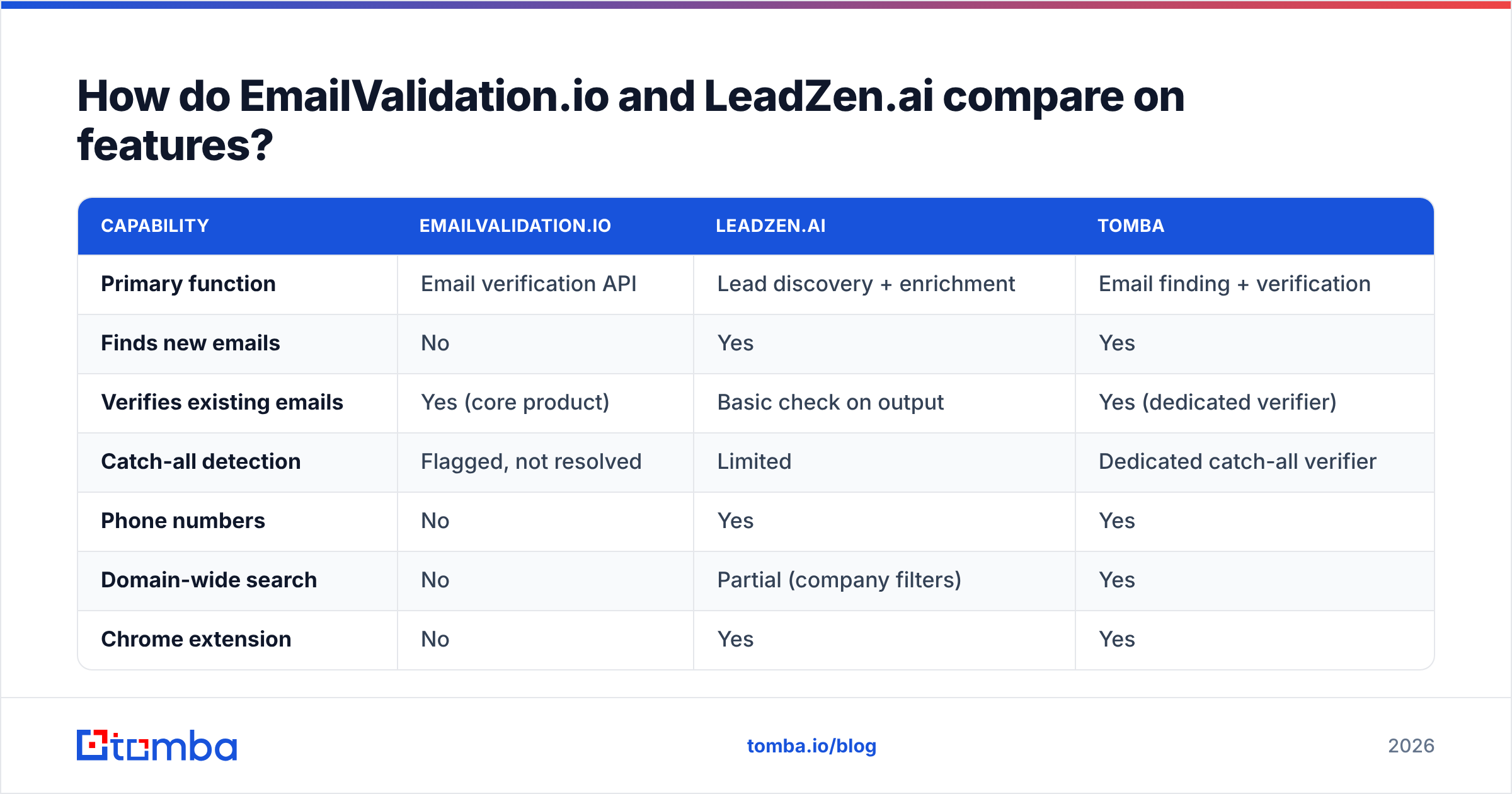
For a verifier, accuracy is simple: of the addresses you marked valid, how many actually landed? Good verification APIs score 95–98% on standard mailboxes. That number collapses on catch-all domains. A catch-all server accepts mail at any address, so no live check can prove the mailbox exists.
EmailValidation.io flags catch-alls instead of guessing. That is the right call, but it means part of your B2B list comes back as unknown. Roughly 15–25% of business domains run catch-all setups, so this is not a rare edge case. If that bucket matters to you, a dedicated catch-all verifier adds pattern inference and past engagement data on top of the basic check.
For a discovery tool, accuracy is different: of the emails you returned, how many are real and current? Every vendor here quotes 95%+. Independent testing rarely repeats it. Real hit rates on B2B databases sit closer to 65–85%, depending on region, seniority and company size. Engineering leaders at 5,000-person US firms are easy to find. Ops managers at 30-person firms in smaller markets are not. LeadZen.ai's Indian data density is a genuine edge there, and its coverage thins out in Western Europe.
Run a practical test before you commit. Take 100 contacts you can confirm yourself — your own customers, your team, partner companies — and push them through the tool. Then measure. Published accuracy figures are marketing claims, not benchmarks. Knowing where the data comes from tells you more than any single test.
What does each one cost in 2026?#
Price per unit is where the two categories split hardest. It is also where teams misbudget.
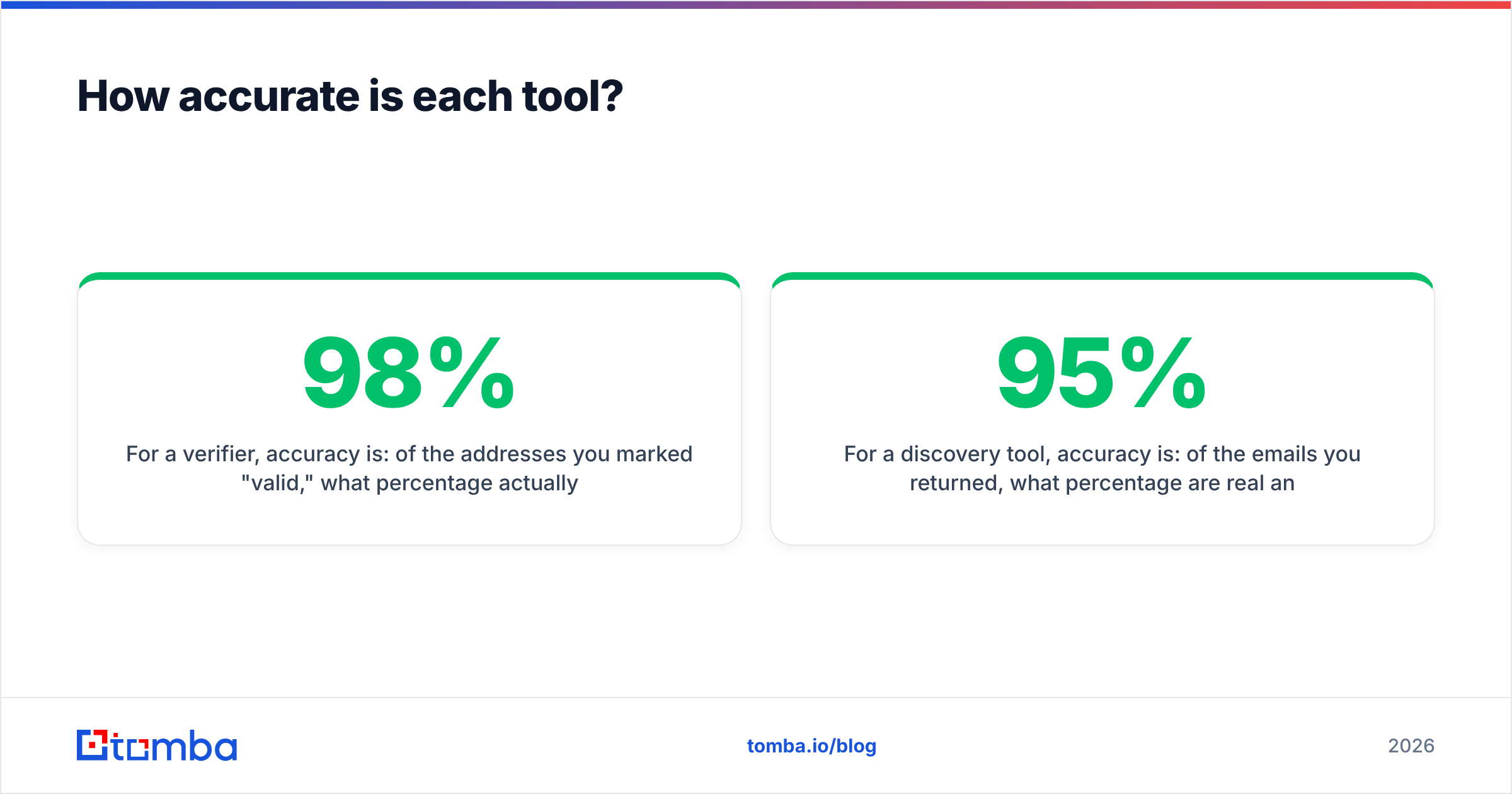
| Pricing dimension | EmailValidation.io | LeadZen.ai | Tomba |
|---|---|---|---|
| Model | Credit packs / monthly | Seat + credit, quote-based | Monthly tiers |
| Entry paid tier | ~$15/mo (~5k verifications) | ~$30–50/mo equivalent | $49/mo Starter |
| Mid tier | ~$50/mo (~25k) | Custom | $99/mo Growth |
| High tier | ~$150/mo+ (~100k) | Custom / enterprise | $249/mo Pro |
| Free option | Yes, limited | Trial credits | 25 searches/mo |
| Effective unit cost | $0.0015–$0.003 / email | $0.02–$0.10 / contact | Blended finder + verifier |
| Annual discount | Yes | Negotiable | Yes |
| API on entry plan | Yes | No (higher tiers) | Yes |
Read the unit-cost row twice. Verification is roughly 10 to 50 times cheaper per record than discovery. No one is ripping you off. Finding a person's email is a research problem; checking whether a mailbox exists is one network call. But it does mean that "we spend $200 a month on data tools" describes two very different volumes.
Most teams hit the same trap. They buy discovery credits, then find the API is locked to a higher tier, or that exports are capped per seat. Check three things before you sign: API access on your tier, export caps, and whether credits roll over. LeadZen.ai quotes prices case by case, so pin those details down in writing.

What are the real limitations of each?#
EmailValidation.io's limits:
- No discovery, ever. If your list is empty, this tool does nothing for you.
- Catch-all ambiguity. The flag is honest, but it leaves a chunk of B2B domains unresolved.
- No enrichment. You get a verdict, not a job title, company size, or LinkedIn URL.
- Stack sprawl. One more vendor, one more API key, one more invoice.
LeadZen.ai's limits:
- Regional skew. India coverage is excellent. US and EU coverage is thinner than global-first databases.
- Verification depth. The built-in check is no substitute for a dedicated email verifier before a large send.
- Opaque pricing. Quote-based means your cost depends on your negotiation, not a published rate card.
- Compliance homework. Any database sourced across borders needs a GDPR review before you email EU records. See G2's category reviews for what buyers report about data sources.
Neither list is disqualifying. These are the things to ask about on a sales call, not to discover in month three.
Are there better all-in-one alternatives?#
Yes, if you'd rather run one vendor than two. The case for consolidating is simple: fewer integrations, one credit pool, and one place where finding and verifying happen in order.
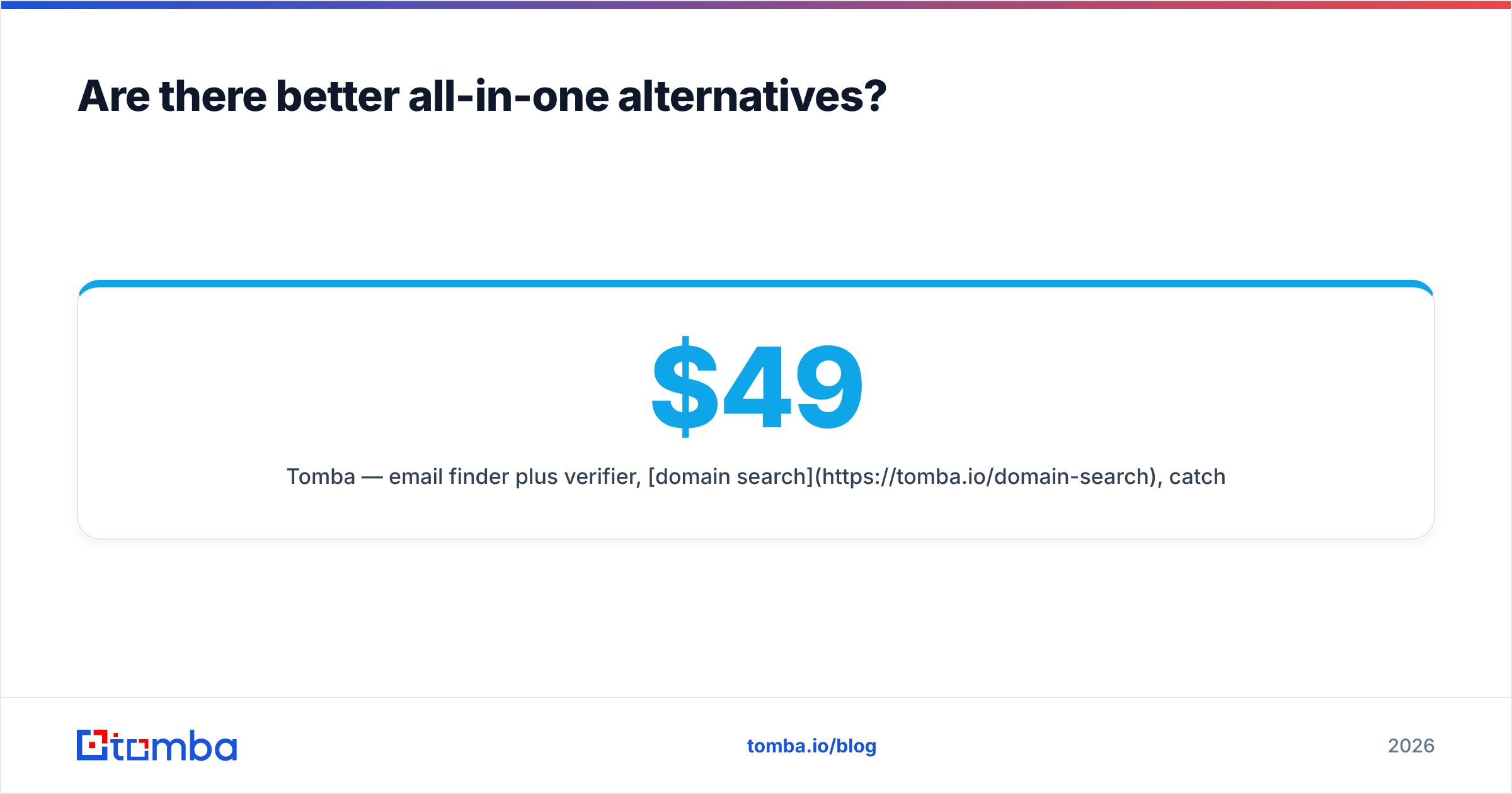
- Tomba — email finder plus verifier, domain search, catch-all handling, phone finder, and enrichment on one credit system. Free tier at 25 searches a month, Starter at $49/mo, Growth $99/mo, Pro $249/mo. Coverage is strong in the EU and globally, and the API is on every paid plan rather than locked to enterprise.
- BookYourData — pay-as-you-go B2B contact lists with a published accuracy guarantee and no subscription lock-in. A good fit when you want a defined list purchase instead of an ongoing seat cost. Its credits don't expire the way subscription pools do.
- Apollo — database plus sequencing plus dialer. The widest feature set here, and the heaviest. Worth it if you want the CRM-style workflow; overkill if you just need contacts. Tomba's Apollo alternative page breaks down the credit-model differences.
- Clearbit (now Breeze Intelligence) — firmographic enrichment inside the HubSpot ecosystem. Excellent if you already run HubSpot, largely irrelevant if you don't.
The right pick depends on where you start. If India is your main market and you need volume discovery, LeadZen.ai's regional data is worth paying for. If you already have lists and want them clean at the lowest cost per record, EmailValidation.io is hard to beat on price. If you're building outbound from scratch in the US or Europe and want one bill, a consolidated platform wins on total cost, even when its per-unit price looks higher.
How should you set up the workflow either way?#
Whatever you buy, the sequence matters more than the vendor.
- Source — pull contacts from a database, LinkedIn, or a domain-wide search. Record the source and the date on every row. You will need both for compliance and for decay tracking.
- Deduplicate — do this before you spend a credit. Duplicate records are the most common cause of inflated verification bills. A remove duplicates pass costs nothing.
- Verify — run everything through a verifier. Drop hard bounces. Move catch-alls into a separate, lower-priority segment instead of deleting them.
- Warm — if the sending domain is new or has been idle, ramp up volume slowly. Reputation is earned slowly and lost in a day.
- Re-verify on a schedule — B2B contact data decays around 22–30% a year as people change jobs. A list verified in January is measurably worse by July. Quarterly re-verification on active segments is the standard cadence.
Step 3 is where the EmailValidation.io vs LeadZen.ai decision actually bites. Choose discovery only, and you still need step 3 from somewhere. Choose verification only, and you still need step 1. Budget for both, whether that means two vendors or one.
Which should you choose?#
Choose EmailValidation.io when you have lists, want them clean at the lowest cost per record, are happy with an API-first tool, and have a separate source for new contacts.
Choose LeadZen.ai when discovery is the bottleneck, your target market skews to India or APAC, and you're ready to add a verification step before you send.
Choose a consolidated platform when you want both halves under one contract, one credit pool, and one support channel. That covers most teams building outbound seriously, and nearly all teams under 50 people.
There is no wrong answer here, only a mismatched one. The tool that fails you is the one you bought for a problem you didn't have.
Ready to close both halves of the loop? The Tomba Email Finder finds professional addresses by name, domain, or company. Every result runs through verification before it reaches your export, so you're not paying two vendors to do one job. Start on the free tier with 25 searches a month, or move to Starter at $49/mo when your pipeline demands it. The Tomba pricing page has the full breakdown across Growth and Pro.
Related guides#
Ready to find emails that actually work?
Join 150,000+ professionals who stopped guessing and started sending. Free credits on signup — no credit card required.
Get the Tomba newsletter
Practical outbound tactics and product updates — once every two weeks.
About the author