FindThatLead vs Validity: Which B2B Email Tool Wins in 2026?
FindThatLead finds prospects. Validity protects your sender reputation. They solve opposite halves of the same problem — here is which one your team actually needs, and what it costs.
TL;DR
- FindThatLead and Validity are not really competitors. FindThatLead is a prospecting tool (find emails, build lists, send campaigns). Validity is a deliverability and CRM-data company (Everest, BriteVerify, DemandTools).
- If your problem is "I don't have enough contacts," FindThatLead is the closer match. If your problem is "my emails land in spam," Validity is.
- Validity's pricing is quote-heavy and enterprise-shaped; BriteVerify is pay-as-you-go at roughly $0.01 per verification, and Everest sits well above most SMB budgets.
- Most teams under 50 seats need one tool that does discovery and verification. That is where a combined stack — like Tomba's email finder plus its email verifier at $49/mo — beats buying two half-solutions.
- Buy in this order: verified data first, sending infrastructure second, deliverability monitoring third. Reversing that order is how teams end up paying $1,000/mo to monitor a list that was never clean.
What Are FindThatLead and Validity, Actually?#
The comparison people type into Google is "findthatlead vs validity," but the two products barely overlap. Understanding what each one is built for saves you from buying the wrong category entirely.
FindThatLead is a Spanish-built B2B prospecting platform. Its core loop: search by domain, by name, or by LinkedIn URL, get an email address back, push it into a list, and optionally run a cold-email campaign from the same dashboard. It bundles a Chrome extension, a lead search by keyword/location, a basic verifier, and a sender module. It is a generalist tool aimed at solo founders, agencies, and small sales teams who want prospecting and sending in one tab.
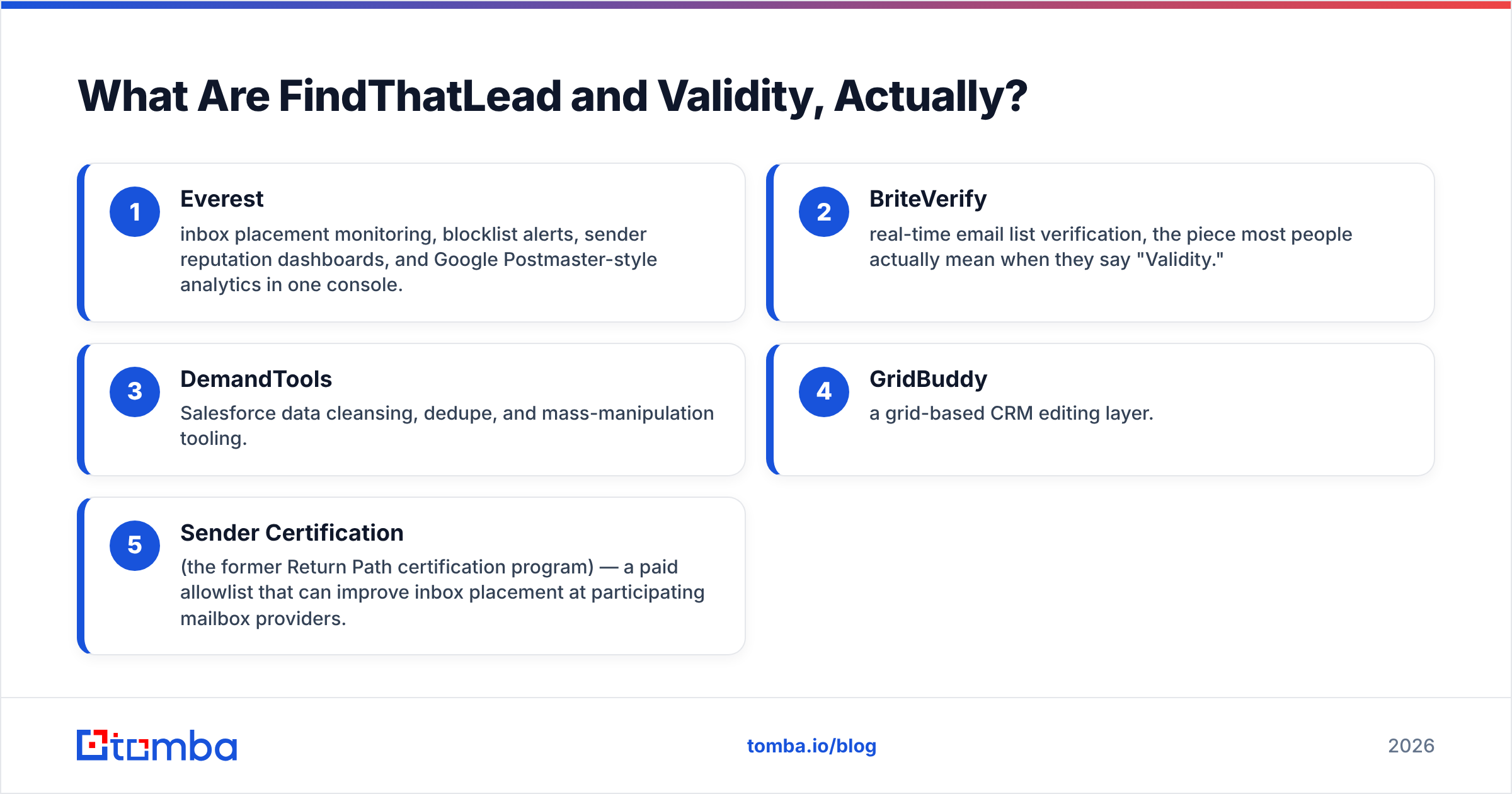
Validity is a data-quality holding company. Under one brand it sells:
- Everest — inbox placement monitoring, blocklist alerts, sender reputation dashboards, and Google Postmaster-style analytics in one console.
- BriteVerify — real-time email list verification, the piece most people actually mean when they say "Validity."
- DemandTools — Salesforce data cleansing, dedupe, and mass-manipulation tooling.
- GridBuddy — a grid-based CRM editing layer.
- Sender Certification (the former Return Path certification program) — a paid allowlist that can improve inbox placement at participating mailbox providers.
So the honest framing: FindThatLead helps you get addresses. Validity helps you make sure the addresses you already have are real and that your mail reaches them. One is offense, the other is defense.
How Do FindThatLead and Validity Compare Head to Head?#
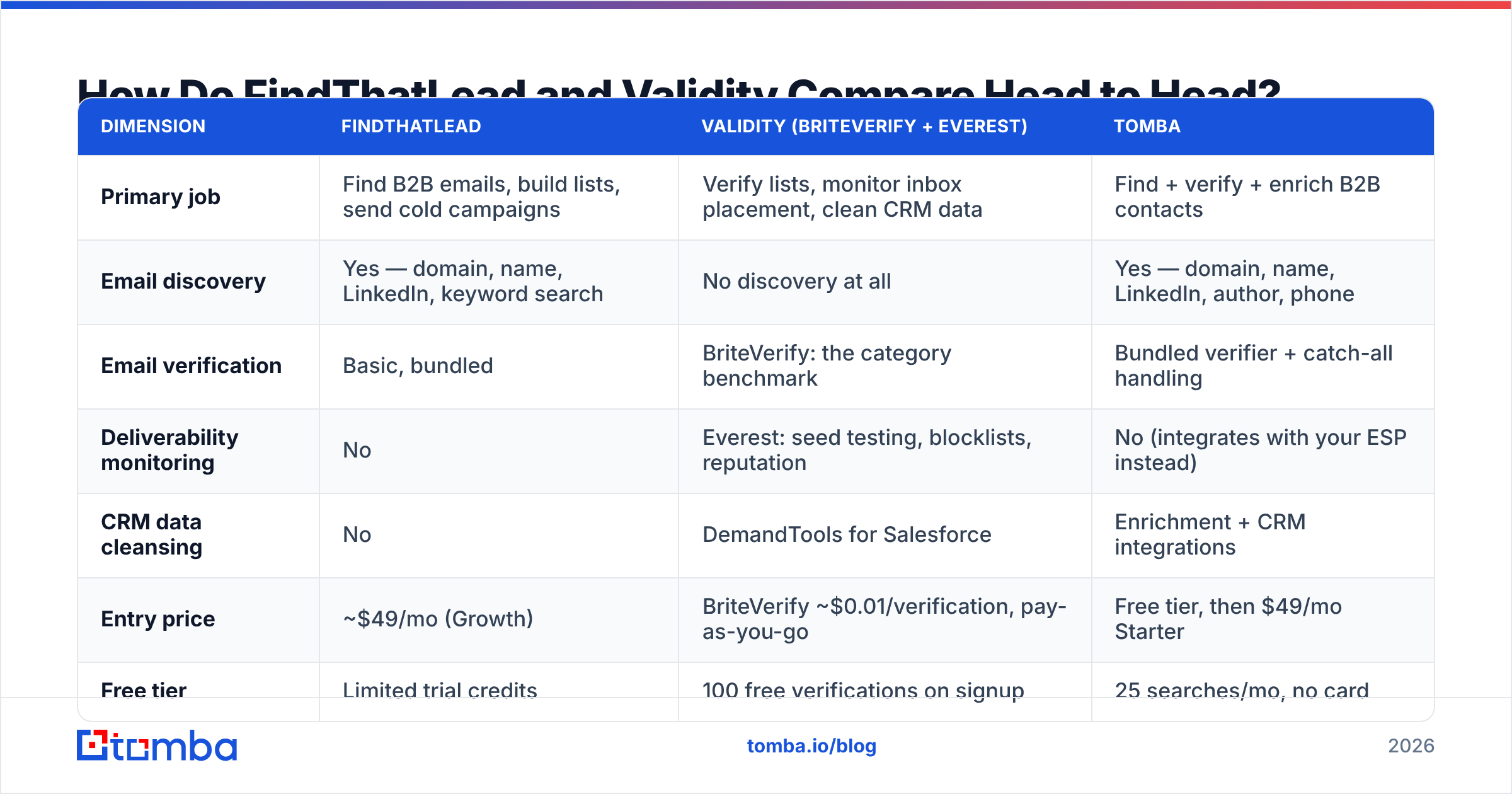
Here is the practical side-by-side. Pricing reflects publicly listed tiers as of early 2026; Validity's enterprise products are quote-based and vary heavily by volume, so treat those cells as directional.
| Dimension | FindThatLead | Validity (BriteVerify + Everest) | Tomba |
|---|---|---|---|
| Primary job | Find B2B emails, build lists, send cold campaigns | Verify lists, monitor inbox placement, clean CRM data | Find + verify + enrich B2B contacts |
| Email discovery | Yes — domain, name, LinkedIn, keyword search | No discovery at all | Yes — domain, name, LinkedIn, author, phone |
| Email verification | Basic, bundled | BriteVerify: the category benchmark | Bundled verifier + catch-all handling |
| Deliverability monitoring | No | Everest: seed testing, blocklists, reputation | No (integrates with your ESP instead) |
| CRM data cleansing | No | DemandTools for Salesforce | Enrichment + CRM integrations |
| Entry price | ~$49/mo (Growth) | BriteVerify ~$0.01/verification, pay-as-you-go | Free tier, then $49/mo Starter |
| Free tier | Limited trial credits | 100 free verifications on signup | 25 searches/mo, no card |
| API | Yes | Yes (BriteVerify real-time API) | Yes — full REST + CLI + MCP |
| Best fit | Solo founders, agencies, SMB outbound | Enterprise email programs, Salesforce-heavy orgs | Teams that need accurate contacts at SMB pricing |
The table makes the real decision obvious. If you only have budget for one, ask which failure is currently costing you more: an empty pipeline, or a poisoned sender reputation.
Which One Should You Buy First?#
Buy discovery and verification before you buy monitoring. Everest tells you your reputation is degrading. It does not tell you which 4,000 addresses in your list caused it. If your bounce rate is 11%, the fix is not a monitoring dashboard — it is a clean list.
The right sequence for a team going from zero to a working outbound motion:
- Source verified contacts. Whatever tool you pick, it must return a confidence score and flag catch-all domains separately. Unscored data is guesswork with a price tag.
- Authenticate your domain. SPF, DKIM, DMARC. Run an SPF checker before your first send, not after your first block.
- Warm the mailbox. Ramp volume over 3–4 weeks. Use a warmup calculator so the schedule is arithmetic, not vibes.
- Send small, measure hard. Watch bounce rate, spam complaints, and reply rate per segment.
- Add monitoring only when volume justifies it. Below roughly 50k sends/month, Google Postmaster Tools plus your ESP's own analytics cover most of what Everest surfaces — for free.
- Layer in CRM hygiene. If you live in Salesforce and have five years of duplicate accounts, DemandTools genuinely earns its keep. If you live in a spreadsheet, it does not.
Teams that skip straight to step 5 buy a very expensive thermometer while their house is on fire.
How Accurate Is FindThatLead Compared to a Dedicated Finder?#
Accuracy is where FindThatLead's generalist positioning shows. Because it bundles discovery, verification, and sending, each module is decent rather than best-in-class. In practice, users report solid hit rates on well-known company domains and noticeably weaker coverage on small businesses, non-English domains, and companies with non-obvious email patterns.
Two things to test before committing to any finder:
- Run your own sample. Take 100 contacts you already know are valid — from closed-won deals or your CRM — and run them through the tool. Measure how many it returns and how many it returns correctly. Vendor-published accuracy figures are marketing; your own list is evidence.
- Check catch-all behavior. Roughly a fifth of B2B domains accept every address at the SMTP layer, which makes standard verification useless. A tool that silently marks catch-all addresses as "valid" is inflating its own accuracy number at the cost of your bounce rate. Tools with a dedicated catch-all verifier treat them as their own risk class instead of hiding them.
FindThatLead's bundled verification is fine for a first pass. It is not a substitute for BriteVerify if you are loading a million-record list into Marketo. That is precisely the gap Validity built its business on.
Is Validity Worth the Price for a Small Team?#
Usually not — and Validity would probably agree. Its products are engineered for organizations with dedicated email operations staff, Salesforce as the system of record, and enough send volume that a one-point placement swing is worth real money.
The math is straightforward. Everest's list price lands in enterprise territory, typically several hundred to several thousand dollars per month depending on volume and modules. If you send 8,000 cold emails a month from three mailboxes, that spend buys you dashboards you will check twice and then ignore. The same budget spent on better source data changes your reply rate immediately.
BriteVerify is the exception. At roughly a cent per verification with no monthly minimum, it is easy to justify as a pre-send safety net for imported lists — a marketing-ops standard for a reason. If you already own good discovery, BriteVerify as a standalone line item is defensible at any company size. You can find ZeroBounce alternative comparisons useful here too, since the verification-only market is crowded and priced within a narrow band.
Where Validity genuinely wins: regulated industries, high-volume ESP senders, brands with legacy CRM debt, and anyone who has already been blocklisted once and never wants a repeat. Those are real problems and Everest solves them. They are just not the problems of a five-person sales team trying to book demos.

What Are the Better Alternatives to Both?#
The uncomfortable truth is that most buyers searching "FindThatLead vs Validity" are trying to assemble one workflow out of two categories. There are three sane ways to do it.
Option 1 — All-in-one prospecting (FindThatLead, Apollo, Lusha). You get discovery, light verification, and sending in one seat. Convenient. The trade-off is that you inherit whoever's database is weakest, and switching costs later are high because your sequences live there too. If you want the sending piece elsewhere, an Apollo alternative comparison is a useful starting point.
Option 2 — Best-in-class per layer. A dedicated finder, a dedicated verifier, a dedicated sender, and monitoring on top. Highest quality, highest cost, most integration work. This is what mature revenue teams end up with, and it is the stack Validity's products are designed to slot into.
Option 3 — Data layer + your existing sender. Pick a finder that also verifies and enriches, then push clean records into the ESP or sequencer you already pay for. You skip the redundant sending module and skip enterprise monitoring you cannot yet justify.
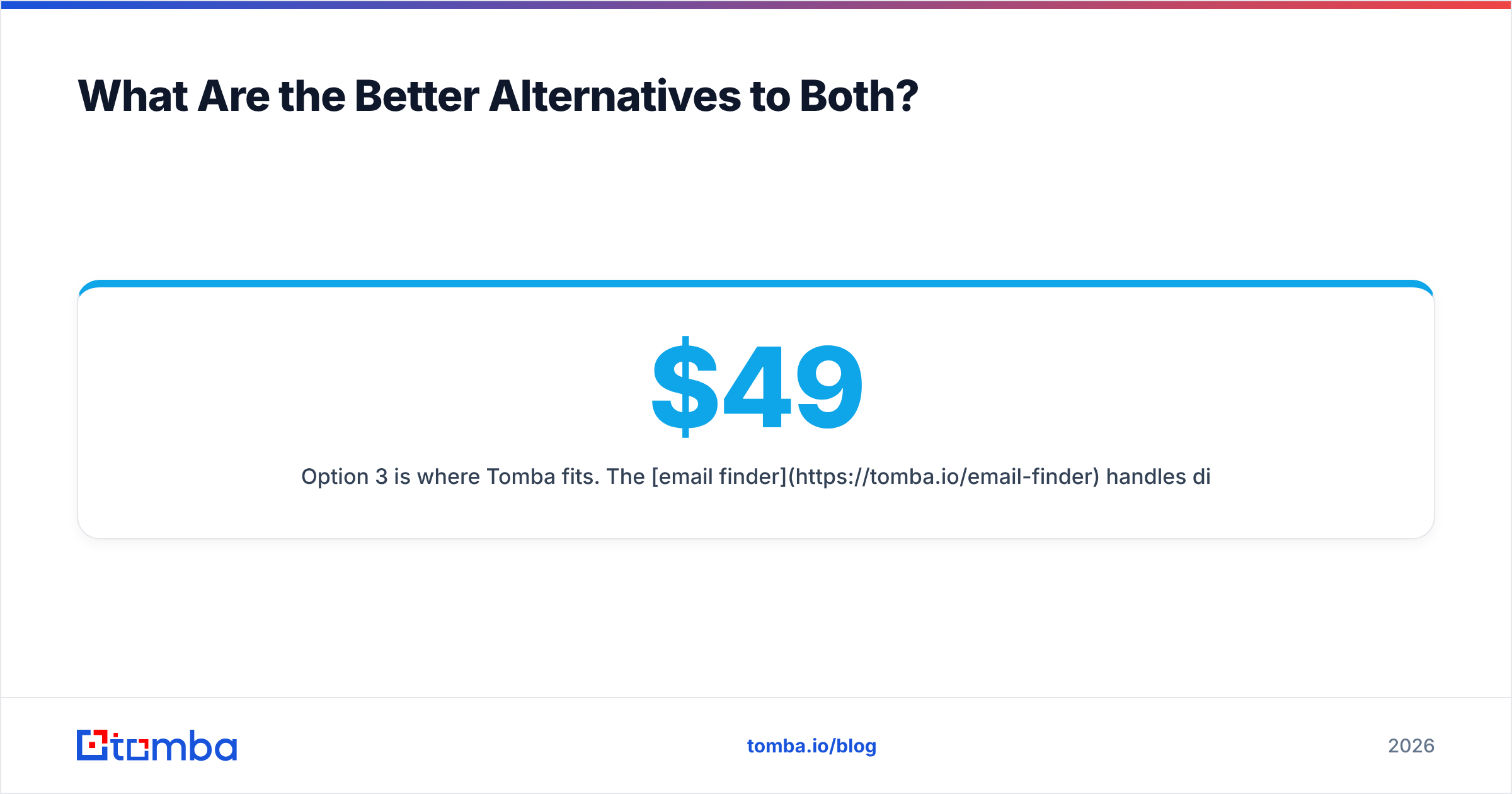
Option 3 is where Tomba fits. The email finder handles discovery by domain, name, or LinkedIn; the verifier and catch-all logic run on the same records; data enrichment fills in the firmographics; and everything is reachable through the Tomba API, CLI, Sheets, Excel, or a Chrome extension. Pricing is a free tier at 25 searches/month, then $49/mo Starter, $99/mo Growth, $249/mo Pro, and custom Enterprise — visible on the Tomba pricing page rather than behind a sales call.
For teams that specifically need bulk verified lists rather than one-off lookups, BookYourData is a well-regarded option in the pay-as-you-go database space, with a per-record model that suits campaigns where you know your ICP precisely and want volume without a subscription commitment.
What Does a Sane 2026 Outbound Stack Look Like?#
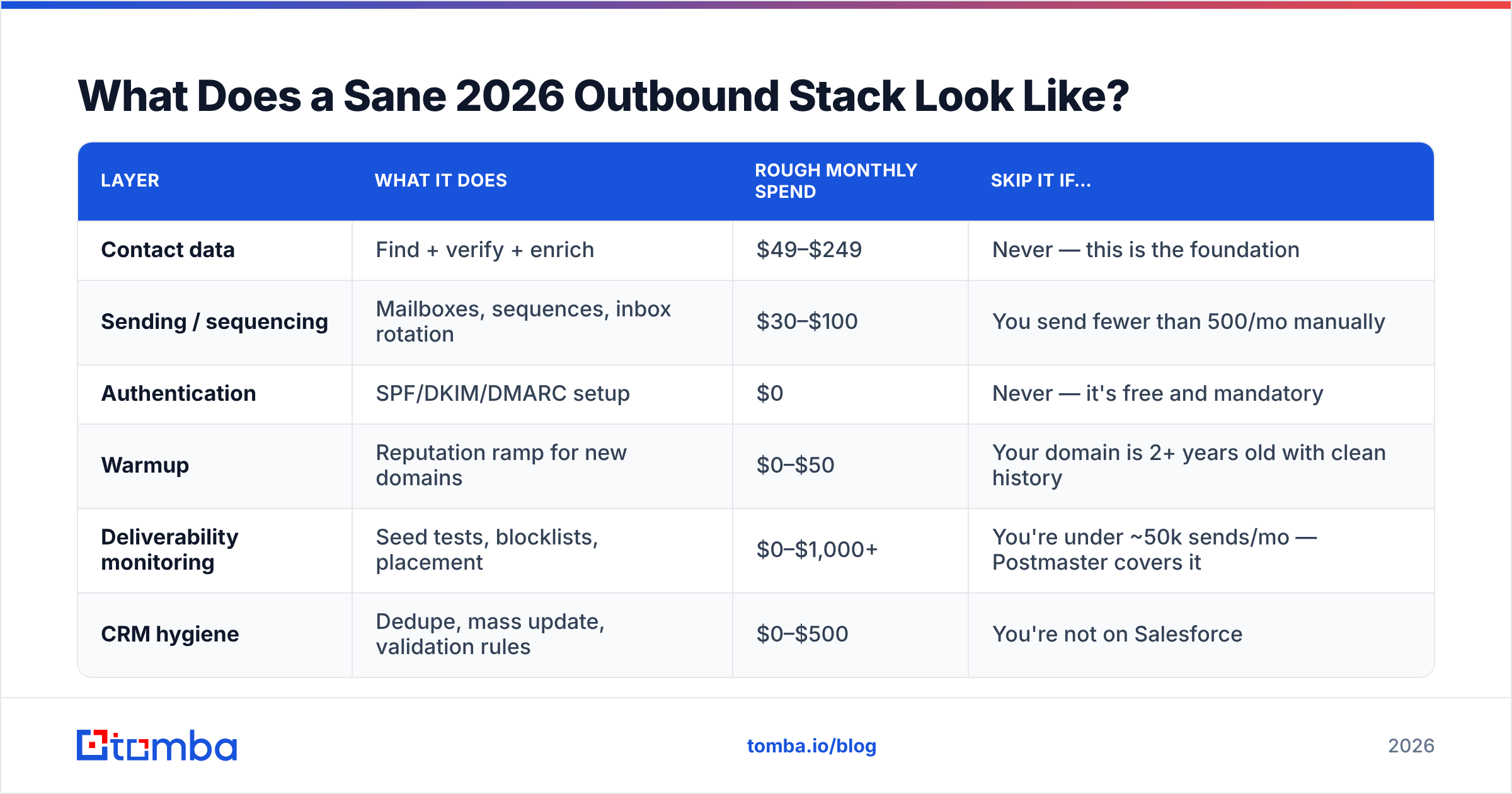
Assume you are a 10-person GTM team sending 20k emails a month. Here is the allocation that actually correlates with booked meetings:
| Layer | What it does | Rough monthly spend | Skip it if… |
|---|---|---|---|
| Contact data | Find + verify + enrich | $49–$249 | Never — this is the foundation |
| Sending / sequencing | Mailboxes, sequences, inbox rotation | $30–$100 | You send fewer than 500/mo manually |
| Authentication | SPF/DKIM/DMARC setup | $0 | Never — it's free and mandatory |
| Warmup | Reputation ramp for new domains | $0–$50 | Your domain is 2+ years old with clean history |
| Deliverability monitoring | Seed tests, blocklists, placement | $0–$1,000+ | You're under ~50k sends/mo — Postmaster covers it |
| CRM hygiene | Dedupe, mass update, validation rules | $0–$500 | You're not on Salesforce |
Notice that the biggest single lever — contact data quality — is also among the cheapest. A 92%-accurate list at $99/mo outperforms an 70%-accurate list at $49/mo every time, because every bad address costs you twice: once in wasted send volume, and again in the sender reputation damage that raises the bounce ceiling for every future campaign.
If you want to sanity-check vendor claims before you buy, G2's email verification category has enough recent reviews to spot patterns, and both vendors publish their own product documentation — FindThatLead and Validity — which is worth reading for feature scope even though neither will tell you where it is weak.
Frequently Asked Questions#
Does FindThatLead replace Validity? No. FindThatLead's bundled verification is a first-pass filter, not an enterprise-grade list-cleaning engine, and it has no inbox-placement monitoring at all. If you need seed testing and blocklist alerts, FindThatLead does not offer them.
Does Validity find email addresses? No. None of Validity's products do prospecting. BriteVerify validates addresses you already have; Everest monitors mail you already send. You still need a discovery source.
Which is cheaper? FindThatLead, for typical SMB usage. Validity's BriteVerify is cheap per verification but has no discovery, so it is not an apples-to-apples cost comparison — you would still need to buy a finder alongside it.
Can I use both? Yes, and some teams do: FindThatLead for sourcing, BriteVerify for a final pre-send check. Just be aware you are paying twice for overlapping verification. A finder with credible native verification collapses that into one line item.
What about catch-all domains? Neither tool fully solves them — nobody does, because the SMTP layer genuinely does not reveal the answer. The best you can get is a tool that classifies catch-all separately, applies pattern confidence, and lets you decide the risk. Never let a tool quietly mark catch-all as valid.
The Bottom Line#
FindThatLead and Validity answer different questions. Pick FindThatLead if your bottleneck is finding people. Pick Validity — specifically BriteVerify — if your bottleneck is a dirty list about to torch your domain. Pick Everest only when your send volume makes a 2% placement shift worth more than the subscription.
For the majority of teams reading this, the actual answer is neither: you need one accurate data layer that finds, verifies, and enriches in a single pass, feeding the sender you already use. Start with Tomba's Email Finder on the free tier — 25 searches a month, no card — run it against 100 contacts you can already validate, and compare the hit rate to whatever you are paying for now. If the data holds up, $49/mo buys you the foundation everything else in your stack depends on.
Related guides#
Ready to find emails that actually work?
Join 150,000+ professionals who stopped guessing and started sending. Free credits on signup — no credit card required.
Get the Tomba newsletter
Practical outbound tactics and product updates — once every two weeks.
About the author