Follow Up Email After Networking: Templates That Get Replies
Most networking conversations die in the 48 hours after the event. Here is the timing, structure, and template set that turns a handshake or a LinkedIn hello into a booked call — plus the mistakes that quietly kill your reply rate.
TL;DR
- Send within 24–48 hours. After 72 hours you are a stranger again, and your open rate drops with your memory in their head.
- The single highest-leverage element is a specific callback to something only the two of you discussed. Generic "great to meet you" notes get ignored at scale.
- One ask per email. A 15-minute call, an intro, a doc — pick one. Two asks means zero decisions.
- Most people never send the follow-up because they lost the email address. That is a data problem, not a willpower problem, and it takes 30 seconds to fix.
- Three touches over three weeks beats one perfect email. Reply rates on networking follow-ups typically peak on the second or third touch, not the first.
Why does the follow up email after networking matter more than the conversation?#
Because the conversation was free and the follow-up is not.
Everyone at a conference, a webinar, a LinkedIn group, or a local meetup is having roughly the same pleasant, forgettable exchange. The differentiator is not charisma in the room — it is who lands in the inbox 24 hours later with something useful and specific. That email is what converts an ambient acquaintance into a pipeline entry, a hiring lead, or a partnership.
Think of networking like planting seeds in the wrong season. The conversation is the seed; the follow-up is the water. Without the second step, nothing happens, and you spent a day and a flight to hand out cardboard.
There is a mechanical reason too. Human memory of a brief social encounter decays sharply in the first three days. Your email at hour 24 gets read against a warm memory: "Oh right, the person who told me about the pricing migration." Your email at day nine gets read against nothing, so the recipient does the cheapest possible thing — archives it.
When should you send a follow up email after networking?#
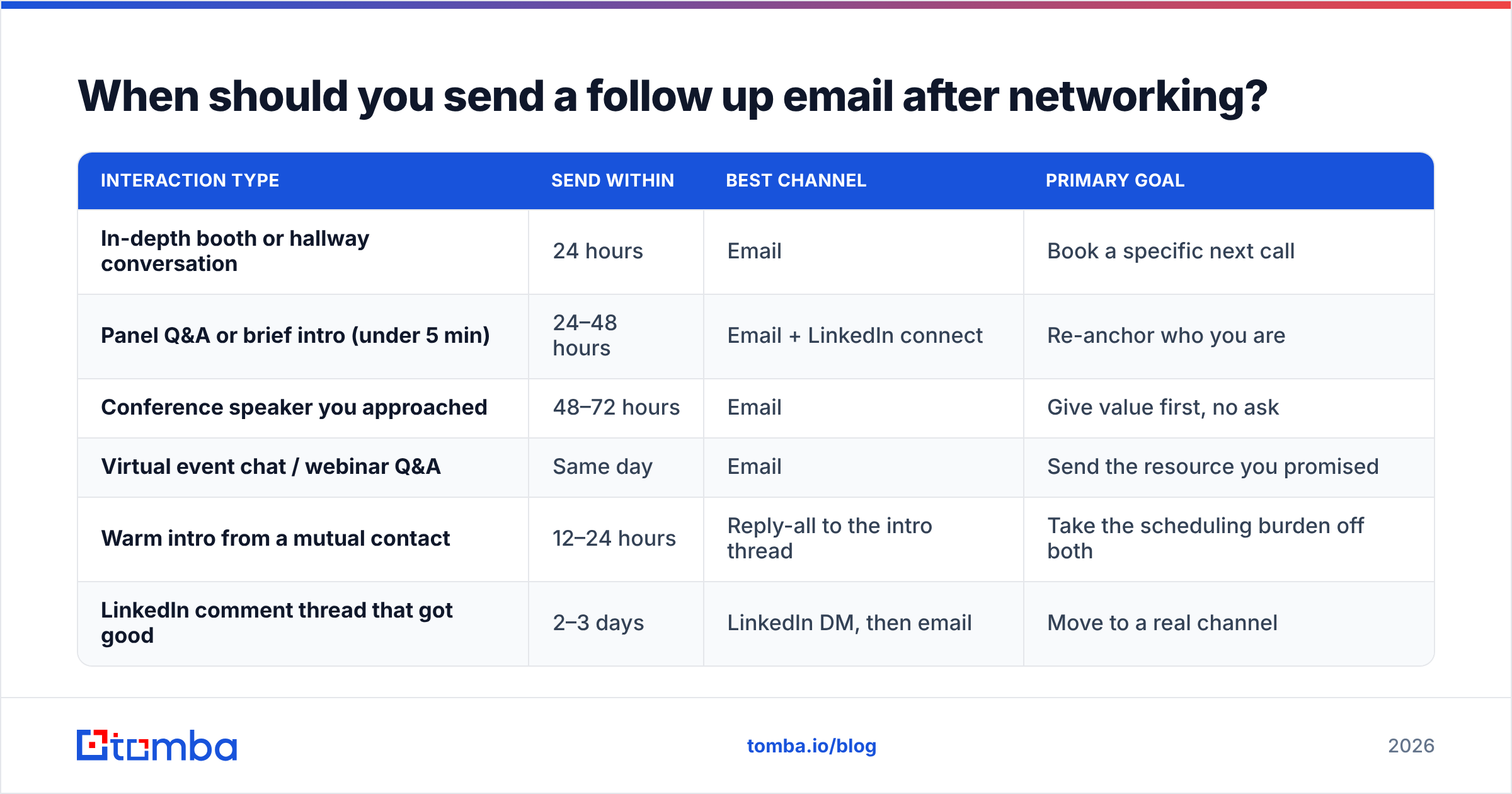
Timing is the variable you control completely, and it is the one most people get wrong. The rule is simple: the warmer and more specific the interaction, the faster you send.
| Interaction type | Send within | Best channel | Primary goal |
|---|---|---|---|
| In-depth booth or hallway conversation | 24 hours | Book a specific next call | |
| Panel Q&A or brief intro (under 5 min) | 24–48 hours | Email + LinkedIn connect | Re-anchor who you are |
| Conference speaker you approached | 48–72 hours | Give value first, no ask | |
| Virtual event chat / webinar Q&A | Same day | Send the resource you promised | |
| Warm intro from a mutual contact | 12–24 hours | Reply-all to the intro thread | Take the scheduling burden off both |
| LinkedIn comment thread that got good | 2–3 days | LinkedIn DM, then email | Move to a real channel |
Two nuances worth internalizing:
The "24 hours" rule is about their memory, not your politeness. If you met at 9pm on day two of a three-day conference, sending at 7am the next morning is fine — they are still on-site and still in event mode. If you wait until they are home and 400 emails deep, you are competing with their real job.
For speakers and senior people, slow down slightly. They got 40 messages that day. Landing on day three, when the flood has passed, often works better than being message 41.
What actually goes into a follow up email that gets replied to?#
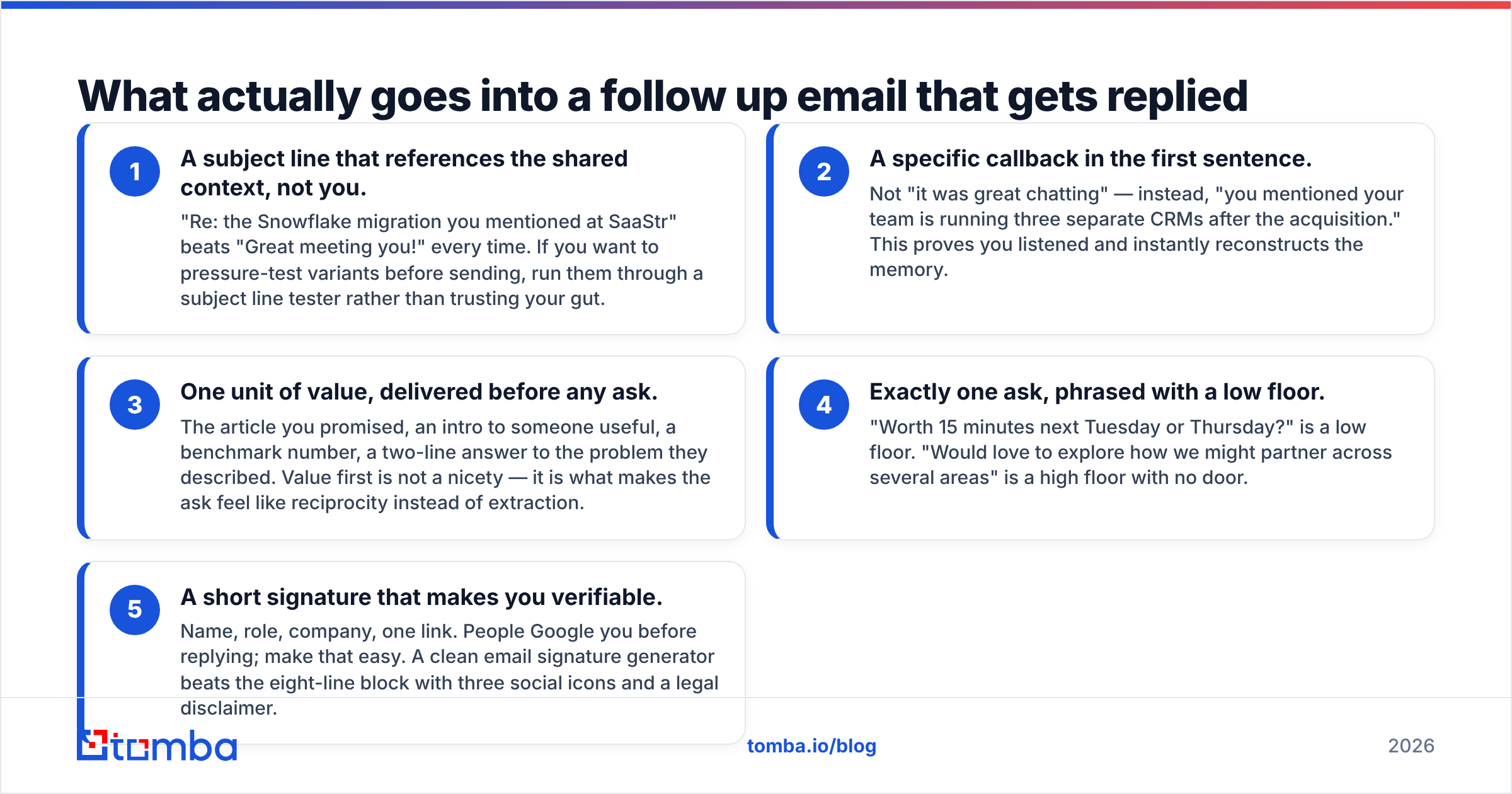
Five components. Miss any one and the reply rate falls off a cliff.
- A subject line that references the shared context, not you. "Re: the Snowflake migration you mentioned at SaaStr" beats "Great meeting you!" every time. If you want to pressure-test variants before sending, run them through a subject line tester rather than trusting your gut.
- A specific callback in the first sentence. Not "it was great chatting" — instead, "you mentioned your team is running three separate CRMs after the acquisition." This proves you listened and instantly reconstructs the memory.
- One unit of value, delivered before any ask. The article you promised, an intro to someone useful, a benchmark number, a two-line answer to the problem they described. Value first is not a nicety — it is what makes the ask feel like reciprocity instead of extraction.
- Exactly one ask, phrased with a low floor. "Worth 15 minutes next Tuesday or Thursday?" is a low floor. "Would love to explore how we might partner across several areas" is a high floor with no door.
- A short signature that makes you verifiable. Name, role, company, one link. People Google you before replying; make that easy. A clean email signature generator beats the eight-line block with three social icons and a legal disclaimer.
Length target: 90 to 130 words. Anything past 150 gets skimmed, and skimming kills the ask.
What do the best follow up email templates look like?#
Six templates you can adapt. Change the specifics — the structure is what carries.
1. The standard post-conference follow-up
Subject: The three-CRM problem you mentioned at SaaStr
Hi Dana,
Great talking by the coffee line yesterday — you mentioned your team is stitching together three CRMs post-acquisition and losing about a third of the records in the merge.
Here's the migration checklist I mentioned: [link]. Section 4 covers the dedupe order, which is where most teams create the duplicates they're trying to avoid.
If it's useful, I'm happy to walk through how two similar teams handled it. 15 minutes next Tuesday or Thursday?
— Marc, RevOps Lead, Northgate
2. The brief-encounter follow-up (they may not remember you)
Subject: Quick note from the Tuesday RevOps panel
Hi Priya,
We spoke briefly after the RevOps panel — I was the one asking about attribution on self-serve signups. Grey jacket, terrible question.
You said something that stuck with me: that attribution stops mattering below a certain ACV. I've been arguing that internally for a year.
No ask here. Just wanted to say it landed. If you ever write that up, I'll read it.
— Marc
3. The speaker or senior-person follow-up
Subject: Your point on pipeline hygiene (and one data point)
Hi Tom,
Your talk on pipeline hygiene was the most useful 20 minutes of the event. The "stale after 21 days" heuristic in particular.
One data point in case it's useful: we ran the same cut across 400 opportunities and stale-after-14 was the sharper break for mid-market. Happy to send the raw numbers.
— Marc
4. The mutual-introduction follow-up
Subject: Re: Intro — Marc <> Elena
Elena, thanks Sam for making this.
Moving Sam to bcc. Elena, Sam mentioned you're rebuilding outbound data sourcing at Kestrel. I spent last year doing exactly that and made most of the available mistakes.
Happy to just share what broke, no pitch. Does Thursday 2pm or Friday 10am work? Here's my calendar if easier: [link]
— Marc
5. The second touch (no reply to the first)
Subject: Re: The three-CRM problem you mentioned at SaaStr
Hi Dana,
Bumping this in case it got buried — conference inboxes are brutal.
Since I wrote, one more thing surfaced that's relevant to the dedupe order: [one-line insight].
Still happy to walk through it, or happy to drop it if the timing's wrong. Either is a fine answer.
— Marc
6. The graceful close (third touch)
Subject: Closing the loop
Hi Dana,
I'll stop here so I'm not cluttering your inbox. If the migration project comes back around next quarter, I'm easy to find.
Good luck with it either way.
— Marc
That last one gets more replies than people expect. Removing the pressure is itself a form of pressure release, and a meaningful share of "closing the loop" emails get a "no wait, let's talk" response.
How do you find the email when you never got their address?#
This is the failure point nobody admits to. You had a great 20-minute conversation, you connected on LinkedIn, and now you are staring at a profile with no contact info and a company website with a generic info@ inbox.
Guessing is not a strategy. Sending to dana@company.com and hoping is how you generate bounces, and bounces damage your sender reputation — which then hurts every legitimate email you send afterward.
A cleaner sequence:
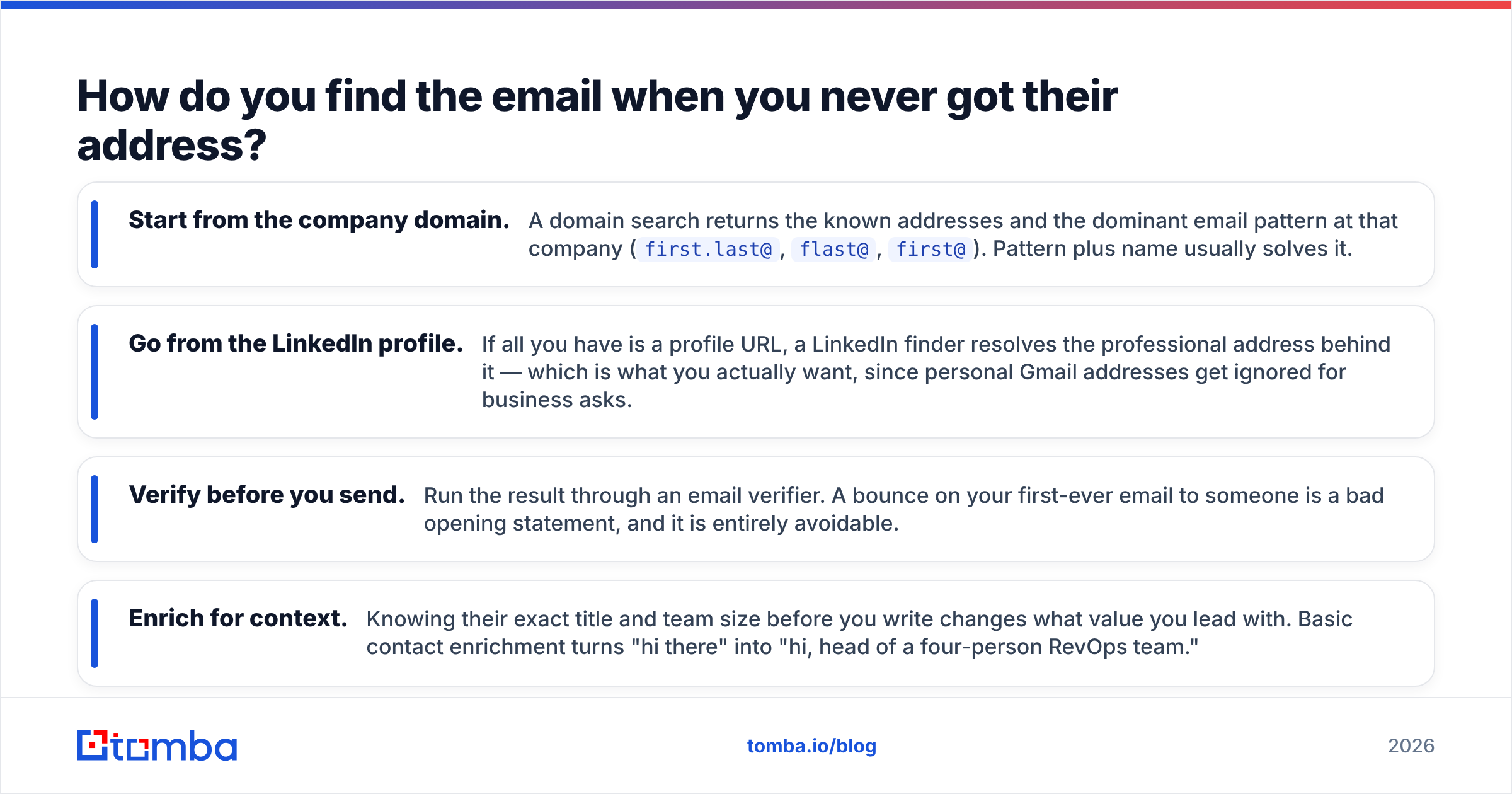
- Start from the company domain. A domain search returns the known addresses and the dominant email pattern at that company (
first.last@,flast@,first@). Pattern plus name usually solves it. - Go from the LinkedIn profile. If all you have is a profile URL, a LinkedIn finder resolves the professional address behind it — which is what you actually want, since personal Gmail addresses get ignored for business asks.
- Verify before you send. Run the result through an email verifier. A bounce on your first-ever email to someone is a bad opening statement, and it is entirely avoidable.
- Enrich for context. Knowing their exact title and team size before you write changes what value you lead with. Basic contact enrichment turns "hi there" into "hi, head of a four-person RevOps team."
The whole loop takes under a minute per contact. Compared to the cost of attending the event, it is the cheapest step in the chain and the one most often skipped.
How many follow-ups should you send, and what changes each time?#
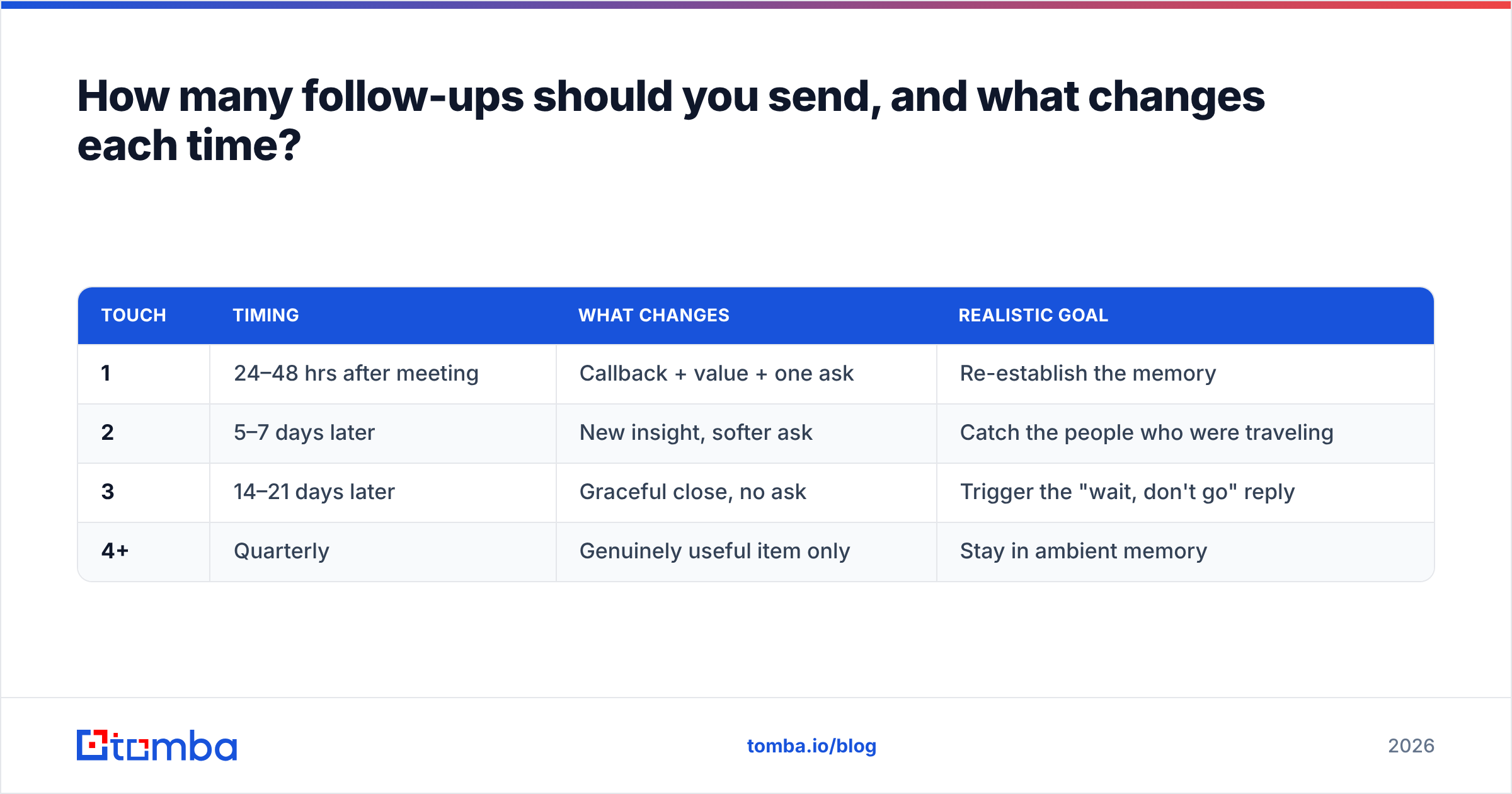
Three touches over roughly three weeks. Each one should carry new information — a bump that says "just following up" is a tax on their attention with no payment attached.
| Touch | Timing | What changes | Realistic goal |
|---|---|---|---|
| 1 | 24–48 hrs after meeting | Callback + value + one ask | Re-establish the memory |
| 2 | 5–7 days later | New insight, softer ask | Catch the people who were traveling |
| 3 | 14–21 days later | Graceful close, no ask | Trigger the "wait, don't go" reply |
| 4+ | Quarterly | Genuinely useful item only | Stay in ambient memory |
Two rules that keep this from becoming spam. First, reply on the same thread for touches two and three — a fresh subject line resets the context you worked to build. Second, never send a fourth touch inside the same month. If three specific, useful emails did not land, the answer is no for now, and the relationship is worth more than the sequence.
If you are tracking this at any scale, log the outcome per touch. Most people discover their response rate on touch two is higher than on touch one, which reframes the whole exercise: the first email is not the pitch, it is the setup.
Which follow-up mistakes quietly kill your reply rate?#
- Attaching a deck to the first email. It signals a sales motion before trust exists. Link to one page instead, or send nothing.
- The multi-ask email. "Would love to grab coffee, also happy to send our case study, also curious if you know anyone hiring." Three asks, zero replies.
- Writing to your own memory instead of theirs. You remember the conversation vividly. They remember roughly nothing. Rebuild the context in one sentence, every time.
- CC'ing your colleague on touch one. It turns a peer conversation into a sales team ambush.
- Sending from a domain with no authentication. If your SPF and DKIM are not set up, your carefully written note lands in spam and you conclude that networking does not work. Check with a free SPF checker before blaming your copy.
- Batch-sending identical notes to 40 people from the same event. They talk to each other. Word-for-word identical emails become a screenshot in a group chat.
For broader context on how professional relationship-building actually compounds, the business networking literature and HubSpot's sales blog both make the same point from different angles: consistency in follow-through beats volume in first contacts. And if the relationship started on LinkedIn, move it to email early — platform DMs are a rented channel with a real inbox limit.
What should you do in the next 24 hours?#
If you just came back from an event, the highest-return hour of your week is this one:
- Dump every name you can remember into a spreadsheet with one line of context each. Do it before the memory fades — context is the entire asset.
- Resolve the missing email addresses in bulk rather than one at a time.
- Write six emails, not forty. Prioritize the conversations that were actually good.
- Schedule touch two for seven days out, right now, while you still have the context loaded.
The people who get compounding returns from networking are not better in the room. They are just the ones who send the email.
Start with the addresses you're missing. Every follow-up you never sent because you could not find the email is a conversation you paid for and threw away. Tomba's Email Finder resolves professional addresses from a name and company domain, verifies them before you send, and works in bulk when you come back from an event with 40 names and no contact details. The free tier covers 25 searches a month — enough to clear a conference backlog — and paid plans start at $49/mo on the Starter tier. Full Tomba pricing is public, no demo call required.
Related guides#
Ready to find emails that actually work?
Join 150,000+ professionals who stopped guessing and started sending. Free credits on signup — no credit card required.
Get the Tomba newsletter
Practical outbound tactics and product updates — once every two weeks.
About the author