Free B2B Database Options in 2026: What You Actually Get
Free B2B databases exist, but the credits, accuracy, and export limits vary wildly. Here's a side-by-side breakdown of what each free tier really gives you before you pay a cent.
TL;DR
- A genuinely free B2B database means one of three things: a limited-credit free tier from a paid vendor, an open dataset you enrich yourself, or a scraped list someone is selling as "free." Only the first two are usable.
- Free tiers typically run 25–100 credits/month. That is enough to test accuracy and email patterns, not enough to run outbound.
- Accuracy matters more than volume. A free list of 10,000 stale contacts costs you more in bounced sends and domain reputation than a paid list of 500 verified ones.
- The smartest play in 2026: use free tiers to validate the data source, then pay only for the vendor whose verified-rate holds up on your ICP.
- Tomba's free tier gives 25 searches/month with full verification, then $49/mo on Starter — see Tomba pricing for the full ladder.
What is a free B2B database, really?#
A B2B database is a structured store of company and contact records: firmographics (industry, headcount, revenue, tech stack), plus contact-level data (name, title, work email, direct dial, LinkedIn URL). A free B2B database is any way to access some of that without paying.
There are exactly three honest categories, and they behave very differently.
- Free tiers of commercial platforms. Vendors like Tomba, Apollo, Lusha, and Hunter give you a monthly credit allowance. The data quality is identical to the paid product — you just get less of it. This is the highest-signal free option because what you test is what you'd buy.
- Open and public datasets. Government business registries, SEC EDGAR filings, Crunchbase's free tier, OpenCorporates, and public LinkedIn company pages. These give you company records for free but almost never verified contact emails. You supply the contact layer yourself.
- "Free download" lead lists. CSVs floating around forums, torrents of scraped data, and lead-magnet gated files. These are almost always recycled, years old, GDPR-hostile, and heavily bounced. Avoid.
The gap between category 1 and category 3 is the whole article. Free credits from a real vendor are a sample. A free scraped CSV is someone else's spam problem transferred to your domain.
Why do free B2B database lists bounce so often?#
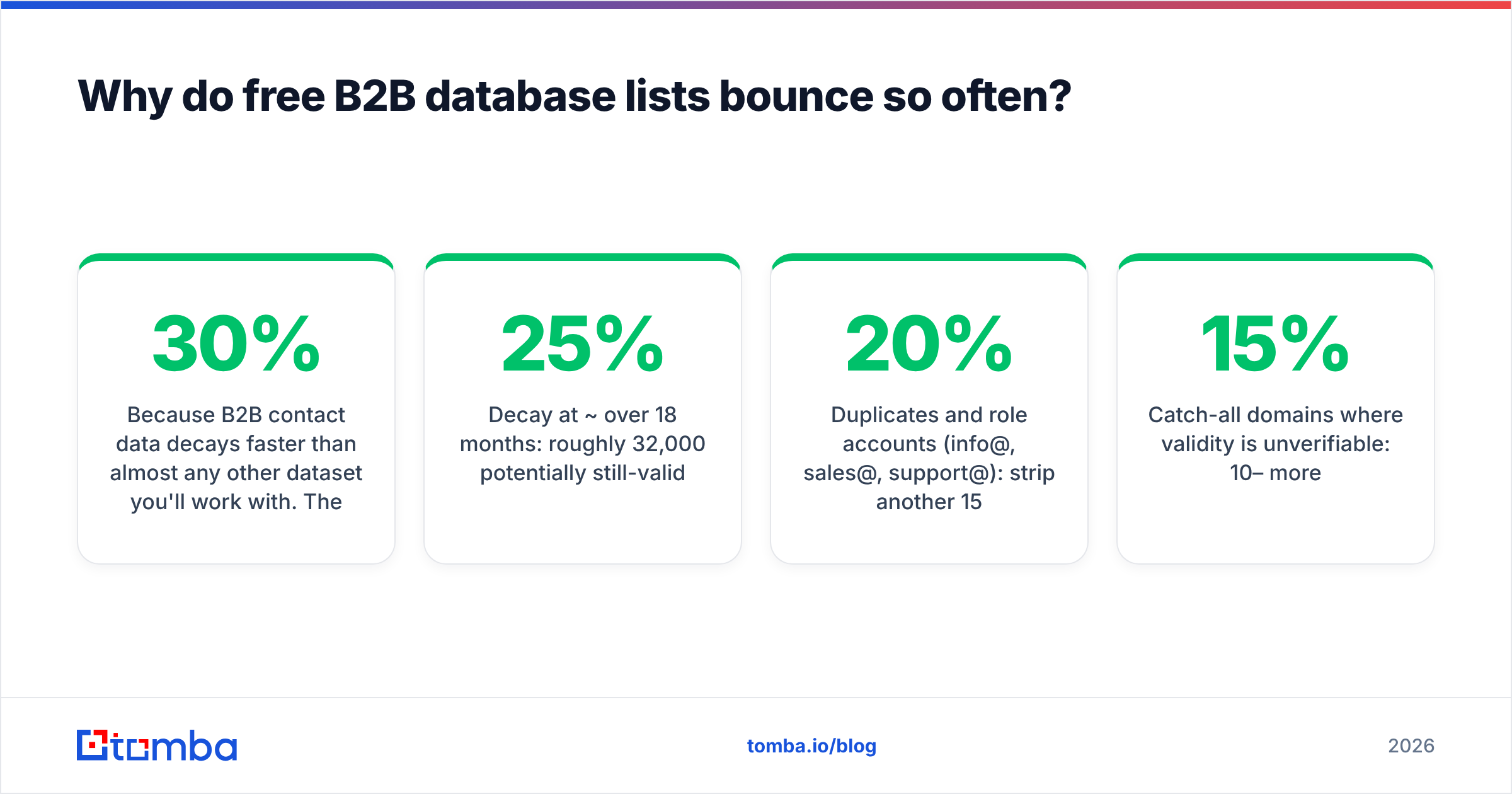
Because B2B contact data decays faster than almost any other dataset you'll work with. The commonly cited figure across industry research is roughly 22–30% annual decay — people change jobs, companies rebrand, domains get consolidated after acquisitions, and mailbox providers retire aliases.
Run the math on a "free" 50,000-row list that was scraped 18 months ago:
- Start: 50,000 rows
- Decay at ~25%/year over 18 months: roughly 32,000 potentially still-valid
- Duplicates and role accounts (info@, sales@, support@): strip another 15–20%
- Catch-all domains where validity is unverifiable: 10–15% more
- Realistically deliverable and targeted: maybe 18,000–20,000, and you don't know which ones
Now send to that list without verification. A bounce rate above 3–5% is the threshold where Google and Microsoft start throttling. One bad send can cost you weeks of email deliverability repair on a domain you spent a year warming. The free list wasn't free.
This is why every serious workflow puts an email verifier between the data source and the sending tool — regardless of whether the data came from a free tier or a $2,000/mo contract.

Which free B2B database tiers are worth using in 2026?#
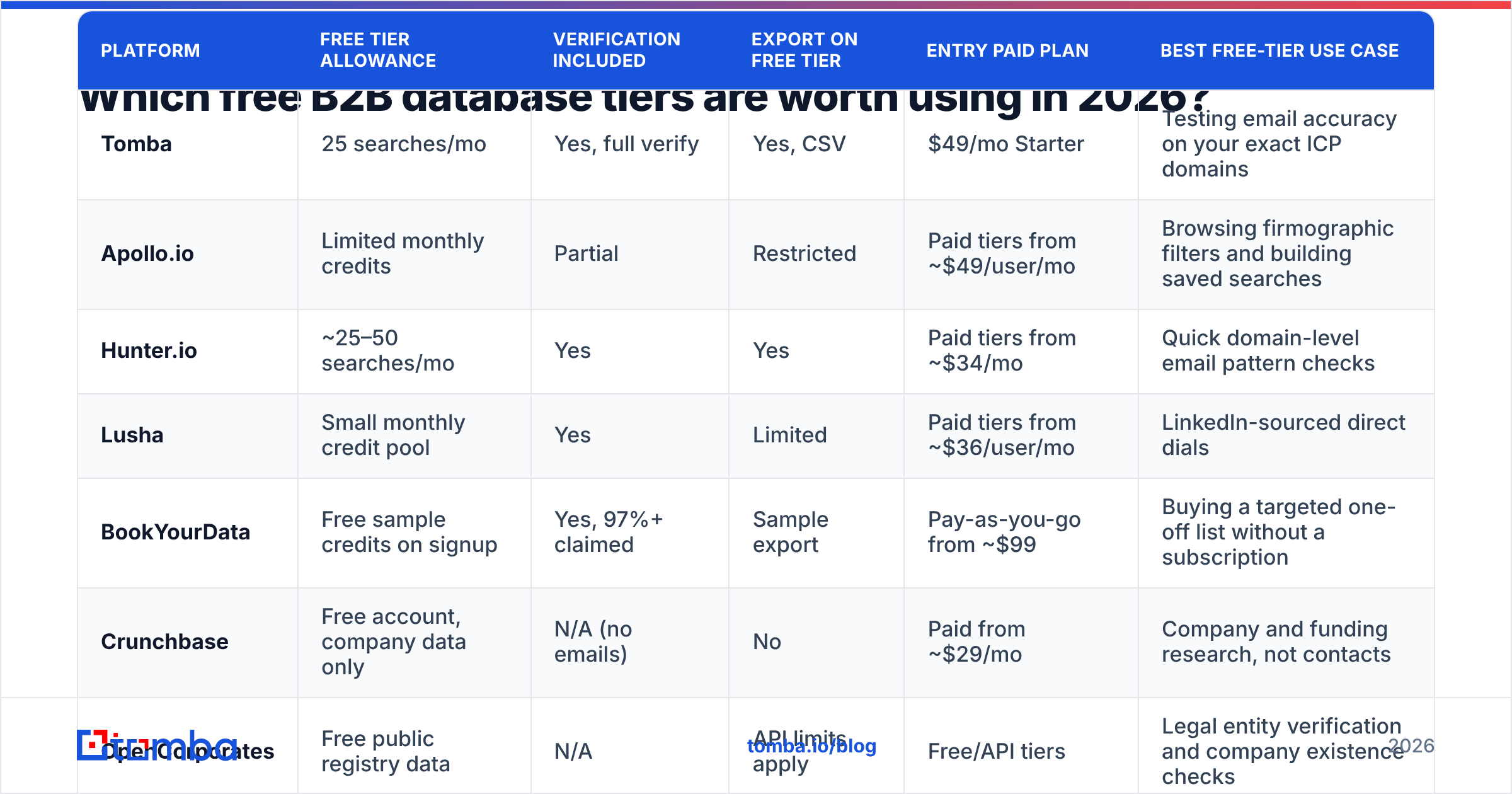
Here's the honest side-by-side. Credit allowances change, so treat these as directional and confirm on each vendor's pricing page before committing.
| Platform | Free tier allowance | Verification included | Export on free tier | Entry paid plan | Best free-tier use case |
|---|---|---|---|---|---|
| Tomba | 25 searches/mo | Yes, full verify | Yes, CSV | $49/mo Starter | Testing email accuracy on your exact ICP domains |
| Apollo.io | Limited monthly credits | Partial | Restricted | Paid tiers from ~$49/user/mo | Browsing firmographic filters and building saved searches |
| Hunter.io | ~25–50 searches/mo | Yes | Yes | Paid tiers from ~$34/mo | Quick domain-level email pattern checks |
| Lusha | Small monthly credit pool | Yes | Limited | Paid tiers from ~$36/user/mo | LinkedIn-sourced direct dials |
| BookYourData | Free sample credits on signup | Yes, 97%+ claimed | Sample export | Pay-as-you-go from ~$99 | Buying a targeted one-off list without a subscription |
| Crunchbase | Free account, company data only | N/A (no emails) | No | Paid from ~$29/mo | Company and funding research, not contacts |
| OpenCorporates | Free public registry data | N/A | API limits apply | Free/API tiers | Legal entity verification and company existence checks |
Two things jump out.
First, nobody gives away contact-level data at volume. The free tiers cluster around 25–100 credits because that's the size of a genuine product trial, not a lead source. Any vendor advertising "unlimited free B2B emails" is either selling scraped data or gating it behind a paywall two clicks later.
Second, "free" splits by data type. Company-level data (registries, Crunchbase, OpenCorporates) is genuinely abundant and free. Contact-level data — the verified work email of a specific decision-maker — is where the cost sits, because it requires ongoing crawling, pattern inference, and SMTP-level verification.

How do you build a usable B2B list from free sources?#
This is the workflow that actually gets you contacts without a big spend. Five steps, each using free or near-free inputs.
- Define the account list first, not the contact list. Pull companies from free sources: OpenCorporates for legal entities, Crunchbase for funded startups, G2 category pages for software buyers, industry association member directories, and conference exhibitor lists. Target 200–500 named accounts, not 50,000.
- Get the domain for each company. Free tools handle this in bulk — a company website finder maps a company name to its primary domain, which is the key that unlocks everything downstream.
- Find the email pattern per domain. Most companies use one dominant format:
first.last@,flast@, orfirst@. A company email pattern check or a domain search reveals it from known public addresses on that domain. Once you have the pattern, you can infer the rest. - Identify the right person, not just any person. Use LinkedIn Sales Navigator's free trial, company About pages, press releases, and conference speaker bios. You want name + exact title, because a wrong-persona email is a wasted send even if it delivers.
- Verify before you send. Always. Pattern inference gives you a plausible address, not a valid one. Run every address through verification and drop anything that isn't "valid" or a knowingly-accepted catch-all. Free checkers like a free email checker handle one-off checks; bulk needs an API or a batch upload.
- Log where each record came from. Under GDPR and CCPA you need a documented basis for processing. "Downloaded a CSV" is not one. "Sourced from the company's public website on 2026-08-14 for legitimate B2B interest" is defensible. The ICO's guidance on direct marketing is the reference point for UK/EU sends.
This process gets you a few hundred verified, well-targeted contacts per month using mostly free inputs plus a small verification spend. That beats 50,000 unverified rows on every metric that matters: reply rate, bounce rate, and legal exposure.
Is a free B2B database better than a paid one?#
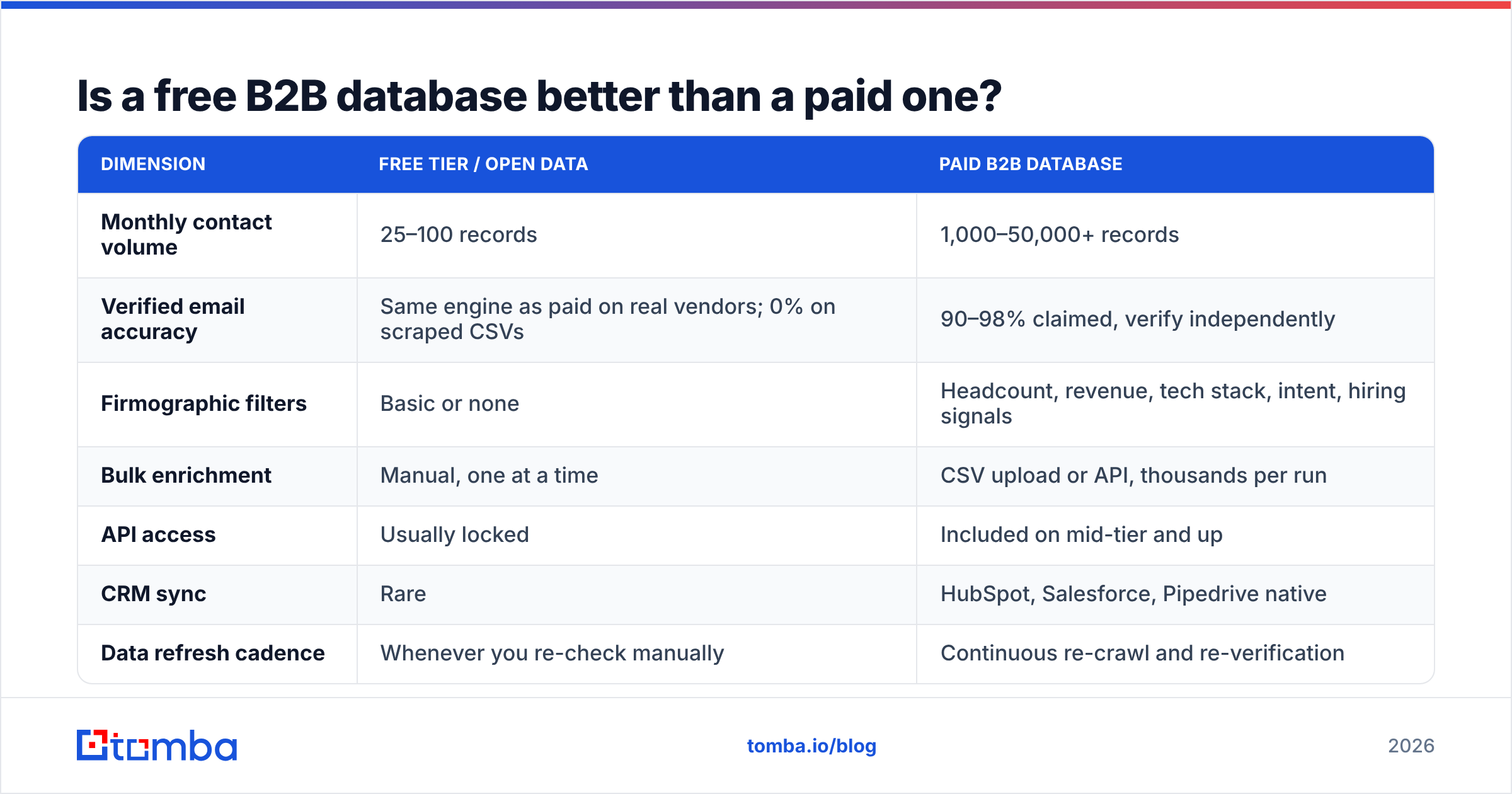
For evaluation, yes. For execution, no. The comparison isn't free-vs-paid — it's sample-vs-supply.
| Dimension | Free tier / open data | Paid B2B database |
|---|---|---|
| Monthly contact volume | 25–100 records | 1,000–50,000+ records |
| Verified email accuracy | Same engine as paid on real vendors; 0% on scraped CSVs | 90–98% claimed, verify independently |
| Firmographic filters | Basic or none | Headcount, revenue, tech stack, intent, hiring signals |
| Bulk enrichment | Manual, one at a time | CSV upload or API, thousands per run |
| API access | Usually locked | Included on mid-tier and up |
| CRM sync | Rare | HubSpot, Salesforce, Pipedrive native |
| Data refresh cadence | Whenever you re-check manually | Continuous re-crawl and re-verification |
| Compliance documentation | You build it | Vendor provides sourcing and DPA |
| Real cost | Your time + bounce risk | $34–$249/mo typical entry range |
The honest read: free tiers are a diagnostic instrument. Run 25 searches against your 25 hardest target domains — the ones with unusual TLDs, tiny headcounts, or non-English company names. Whichever vendor returns verified hits on those is the one worth paying for. Vendors all look identical on Fortune 500 domains; they diverge sharply on the long tail, and the long tail is usually where your ICP lives.

What should you check before trusting any free B2B data?#
Run this checklist on any free list, free tier, or open dataset before it touches your sending domain.
- Sourcing transparency. Can the vendor tell you where a record came from? Tomba publishes its data sources; most reputable vendors do something similar. A "free list" with no provenance is a liability.
- Verification status per record. Is each email marked valid, invalid, catch-all, or unknown? A list without status flags is a list you have to verify yourself anyway.
- Catch-all handling. Roughly 15–20% of B2B domains accept all mail, so standard SMTP checks return "unknown." A catch-all verifier applies pattern confidence and secondary signals to those. Sending blind to catch-alls inflates your apparent delivery while tanking reply rates.
- Role-account contamination. Strip
info@,admin@,contact@,noreply@. These skew engagement metrics and often route to shared inboxes that mark cold mail as spam. - Duplicate density. Free lists frequently contain the same person under two employers or two email formats. Deduplicate before import — a remove duplicates pass takes seconds.
- Recency stamp. When was each record last verified? Anything older than 90 days needs a re-check. Anything with no timestamp at all should be treated as unverified.
- Regional legality. B2B contact data rules differ across the EU, UK, US, and Canada. CASL in Canada requires consent for commercial electronic messages in most cases; GDPR permits legitimate interest for B2B but demands documentation and easy opt-out.
If a free source fails three or more of these, it's not a database. It's a text file with commas in it.
How do free tiers scale into a paid workflow?#
The transition point is predictable. You outgrow a free tier when any of these become true:
- You're finding more than ~30 contacts a month by hand
- You need the same contact enriched with phone, LinkedIn, and firmographics in one call
- You want the data landing in your CRM automatically instead of via CSV
- You need an API so your own tooling can request contacts on demand
At that point the cost calculus flips. Thirty manual lookups at three minutes each is 90 minutes a month; a paid tier that does it in one bulk upload pays for itself against almost any hourly rate.
The practical path is to start on a free tier, keep the same vendor, and step up only when volume demands it. Switching vendors mid-workflow means re-testing accuracy, rebuilding integrations, and re-normalizing your CRM fields. Tomba's ladder — free at 25 searches, $49/mo Starter, $99/mo Growth, $249/mo Pro, Enterprise custom — is designed so the API, bulk email finder, and integrations behave identically at every step. What you test for free is exactly what you scale.
For teams evaluating alternatives, it's worth running the same 25-domain test against an Apollo alternative and whichever incumbent you're considering. The vendor that wins on your specific ICP is rarely the one with the biggest advertised database size.
Start with 25 free searches against your hardest domains#
Stop downloading lists. Take the 25 accounts you most want to reach this quarter — the ones where a wrong email costs you a real opportunity — and run them through the Tomba Email Finder on the free tier. No card required, full verification included, CSV export enabled.
If the verified hit rate holds on those 25, you've found your data source and you can scale it on Starter at $49/mo. If it doesn't, you've learned that for free instead of after a twelve-month contract. Either way, that's a better outcome than any 50,000-row CSV will ever give you.
Related guides#
Ready to find emails that actually work?
Join 150,000+ professionals who stopped guessing and started sending. Free credits on signup — no credit card required.
Get the Tomba newsletter
Practical outbound tactics and product updates — once every two weeks.
About the author