Free Cold Emailing Software in 2026: What Actually Works
Free cold email tools can carry you to your first 50 replies — if you know which limits bite first. Here's an honest breakdown of the real free tiers, the hidden ceilings, and when paying starts paying off.
TL;DR
- Genuinely free cold emailing software exists, but "free" almost always caps one of three things: sending volume, verified contact credits, or the number of connected mailboxes.
- The sending tool is rarely your bottleneck. Bad data is. A free sequencer sending to a 22% invalid list will burn your domain faster than any paid plan would have.
- Best free stack in 2026: a free sequencer (Smartlead trial tier, Saleshandy free, or Gmail + a script), plus a free-tier email finder for verified addresses, plus free SPF/DMARC checkers.
- Free breaks down around 200–500 sends/month or the moment you need multi-inbox rotation, reply detection, and deliverability reporting in one place.
- Budget-realistic move: stay free on sending, spend your first dollars on data accuracy. A $49/mo data plan beats a $99/mo sequencer when your list is the problem.
What Counts as Free Cold Emailing Software?#
Most tools marketed as "free cold emailing software" fall into one of four buckets, and they are not interchangeable. Confusing them is why people end up with three subscriptions and still no replies.
- Free sequencers — schedule multi-step campaigns, handle follow-ups, detect replies. Free tiers usually cap monthly sends or connected inboxes.
- Free mail-merge tools — Gmail/Outlook add-ons that blast a spreadsheet. Cheap and simple, but no reply detection, no warmup, no inbox rotation.
- Free data tools — email finders and verifiers with a monthly free credit allowance. These decide whether your campaign lands at all.
- Free deliverability utilities — SPF/DKIM/DMARC checkers, blacklist lookups, spam scorers. Almost always free, and the most neglected part of the stack.
A working free setup needs at least one tool from buckets 1, 3, and 4. Skip bucket 3 and you are sending to guesses. Skip bucket 4 and you never find out why your open rate collapsed in week two.
Which Free Cold Emailing Software Is Actually Worth Using in 2026?#
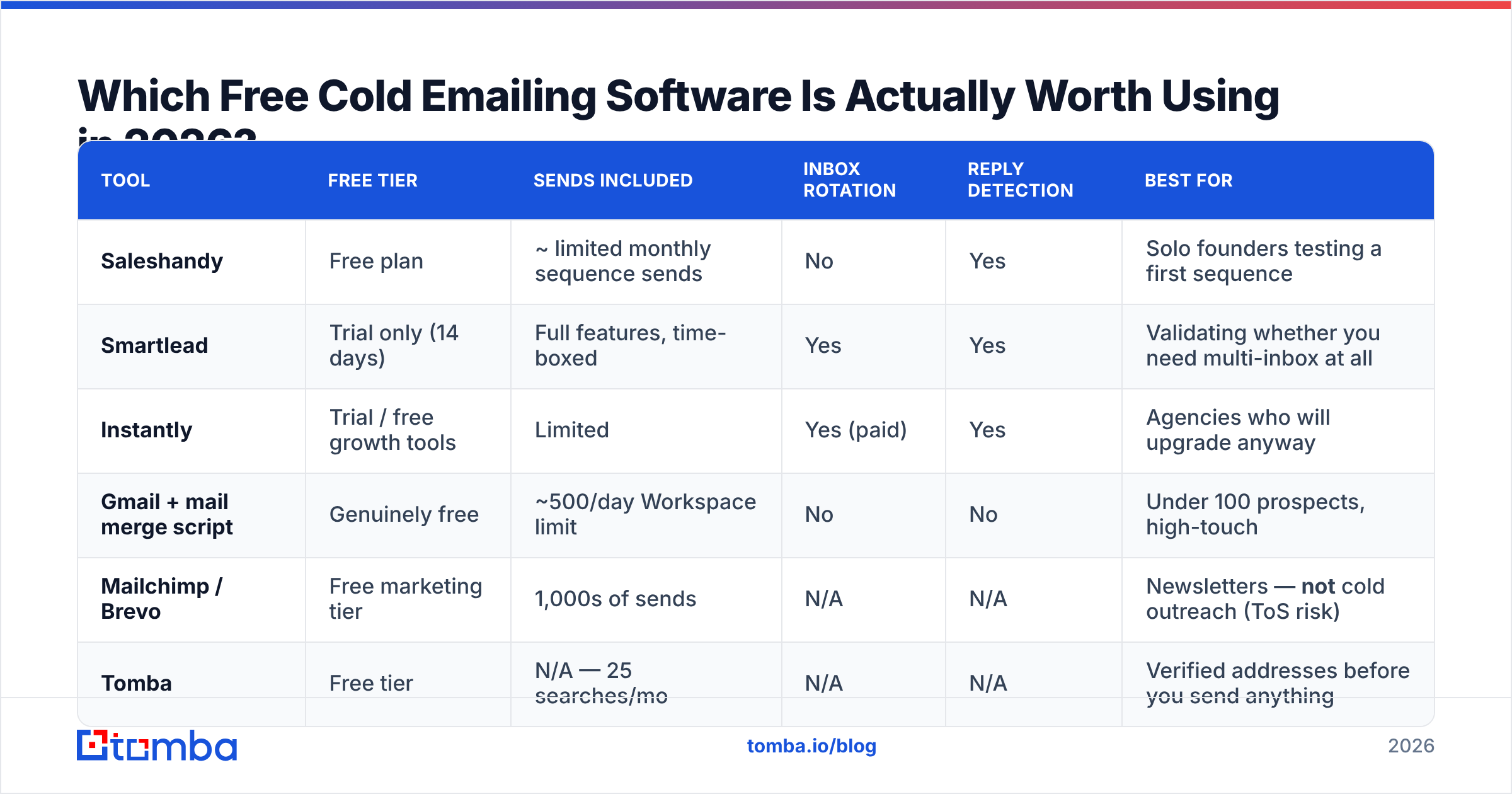
Here is the honest state of free tiers. Note that vendors change limits often — check the pricing page before committing a campaign to any of these.
| Tool | Free tier | Sends included | Inbox rotation | Reply detection | Best for |
|---|---|---|---|---|---|
| Saleshandy | Free plan | ~ limited monthly sequence sends | No | Yes | Solo founders testing a first sequence |
| Smartlead | Trial only (14 days) | Full features, time-boxed | Yes | Yes | Validating whether you need multi-inbox at all |
| Instantly | Trial / free growth tools | Limited | Yes (paid) | Yes | Agencies who will upgrade anyway |
| Gmail + mail merge script | Genuinely free | ~500/day Workspace limit | No | No | Under 100 prospects, high-touch |
| Mailchimp / Brevo | Free marketing tier | 1,000s of sends | N/A | N/A | Newsletters — not cold outreach (ToS risk) |
| Tomba | Free tier | N/A — 25 searches/mo | N/A | N/A | Verified addresses before you send anything |
Two things stand out. First, no free sequencer gives you unlimited sends — the economics do not work, since every send costs the vendor deliverability infrastructure. Second, the marketing platforms with the most generous free tiers (Mailchimp, Brevo, and similar) explicitly forbid cold outreach to non-opted-in contacts. Using them for cold email is the fastest route to a permanent account ban. Their acceptable use policies are not decorative.
Is Free Cold Email Software Enough to Get Replies?#
Yes, up to a point — and that point is more about your list than your sender.
Run the arithmetic. A free tier that permits 500 sends a month, at a realistic 3% positive reply rate on a well-targeted list, produces roughly 15 conversations. For a solo consultant looking for three clients, that is plenty. For a five-rep sales team with a 2,000-account territory, it is a rounding error.
The failure mode is not volume, though. It is bounce rate. Every major provider treats hard bounces as a spam signal, and Google's bulk sender requirements put the practical spam-complaint ceiling at 0.3%. Scraped or guessed addresses routinely bounce at 15–30%. Two campaigns like that and your domain reputation is compromised — at which point no amount of free software helps, because the messages that do get delivered land in spam.
This is why the sequencing of spend matters. If you have $50 a month total, do not put it into a sequencer. Put it into verified data, then use a free sender.

Accuracy differences between data providers compound across a campaign. A source at 95% deliverable versus one at 78% is not a 17-point gap — over 500 sends it is the difference between 25 bounces and 110, and only one of those numbers keeps you out of the spam folder.
How Do You Build a Free Cold Email Stack That Doesn't Get You Blocked?#
Six components, in the order you should set them up.
- Domain and DNS — Buy a secondary domain for outreach. Never send cold volume from your primary. Set SPF, DKIM, and DMARC before the first send; verify with a free SPF checker and confirm your SPF record resolves cleanly.
- Warmup — Ramp from 10 sends/day to your target over 3–4 weeks. Use the email warmup calculator to plan the curve rather than guessing. Most free sequencers exclude warmup, so this is manual or a separate tool.
- List building — Define the account list first, then find contacts. A domain search against a target company returns the addresses and patterns you need; a free-tier email finder confirms individual contacts.
- Verification — Run every address through an email verifier before it enters a sequence. Non-negotiable. Treat catch-all domains as a separate risk bucket, not as valid.
- Sequencing — Load into your free sequencer. Three steps maximum for a first campaign: initial, value-add follow-up at day 4, breakup at day 10.
- Monitoring — Weekly check on bounce rate, spam complaints, and reply rate. Google Postmaster Tools is free and shows you domain reputation directly.
Skipping step 4 to save time is the single most common self-inflicted wound in cold email. It costs nothing in the moment and everything three weeks later.
What Are the Hidden Costs of Free Cold Emailing Software?#
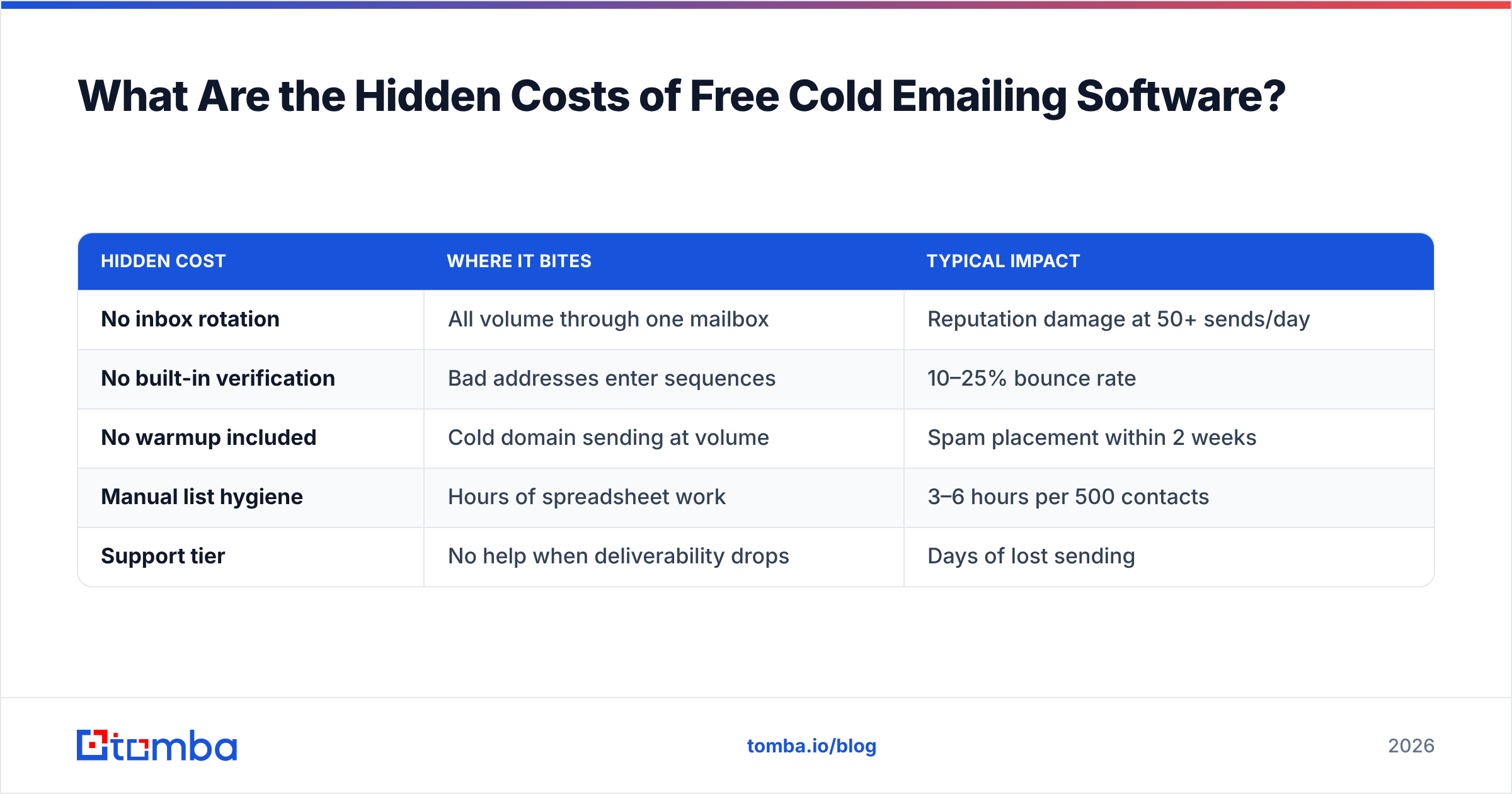
"Free" is a pricing label, not a cost model. The real costs show up in four places.
| Hidden cost | Where it bites | Typical impact |
|---|---|---|
| No inbox rotation | All volume through one mailbox | Reputation damage at 50+ sends/day |
| No built-in verification | Bad addresses enter sequences | 10–25% bounce rate |
| No warmup included | Cold domain sending at volume | Spam placement within 2 weeks |
| Manual list hygiene | Hours of spreadsheet work | 3–6 hours per 500 contacts |
| Support tier | No help when deliverability drops | Days of lost sending |
The spreadsheet time is the one people underestimate. Deduplicating, normalising, and pattern-guessing 500 contacts by hand is roughly a full working day. A bulk email finder run against the same account list takes minutes. If your time is worth anything at all, the free-tool math flips well before you hit the sending cap.
There is also a compliance cost. CAN-SPAM, GDPR, and CASL all apply to cold B2B email, and free tools rarely include suppression-list management or automatic unsubscribe handling. You are responsible either way — the tool's price tag does not change your legal exposure. G2's cold email category is a reasonable place to check which vendors actually ship compliance features versus which just mention them.
When Should You Stop Using Free Tools and Pay?#
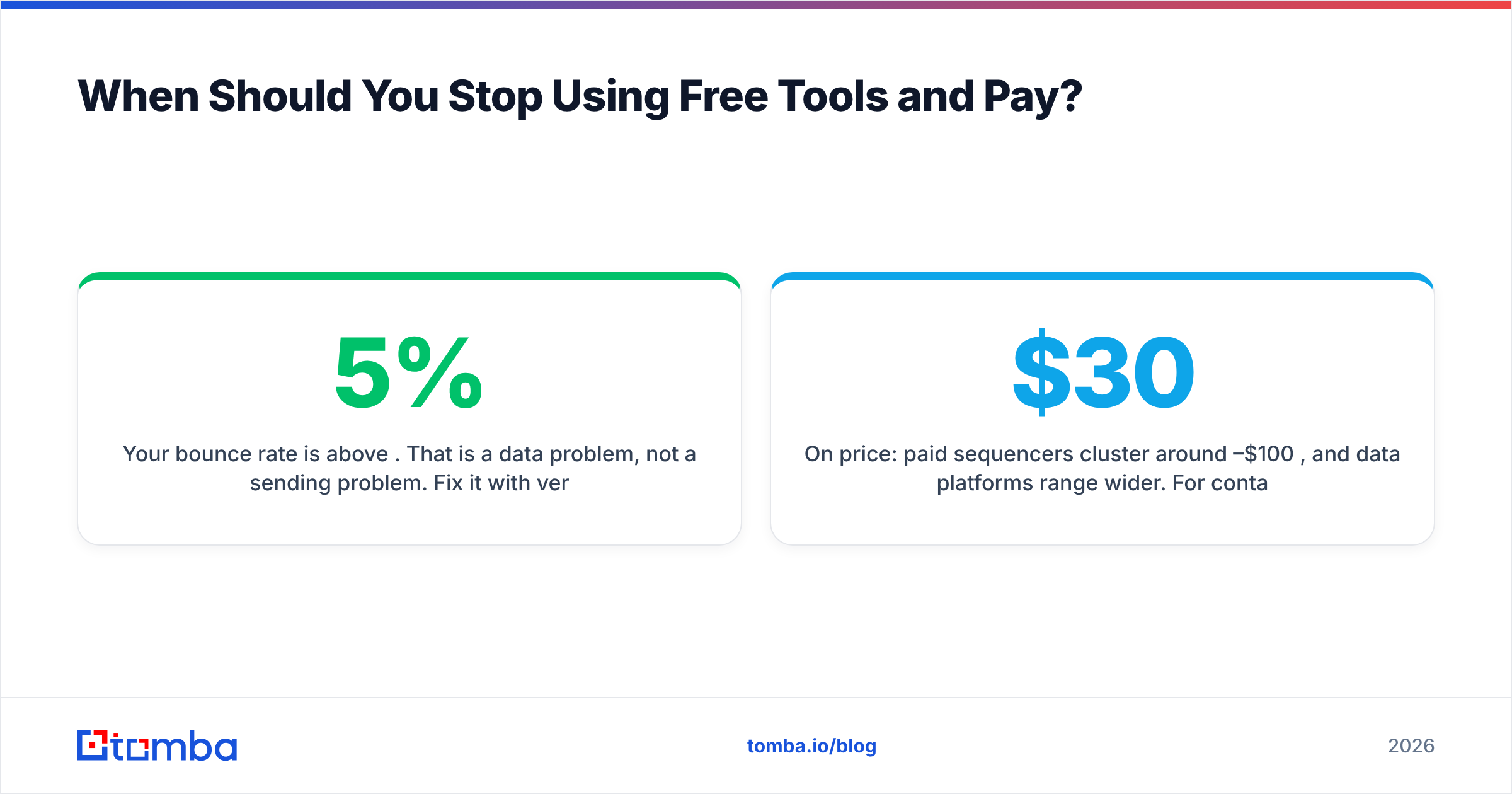
Four clear triggers. Hit any two and free is now costing you more than it saves.
You need more than one sending mailbox. Once your target volume exceeds ~50 sends/day, single-inbox sending is a reputation risk. Rotation is a paid feature everywhere.
Your bounce rate is above 5%. That is a data problem, not a sending problem. Fix it with verified data before you touch anything else.
You are managing more than one campaign at a time. Free tiers give you no meaningful reporting. You cannot tell which sequence is working, so you cannot improve either.
You have a team. Shared inboxes, assignment rules, and reply routing simply do not exist below paid tiers.
On price: paid sequencers cluster around $30–$100 per user per month, and data platforms range wider. For contact data specifically, Tomba pricing starts free at 25 searches a month, then $49/mo for Starter, $99/mo Growth, and $249/mo Pro. That free tier is genuinely useful for testing a list-building workflow before you commit — 25 searches is enough to validate whether the addresses for your target accounts are findable at all.
Worth naming honestly: if your model is buying a static, pre-verified list rather than searching live, a provider like BookYourData is a different and legitimate shape of the same problem — pay-per-record rather than subscription. Which fits depends on whether your ICP is stable (list purchase works) or shifts campaign to campaign (search-based works better).
What Does a Realistic Free-to-Paid Path Look Like?#
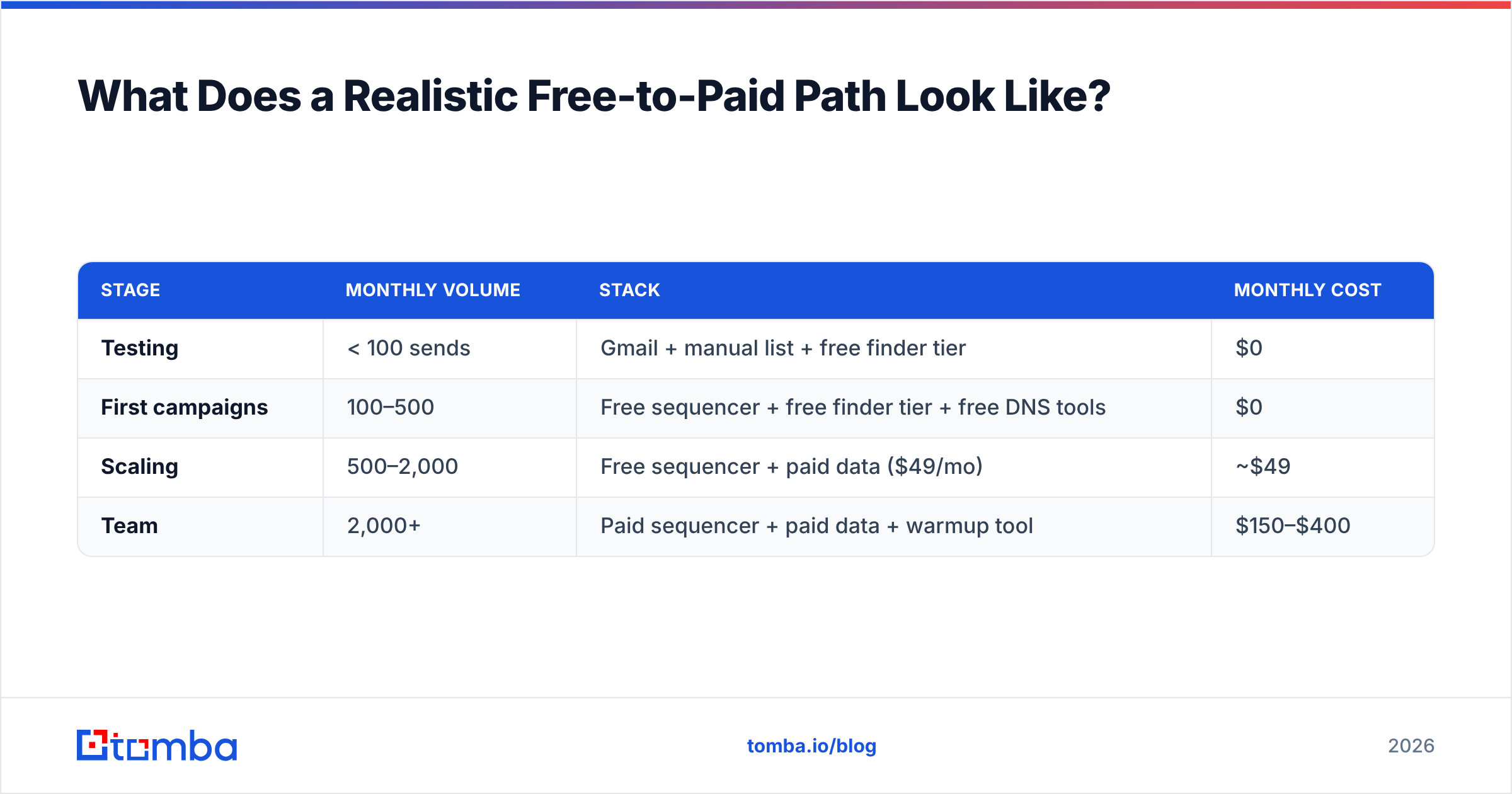
| Stage | Monthly volume | Stack | Monthly cost |
|---|---|---|---|
| Testing | < 100 sends | Gmail + manual list + free finder tier | $0 |
| First campaigns | 100–500 | Free sequencer + free finder tier + free DNS tools | $0 |
| Scaling | 500–2,000 | Free sequencer + paid data ($49/mo) | ~$49 |
| Team | 2,000+ | Paid sequencer + paid data + warmup tool | $150–$400 |
Notice where the first dollar goes: data, not sending. That ordering is deliberate and it is the opposite of what most people do. A free sequencer sending 500 verified emails outperforms a $99/mo sequencer sending 500 guessed ones, every time, because deliverability is upstream of everything else. Your sender reputation is the asset — the software is just a delivery mechanism for it.
What About AI Cold Email Tools — Are Those Free?#
Partly. Generation is cheap; distribution is not.
Free AI writing tools will draft your sequences competently — a cold email AI generator or a subject line generator costs nothing and removes the blank-page problem. What they cannot do is personalise at the account level without data, and account-level data is the part that costs money.
Be careful with fully AI-generated sequences at volume. Filters have gotten good at detecting template patterns, and a sequence that reads like every other AI sequence in the recipient's inbox performs worse than a clumsy human one. Use AI for the first draft and the structure; write the first two lines yourself, informed by something specific about the account. Run the result through a free spam checker before it goes live.
Frequently Asked Questions#
Is there truly unlimited free cold email software? No. Any tool advertising unlimited free sending is either a marketing-email platform that prohibits cold outreach in its terms, or it is using your sending to season shared IP pools. Neither ends well.
Can I just use Gmail for cold email? For under 100 prospects a month, yes — Google Workspace allows around 500 external recipients per day, and a mail-merge add-on handles the mechanics. You lose reply detection and follow-up automation, which becomes painful past about 50 active conversations.
How many emails can I send from a new domain? Start at 10–15 per day and increase roughly 30% weekly. Reaching 100/day safely takes about four weeks. Rushing this is the most common cause of a domain that never recovers.
Do free email finders give worse data than paid ones? Usually not worse per-lookup — they are the same engine with a credit cap. The free tier is a sample of the paid product, so it is a fair way to judge accuracy before paying.
Start With Data, Not Volume#
Free cold emailing software will take you further than most people expect — through validation, through your first fifty conversations, often through your first few customers. The constraint that stops you is never the sender. It is whether the addresses in your list are real.
Test that cheaply. The Tomba Email Finder free tier gives you 25 searches a month with no card required — enough to build a verified micro-list for your top target accounts and see what a clean bounce rate actually feels like. Send those 25 through whatever free sequencer you like, compare the results to your last scraped list, and let the reply rate decide where your first dollar goes.
Related guides#
Ready to find emails that actually work?
Join 150,000+ professionals who stopped guessing and started sending. Free credits on signup — no credit card required.
Get the Tomba newsletter
Practical outbound tactics and product updates — once every two weeks.
About the author