Free Email Validation Checker: What Actually Works in 2026
Free email validation checkers all promise clean lists, but most cap you at 100 credits and guess on catch-all domains. Here is what free tiers actually verify, where they break, and when paid checks pay for themselves.
TL;DR
- A free email validation checker handles syntax, MX records, disposable-domain flags, and basic SMTP probes — that covers roughly 70–80% of the junk in a typical list.
- The remaining 20% is where money burns: catch-all domains, role accounts, greylisted servers, and stale-but-syntactically-perfect addresses.
- Free tiers realistically cap out at 25–100 verifications per month per tool. Rotating across three free checkers to validate a 5,000-row list is a false economy.
- Use free tools for one-off checks, small lists, and testing a vendor's accuracy before you pay. Move to paid the moment your list exceeds ~500 addresses or you're sending from a domain you care about.
- The single highest-ROI move is verifying at capture time — an email verifier on your form beats a bulk cleanup six months later.
What is a free email validation checker?#
A free email validation checker is a tool that tells you whether an email address is likely to accept mail, without charging you — usually up to a monthly credit cap.
The everyday analogy: it's like checking whether a street address exists before mailing a package. You can confirm the street is real (syntax), that the postal service delivers there (MX records), and sometimes whether anyone actually lives at that number (SMTP probe). What you usually can't confirm for free is whether the resident moved out last year.
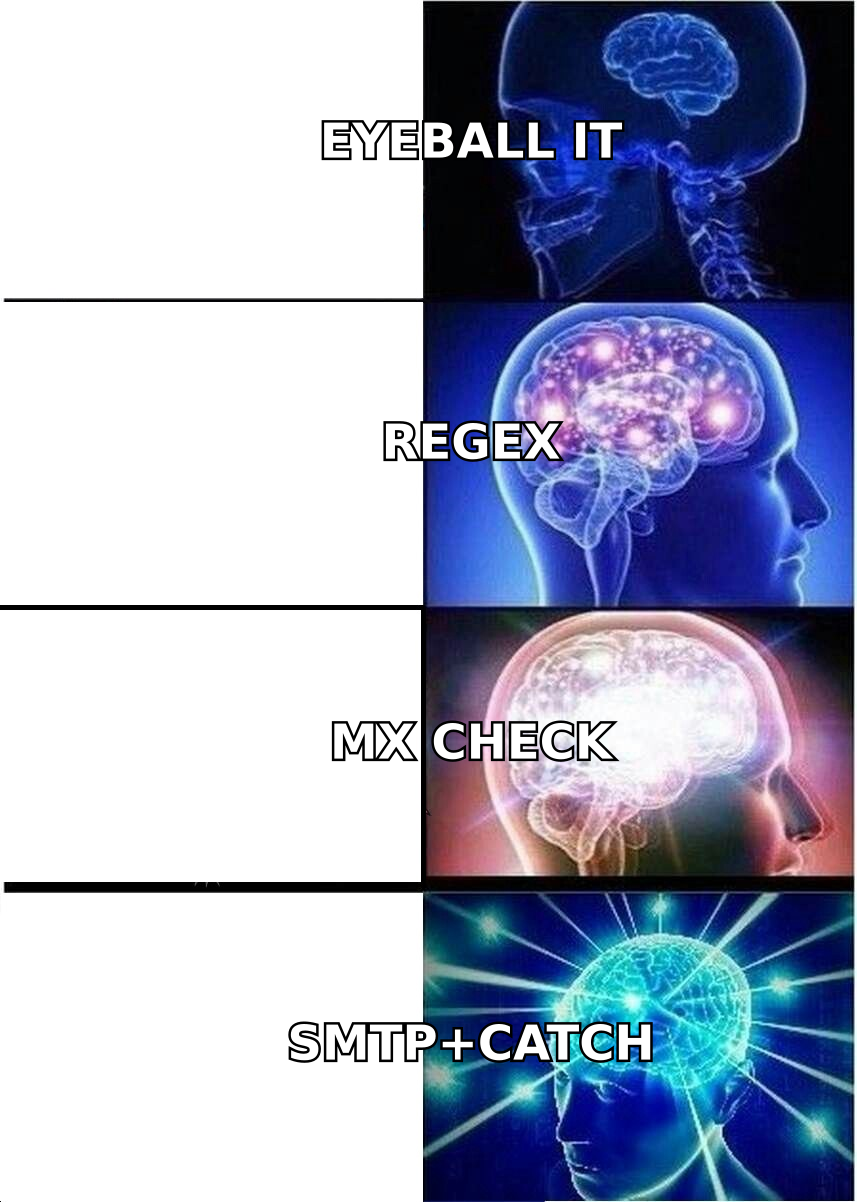
Under the hood, almost every checker runs the same layered sequence. The differences between "free" and "paid" are how many layers run, and how honestly the tool reports the layers it couldn't complete.
- Syntax parsing — Does the address match RFC 5322? Catches typos like
john@@acme.comandjane@acmewith no TLD. Instant, zero cost, and every free tool does it. - Domain and MX lookup — Does
acme.comresolve, and does it publish mail exchanger records? Kills dead domains and parked pages. Still cheap, still universal. - Disposable and role detection — Flags
mailinator.comthrowaways and generic inboxes likeinfo@,sales@,support@. Free tools usually check this against a static list; paid tools update the list weekly. - SMTP handshake — Opens a connection to the receiving server and asks whether the mailbox exists, without sending mail. This is where free tools get rate-limited or blocked, because it requires clean sending IPs.
- Catch-all resolution — Determines whether a domain accepts mail for every address, making the SMTP answer meaningless. Most free tools return "unknown" here and stop. Paid tools apply pattern confidence and historical engagement data.
How accurate is free email validation, really?#
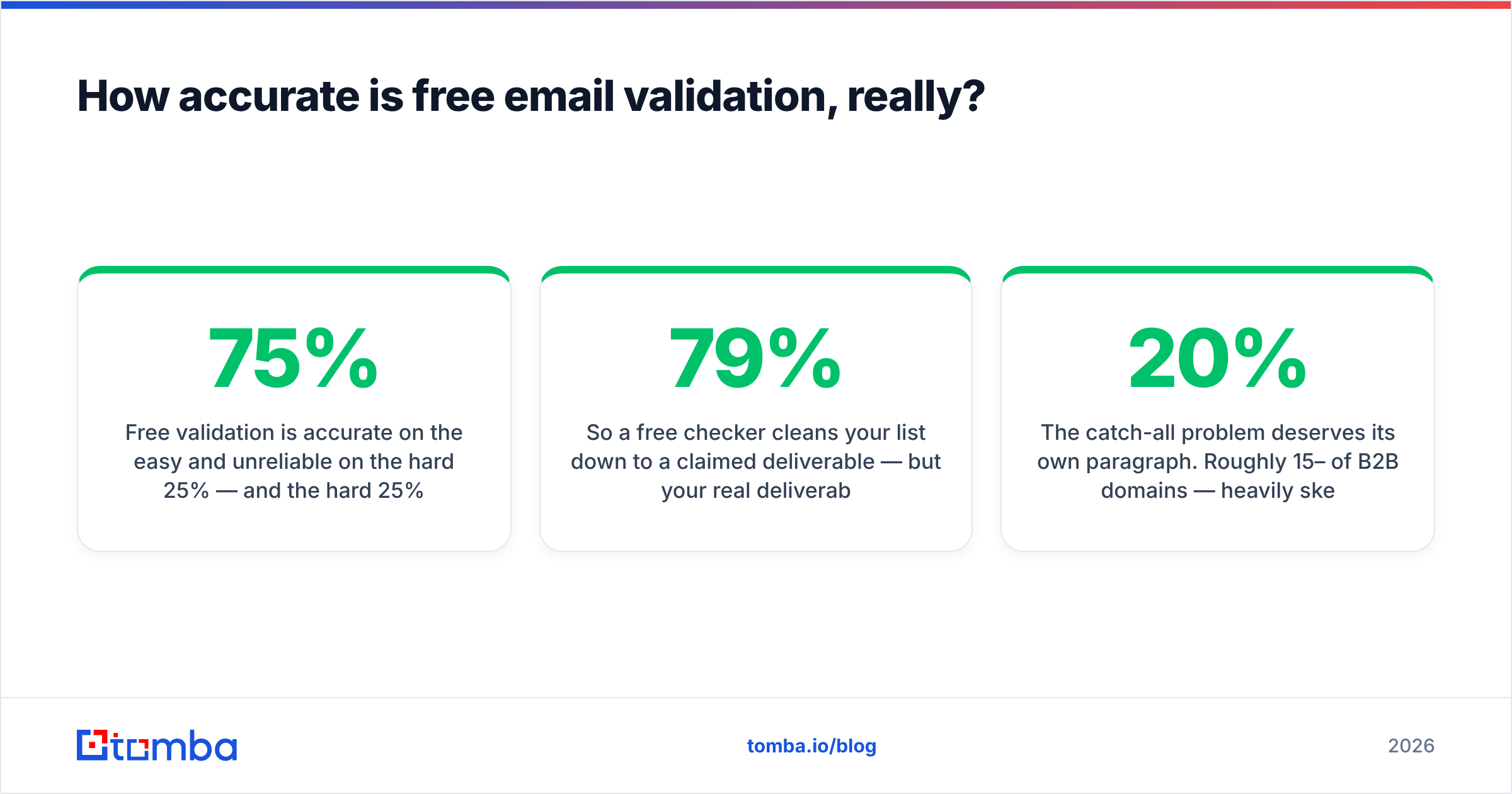
Free validation is accurate on the easy 75% and unreliable on the hard 25% — and the hard 25% is exactly where your bounce rate lives.
Here's the uncomfortable arithmetic. Take a 1,000-address list scraped from LinkedIn and company sites. A typical breakdown after full verification:
- ~120 fail syntax, DNS, or MX. Every free tool catches these.
- ~90 are disposable or role accounts. Most free tools catch these.
- ~140 sit on catch-all domains. Free tools return "unknown."
- ~60 are valid-looking but abandoned mailboxes (person left the company 14 months ago). Free tools almost never catch these.
- The rest are deliverable.
So a free checker cleans your list down to a claimed 79% deliverable — but your real deliverable rate is closer to 69%, and you'll discover the gap only after you've sent. At a 10% surprise bounce rate you're already past the threshold where Google and Microsoft start throttling. Google's Postmaster Tools guidelines are explicit that high invalid-recipient rates damage domain reputation, and that damage outlasts the campaign that caused it.
The catch-all problem deserves its own paragraph. Roughly 15–20% of B2B domains — heavily skewed toward enterprises and agencies — accept mail addressed to anything. asdfgh@bigcorp.com returns "valid" on an SMTP probe. Any tool that reports catch-all addresses as simply "valid" is inflating its own accuracy number at your expense. A dedicated catch-all verifier resolves these using pattern matching and engagement signals rather than the SMTP answer alone, which is the one capability free tiers essentially never include.
What do the free tiers actually give you?#
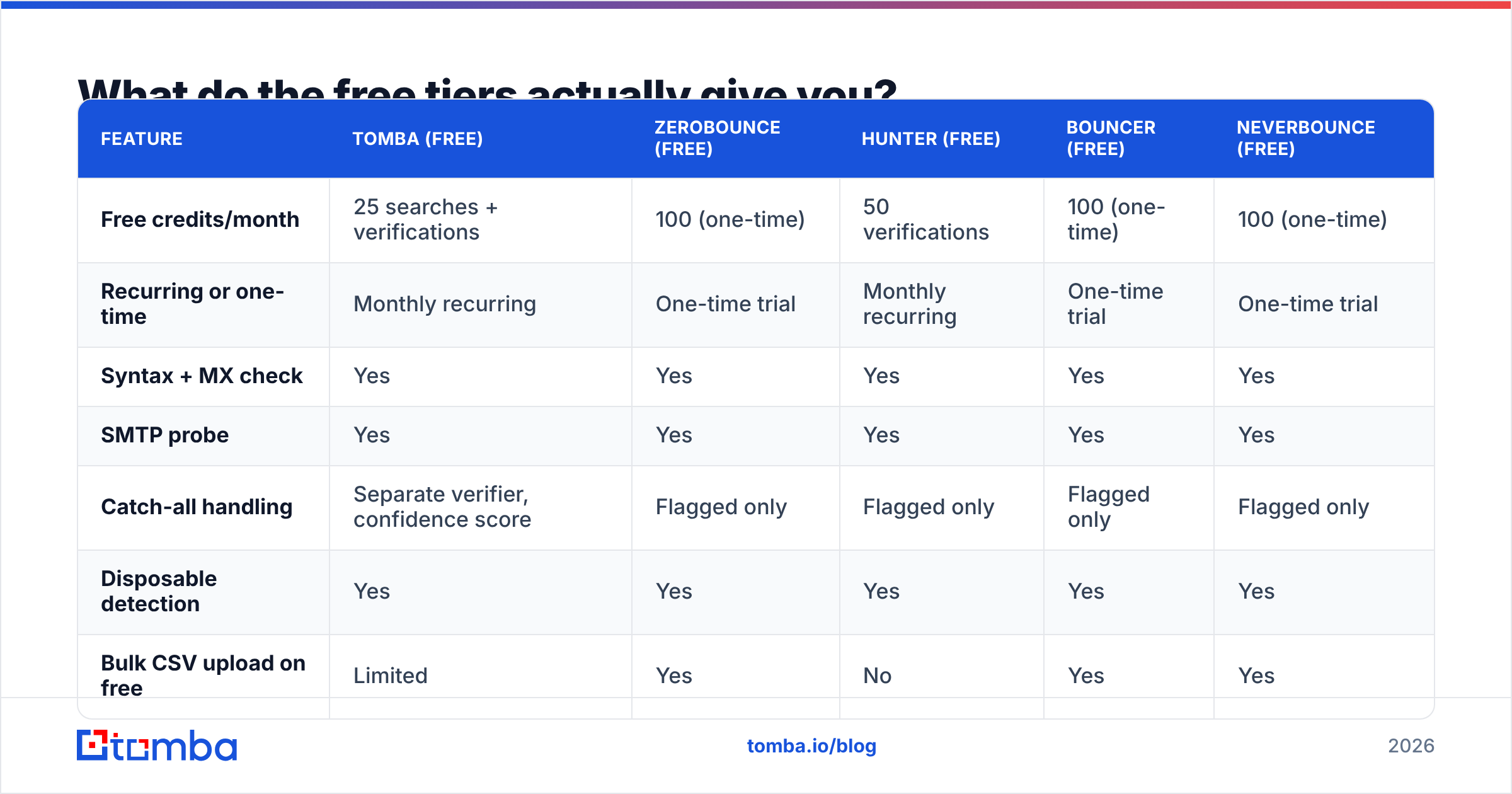
Free plans differ enormously in credits, features, and what they do when they're unsure. This is the comparison that matters when you're picking one.
| Feature | Tomba (Free) | ZeroBounce (Free) | Hunter (Free) | Bouncer (Free) | NeverBounce (Free) |
|---|---|---|---|---|---|
| Free credits/month | 25 searches + verifications | 100 (one-time) | 50 verifications | 100 (one-time) | 100 (one-time) |
| Recurring or one-time | Monthly recurring | One-time trial | Monthly recurring | One-time trial | One-time trial |
| Syntax + MX check | Yes | Yes | Yes | Yes | Yes |
| SMTP probe | Yes | Yes | Yes | Yes | Yes |
| Catch-all handling | Separate verifier, confidence score | Flagged only | Flagged only | Flagged only | Flagged only |
| Disposable detection | Yes | Yes | Yes | Yes | Yes |
| Bulk CSV upload on free | Limited | Yes | No | Yes | Yes |
| API access on free | Yes | Limited | Yes | No | Limited |
| Also finds emails | Yes | No | Yes | No | No |
| Paid entry price | $49/mo | $18/mo (2k credits) | $34/mo | Pay-as-you-go | Pay-as-you-go |
Two structural things to notice.
First, "100 free credits" is usually a one-time trial, not a monthly allowance. Tools that recur monthly (Tomba, Hunter) are more useful for ongoing low-volume work even when the headline number is smaller. Read the fine print before you build a workflow around a number.
Second, verification-only tools and find-plus-verify tools solve different problems. If you already have a list, a pure verifier is fine. If you're building the list, a tool that runs domain search and verification in one pass saves you an export/import cycle and a second vendor relationship. That matters more than a few dollars of credit pricing.
Worth naming a category that sits outside both: pre-verified database vendors. BookYourData, for example, sells contacts that ship already validated with a bounce guarantee, which is a genuinely different buying decision from renting a verification API. If your bottleneck is sourcing rather than cleaning, that model can be the cheaper path — it's not a competitor to verification so much as a different place to spend the same budget.
When should you stop using free tools?#
Stop when the cost of a bad send exceeds the cost of verification — which happens far earlier than most people assume.
Run the math on your own numbers. A paid verification credit costs roughly $0.001–$0.008 depending on volume. Verifying 5,000 addresses costs $5–$40. A domain reputation recovery — where you pause sending, warm a new domain, and rebuild for 4–8 weeks — costs you an entire quarter of pipeline. The break-even isn't close.
Concrete triggers to move off free:
- Your list exceeds 500 addresses. Below that, free monthly credits plus patience works. Above it, you're rotating accounts and wasting hours.
- You're sending from your primary domain. Reputation damage on
yourcompany.comaffects invoices and support replies, not just outbound. - More than 10% of your list is on catch-all domains. Free tools can't resolve these, so you're flying blind on a fifth of your list.
- You need verification inside a workflow. Free API tiers throttle hard. If verification runs on form submit or CRM sync, you need reliable rate limits.
- You're buying or inheriting a list. Assume nothing about its age. Full bulk verify before the first send, every time.

How do you use free checkers without wasting them?#
Treat free credits as a testing budget, not a production budget. Three tactics that get real value out of 25–100 credits.
1. Use free credits to audit the vendor, not the list. Build a 30-address control set where you already know the truth: 10 addresses you've successfully emailed this month, 10 you know bounced, 10 on known catch-all domains. Run it through each candidate tool. The tool that correctly flags your known-bad addresses and honestly says "unknown" on the catch-alls is the one worth paying for. A tool that confidently calls all 10 catch-alls "valid" is telling you it optimizes for a pretty accuracy stat.
2. Validate at capture, not in batch. A free email checker on a signup form catches typos while the user is still there to fix them. gmial.com corrected at capture costs nothing; discovered six months later it's a dead record you paid to store, sync, and eventually verify again.
3. Deduplicate before you verify. This is the most-skipped step and the cheapest win. Lists assembled from multiple sources routinely carry 8–15% duplicates, often with formatting variance (John.Smith@acme.com vs john.smith@acme.com). Run a remove duplicates pass first and you may cut your verification volume by a tenth before spending a single credit.
One more thing free tools rarely tell you: verification has a shelf life. B2B contact data decays at roughly 22–30% per year as people change jobs — a figure consistently reported across data-quality research from Gartner and vendor benchmarks alike. An address verified in January is a guess by October. Re-verify anything older than 90 days before a send, or accept the bounce.
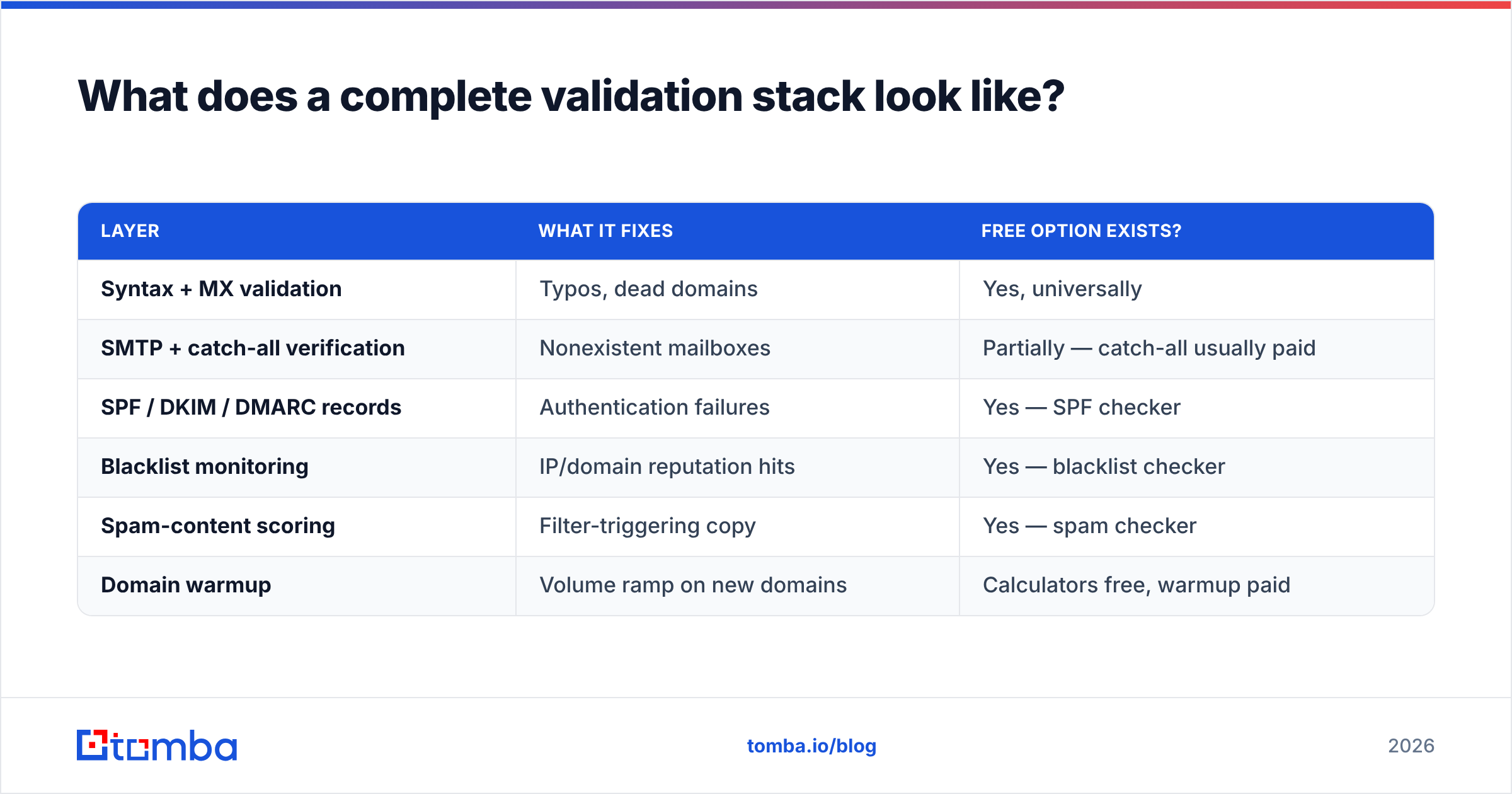
What does a complete validation stack look like?#
Verification is one layer. If your bounce rate is fine but replies still aren't landing, the problem is upstream or downstream of the checker.
| Layer | What it fixes | Free option exists? |
|---|---|---|
| Syntax + MX validation | Typos, dead domains | Yes, universally |
| SMTP + catch-all verification | Nonexistent mailboxes | Partially — catch-all usually paid |
| SPF / DKIM / DMARC records | Authentication failures | Yes — SPF checker |
| Blacklist monitoring | IP/domain reputation hits | Yes — blacklist checker |
| Spam-content scoring | Filter-triggering copy | Yes — spam checker |
| Domain warmup | Volume ramp on new domains | Calculators free, warmup paid |
The order matters. Verify the list, then confirm authentication, then check the content. Fixing copy while your DMARC record is broken is rearranging furniture in a house with no roof. If you're unsure where you stand, run the free SPF and blacklist checks first — they take two minutes and rule out the highest-severity problems before you spend anything on credits.
It's also worth being precise about what verification does not promise. A verified address means the mailbox exists and will accept mail. It does not mean the message lands in the primary inbox, that the person is the right buyer, or that the address wasn't harvested in a way that makes contacting it legally risky. Email deliverability is a separate discipline that starts after verification succeeds.
Which free email validation checker should you pick?#
Pick by what you'll do next, not by credit count.
- One-off check of a handful of addresses → any free browser tool. Don't create an account.
- Ongoing small-volume work (under 25/month) → a recurring free tier beats a larger one-time trial. You want the credits to come back next month.
- Evaluating vendors before committing → the largest one-time trial, spent on a control set you already know the answers to.
- Finding and verifying → a combined tool. Two vendors for one workflow is friction you'll pay for weekly.
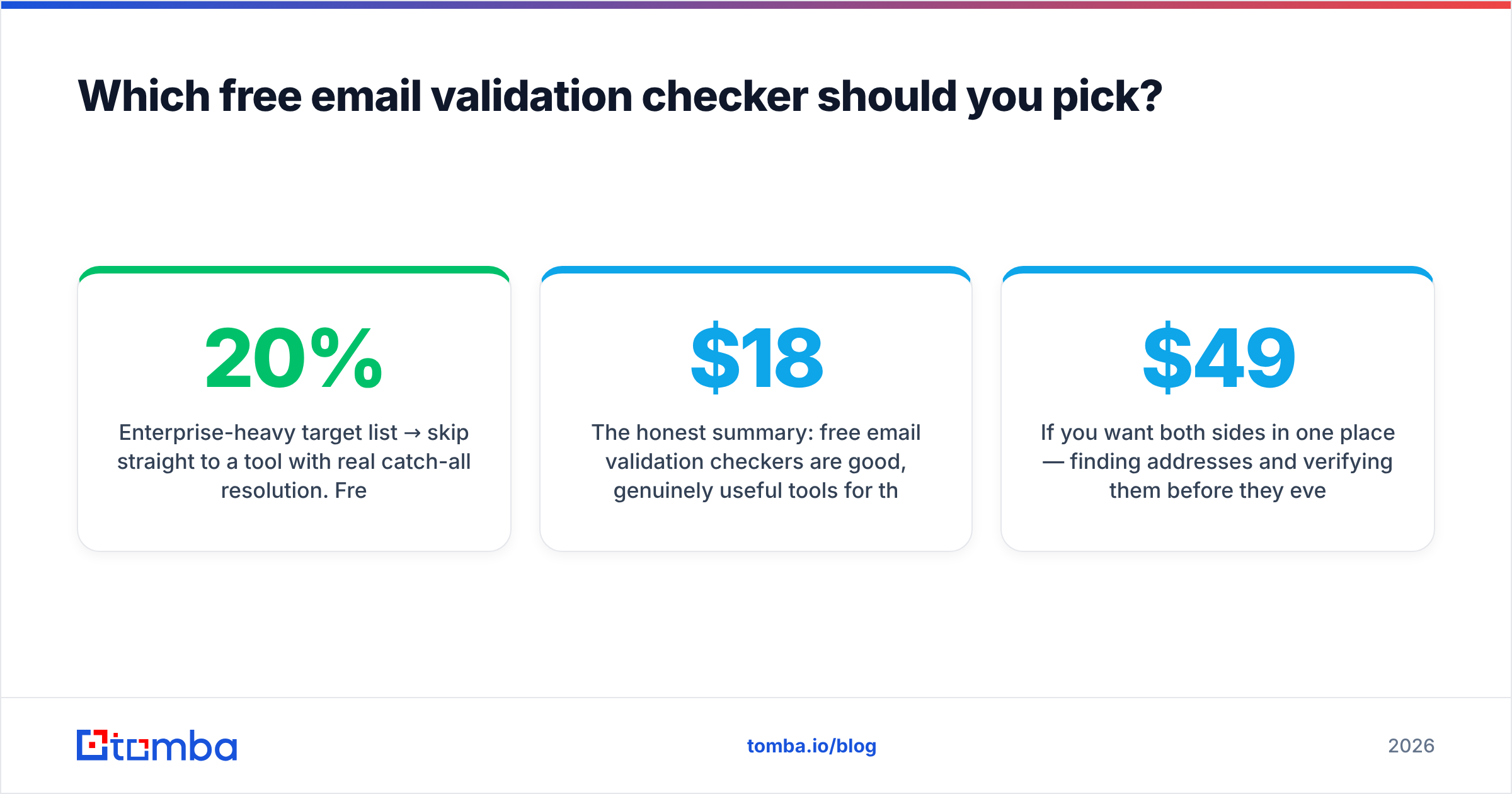
- Enterprise-heavy target list → skip straight to a tool with real catch-all resolution. Free tiers won't answer your hardest 20%.
The honest summary: free email validation checkers are good, genuinely useful tools for the problem they solve — and they solve about three-quarters of the problem. The last quarter is catch-all domains, decayed mailboxes, and the confidence scoring that separates "probably fine" from "definitely fine." That quarter is what paid tiers sell, and whether it's worth $18 or $49 a month depends entirely on whether a damaged sending domain would cost you more than that.
If you want both sides in one place — finding addresses and verifying them before they ever hit your sequence — start with the Tomba Email Finder. The free tier gives you 25 searches and verifications a month with no card, the email verification API is available on every plan including free, and paid plans start at $49/mo when your volume outgrows the trial. Test it against a control set you already know the answers to. That's the only benchmark that matters. Full Tomba pricing is public if you want to run the break-even math yourself.
Related guides#
Ready to find emails that actually work?
Join 150,000+ professionals who stopped guessing and started sending. Free credits on signup — no credit card required.
Get the Tomba newsletter
Practical outbound tactics and product updates — once every two weeks.
About the author