G-Lock EasyMail7 vs Apollo.io: Which Fits Your 2026 Stack?
One is a self-hosted Windows bulk sender you own outright. The other is a cloud sales platform with a 200M+ contact database. They solve different problems — here is how to pick, and what neither one fixes.
TL;DR
- They are not really competitors. G-Lock EasyMail7 is self-hosted Windows email-marketing software you install and own. Apollo.io is a cloud sales platform bundling a B2B contact database, sequencing, dialer, and CRM sync.
- Pick EasyMail7 if you already have a permission-based list, want a perpetual license instead of a per-seat subscription, and care about keeping subscriber data on your own machine.
- Pick Apollo.io if your bottleneck is finding prospects, not sending to them, and you need multi-channel sequences plus rep-level reporting.
- Neither one fixes your data quality. EasyMail7 sends whatever list you feed it; Apollo's database goes stale like every database does. Verification is a separate job.
- The cheapest working stack is often a dedicated data layer (email finding + verification) feeding whichever sender fits your compliance posture.
What are G-Lock EasyMail7 and Apollo.io, exactly?#
Start here, because the naming makes them sound more alike than they are.
G-Lock EasyMail7 is desktop email-marketing software from G-Lock Software. You install it on a Windows machine (or a Windows server), it stores your contact lists locally in its own database, and it sends through SMTP accounts you connect — your Google Workspace, Amazon SES, SendGrid, Mailgun, or an internal mail server component that ships with some editions. There is no monthly per-subscriber fee, because there is no vendor cloud holding your list. Think of it like owning a printing press instead of renting time at a print shop: higher setup effort, no meter running.
Apollo.io sits at the opposite end. It is a cloud go-to-market platform whose headline asset is a contact database in the hundreds of millions of records, wrapped in sequencing, an integrated dialer, LinkedIn extension, meeting scheduler, deal tracking, and two-way sync with HubSpot and Salesforce. You do not bring a list to Apollo — you build one inside it using filters, then push those contacts straight into a sequence.
So the honest framing of G-Lock EasyMail7 vs Apollo.io is: do you have a data problem or a sending problem? Answer that first and the comparison mostly resolves itself.
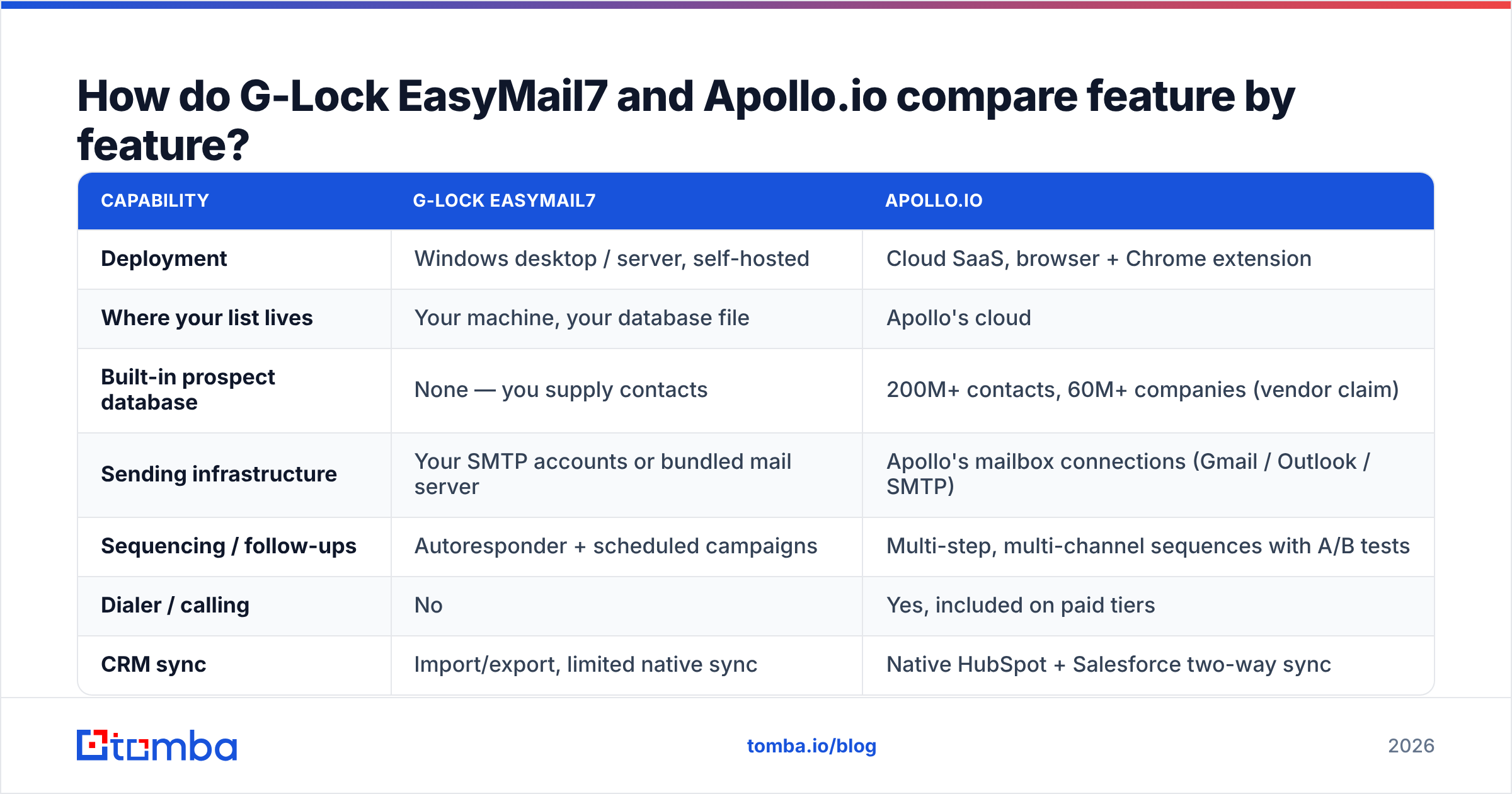
How do G-Lock EasyMail7 and Apollo.io compare feature by feature?#
| Capability | G-Lock EasyMail7 | Apollo.io |
|---|---|---|
| Deployment | Windows desktop / server, self-hosted | Cloud SaaS, browser + Chrome extension |
| Where your list lives | Your machine, your database file | Apollo's cloud |
| Built-in prospect database | None — you supply contacts | 200M+ contacts, 60M+ companies (vendor claim) |
| Sending infrastructure | Your SMTP accounts or bundled mail server | Apollo's mailbox connections (Gmail / Outlook / SMTP) |
| Sequencing / follow-ups | Autoresponder + scheduled campaigns | Multi-step, multi-channel sequences with A/B tests |
| Dialer / calling | No | Yes, included on paid tiers |
| CRM sync | Import/export, limited native sync | Native HubSpot + Salesforce two-way sync |
| Personalization | Merge fields, conditional blocks | Merge fields, AI-written variants, dynamic snippets |
| Email verification | Basic list cleaning / bounce handling | Bundled verification against its own records |
| Reporting | Opens, clicks, bounces per campaign | Rep-level activity, sequence analytics, pipeline attribution |
| Best-fit team size | 1–5 people, technical operator | 5–500 reps with a sales manager |
| Licence model | Perpetual desktop licence + paid upgrades | Per-user subscription, annual discount |
The pattern is clear. EasyMail7 is deep on sending mechanics and shallow on pipeline management. Apollo is the reverse: it will happily orchestrate a twelve-touch sequence across email, calls, and LinkedIn, but it gives you almost no control over the sending substrate beyond connecting a mailbox.
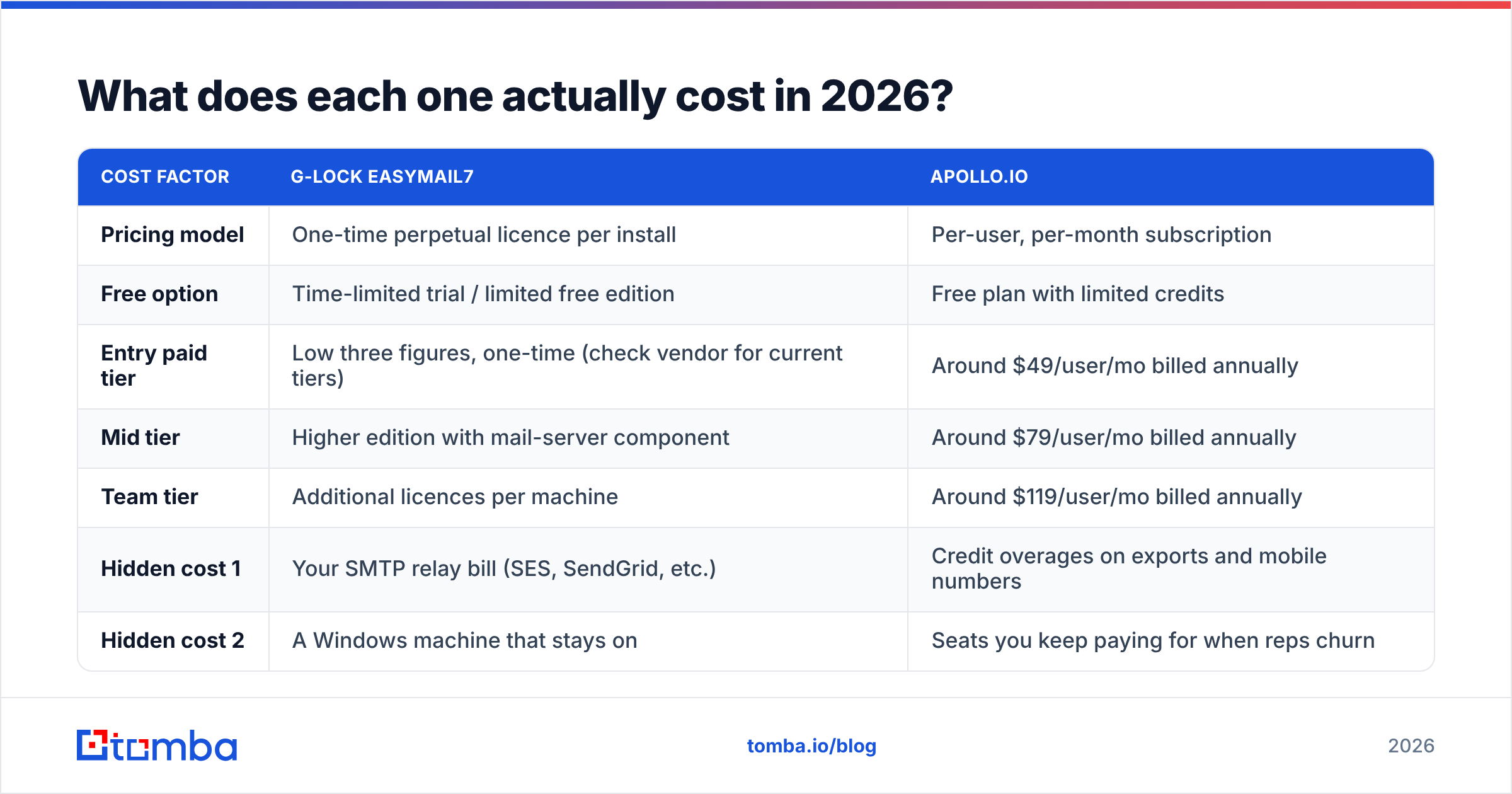
What does each one actually cost in 2026?#
Pricing is where the two models diverge hardest, and where a lot of teams miscalculate.
| Cost factor | G-Lock EasyMail7 | Apollo.io |
|---|---|---|
| Pricing model | One-time perpetual licence per install | Per-user, per-month subscription |
| Free option | Time-limited trial / limited free edition | Free plan with limited credits |
| Entry paid tier | Low three figures, one-time (check vendor for current tiers) | Around $49/user/mo billed annually |
| Mid tier | Higher edition with mail-server component | Around $79/user/mo billed annually |
| Team tier | Additional licences per machine | Around $119/user/mo billed annually |
| Hidden cost 1 | Your SMTP relay bill (SES, SendGrid, etc.) | Credit overages on exports and mobile numbers |
| Hidden cost 2 | A Windows machine that stays on | Seats you keep paying for when reps churn |
| Hidden cost 3 | Major-version upgrade fees | Annual lock-in on most discounted plans |
Always re-check current numbers on the vendor pages before you budget — SaaS tiers move, and Apollo has restructured its credit system more than once. Third-party review aggregators like G2 are useful for spotting the gap between advertised pricing and what buyers report actually paying.
The five-seat math is worth doing in your head. Five Apollo Professional seats runs roughly $4,700 a year. Five EasyMail7 installs is a one-time spend plus your relay costs — dramatically cheaper on paper. But that comparison is only fair if you already have the contact data. If you would be buying lists or paying a separate data vendor to feed EasyMail7, add that line back in before declaring a winner.
Which one should you actually choose?#
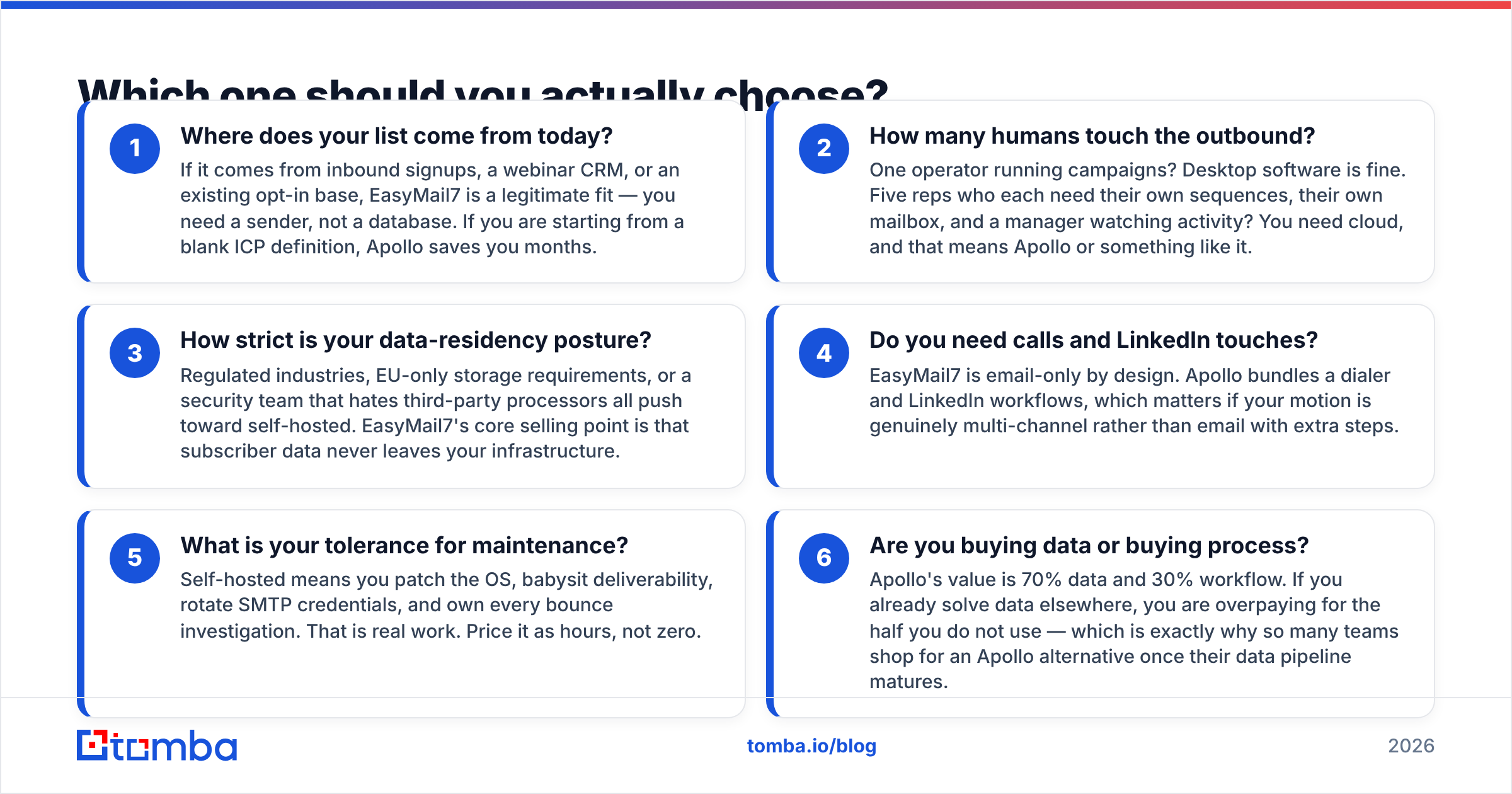
Here is the decision framework, ordered by how much weight each factor usually deserves:
- Where does your list come from today? If it comes from inbound signups, a webinar CRM, or an existing opt-in base, EasyMail7 is a legitimate fit — you need a sender, not a database. If you are starting from a blank ICP definition, Apollo saves you months.
- How many humans touch the outbound? One operator running campaigns? Desktop software is fine. Five reps who each need their own sequences, their own mailbox, and a manager watching activity? You need cloud, and that means Apollo or something like it.
- How strict is your data-residency posture? Regulated industries, EU-only storage requirements, or a security team that hates third-party processors all push toward self-hosted. EasyMail7's core selling point is that subscriber data never leaves your infrastructure.
- Do you need calls and LinkedIn touches? EasyMail7 is email-only by design. Apollo bundles a dialer and LinkedIn workflows, which matters if your motion is genuinely multi-channel rather than email with extra steps.
- What is your tolerance for maintenance? Self-hosted means you patch the OS, babysit deliverability, rotate SMTP credentials, and own every bounce investigation. That is real work. Price it as hours, not zero.
- Are you buying data or buying process? Apollo's value is 70% data and 30% workflow. If you already solve data elsewhere, you are overpaying for the half you do not use — which is exactly why so many teams shop for an Apollo alternative once their data pipeline matures.
Is Apollo.io's built-in database good enough on its own?#
Partly. And "partly" is the expensive word.
Apollo's coverage of US mid-market and tech is genuinely strong. Coverage thins out for smaller European companies, non-English markets, and roles that change hands frequently. Every large B2B database is a snapshot of a world where roughly a quarter of professionals change jobs each year, which means a record that was perfect in January is a guess by October.
That decay hits both tools, just differently:
- With Apollo, you export a contact, the sequence fires, the mailbox bounces, and your domain reputation absorbs the hit.
- With EasyMail7, you import a CSV that someone assembled six months ago and the same thing happens at higher volume, because desktop senders make it very easy to blast a large list quickly.
The fix in both cases is the same: a verification pass immediately before send, not at import time. Running a list through an independent email verifier catches the records that went stale between sourcing and sending. If you send to catch-all domains — common in enterprise — you also want a catch-all verifier, because a plain SMTP check returns "accepted" for every address on those domains and tells you nothing.

How do the two tools affect deliverability?#
Differently enough that it should influence your choice.
Apollo connects to your real mailbox (Google Workspace or Microsoft 365) and sends as you, with per-mailbox daily limits. That is good for reputation — you inherit your domain's existing standing — but it also means a bad list burns your primary domain unless you set up dedicated sending domains first.
EasyMail7 hands you the throttle. You choose the relay, the send rate, the connection count, and the retry logic. Used carefully, that control is an advantage: you can warm slowly, segment by ISP, and route different campaigns through different relays. Used carelessly, it is a foot-gun, because nothing stops you from firing 20,000 messages an hour through a cold SES identity.
Whichever you pick, the deliverability fundamentals do not change. Authenticate properly — Google and Yahoo have required SPF, DKIM, and DMARC alignment for bulk senders since 2024, and enforcement has only tightened since. Keep hard bounces under 2%. Warm new domains for at least three weeks. If you are unsure where your records stand, run a quick SPF checker pass before your next campaign, and audit your sender reputation monthly rather than after a deliverability incident.
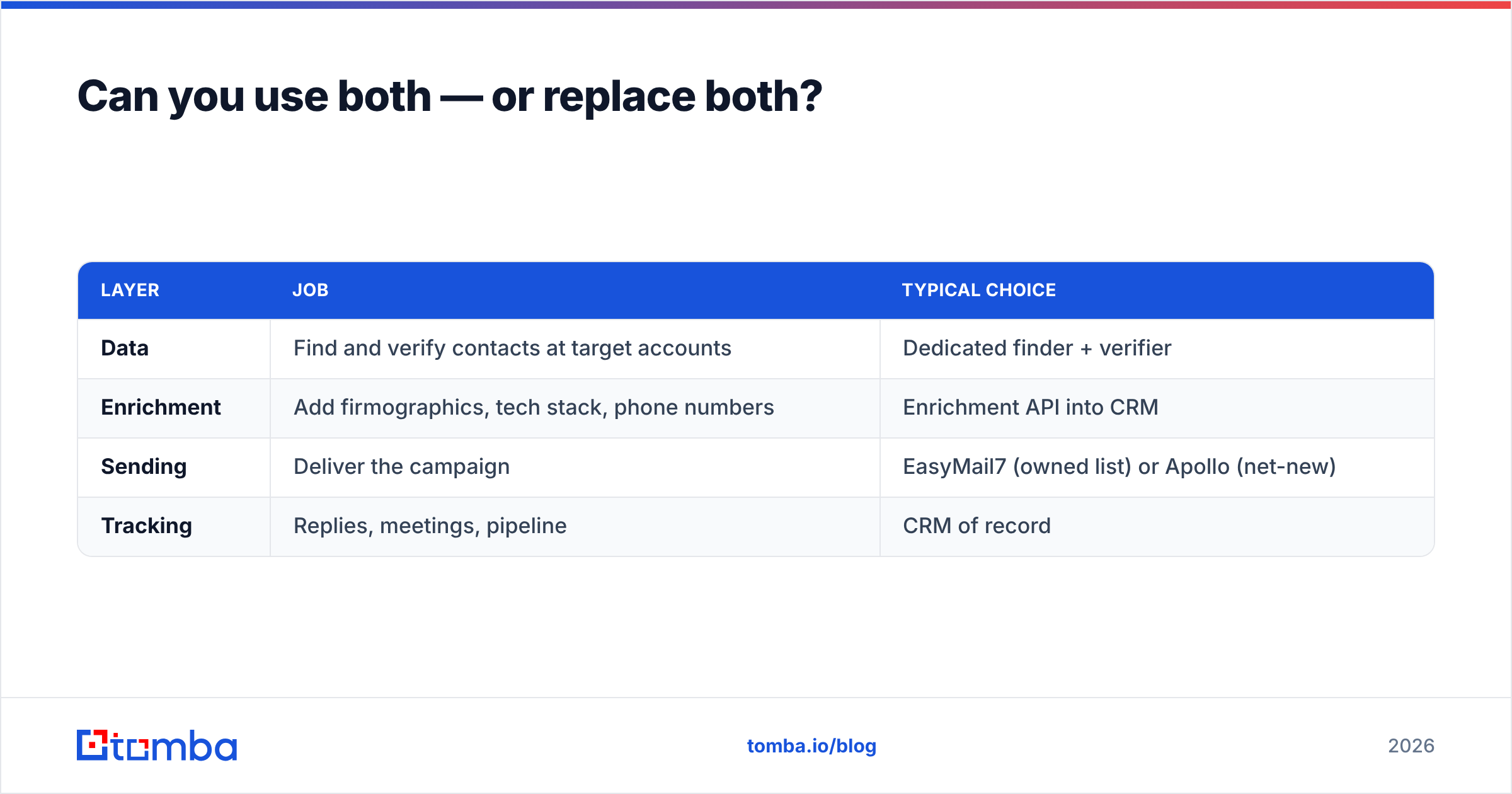
Can you use both — or replace both?#
Plenty of teams run a hybrid, and it usually looks like this:
| Layer | Job | Typical choice |
|---|---|---|
| Data | Find and verify contacts at target accounts | Dedicated finder + verifier |
| Enrichment | Add firmographics, tech stack, phone numbers | Enrichment API into CRM |
| Sending | Deliver the campaign | EasyMail7 (owned list) or Apollo (net-new) |
| Tracking | Replies, meetings, pipeline | CRM of record |
Splitting the data layer out is what makes the "replace both" option viable. If you use a standalone provider for finding and verifying addresses, EasyMail7 becomes a perfectly capable sender for owned lists, and Apollo's per-seat cost becomes optional rather than structural.
That is where a focused data tool earns its place. Tomba runs on a different model than either product here: Tomba pricing starts with a free tier at 25 searches per month, then Starter at $49/mo, Growth at $99/mo, and Pro at $249/mo — priced by usage, not by seat, so a three-person team and a thirty-person team pay for the same volume the same way. You can pull contacts by company with domain search, clean an existing list in bulk with the bulk email finder, and push results straight into your sender via the Tomba API or a Google Sheet.
What are the biggest trade-offs to accept?#
Be honest with yourself about these before you commit.
- Choosing EasyMail7 means owning deliverability yourself. No vendor support team will diagnose why Outlook started foldering your mail. That is now your Tuesday.
- Choosing Apollo means renting your prospect data. Cancel the subscription and the workflow stops, though exported contacts remain yours subject to their terms.
- Choosing EasyMail7 means Windows. If your team is on macOS, you are running a VM or a cloud Windows instance, and that is an ongoing cost plus an ongoing annoyance.
- Choosing Apollo means per-seat economics. Costs scale with headcount, not with results, which stings during a hiring freeze.
- Choosing either without a verification step means paying for bounces twice — once in wasted sends, once in reputation damage that takes months to repair.
Frequently asked questions#
Is G-Lock EasyMail7 still actively developed? G-Lock Software has shipped EasyMail7 for years and continues to publish updates. Check the vendor's changelog for the current release cadence before purchasing a perpetual licence — active maintenance matters more for self-hosted software than for SaaS.
Does Apollo.io include email verification? It validates contacts against its own records and flags likely-bad addresses, but it is not a substitute for an independent verification pass immediately before sending, especially on records that have been sitting in your CRM.
Can EasyMail7 send cold outbound? Technically yes. Legally and practically, it depends entirely on your jurisdiction and consent basis. Self-hosting does not exempt you from CAN-SPAM, GDPR, or CASL.
Which is better for a solo founder? If you have a list: EasyMail7, easily, on cost. If you do not: Apollo's free tier or a usage-based data tool will get you further faster.
Where should you start?#
Solve the data layer first, then pick a sender. Almost every team that regrets its choice here got the order backwards — they bought a platform, then discovered the addresses inside it bounced, or bought a sender and had nothing good to send to.
Start by testing coverage on accounts you actually care about. Run twenty target companies through the Tomba Email Finder, check the confidence scores and sources against what you already know, and see how many verified addresses come back. Twenty-five searches a month are free, no card required — enough to prove or disprove the data layer before you sign anything with a per-seat price tag or a perpetual licence attached to it.
Related guides#
Ready to find emails that actually work?
Join 150,000+ professionals who stopped guessing and started sending. Free credits on signup — no credit card required.
Get the Tomba newsletter
Practical outbound tactics and product updates — once every two weeks.
About the author