Gamalogic Alternatives: 9 Email Finder Tools Compared 2026
Gamalogic is cheap and API-first, but coverage gaps and thin enrichment push teams to look elsewhere. Here are 9 Gamalogic alternatives compared on accuracy, pricing, and credit rules.
TL;DR
- Gamalogic is a low-cost, API-first email finder and verifier. It's fine for simple first-name/last-name/domain lookups, but coverage thins out on non-US domains, catch-all servers, and anything requiring enrichment beyond an email address.
- The main reasons teams look for Gamalogic alternatives: hit rate on hard domains, no meaningful enrichment (title, LinkedIn, phone), limited native integrations, and support latency.
- If you want breadth of data plus verification in one workflow, Tomba, Hunter, and Findymail are the closest functional replacements. Tomba starts at $49/mo with a free 25-search tier.
- If you buy lists rather than search them, BookYourData is a different model entirely — pay-per-record, no subscription — and often cheaper for one-off campaigns.
- Don't pick on price per credit alone. Compare cost per verified, deliverable contact, which is what actually lands in your sequence.
What is Gamalogic and who actually uses it?#
Gamalogic is a bulk email finder and email verification service aimed at developers and lean growth teams. You feed it a name and a domain, or upload a CSV, and it returns candidate email addresses with a validity signal. It also runs standalone verification on lists you already own, and exposes an API for programmatic use.
The pitch is straightforward: low price per credit, no bloated seat-based platform, an API you can wire into a script in an afternoon. For a solo founder scraping a few thousand company domains, that's a reasonable place to start.
The problems show up at scale. Email finders live or die on their underlying data — crawled pages, contributed contacts, pattern libraries, and SMTP behavior modeling. Smaller vendors typically lean hard on pattern permutation plus SMTP ping: guess first.last@domain.com, then ask the mail server if it exists. That approach works beautifully on Google Workspace domains with open SMTP responses and collapses on Microsoft 365 tenants, catch-all configurations, and anything behind Proofpoint or Mimecast.
That's the real reason people search for Gamalogic alternatives. Not price — coverage.

Why do teams switch away from Gamalogic?#
Five recurring complaints, in rough order of how often they trigger a switch:
- Coverage on hard domains. Enterprise mail servers that accept all recipients (catch-all) return "valid" for addresses that don't exist. Without a dedicated catch-all handling layer, you either discard those contacts or bounce on them.
- No enrichment beyond the email. Modern outbound needs job title, seniority, company size, LinkedIn URL, and often a phone number. If the tool returns only an email string, you're paying a second vendor to fill the rest.
- Thin native integrations. If your workflow is HubSpot → sequence tool → CRM, you want a native connector, not a Zapier chain you maintain yourself.
- Credit accounting. Some finders charge a credit for a search attempt, not a successful result. On a 5,000-row list with a 55% hit rate, that's a 45% tax you didn't budget for.
- Support responsiveness. Small teams, small support surface. Fine until a batch job silently fails mid-run.
None of these makes Gamalogic a bad tool. They make it a narrow tool. Know which of the five is your blocker before you shop, because the right alternative differs sharply depending on which one hurts.
Which Gamalogic alternatives are worth evaluating in 2026?#
Here's the shortlist, grouped by what they're actually good at.
Search-first email finders (closest to Gamalogic)#
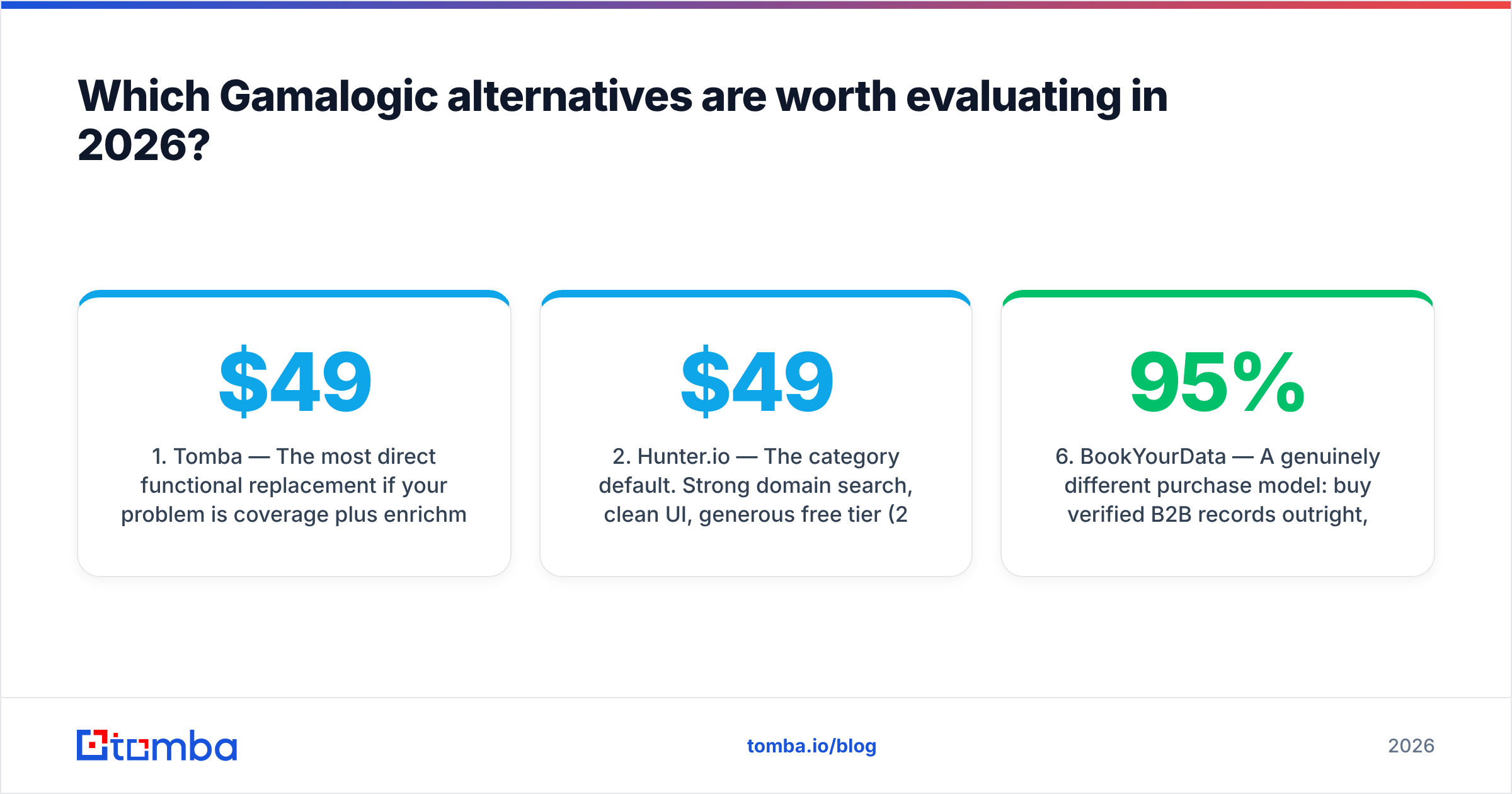
1. Tomba — The most direct functional replacement if your problem is coverage plus enrichment. Tomba runs an email finder, email verifier, domain search, catch-all verifier, phone finder, and data enrichment under one account, so a single credit-buying decision covers the whole chain. There's a free tier at 25 searches/month, Starter at $49/mo, Growth at $99/mo, and Pro at $249/mo. The API, CLI, Chrome extension, and Sheets/Excel add-ins mean you can keep whatever workflow you already built around Gamalogic's API.
2. Hunter.io — The category default. Strong domain search, clean UI, generous free tier (25 searches/mo), well-documented API. Weaker on enrichment depth and phone data. Pricing starts around $49/mo.
3. Findymail — Built specifically for cold email agencies, with a hard focus on low bounce rates and native Lemlist/Instantly/Smartlead pushes. Charges only for found contacts. Less useful if you need enrichment or firmographics.
4. Prospeo — LinkedIn-centric extraction with solid mobile-number coverage. Good if your prospecting starts in Sales Navigator rather than from a domain list.
Database-first platforms (different model)#
5. Apollo.io — 275M+ contact database, sequencer, dialer, and basic CRM in one. Heavier and pricier than a pure finder, and the data quality varies by segment, but you replace three tools. If you're weighing it, the Apollo alternative breakdown covers the trade-offs in detail.
6. BookYourData — A genuinely different purchase model: buy verified B2B records outright, pay per record, no subscription, with a 95%+ accuracy guarantee and credits refunded on bounces. If your need is "give me 3,000 verified CFOs in German manufacturing" rather than "look up this specific person," it's often the cheapest and fastest path. It's a list-buying platform, not a lookup API — pick it for volume acquisition, not for enriching a CRM row by row.
7. RocketReach — Broad coverage across 700M+ profiles, strong on personal emails and phone numbers. Credit costs add up fast on bulk work.
Verification-first tools (if that's your actual gap)#
8. ZeroBounce — If your issue is list hygiene rather than discovery, a dedicated verifier with catch-all scoring and deliverability tooling is a better spend than a second finder.
9. NeverBounce / Bouncer — Same category, competitive pricing, strong API. Pair with any finder above.

How do the top Gamalogic alternatives compare on price and features?#
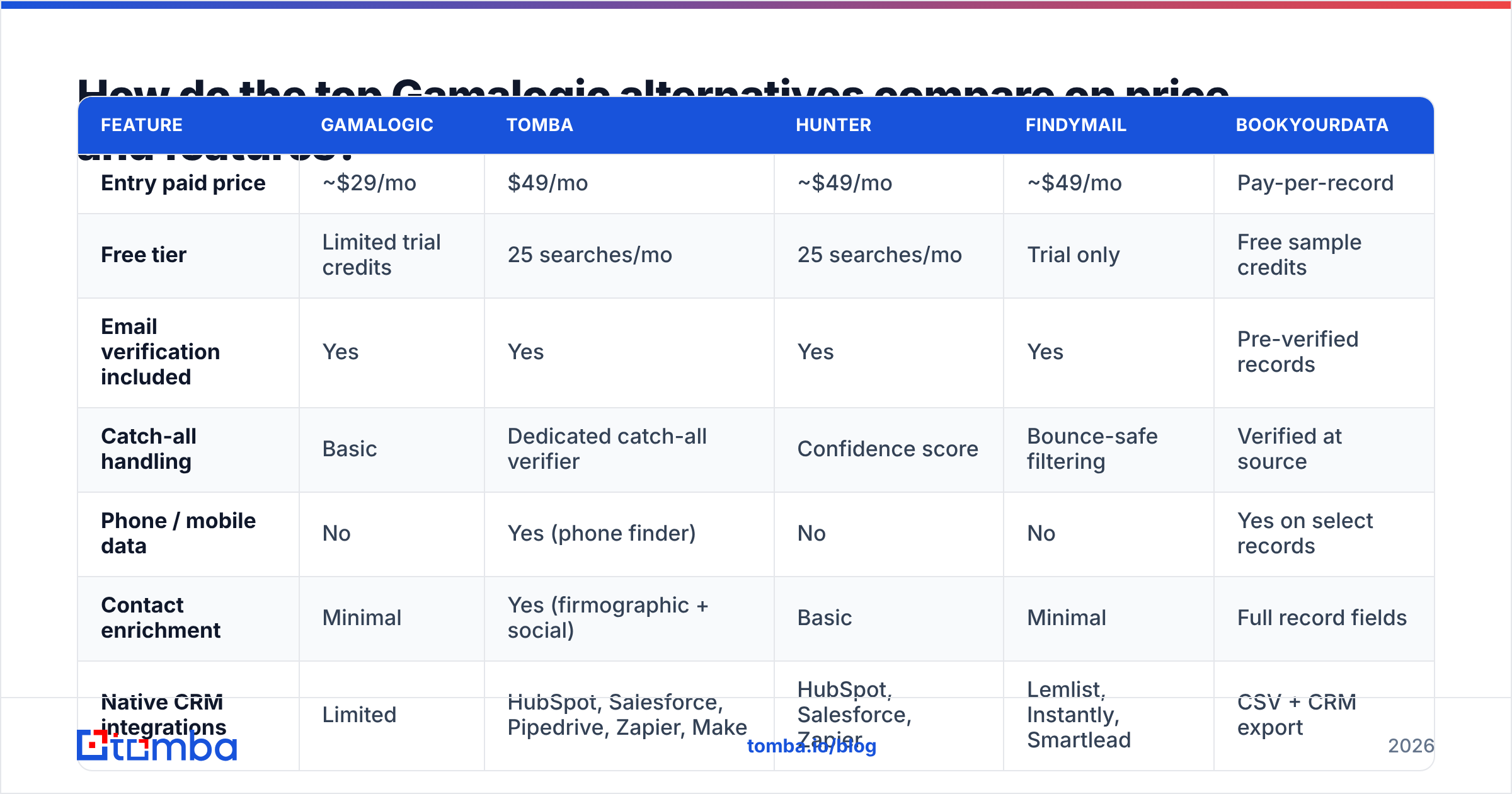
The table below uses publicly listed entry pricing as of early 2026. Vendors change plans often — verify before you buy.
| Feature | Gamalogic | Tomba | Hunter | Findymail | BookYourData |
|---|---|---|---|---|---|
| Entry paid price | ~$29/mo | $49/mo | ~$49/mo | ~$49/mo | Pay-per-record |
| Free tier | Limited trial credits | 25 searches/mo | 25 searches/mo | Trial only | Free sample credits |
| Email verification included | Yes | Yes | Yes | Yes | Pre-verified records |
| Catch-all handling | Basic | Dedicated catch-all verifier | Confidence score | Bounce-safe filtering | Verified at source |
| Phone / mobile data | No | Yes (phone finder) | No | No | Yes on select records |
| Contact enrichment | Minimal | Yes (firmographic + social) | Basic | Minimal | Full record fields |
| Native CRM integrations | Limited | HubSpot, Salesforce, Pipedrive, Zapier, Make | HubSpot, Salesforce, Zapier | Lemlist, Instantly, Smartlead | CSV + CRM export |
| API + CLI | API | API, CLI, MCP server | API | API | API |
| Spreadsheet add-ins | No | Sheets + Excel | Sheets | No | No |
| Best for | Cheap bulk lookups | Full find → verify → enrich chain | Domain-level prospecting | Agency cold email | Buying verified lists |

Two things to read out of that table.
First, the cheapest sticker price is rarely the cheapest outcome. A $29/mo tool with a 50% hit rate and a 12% bounce rate costs more per delivered email than a $49/mo tool at 70% and 3%. Run the arithmetic on your own list before switching on price alone.
Second, bundling matters more than it looks. If you need find + verify + phone + enrich, three vendors means three minimums, three API keys, three billing cycles, and three places for your data schema to drift.
How should you actually test an alternative before switching?#
Don't trust anyone's marketing accuracy number — including ours. Run a controlled bake-off. It takes about two hours.
- Build a 200-row golden list. Pull contacts you already have confirmed, working emails for — closed-won accounts, past webinar attendees, replied-to prospects. Strip the email column, keep first name, last name, and domain.
- Include deliberately hard rows. At least 30% should be non-US domains, Microsoft 365 tenants, and known catch-all providers. A test list of US Google Workspace startups flatters every tool equally and tells you nothing.
- Run the same list through each candidate. Record hit rate (rows returned), accuracy (matches your known-good email), and credits consumed.
- Send a real 100-address test. Route the found addresses through a warmed domain and measure actual bounce rate. SMTP-level "valid" and inbox-level "delivered" are not the same claim. Check your SPF record and sender reputation first so you're measuring the data, not your infrastructure.
- Compute cost per verified contact. Total spend ÷ contacts that were both found and delivered. This is the only number that transfers to your P&L.
Most teams that run this test discover their hit-rate gap is 15–25 points wider than the vendor comparison pages suggested, and that a chunk of what they were calling "valid" was catch-all noise.

Is a cheaper email finder ever the right call?#
Yes — in three specific situations.
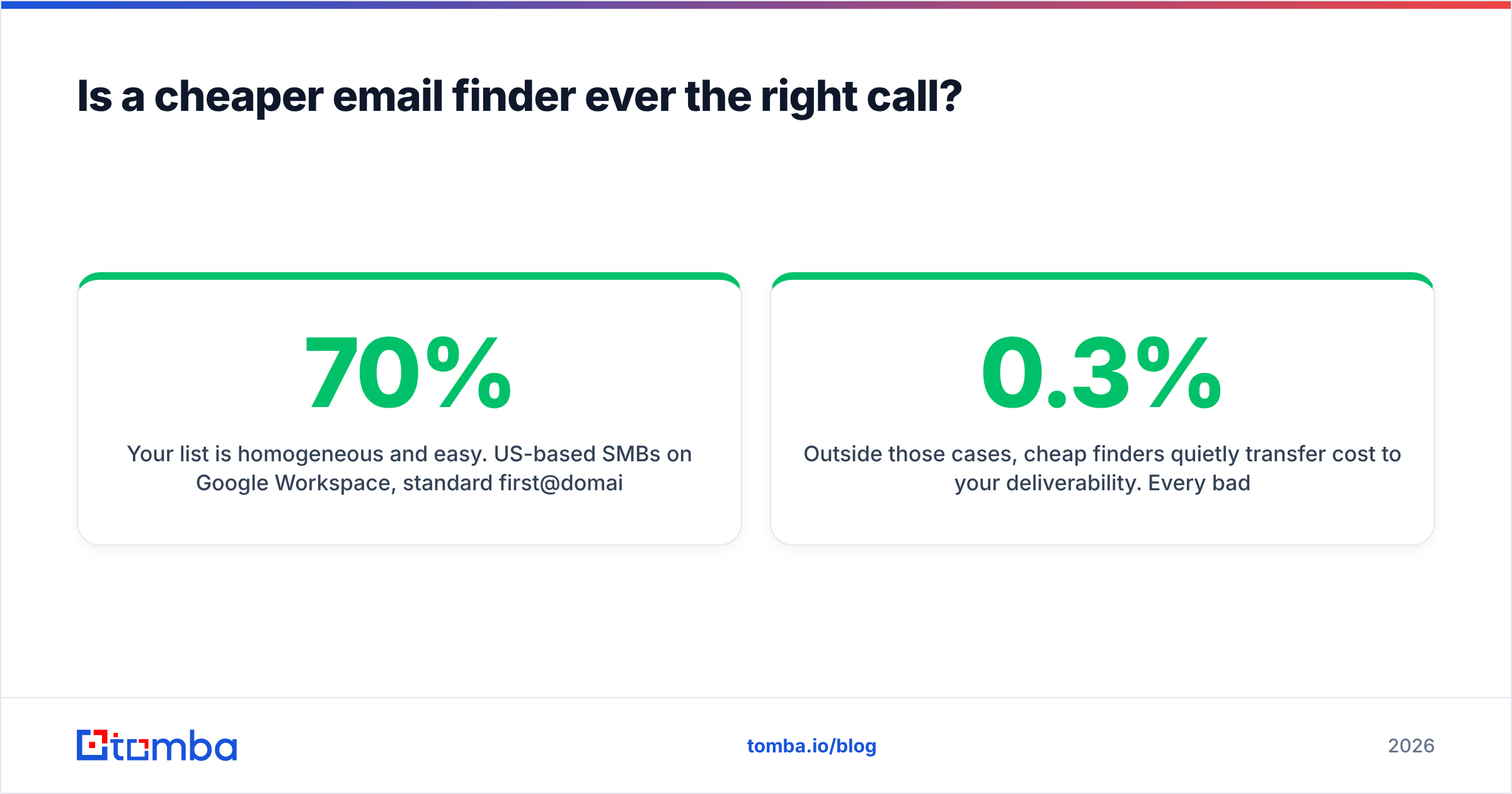
- Your list is homogeneous and easy. US-based SMBs on Google Workspace, standard
first@domainpatterns. Almost any finder clears 70% here. Pay the least. - You're a developer building a side feature. If email lookup is one small function in a bigger product and accuracy tolerance is loose, cheap API credits win.
- You already own the verification layer. If a dedicated verifier sits downstream and catches the garbage, a cheap finder plus a good verifier can beat one mid-priced bundled tool.
Outside those cases, cheap finders quietly transfer cost to your deliverability. Every bad address that reaches a mailbox provider is a signal against your sending domain, and email deliverability damage compounds. Google and Yahoo's bulk-sender requirements put a hard 0.3% spam-complaint ceiling on senders, and elevated bounce rates are one of the fastest ways to trip filtering. A tool that saves you $20/month and costs you a domain is not a saving.
What about credit models and hidden costs?#
This is where vendors differ most and disclose least. Four models are in the market:
- Charge per search attempt. You pay whether or not an email comes back. Worst for prospecting on cold domains.
- Charge per found result. You pay only on a hit. Findymail and several agency-focused tools work this way.
- Charge per verification separately. Finding and verifying draw from different pools, which can double your effective cost.
- Pay per record, no subscription. BookYourData's model. Predictable, no unused-credit waste, and it fits campaign-based buying.
Ask three questions of any vendor before you commit: Do unused credits roll over? Are failed searches charged? Is verification included in the search credit or billed separately? Get the answers in writing. The Tomba pricing page states search and verification allowances per plan explicitly, which is the disclosure standard to hold every vendor to.
Also budget for the things that don't appear on a pricing page: engineering time to migrate an API integration, CSV re-mapping, and the two weeks of reduced output while your team relearns a UI. Switching costs are real even when the software is better.
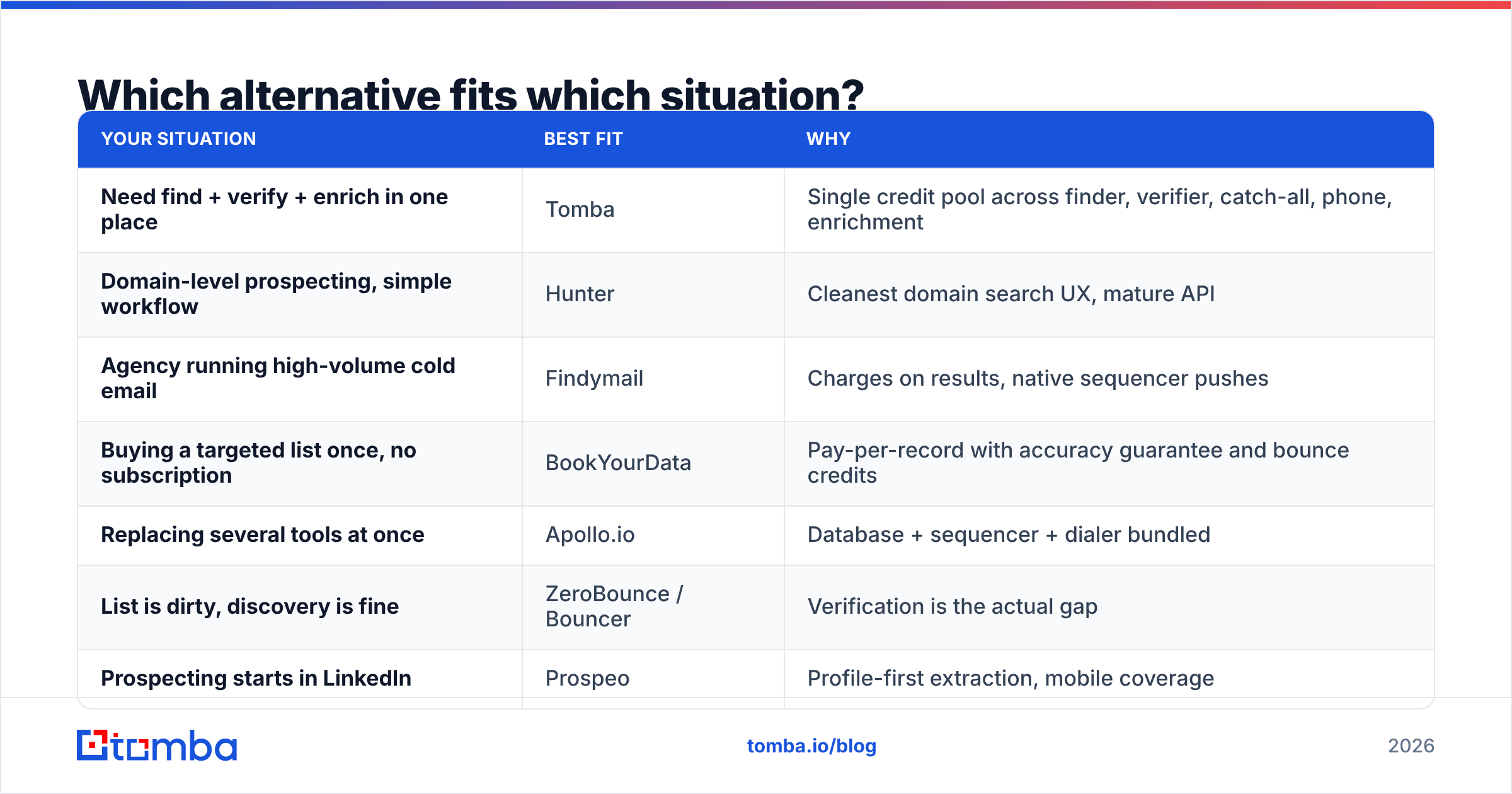
Which alternative fits which situation?#
| Your situation | Best fit | Why |
|---|---|---|
| Need find + verify + enrich in one place | Tomba | Single credit pool across finder, verifier, catch-all, phone, enrichment |
| Domain-level prospecting, simple workflow | Hunter | Cleanest domain search UX, mature API |
| Agency running high-volume cold email | Findymail | Charges on results, native sequencer pushes |
| Buying a targeted list once, no subscription | BookYourData | Pay-per-record with accuracy guarantee and bounce credits |
| Replacing several tools at once | Apollo.io | Database + sequencer + dialer bundled |
| List is dirty, discovery is fine | ZeroBounce / Bouncer | Verification is the actual gap |
| Prospecting starts in LinkedIn | Prospeo | Profile-first extraction, mobile coverage |
If you're moving off Gamalogic mainly because of coverage, run the bake-off against Tomba and Hunter first — they're the closest architectural match with meaningfully deeper data. If you're moving because you want fewer vendors, Apollo or Tomba. If you're moving because you'd rather buy a list than build one, BookYourData is a legitimately different and often cheaper answer.
What's the fastest way to migrate?#
Keep both tools live for one billing cycle. Route 20% of your lookup volume to the new vendor, compare bounce rates on real sends, then flip the remaining 80% once you have two weeks of evidence. Export your existing found-contacts table first so you can dedupe against it — removing duplicates before you re-search saves credits immediately.
If you built against Gamalogic's API, budget half a day for the swap. Most finder APIs share the same request shape — name plus domain in, email plus confidence score out — so the mapping is usually mechanical rather than architectural. Tools that also ship a CLI or an MCP server give you a scripting path that doesn't require touching your application code at all.
Start with a free test, not a contract#
The honest conclusion: there's no single best Gamalogic alternative, only the one that closes your specific gap. Coverage, enrichment, integrations, credit fairness, support — pick the one that's costing you money and shop against it.
If your gap is coverage plus everything downstream of the email address, run your golden list through the Tomba Email Finder. The free tier gives you 25 searches with no card, which is enough to sanity-check hit rate on your hardest domains before you spend anything. If it beats what you're getting today, Starter is $49/mo and includes verification in the same account. If it doesn't, you've lost nothing but an afternoon — and you'll have a real number to take to the next vendor.
Sources worth checking directly: Hunter.io, Apollo.io, and vendor reviews on G2 and Capterra.
Related guides#
Ready to find emails that actually work?
Join 150,000+ professionals who stopped guessing and started sending. Free credits on signup — no credit card required.
Get the Tomba newsletter
Practical outbound tactics and product updates — once every two weeks.
About the author