Generative AI Sales Risks: 9 Failure Modes and How to Fix Them
AI writes your outbound in seconds — and can burn your domain just as fast. Here are the nine generative AI sales risks that actually cost pipeline in 2026, plus the controls that contain each one.
TL;DR
- Generative AI did not create new sales risks so much as it removed the friction that used to cap them. Bad data, weak targeting, and sloppy copy now ship at 100x volume.
- The nine risks that actually cost money in 2026: hallucinated contact data, domain reputation collapse, prompt-injected CRM records, regulatory exposure under GDPR/CCPA/EU AI Act, model-generated claims your legal team never approved, personalization that reads as surveillance, pipeline inflation from AI-scored junk leads, rep skill atrophy, and vendor lock-in on proprietary embeddings.
- The single highest-ROI control is boring: verify every AI-sourced email address before it enters a sequence. Most AI outbound disasters start as a data problem, not a copy problem.
- Human-in-the-loop is not a checkbox. Define which decisions AI can make alone (draft, score, summarize) and which always need a human (send-to-net-new, pricing claims, contract language).
- Governance that works looks like a two-page policy plus enforced tooling — not a 40-page framework nobody reads.
What are the real generative AI sales risks in 2026?#
The honest framing: generative AI is an amplifier, not a source of risk. Every failure mode below existed in 2019. What changed is that a single rep can now execute a bad idea across 40,000 contacts before lunch.
Three years into mainstream AI adoption in revenue teams, the pattern is clear. Teams that got burned did not get burned by the model producing weird sentences. They got burned by acting on outputs nobody checked. The model was confident, the pipeline dashboard looked great, and the damage surfaced 60 days later as a spam-folder placement rate nobody could explain.
Here is the risk map, sorted by how frequently it shows up in post-mortems rather than how scary it sounds on a conference slide.
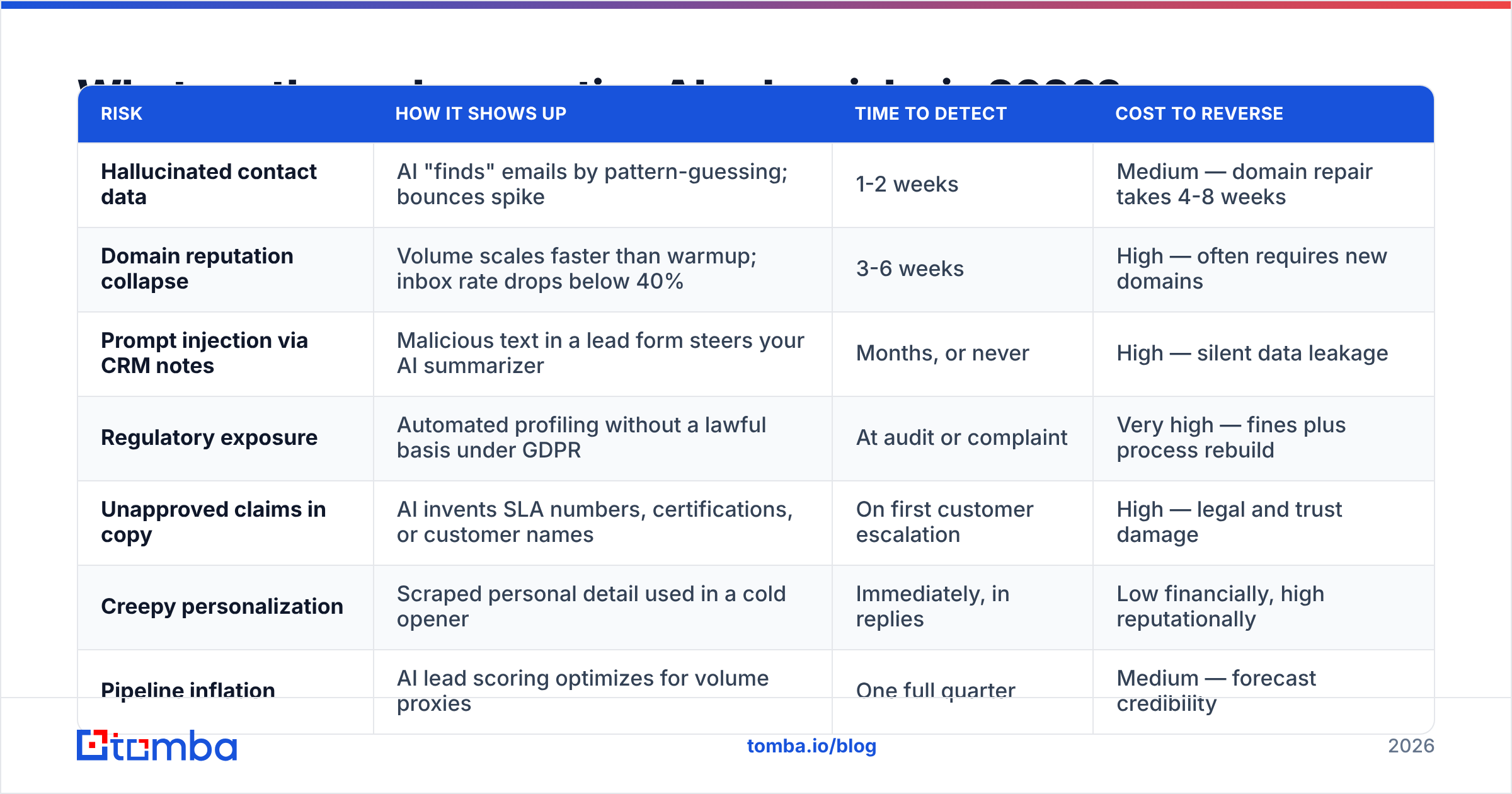
| Risk | How it shows up | Time to detect | Cost to reverse |
|---|---|---|---|
| Hallucinated contact data | AI "finds" emails by pattern-guessing; bounces spike | 1-2 weeks | Medium — domain repair takes 4-8 weeks |
| Domain reputation collapse | Volume scales faster than warmup; inbox rate drops below 40% | 3-6 weeks | High — often requires new domains |
| Prompt injection via CRM notes | Malicious text in a lead form steers your AI summarizer | Months, or never | High — silent data leakage |
| Regulatory exposure | Automated profiling without a lawful basis under GDPR | At audit or complaint | Very high — fines plus process rebuild |
| Unapproved claims in copy | AI invents SLA numbers, certifications, or customer names | On first customer escalation | High — legal and trust damage |
| Creepy personalization | Scraped personal detail used in a cold opener | Immediately, in replies | Low financially, high reputationally |
| Pipeline inflation | AI lead scoring optimizes for volume proxies | One full quarter | Medium — forecast credibility |
| Rep skill atrophy | Juniors cannot discover or object-handle unaided | 2-4 quarters | Medium — retraining cycle |
| Vendor lock-in | Enrichment and scoring tied to one proprietary stack | At renewal | Medium — migration cost |
Notice how many of these are slow-detect. That asymmetry is the actual problem. AI failures in sales are rarely loud. They are quiet degradations that look like normal quarter-to-quarter noise until the trendline is undeniable.
Why does hallucinated contact data cause the most damage?#
Because it poisons everything downstream and it is the easiest risk to mistake for success.
Ask a general-purpose LLM for "the email address of the VP of Engineering at Acme Corp" and you will get an answer. It will be formatted correctly. It will use the right domain. It may even use the right first-name-dot-last-name convention. And it will be a guess, because the model is doing pattern completion, not lookup.
The failure chain runs like this: guessed address → hard bounce → bounce rate climbs past 3% → mailbox providers throttle your domain → your verified contacts stop landing in inboxes too. One bad list contaminates good outreach for months. Google and Yahoo's 2024 bulk-sender requirements formalized a 0.3% spam-complaint threshold, and enforcement has only tightened since. You do not get warned. You get quietly filtered.

The controls are unglamorous and they work:
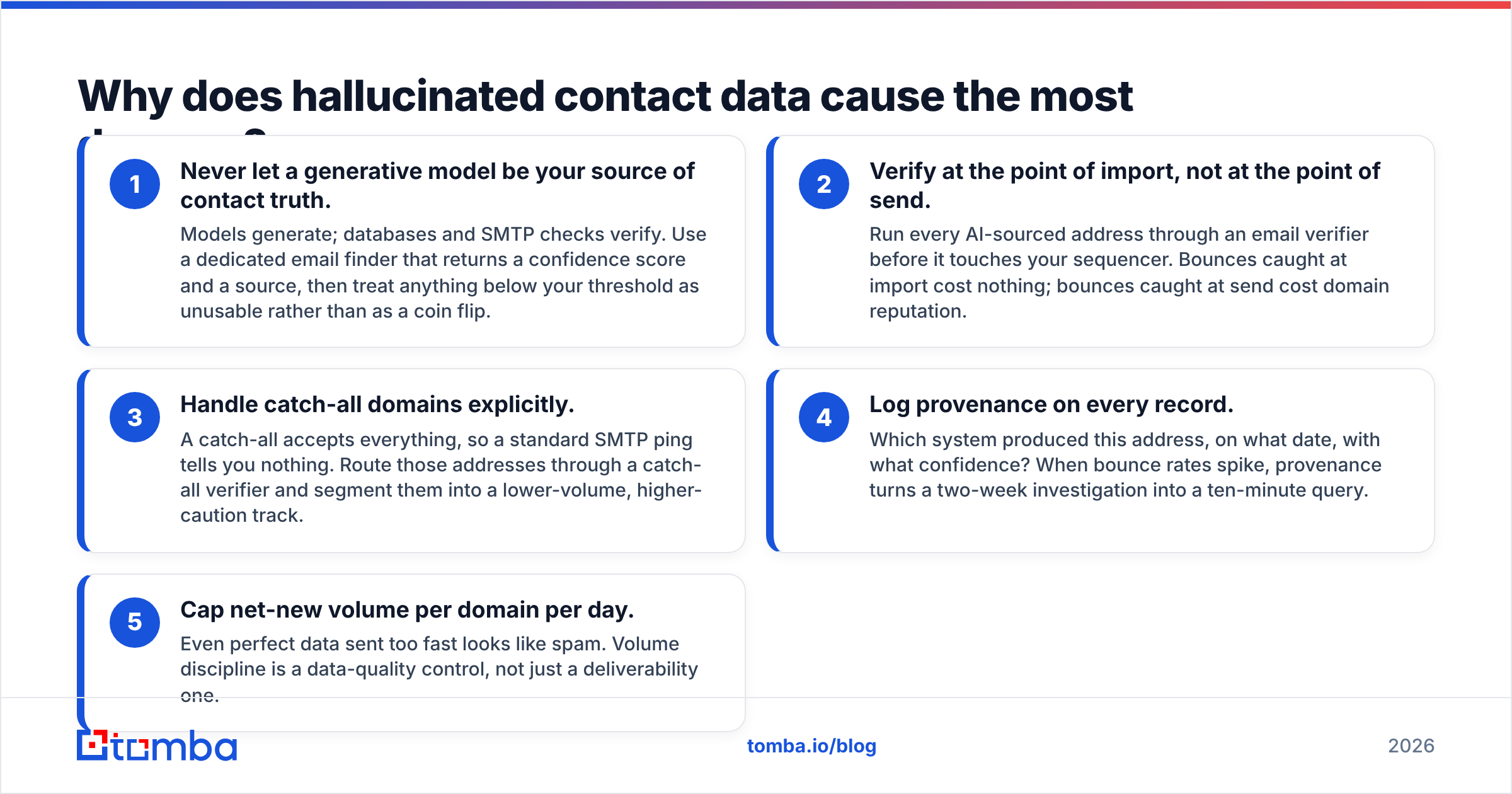
- Never let a generative model be your source of contact truth. Models generate; databases and SMTP checks verify. Use a dedicated email finder that returns a confidence score and a source, then treat anything below your threshold as unusable rather than as a coin flip.
- Verify at the point of import, not at the point of send. Run every AI-sourced address through an email verifier before it touches your sequencer. Bounces caught at import cost nothing; bounces caught at send cost domain reputation.
- Handle catch-all domains explicitly. A catch-all accepts everything, so a standard SMTP ping tells you nothing. Route those addresses through a catch-all verifier and segment them into a lower-volume, higher-caution track.
- Log provenance on every record. Which system produced this address, on what date, with what confidence? When bounce rates spike, provenance turns a two-week investigation into a ten-minute query.
- Cap net-new volume per domain per day. Even perfect data sent too fast looks like spam. Volume discipline is a data-quality control, not just a deliverability one.
The cheapest version of this policy: AI can propose contacts, but only verified contacts can be sequenced. That one rule prevents the majority of AI outbound disasters.
How does generative AI break email deliverability?#
Through volume, sameness, and impatience — usually all three at once.
Volume is obvious. When drafting cost drops to near zero, the natural instinct is to send more. But email deliverability is governed by engagement ratios, not absolute effort. Doubling send volume while reply rate stays flat halves your engagement ratio, and mailbox providers read that as a spam signal.
Sameness is subtler and more dangerous. If 200 companies prompt the same model with roughly the same instruction — "write a cold email to a VP of Sales about improving pipeline efficiency" — the outputs cluster hard. Same rhythm, same three-part structure, same "I noticed you're scaling your team" opener. Spam filters are pattern matchers. When a phrasing signature correlates with low engagement across millions of messages, the whole cluster gets penalized. Your email is not being judged in isolation; it is being judged against every message that looks like it.
Impatience finishes the job. New domains get spun up, warmed for a week instead of six, and loaded with AI-generated volume. Run the numbers through a warmup calculator before you commit to a send schedule, and check the copy itself with a spam checker rather than assuming the model wrote something clean.
Authentication is table stakes and still frequently broken. Verify your SPF record with an SPF checker, confirm DKIM signing on every sending domain, and set DMARC to at least p=quarantine. Google's own bulk sender guidelines spell out the requirements in plain language — read them once a year, because they change.
A practical rule: if your AI tooling lets you increase send volume faster than you can increase reply volume, the tooling is helping you fail faster.
What about data privacy, compliance, and the EU AI Act?#
This is the risk with the longest fuse and the largest blast radius.
Three exposures matter for revenue teams:
Training data leakage. Pasting a call transcript, a deal-room document, or a customer list into a consumer AI tool may hand that data to a third party under terms you never read. Enterprise agreements typically exclude your inputs from training; free tiers often do not. The fix is procurement discipline: approved tools with a signed DPA, and a blocklist for everything else. Assume anything pasted into an unapproved tool is public.
Automated profiling. GDPR Article 22 restricts decisions based solely on automated processing that produce legal or similarly significant effects. Pure lead scoring usually falls outside that, but if your AI system decides who gets pricing, who gets a human SDR, and who gets rejected entirely, you are closer to the line than you think. Document the human review step and make sure it is real.
The EU AI Act. Most sales AI lands in the limited-risk or minimal-risk tier, which means transparency obligations rather than conformity assessments. The practical implication: if a prospect is interacting with an AI system — a chatbot, an autonomous SDR agent, an AI voice caller — you must disclose it. Read the official EU AI Act text rather than a vendor's summary of it, because vendors have an obvious incentive to describe their product as minimal-risk.
Add CCPA/CPRA on the US side, and the operational answer converges: know where every contact record came from, be able to delete it on request, and be able to explain what your models do with it. This is exactly why data sources and provenance metadata matter more than raw record counts. A 200-million-record database with no lineage is a liability, not an asset.
Is AI-generated sales copy actually a legal risk?#
Yes, and it is underrated because the failures are individually small.
Generative models produce plausible specifics. Asked to write a competitive email, a model will happily assert a 99.9% uptime SLA, a SOC 2 Type II certification, a named customer, or a "40% faster than the leading alternative" claim. None of those may be true of your company. If a rep sends that unedited and a prospect relies on it, you have a misrepresentation problem — not a prompt engineering problem.
The failure modes stack:
- Invented capabilities. The model describes a feature roadmap item as shipped.
- Invented social proof. A customer logo or case study number that came from the model's training data, not your marketing team.
- Invented comparisons. Competitive claims that trip false-advertising rules and, in some jurisdictions, comparative-advertising law.
- Invented pricing or terms. The most expensive category, because a written quote can be argued as an offer.
The control is a claims allowlist. Maintain a short document of approved, factual claims — real certifications, real numbers, real named references — and constrain the model to it. Anything outside the allowlist requires human approval before send. If you use a cold email AI writer, feed it your allowlist as context rather than letting it improvise credibility.
Second control: every AI draft gets a named human owner before it sends. Not "the team reviewed it." A person whose name is on it. Accountability that diffuses across a team is accountability that does not exist.
Where should humans stay in the loop?#
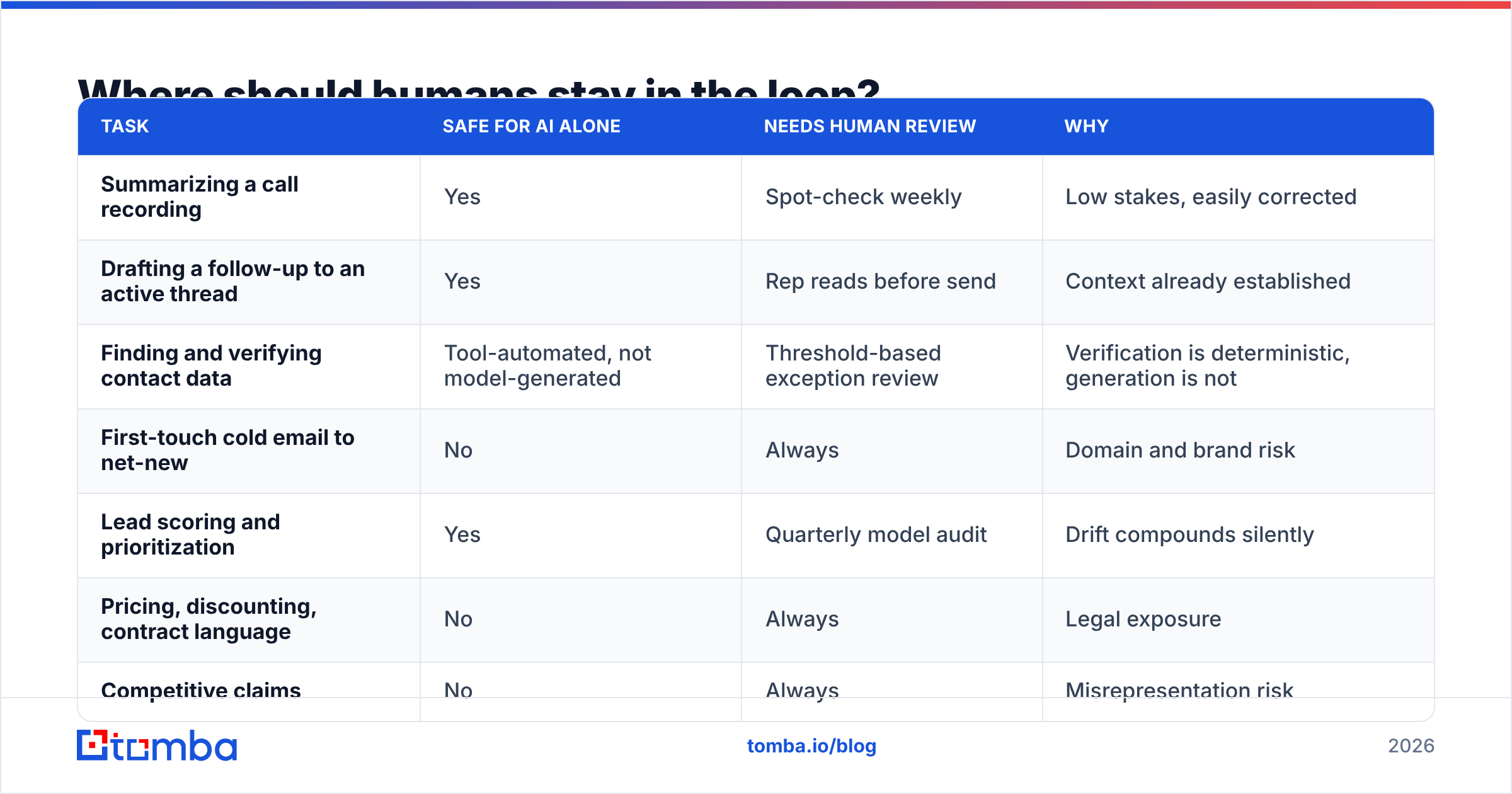
The most useful governance decision is drawing the autonomy line explicitly, task by task, instead of debating "should we use AI" in the abstract.
| Task | Safe for AI alone | Needs human review | Why |
|---|---|---|---|
| Summarizing a call recording | Yes | Spot-check weekly | Low stakes, easily corrected |
| Drafting a follow-up to an active thread | Yes | Rep reads before send | Context already established |
| Finding and verifying contact data | Tool-automated, not model-generated | Threshold-based exception review | Verification is deterministic, generation is not |
| First-touch cold email to net-new | No | Always | Domain and brand risk |
| Lead scoring and prioritization | Yes | Quarterly model audit | Drift compounds silently |
| Pricing, discounting, contract language | No | Always | Legal exposure |
| Competitive claims | No | Always | Misrepresentation risk |
| CRM data hygiene and dedupe | Yes | Monthly sample | Reversible, high volume |
The pattern: AI is safe where outputs are reversible, internally scoped, or deterministic. It needs a human wherever an output creates an external commitment or touches a channel where reputation compounds.
Two implementation notes. First, review must be sampled and logged, not vibes-based; "we look at them" degrades to "nobody looks at them" within two quarters. Second, review load should scale with volume — if a rep reviews 400 AI drafts a day, they are rubber-stamping, and you have re-created the unreviewed pipeline with extra steps.
Does AI lead scoring inflate your pipeline?#
Often, and the damage lands on your forecast rather than your inbox.
AI scoring models learn from historical closed-won data. That data encodes your past biases: the segments your reps happened to prospect, the accounts your marketing happened to reach, the deals that closed because a champion changed jobs. The model does not know which of those were causal. It optimizes for correlation, and correlation in sales data is mostly self-fulfilling.
The observable symptoms:
- Score inflation. Average lead score climbs quarter over quarter while conversion stays flat. The model learned to please the dashboard.
- Segment collapse. The model concentrates high scores in one or two ICP segments, and your team stops discovering new ones.
- Proxy drift. The model optimizes for a proxy like "booked meeting" while the metric that pays rent is closed revenue.
Three controls. Hold out a randomized control group that bypasses scoring entirely — if unscored leads convert at similar rates, your model is decorative. Re-baseline against actual closed-won every quarter, not every year. And track win rate by score band, not just volume by score band, so degradation is visible before the quarter ends.
Analyst coverage from firms like Gartner has been consistent on this: AI scoring improves prioritization efficiency, not lead quality. If your model appears to improve quality, check whether it is actually just reallocating attention toward leads that would have converted anyway.
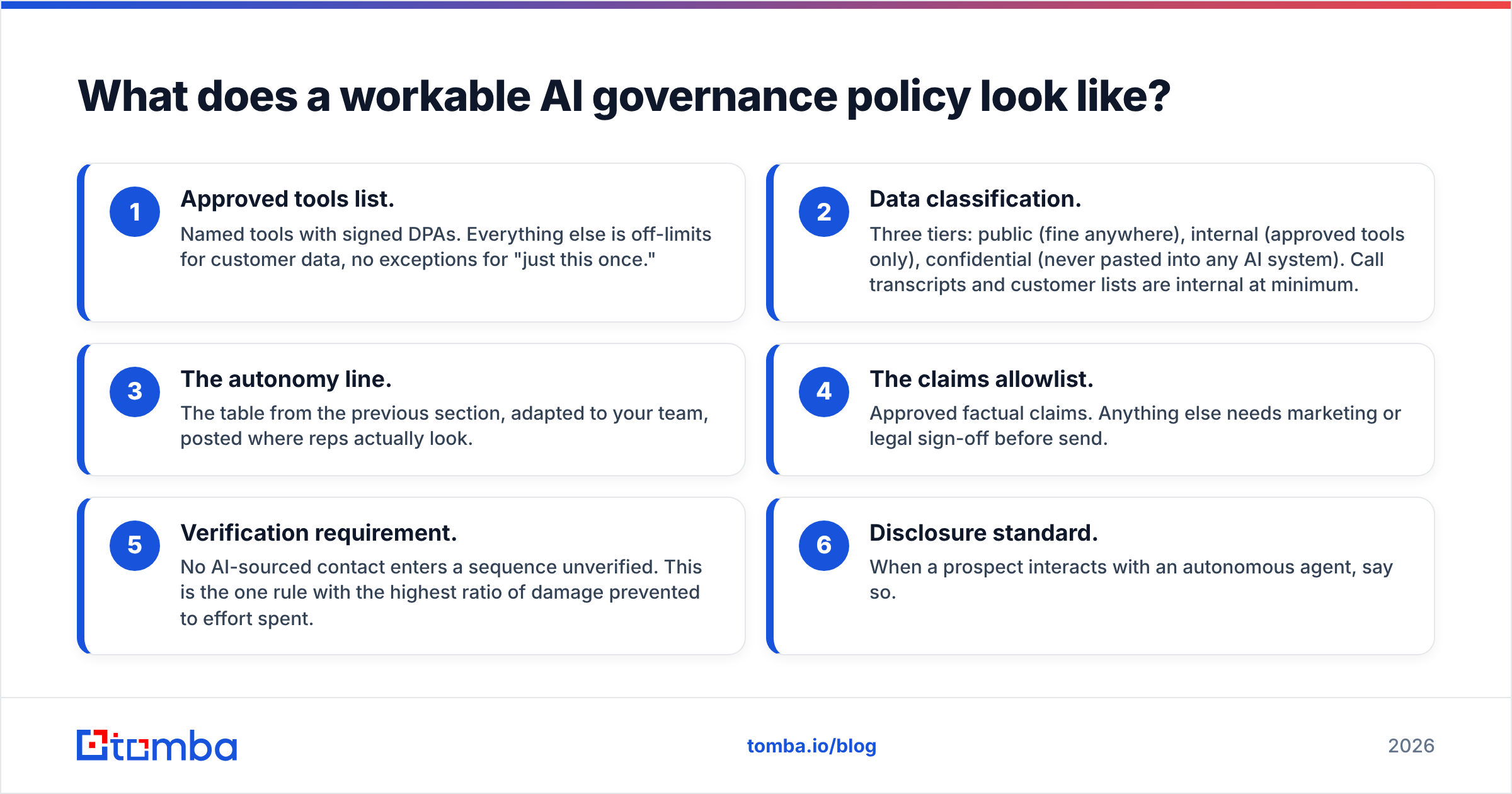
What does a workable AI governance policy look like?#
Two pages. Enforced by tooling, not by memos.
Page one — the rules.
- Approved tools list. Named tools with signed DPAs. Everything else is off-limits for customer data, no exceptions for "just this once."
- Data classification. Three tiers: public (fine anywhere), internal (approved tools only), confidential (never pasted into any AI system). Call transcripts and customer lists are internal at minimum.
- The autonomy line. The table from the previous section, adapted to your team, posted where reps actually look.
- The claims allowlist. Approved factual claims. Anything else needs marketing or legal sign-off before send.
- Verification requirement. No AI-sourced contact enters a sequence unverified. This is the one rule with the highest ratio of damage prevented to effort spent.
- Disclosure standard. When a prospect interacts with an autonomous agent, say so.
Page two — the enforcement. Rules without mechanism are decoration. Wire verification into the import path so unverified records physically cannot be sequenced. Put bounce rate, spam complaint rate, and inbox placement on the same dashboard as pipeline, reviewed at the same cadence. Log which AI tool touched which record, using a Tomba API key per system so provenance is queryable rather than reconstructed.
For teams evaluating vendors, G2's sales AI category is a reasonable starting point for shortlists, but weight the review categories that map to these risks — data accuracy, compliance support, export freedom — over the ones about UI polish.
One more thing worth saying plainly: the vendors most aggressive about "fully autonomous AI SDRs" are the ones whose customers show up in deliverability post-mortems most often. Autonomy is not the goal. Contained autonomy with fast feedback loops is.
Get the data layer right before you scale the AI layer#
Every risk in this post gets meaningfully smaller when your contact data is verified, sourced, and traceable. Hallucinated addresses stop reaching your sequencer. Bounce rates stay under threshold, so deliverability holds. Provenance metadata makes compliance requests a query instead of a fire drill. And AI scoring trained on clean records drifts more slowly than scoring trained on guesses.
Start there. Tomba's Email Finder returns verified addresses with confidence scores and source attribution, so what enters your stack is a fact rather than a model's best guess. The free tier covers 25 searches a month if you want to test the workflow against a list you already have; paid plans start at $49/mo, with full Tomba pricing published if you need to scale. Verify first, automate second — that order is the whole strategy.
Related guides#
Ready to find emails that actually work?
Join 150,000+ professionals who stopped guessing and started sending. Free credits on signup — no credit card required.
Get the Tomba newsletter
Practical outbound tactics and product updates — once every two weeks.
About the author