Global Account Management in 2026: A Practical Playbook
Global account management sounds like enterprise theater until you see the revenue math. Here is how GAM programs actually get built, staffed, comped, and measured in 2026 — plus when not to run one.
TL;DR
- Global account management (GAM) is a coverage model, not a title. You assign one accountable leader to a multinational customer and coordinate every region, business unit, and product line under a single plan.
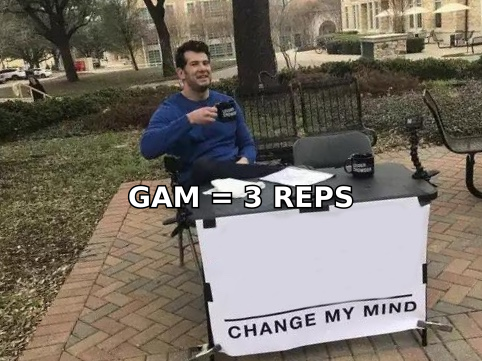
- The programs that work share three traits: fewer than 30 named accounts, split-credit compensation that removes regional turf wars, and an executive sponsor who actually shows up.
- The most common failure is data, not strategy. If your CRM has six duplicate records for the same buyer across three continents, no org chart fixes that.
- Break-even math is brutal: a GAM pod costs roughly $600K–$1.2M fully loaded per year, so each account needs $4M+ in revenue or credible expansion potential.
- Start with two pilot accounts, measure share of wallet and multi-region penetration, and only then scale.
What Is Global Account Management?#
Global account management is the practice of managing a multinational customer as one account instead of a dozen unrelated regional relationships. One global account manager owns the total relationship, the total plan, and the total number — even though the buying happens in Frankfurt, São Paulo, Singapore, and Chicago on different fiscal calendars.
Think of it like being the general contractor on a building that spans four city blocks. Each block has its own crew, permits, and inspectors. The contractor does not lay bricks. The contractor makes sure the plumbing on block one lines up with the electrical on block four, and that the client gets one invoice and one point of accountability instead of four contradictory status reports.
The distinction that matters:
- Key account management — a large customer, usually within one country or region. Depth over geography.
- Strategic account management — a large customer with executive-level joint planning. Depth plus long-horizon commitment.
- Global account management — a large customer buying across three or more countries with cross-border decision influence. Depth, commitment, and coordination overhead.
- National account management — multi-site within a single country. The training wheels version of GAM.
Most companies think they need GAM when they actually need option two with better internal communication. The trigger for real GAM is when a decision made in one country materially changes what another country buys — procurement consolidation, a global MSA, a shared IT stack, or a corporate mandate to standardize vendors.
How Is Global Account Management Different From Key Account Management?#
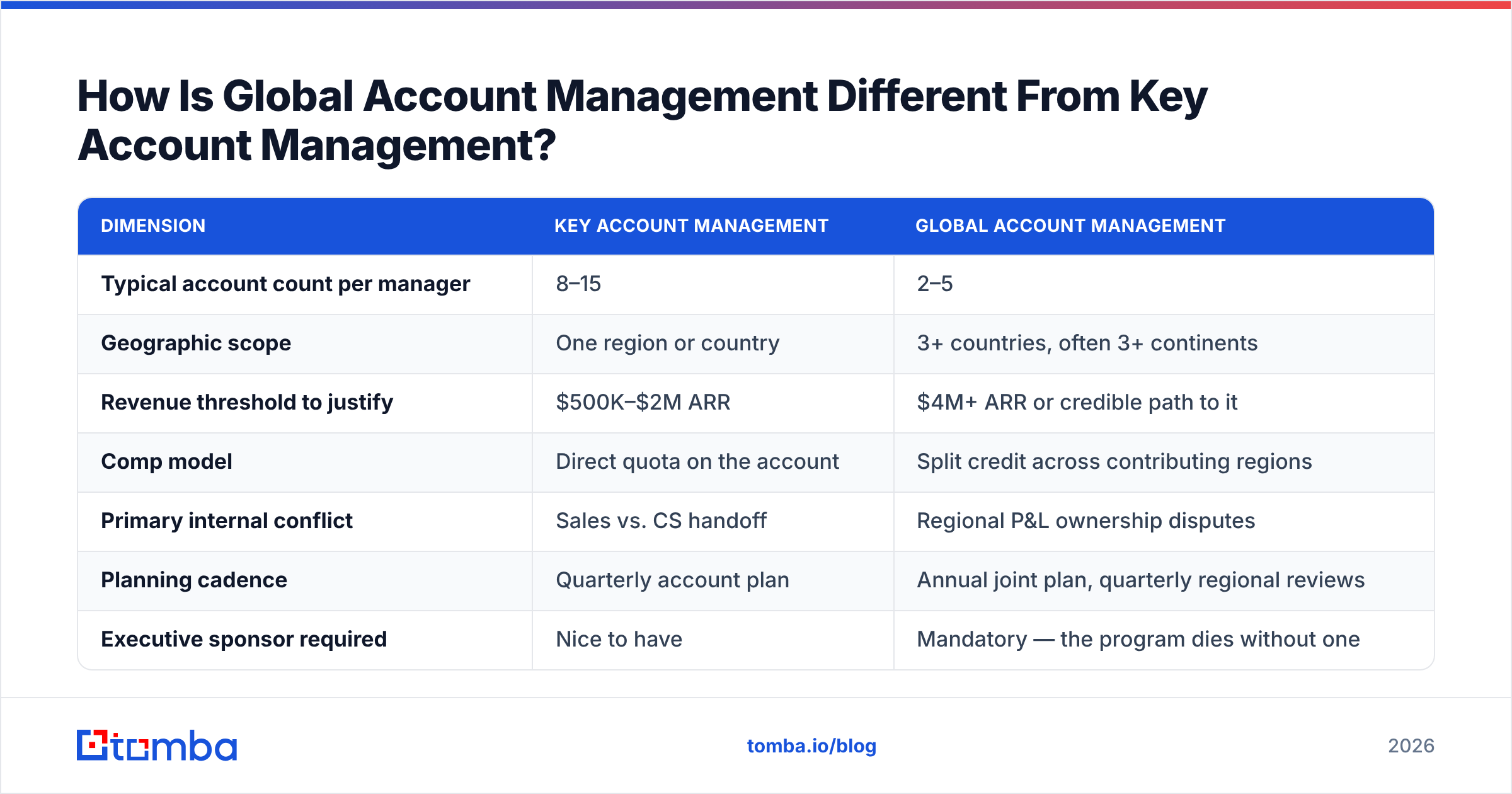
The difference is not size. It is whether authority crosses borders.
| Dimension | Key Account Management | Global Account Management |
|---|---|---|
| Typical account count per manager | 8–15 | 2–5 |
| Geographic scope | One region or country | 3+ countries, often 3+ continents |
| Revenue threshold to justify | $500K–$2M ARR | $4M+ ARR or credible path to it |
| Comp model | Direct quota on the account | Split credit across contributing regions |
| Primary internal conflict | Sales vs. CS handoff | Regional P&L ownership disputes |
| Planning cadence | Quarterly account plan | Annual joint plan, quarterly regional reviews |
| Executive sponsor required | Nice to have | Mandatory — the program dies without one |
| Typical fully loaded cost | $180K–$250K | $600K–$1.2M per account pod |
The row that kills most programs is comp. When a deal closes in Germany because the global account manager spent nine months building the relationship in the US, someone has to decide who gets paid. If you have not written that policy down before launch, your German country manager will treat the GAM as a tourist, and your GAM will stop flying to Germany.
Research from Gartner on B2B buying consistently shows enterprise buying groups now involve 10-plus stakeholders. Multiply that by four countries and you are coordinating 40 humans across timezones. That is the actual job.
When Does a Global Account Management Program Actually Pay Off?#
Run the math before the org chart.
A GAM pod — one global account manager, one solutions architect at 50% allocation, one account-based marketer at 25%, plus travel and executive time — costs $600K to $1.2M fully loaded per year depending on geography. To justify that at a 30% contribution margin target, the account needs to generate roughly $2M–$4M in incremental margin. In most SaaS and services businesses, that means $4M+ in account revenue or a credible two-year path there.
Signals that GAM will pay off:
- Procurement is consolidating. The customer has told you they are moving from 40 regional vendors to 8 global ones. You either become one of the 8 or you disappear.
- Your pricing is leaking. The same customer pays $180K in the US and $95K in APAC for identical scope. Someone will notice, and it will be their CFO, not yours.
- Expansion is blocked by ignorance. Your Brazil team has no idea the customer's US division renewed at 3x last quarter. That is a data problem masquerading as a strategy problem.
- Competitors are already there. If a rival has a named global lead on the account and you do not, you are the incumbent regional vendor waiting to be consolidated out.
Signals you should not build one yet:
- Fewer than five customers meet the revenue threshold.
- Your CRM cannot produce a single accurate global account hierarchy in under an hour.
- No executive above VP level will commit to two customer visits per year.
- Your product is not actually deployable in the regions the account operates in.
What Does a Global Account Management Structure Look Like?#
There are three viable structures. Pick based on how much your regions fight.
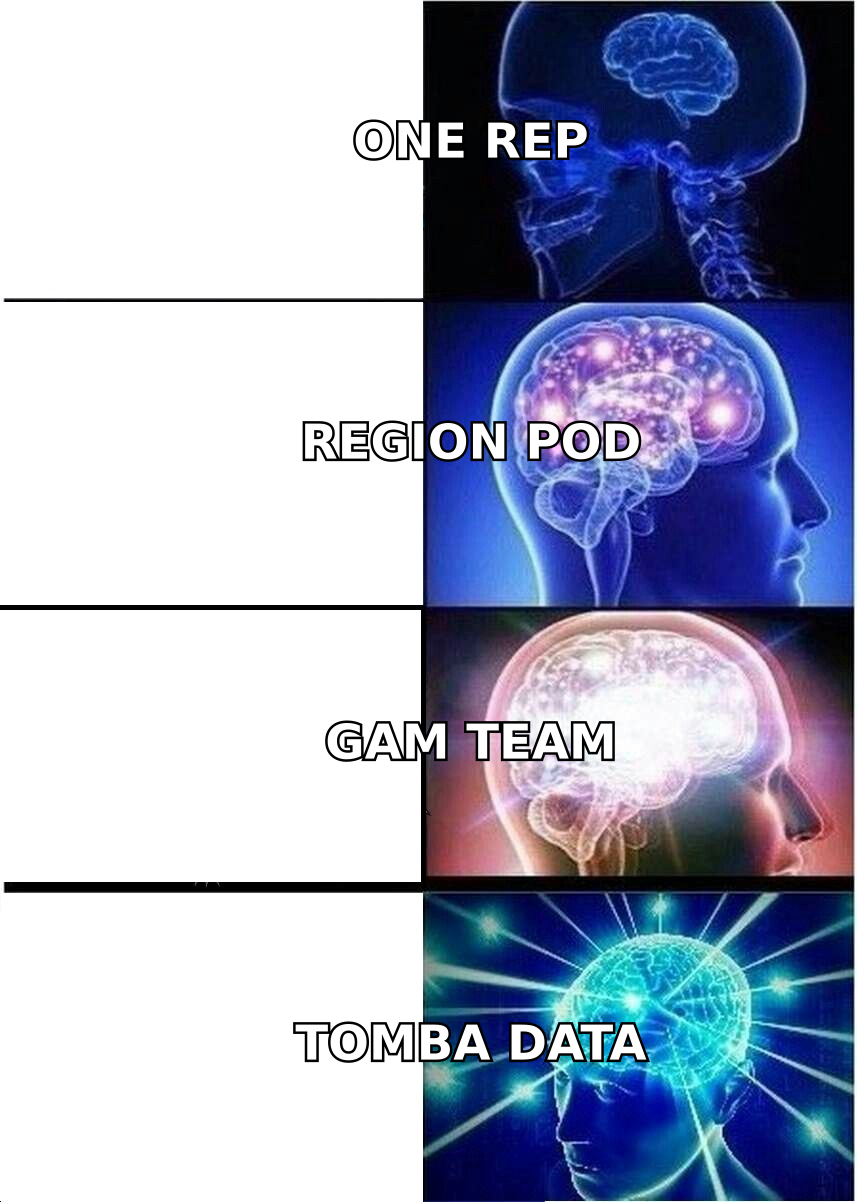
Model A — Overlay. The global account manager sits above regional reps, carries an overlay quota, and has no direct reports. Cheapest to launch. Weakest authority. Works when regional leaders are collaborative and comp is genuinely split.
Model B — Dedicated pod. The GAM owns a small team: a solutions architect, a dedicated CSM, and marketing support. The pod carries the full account number. Regional reps are compensated on a split. Highest cost, highest control, best fit for the top 5–10 accounts.
Model C — Federated council. No single owner. A council of regional leads meets monthly with a rotating chair and a shared plan. Cheap and politically easy. Rarely produces results because nobody's variable comp depends on the outcome.
In practice, most successful programs run Model A for accounts 6–25 and Model B for the top five. Model C is what you build when leadership wants the appearance of a program without the budget.
Whichever model you pick, three artifacts are non-negotiable:
- A single account hierarchy in the CRM — parent, subsidiaries, legal entities, and buying centers, with a clear rule for which record is authoritative.
- A written joint account plan — customer objectives, your value hypothesis per region, named relationships mapped to their org chart, and a 12-month milestone list.
- A split-credit policy signed by every regional leader — before the first deal, not after.
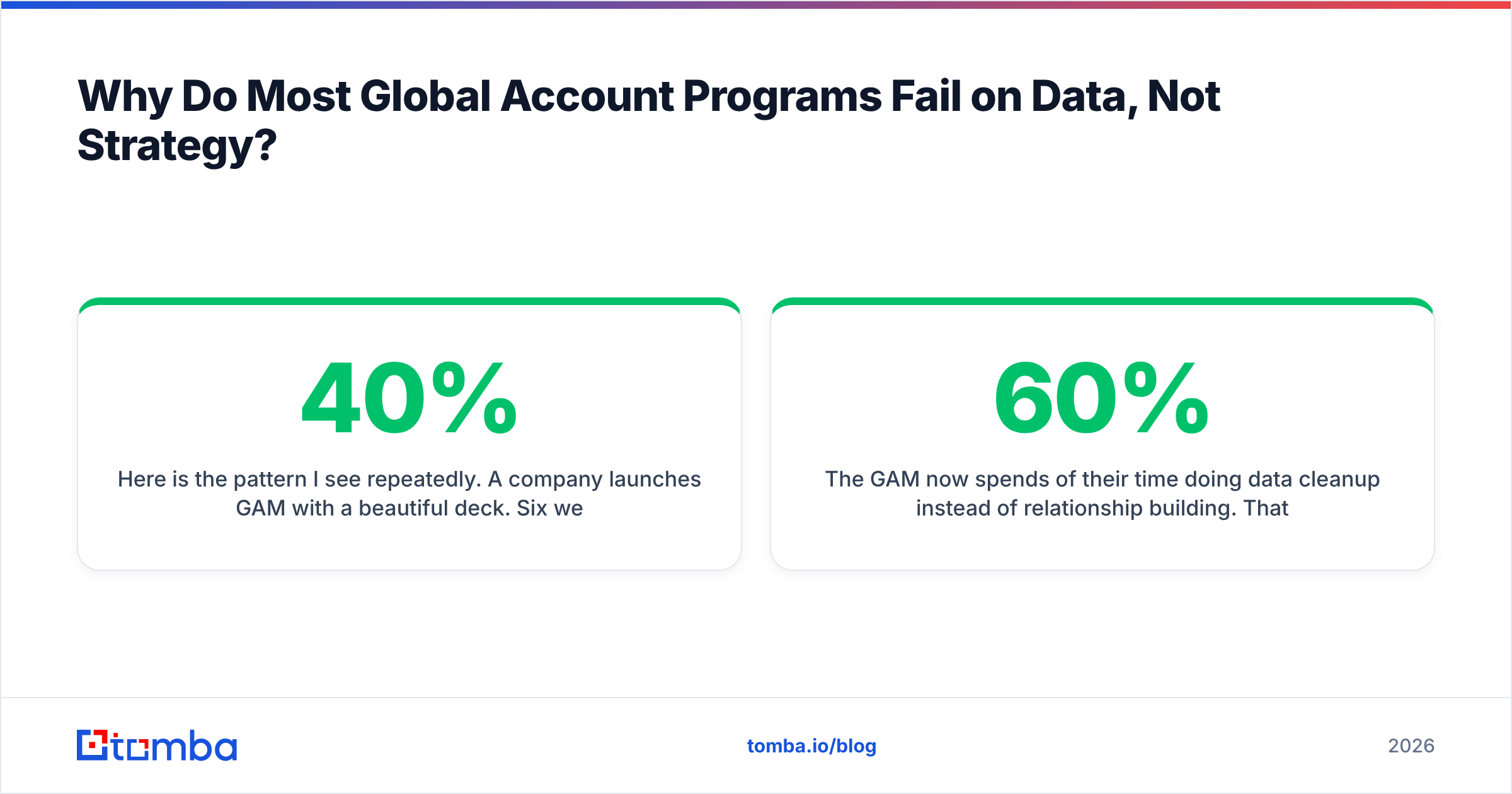
Why Do Most Global Account Programs Fail on Data, Not Strategy?#
Because a global account plan is only as good as your map of who works where.
Here is the pattern I see repeatedly. A company launches GAM with a beautiful deck. Six weeks in, the global account manager tries to build a stakeholder map for a 60,000-person multinational. The CRM has 340 contacts on the account. Roughly 40% have bounced at least once. Half the titles are three years stale. Nobody knows which of the four "Head of Procurement" records is current, and three of the regional subsidiaries are filed as entirely separate accounts because someone typed the company name differently in 2022.
The GAM now spends 60% of their time doing data cleanup instead of relationship building. That is a $700K resource operating as a data entry clerk.
Fixing this is unglamorous and mandatory:
- Deduplicate before you assign. Merge subsidiary records into a real hierarchy. A remove duplicates pass on your exported contact list is a 20-minute job that saves months.
- Verify every contact on the account. Bounced outreach on a strategic global account is worse than no outreach — it signals sloppiness to exactly the buyers you cannot afford to lose. Run the full list through an email verifier before the GAM sends anything.
- Fill the coverage gaps by domain, not by name. Multinationals often run country-specific domains —
company.de,company.com.br,company.co.jp. A domain search across each regional domain surfaces the contacts your regional reps never logged. - Enrich, don't guess. Titles, seniority, department, and location fields drive your entire stakeholder map. Contact enrichment turns a name and a domain into a usable node on the org chart.
For teams building account hierarchies across dozens of regional domains, doing this by hand does not scale. Pulling contacts through a bulk email finder or hitting the Tomba API directly from your CRM enrichment job is the difference between a stakeholder map that stays current and one that rots by Q2.
What Metrics Should You Track for Global Account Management?#
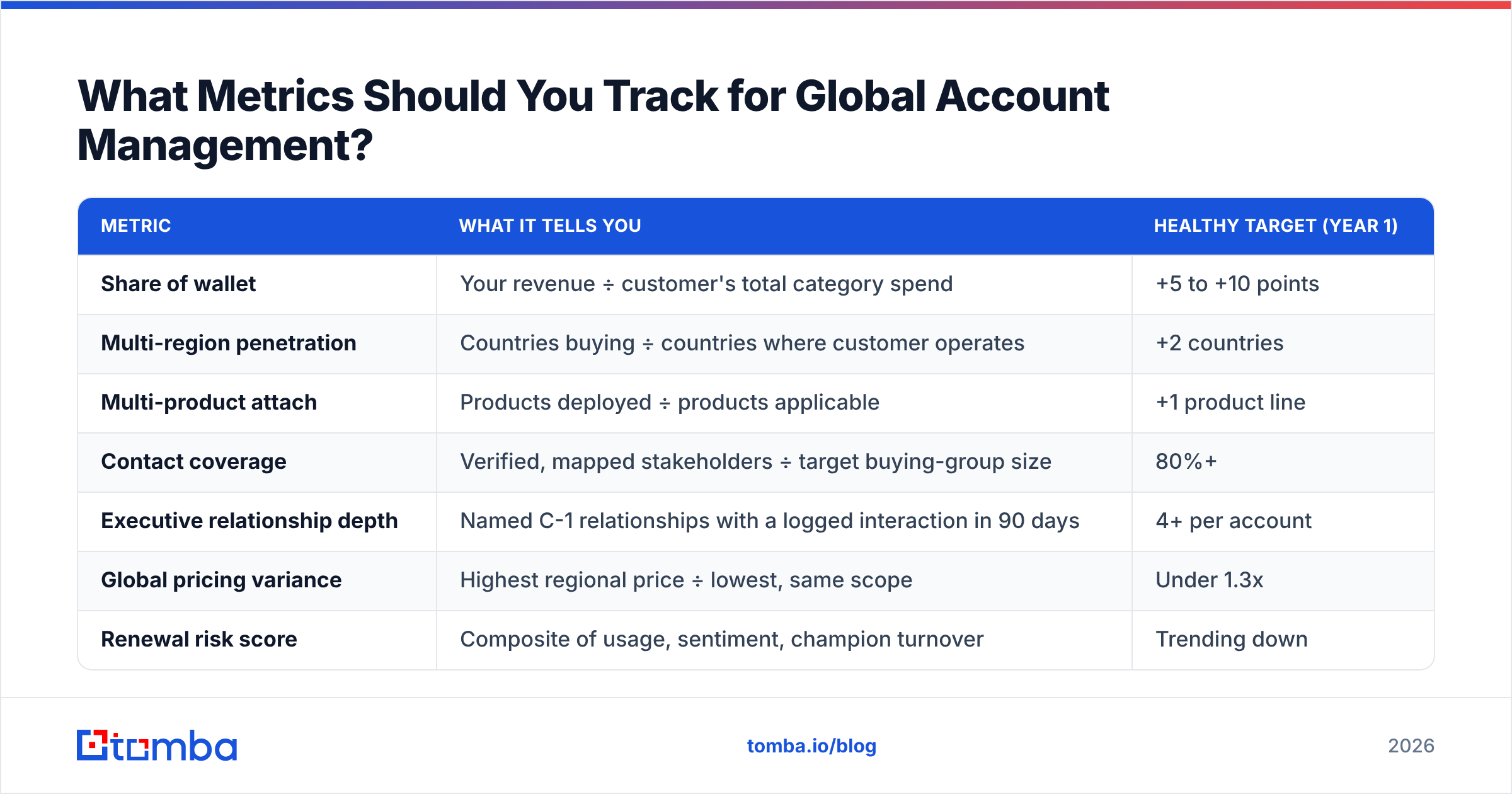
Revenue alone will not tell you whether the program is working, because a global account grows for reasons that have nothing to do with your GAM. Track leading indicators.
| Metric | What it tells you | Healthy target (year 1) |
|---|---|---|
| Share of wallet | Your revenue ÷ customer's total category spend | +5 to +10 points |
| Multi-region penetration | Countries buying ÷ countries where customer operates | +2 countries |
| Multi-product attach | Products deployed ÷ products applicable | +1 product line |
| Contact coverage | Verified, mapped stakeholders ÷ target buying-group size | 80%+ |
| Executive relationship depth | Named C-1 relationships with a logged interaction in 90 days | 4+ per account |
| Global pricing variance | Highest regional price ÷ lowest, same scope | Under 1.3x |
| Renewal risk score | Composite of usage, sentiment, champion turnover | Trending down |
| Cost to serve | Pod cost ÷ account gross margin | Under 25% |
Two of these deserve emphasis. Share of wallet is the only metric that tells you whether you are winning consolidation or just riding the customer's growth. And contact coverage is the leading indicator for everything else — if the GAM cannot name and reach 80% of the buying group across regions, every other number is a lagging accident.
For pricing variance, the fix is usually a global MSA with a regional uplift matrix rather than pure list-price harmonization. Full harmonization sounds clean and usually detonates a regional P&L.
How Do You Launch a Global Account Program Without Burning a Year?#
Ninety days is enough for a credible pilot. Twelve months is what it takes when you try to boil the ocean.
Days 1–15: Select and clean. Pick exactly two accounts. Not ten. Choose one where you are already strong (proves expansion) and one where you are underpenetrated (proves the model). Export every contact record, deduplicate, verify, and rebuild the hierarchy.
Days 16–45: Map and plan. Build the stakeholder map by region and buying center. Identify the gaps — the countries where you have zero named contacts. Fill those with domain search and enrichment before you write a single slide. Then write the joint account plan.
Days 46–60: Align internally. Get the split-credit policy signed. Name the executive sponsor and put two customer visits on their calendar now, not "sometime." Brief every regional leader personally.
Days 61–90: Execute and instrument. Run the first joint business review with the customer. Instrument the eight metrics above in a dashboard your CRO can open without asking anyone. Report honestly at day 90 — including what did not work.
Standard implementation guidance from vendors like HubSpot and peer reviews on G2 will tell you similar sequencing for account-based programs. The part they underweight is how much of the first 45 days is genuinely just data hygiene. Budget for it.
What Tools Do You Actually Need?#
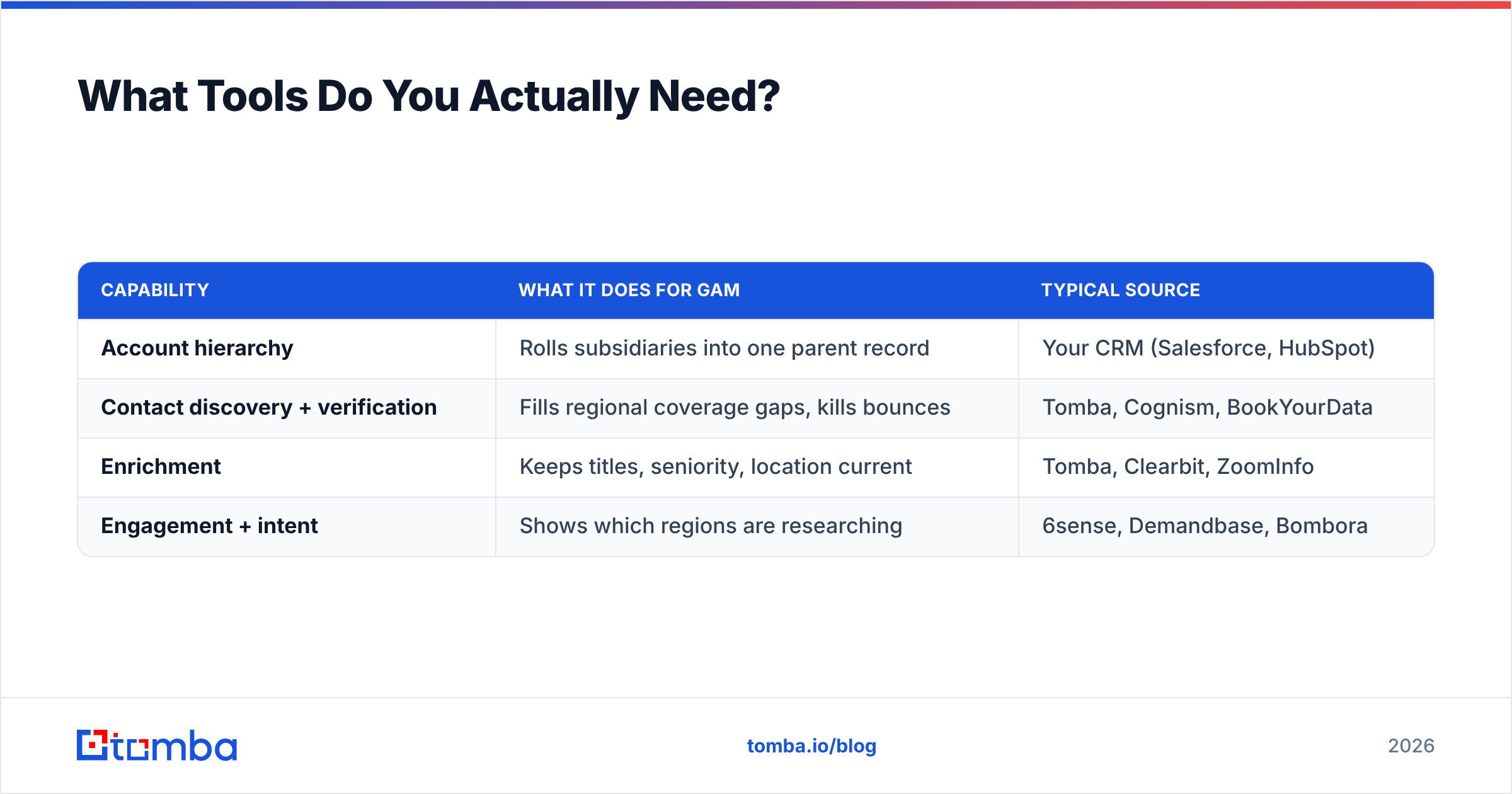
Less than the vendor deck suggests. A GAM program needs four capabilities, and you probably own three already.
| Capability | What it does for GAM | Typical source |
|---|---|---|
| Account hierarchy | Rolls subsidiaries into one parent record | Your CRM (Salesforce, HubSpot) |
| Contact discovery + verification | Fills regional coverage gaps, kills bounces | Tomba, Cognism, BookYourData |
| Enrichment | Keeps titles, seniority, location current | Tomba, Clearbit, ZoomInfo |
| Engagement + intent | Shows which regions are researching | 6sense, Demandbase, Bombora |
On the data layer specifically: for building and maintaining contact coverage across regional domains, Tomba is priced for teams that need volume without an enterprise contract — free tier at 25 searches/month, Starter at $49/mo, Growth at $99/mo, and Pro at $249/mo. See the full Tomba pricing breakdown if you are budgeting a pilot. BookYourData is a solid alternative when you want pre-built, verified lists rather than on-demand lookup, and works well alongside a discovery tool for coverage validation.
Skip the specialized "global account management platform" category for now. In year one, a well-configured CRM object model plus clean data beats a $60K/year point solution that your GAM will abandon by Q3.
Is Global Account Management Worth It in 2026?#
Yes — for a narrow set of companies, and no for everyone else.
It is worth it if you have five or more multinational customers, each above $4M, where procurement is consolidating and you have a real product footprint in three-plus regions. In that scenario, GAM is defensive infrastructure. Without it, you get consolidated out by a competitor who showed up with a single global point of contact and one price list.
It is not worth it if you are doing it because a board member mentioned it, or because "enterprise" felt like the next logical step. Running GAM at scale with fewer than five qualifying accounts means you built a $1M coordination layer for $6M of revenue that was going to renew anyway.
The honest test: can you name the specific decision your customer makes globally that you are currently losing because nobody owns the relationship? If you can name it, build the program. If you cannot, fix your account hierarchy and your contact data first — that alone will surface half the expansion you thought you needed a new org chart to capture.
Start with the data layer. Before you name a single global account manager, get an accurate picture of who works where inside your target accounts. The Tomba Email Finder lets you search by company domain — including regional variants like .de, .com.br, and .co.jp — to build verified stakeholder coverage across every country your customer operates in. Free tier gives you 25 searches to test the coverage gap on your top account; Starter is $49/mo when you are ready to map the whole portfolio.
Related guides#
Ready to find emails that actually work?
Join 150,000+ professionals who stopped guessing and started sending. Free credits on signup — no credit card required.
Get the Tomba newsletter
Practical outbound tactics and product updates — once every two weeks.
About the author