GMass vs Apollo.io (2026): Which Cold Email Tool Wins?
GMass vs Apollo.io: GMass lives inside Gmail and sends mail merges cheaply. Apollo.io sells a 200M-contact database plus sequencing. They solve different halves of the same problem. Here is how to pick, and when to run both.
TL;DR — GMass vs Apollo.io at a glance
GMass vs Apollo.io is not a like-for-like fight. GMass sends email from Gmail. Apollo.io finds the people you email. Here is the short version.
- GMass is a sending tool. Apollo.io is a data-and-sequencing platform. GMass adds mail merge, scheduling, and follow-ups inside Gmail. Apollo gives you a contact database, a dialer, sequences, and pipeline features.
- GMass is far cheaper for a solo founder or a small team that already has a list. Apollo costs more per seat. It also replaces three or four tools.
- Neither one is a safe source of truth for email data. Apollo has a huge database, but accuracy is uneven. GMass has no database at all. Either way, you need a separate verification step.
- GMass quietly wins on deliverability at low volume. Every email goes through your own Gmail account. There is no shared relay.
- Most teams should split the job. Use one tool to send. Use a specialist finder and verifier for the data. Bad addresses sink both platforms equally.
What is GMass, and who actually uses it?#
GMass is a Chrome extension. It turns Gmail into a cold email and mail-merge machine. You install it, write in the normal Gmail window, pull recipients from a Google Sheet, and hit a different send button. You never leave the inbox you already trust.
What you get: mail merge from spreadsheet columns, follow-ups that stop on reply, send-time scheduling, throttling to spread volume across the day, open and click tracking, list building from Gmail search, and an email verifier as an add-on. GMass launched in 2015. Its users skew toward solo operators, agencies, recruiters, university teams, and nonprofits. These are people who need to send 200 personal emails on Tuesday. They do not want to learn a sales platform first.
What you do not get: a contact database, a dialer, intent data, deep CRM sync, or account-based targeting. GMass assumes you already have the list. Keep that in mind for the rest of this comparison.
What is Apollo.io, and what does it replace?#
Apollo.io is a go-to-market platform. It bundles a B2B contact database (Apollo claims well over 200 million contacts and 30+ million companies), list building, email sequencing, a power dialer, a LinkedIn extension, meeting scheduling, call analysis on higher tiers, and enrichment that pushes into your CRM.
The pitch is consolidation. Instead of paying for a data vendor, a sequencing tool, a dialer, and an enrichment vendor, you pay Apollo one fee per seat. For a five-person SDR team, that math adds up. It is also why Apollo climbed the G2 sales intelligence category so fast.
Consolidation costs you depth. Apollo's data is broad, but much of it is self-reported or contributed by users. Accuracy varies by region and job level. The sequencer works, yet it bends less than a dedicated tool. And if you send at volume through Apollo's own infrastructure, you inherit the reputation your neighbors build.

GMass vs Apollo.io: how do they compare feature by feature?#
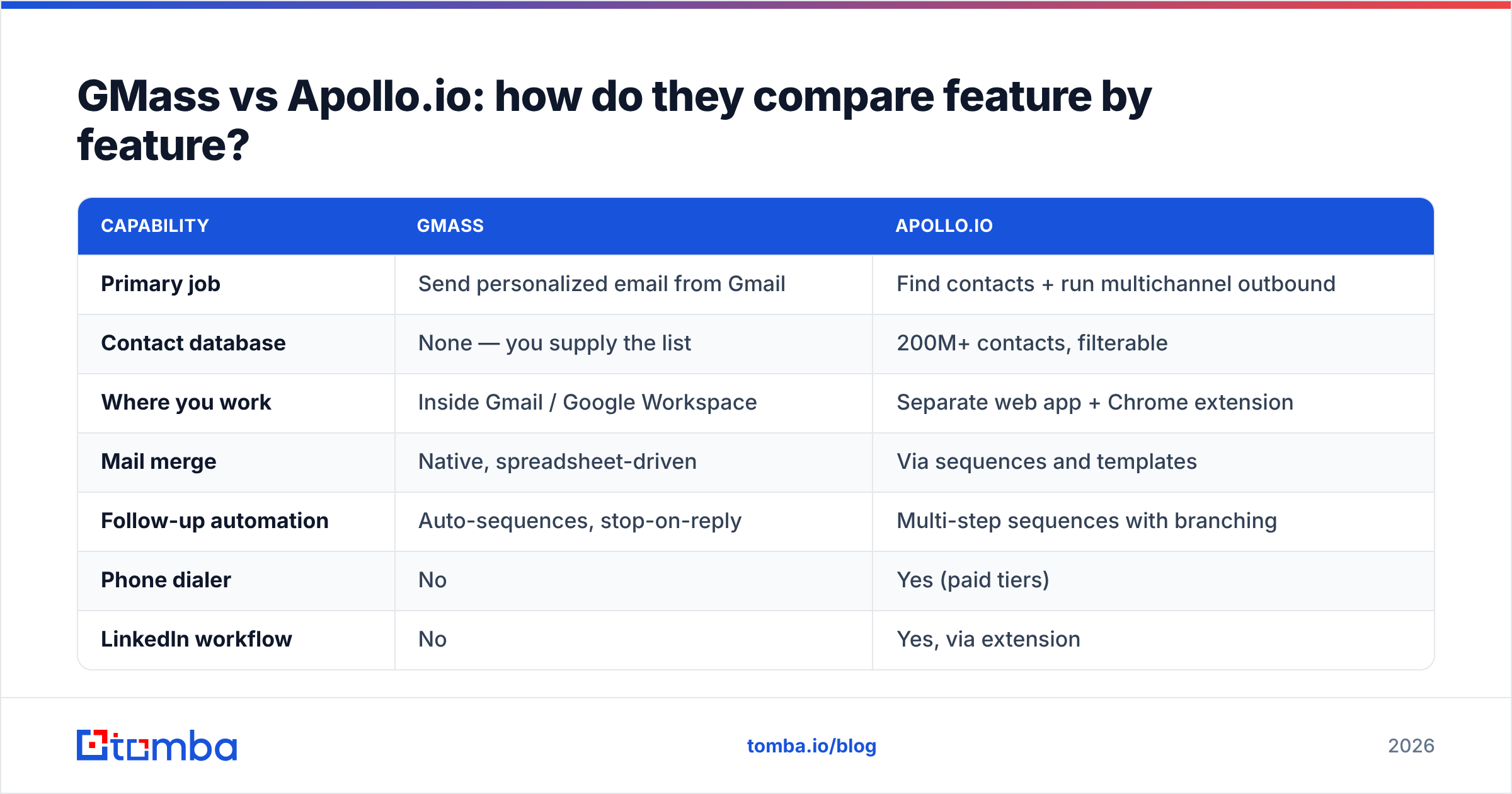
Here is the side-by-side that matters. Read it as "what job is this tool built for." Do not read it as "which one has more checkmarks."
| Capability | GMass | Apollo.io |
|---|---|---|
| Primary job | Send personalized email from Gmail | Find contacts + run multichannel outbound |
| Contact database | None — you supply the list | 200M+ contacts, filterable |
| Where you work | Inside Gmail / Google Workspace | Separate web app + Chrome extension |
| Mail merge | Native, spreadsheet-driven | Via sequences and templates |
| Follow-up automation | Auto-sequences, stop-on-reply | Multi-step sequences with branching |
| Phone dialer | No | Yes (paid tiers) |
| LinkedIn workflow | No | Yes, via extension |
| Email verification | Add-on credits | Included, quality varies |
| Sending infrastructure | Your own Gmail account | Apollo relay or your connected mailbox |
| CRM sync | Light (Sheets, Zapier) | Native HubSpot + Salesforce two-way |
| Learning curve | Under an hour | A few days to use well |
| Best fit | Solo founders, agencies, recruiters | SDR teams, RevOps-led orgs |
The pattern is clear. GMass is a scalpel. Apollo is a workbench. If your problem is "I have 400 warm contacts and need to email them well," GMass solves it in an afternoon. If your problem is "I don't know who to email," GMass cannot help you at all.
How does GMass vs Apollo.io pricing compare in 2026?#
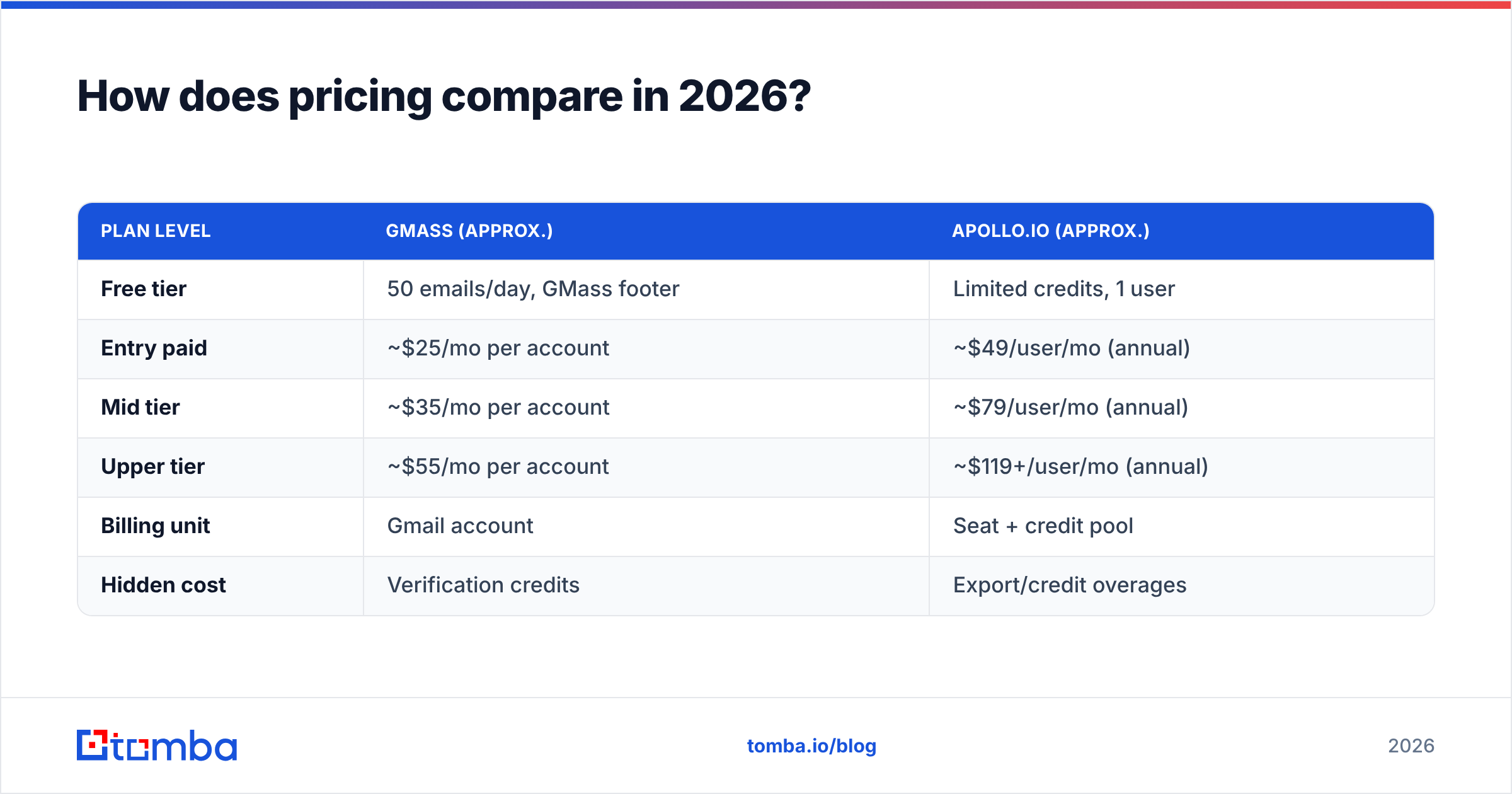
Both vendors change prices often. Treat the numbers below as directional, and check the pricing pages before you buy. The structure is the real difference. GMass charges per Gmail account. Apollo charges per seat, with credit limits on top.
| Plan level | GMass (approx.) | Apollo.io (approx.) |
|---|---|---|
| Free tier | 50 emails/day, GMass footer | Limited credits, 1 user |
| Entry paid | ~$25/mo per account | ~$49/user/mo (annual) |
| Mid tier | ~$35/mo per account | ~$79/user/mo (annual) |
| Upper tier | ~$55/mo per account | ~$119+/user/mo (annual) |
| Billing unit | Gmail account | Seat + credit pool |
| Hidden cost | Verification credits | Export/credit overages |
Two traps to watch.
First, Apollo's export and enrichment credits are the real currency. A team can burn a month of credits in one week of heavy list building. Then you face an upgrade that has nothing to do with headcount. Budget for the tier above the one that looks big enough.
Second, GMass looks cheap until you multiply it. Eight sending accounts means eight subscriptions. At that point the per-account model stops being a bargain, and pooled sending starts to look fair.
Price the data layer on its own too. Tomba pricing starts free at 25 searches a month. Paid plans run $49/mo on Starter, $99/mo on Growth, and $249/mo on Pro. That is often cheaper than buying Apollo seats just for database access.
Which one gives you better contact data?#
Apollo wins on volume. GMass has no database, so there is nothing to compare on breadth.
Accuracy is the harder question. Apollo's records come from contributed data, public sources, and inference. Job changes are the chronic problem. A record that was right in March can be stale by September. B2B contact data churns at roughly 25-30% a year. Apollo shows confidence indicators, but many teams still report bounce rates of 8-15% on raw exports. Most deliverability guidance puts the ceiling at 2-3%.
That does not make Apollo bad. It makes Apollo a discovery tool rather than a validation tool. In the GMass vs Apollo.io stack, the data step belongs to neither one. Here is the workflow that works:
- Build the target list in Apollo with company and title filters. This is what it does best.
- Export names, companies, and domains. Those fields age slowly.
- Re-find and verify each address with a dedicated email finder, or push the export through an email verifier before it reaches a sequence.
- Handle catch-all domains on their own. Standard SMTP checks return "unknown" here. That is where a catch-all verifier earns its keep, and a large share of enterprise domains are set up this way.
- Send from the tool that fits your volume. GMass for high-touch email, Apollo for team-wide sequences.
Teams that skip step 3 write the angry reviews about data accuracy. Teams that keep it get good results from either platform.

Which is better for email deliverability?#
GMass wins for most low-to-mid volume senders. The reason is plumbing, not magic.
Every GMass email leaves through your own Google Workspace account. It uses your domain, your SPF record, and your own sender reputation. There is no shared relay pool. If your list is clean and your copy is not spammy, you get Gmail-to-Gmail delivery. That is about as good as cold outreach gets. GMass also spreads sends across the day, which looks more human than a 500-email burst at 9am.
Apollo lets you connect your own mailbox, so the same logic can apply. But Apollo users tend to send at higher volume. Google Workspace caps you near 2,000 recipients a day, and far lower in practice for cold email. Past that point, teams move to dedicated infrastructure or extra domains. More volume means more room for reputation damage. On shared IPs, you are only as trusted as the worst sender on the platform.
Some advice holds either way. Warm a new domain for two to three weeks before real sending. Keep bounce rate under 2%. Cap daily volume per mailbox. Test your setup with an SPF checker before the first campaign. Google and Yahoo now require authentication for bulk senders. Unauthenticated cold email gets filtered hard, and no sending tool can save a broken domain setup.
Can you use GMass and Apollo.io together?#
Yes. For one team shape it is the best setup available.
The split works like this. Apollo handles discovery: territory planning, ICP filters, account lists, and the dialer. GMass handles the high-value email, sent by founders or account executives. Those emails should look like a person wrote them, and with GMass a person literally did.
You export from Apollo, verify the addresses with a third tool, drop the clean list in a Google Sheet, and let GMass merge from there. That is three tools where the marketing pages promise one. Each one does the job it is good at.
The friction is real. There is no native handoff between the two, so you move CSVs or wire something up through Zapier. Under ten people, that is a weekly annoyance rather than a blocker. Above that, the manual export is what breaks first. Then you want bulk verification or an API pipeline instead of people dragging files around.
Which should you pick in the GMass vs Apollo.io matchup?#
Match the tool to your real constraint, not to your ambition.
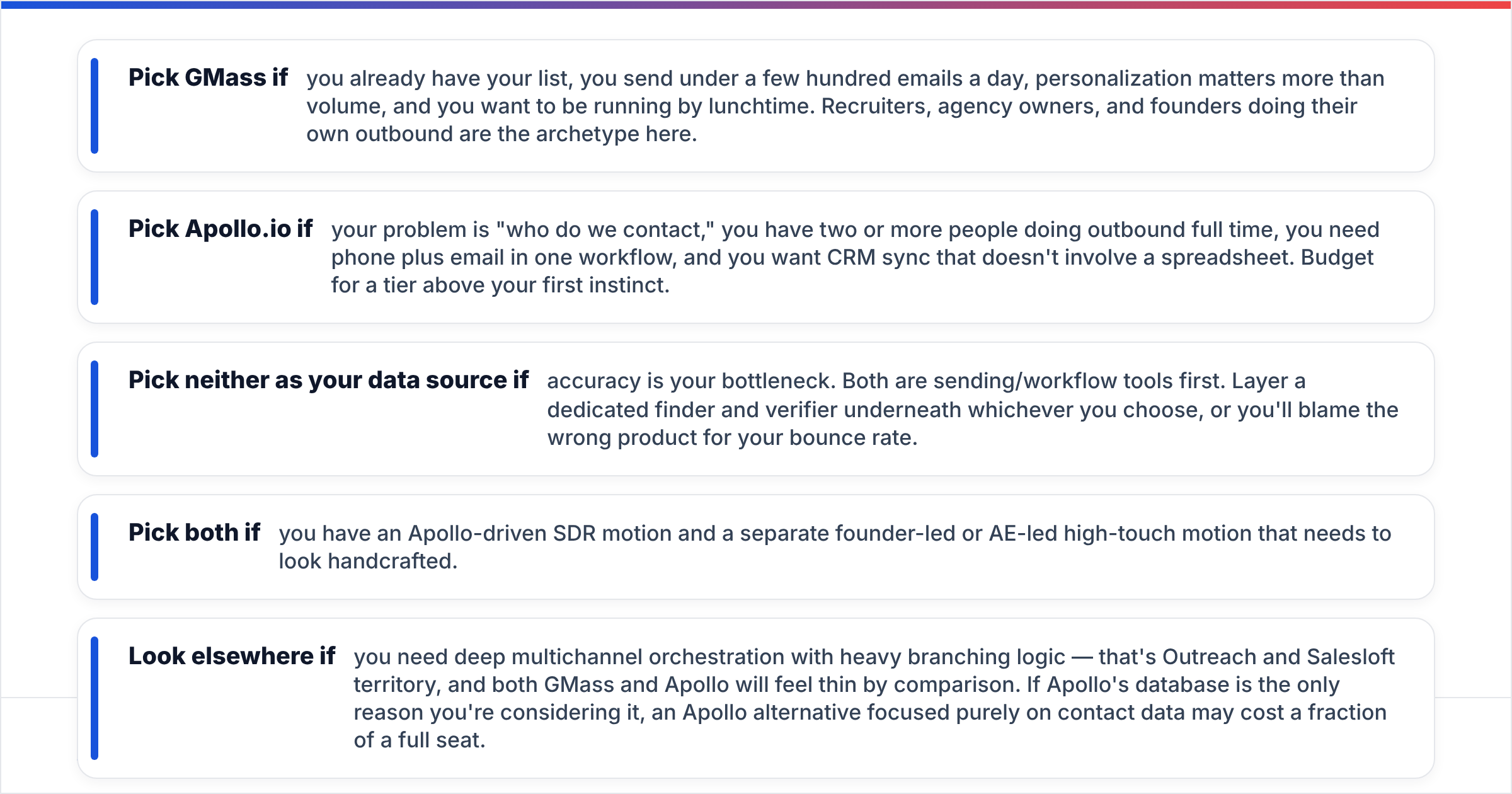
- Pick GMass if you already have the list. It suits senders under a few hundred emails a day who care more about personalization than volume. You can be live by lunchtime. Recruiters, agency owners, and founders doing their own outbound fit here.
- Pick Apollo.io if your problem is "who do we contact." It fits two or more full-time outbound reps who need phone and email in one workflow, plus CRM sync that is not a spreadsheet. Budget one tier above your first instinct.
- Pick both if you run an Apollo-driven SDR motion alongside a founder-led or AE-led motion that has to look handcrafted.
Two cases call for something else.
- Neither one is your data source if accuracy is the bottleneck. Both are workflow tools first. Put a dedicated finder and verifier underneath, or you will blame the wrong product for your bounce rate.
- Look elsewhere if you need deep multichannel orchestration with heavy branching. That is Outreach and Salesloft territory. If Apollo's database is your only reason to buy, an Apollo alternative built purely for contact data can cost a fraction of a seat.
One more filter: think about churn. Leaving GMass means dropping an extension, and your Gmail history stays put. Leaving Apollo means untangling sequences, CRM sync, and a database your whole list-building process leans on. Switching costs matter in a decision you will live with for two years.
What's the verdict?#
GMass vs Apollo.io is the wrong frame, because the two tools answer different questions. They just get marketed into the same search results.
GMass is the better sending tool for personal, moderate-volume email, and it costs much less. Apollo.io is the better platform when you have no list, need phones, and are building a repeatable team motion. Anyone who tells you one is universally better is selling something.
Both share one dependency you can control: the quality of the addresses going in. A 12% bounce rate burns a domain whether the send button says GMass or Apollo. No amount of copy testing brings that domain back.
So invest in that layer on its own. Tomba's Tomba Email Finder verifies addresses at the source, with confidence scores, visible sources, and catch-all handling. The list you hand to GMass, or push into an Apollo sequence, is then one you would stake your domain on. Start free with 25 searches a month. Run your next export through it, and compare the bounce rate to your last campaign. That one number tells you more than any feature table.
Related guides#
Ready to find emails that actually work?
Join 150,000+ professionals who stopped guessing and started sending. Free credits on signup — no credit card required.
Get the Tomba newsletter
Practical outbound tactics and product updates — once every two weeks.
About the author