How to Build an Email List Without a Website in 2026
No domain, no landing page, no budget? You can still build a real opt-in email list. Here are seven methods that work in 2026, with costs, effort, and honest trade-offs.
TL;DR
- You do not need a domain, a CMS, or a developer to build an email list. Hosted form pages from Kit, MailerLite, Beehiiv, and Substack give you a public URL in under 20 minutes.
- The fastest no-website stack in 2026: a hosted signup page + one distribution channel you already own (LinkedIn, YouTube, a Slack community, or in-person events).
- Consent still applies. GDPR, CAN-SPAM, and CASL do not care whether your form lives on your domain or someone else's — you need explicit opt-in and a working unsubscribe.
- Cold B2B outreach is a different motion from list building. Keep the two lists separate, and use a verified source like a bulk email finder for outbound rather than dumping scraped addresses into your newsletter.
- Expect 30-120 subscribers in your first 30 days from a single channel done consistently. Anyone promising 10,000 is selling you a purchased list.
Why would you build an email list without a website at all?#
Because the website is the slowest, most expensive part of the funnel — and it is not the part that collects emails.
Three situations come up constantly:
- You are pre-product. You want to validate demand before you spend six weeks on a Next.js site nobody visits.
- You are a creator or consultant. Your audience lives on LinkedIn, YouTube, or a podcast feed. A website would be a detour they never take.
- You are inside a company with a locked-down web team. Getting a form added to the corporate site means a ticket, a design review, and a legal sign-off. A hosted page takes an afternoon.
In all three cases the actual requirement is a public URL that captures an email and stores it somewhere you control. That is a solved problem. Every major email service provider now ships a hosted landing page as a first-class feature, precisely because so many of their customers do not have a site.
The trade-off is real and worth naming: you rent the page. If Substack changes its terms or Kit deprecates a template, you move. But you own the list itself — export the CSV, import it elsewhere, and your asset survives. That is the difference between building on rented land and storing your valuables there.
What are the actual methods that work in 2026?#
Seven approaches, ranked by how quickly they produce a subscriber who actually wants your email.
- Hosted landing page from your ESP. Kit (formerly ConvertKit), MailerLite, Beehiiv, and Substack all give you a
yourname.kit.comstyle URL with a form, a double opt-in flow, and an automated welcome email. This is the backbone — every other method points traffic here. - LinkedIn as the traffic layer. Post consistently, put the signup link in your featured section and your "contact info" panel, and mention it in comments rather than in the post body (LinkedIn suppresses outbound links in posts). A niche B2B account posting three times a week reliably produces 20-60 signups a month.
- Lead magnet gated by a form, not a site. A Notion doc, a Google Sheet template, or a Figma file works fine as the deliverable. The form collects the email, the automation sends the link. No hosting required.
- Communities and Slack/Discord groups. Answer questions for a month before you mention your list. The conversion rate from a community where you have standing is 5-10x cold traffic.
- In-person and virtual events. A QR code on a slide pointing to your hosted form is still the highest-intent signup source available. Webinars registered through Luma or Zoom export attendee emails directly — with consent captured at registration.
- Podcast and YouTube show notes. The description field is a permanent, indexable link surface. Guests on other people's shows convert unusually well because the host's endorsement transfers.
- Partner cross-promotion. Two newsletters of similar size recommending each other in a welcome email is free, symmetric, and compounds. Beehiiv's recommendation network automates this.
Notice what is absent: buying lists, scraping social profiles into a newsletter, and "email append" services. Those produce spam complaints, not subscribers, and they will destroy your sender reputation before you reach 500 contacts.
Which platform should you actually pick?#
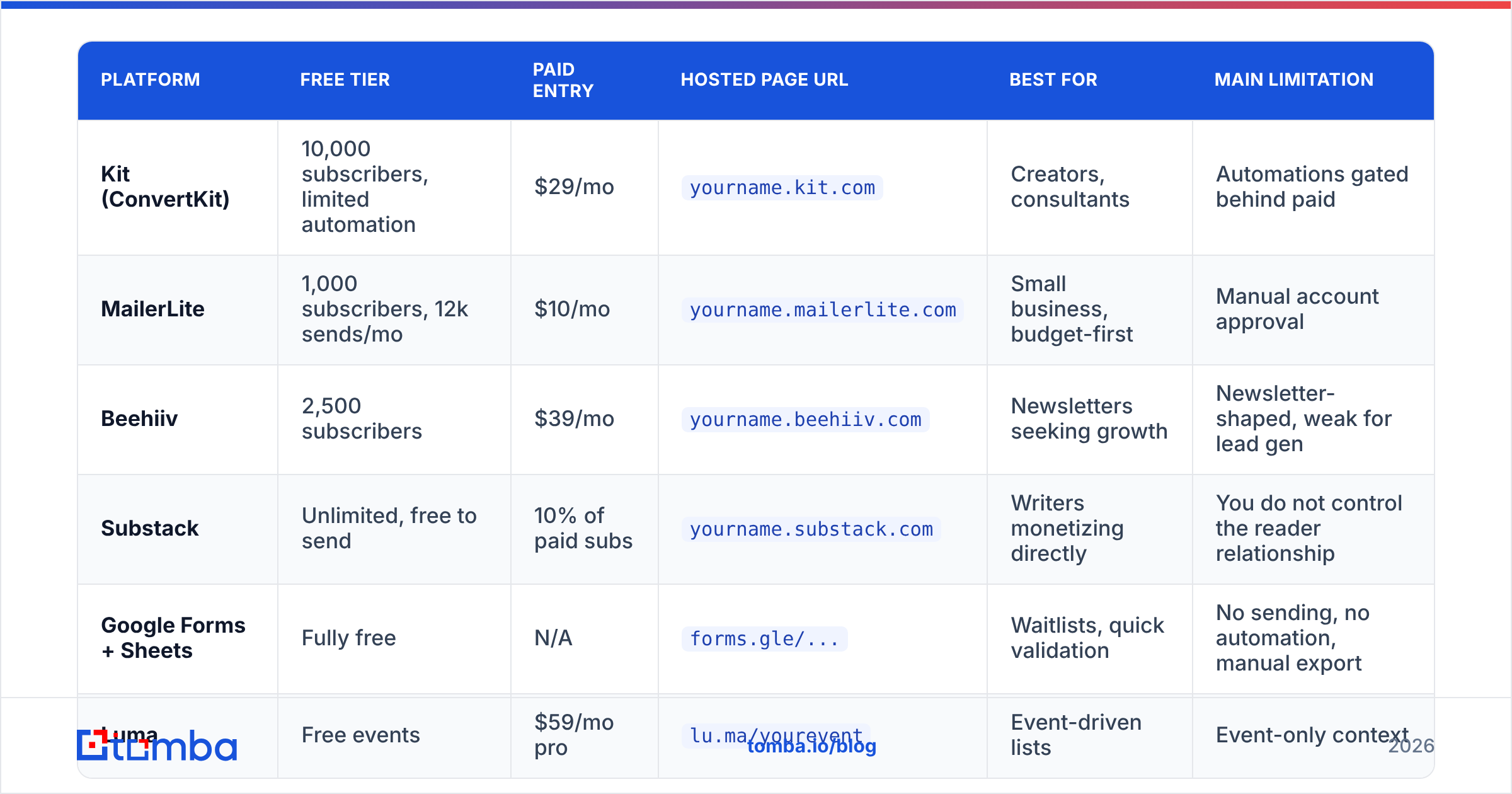
Depends on whether you want a newsletter, a lead-gen list, or a product waitlist. Here is how the main no-website options compare on the things that matter.
| Platform | Free tier | Paid entry | Hosted page URL | Best for | Main limitation |
|---|---|---|---|---|---|
| Kit (ConvertKit) | 10,000 subscribers, limited automation | $29/mo | yourname.kit.com |
Creators, consultants | Automations gated behind paid |
| MailerLite | 1,000 subscribers, 12k sends/mo | $10/mo | yourname.mailerlite.com |
Small business, budget-first | Manual account approval |
| Beehiiv | 2,500 subscribers | $39/mo | yourname.beehiiv.com |
Newsletters seeking growth | Newsletter-shaped, weak for lead gen |
| Substack | Unlimited, free to send | 10% of paid subs | yourname.substack.com |
Writers monetizing directly | You do not control the reader relationship |
| Google Forms + Sheets | Fully free | N/A | forms.gle/... |
Waitlists, quick validation | No sending, no automation, manual export |
| Luma | Free events | $59/mo pro | lu.ma/yourevent |
Event-driven lists | Event-only context |
The honest recommendation for most B2B readers: MailerLite if budget is the constraint, Kit if automation is the constraint, Beehiiv if growth mechanics are the constraint. Substack is excellent for writers but the subscriber relationship is mediated by Substack's app and network, which matters more than people admit when you eventually want to move.
Verify current pricing on each vendor's own page before you commit — MailerLite and Beehiiv both revised tiers in the last 18 months, and G2's email marketing category is a reasonable neutral place to sanity-check the field.
How do you set this up in one afternoon?#
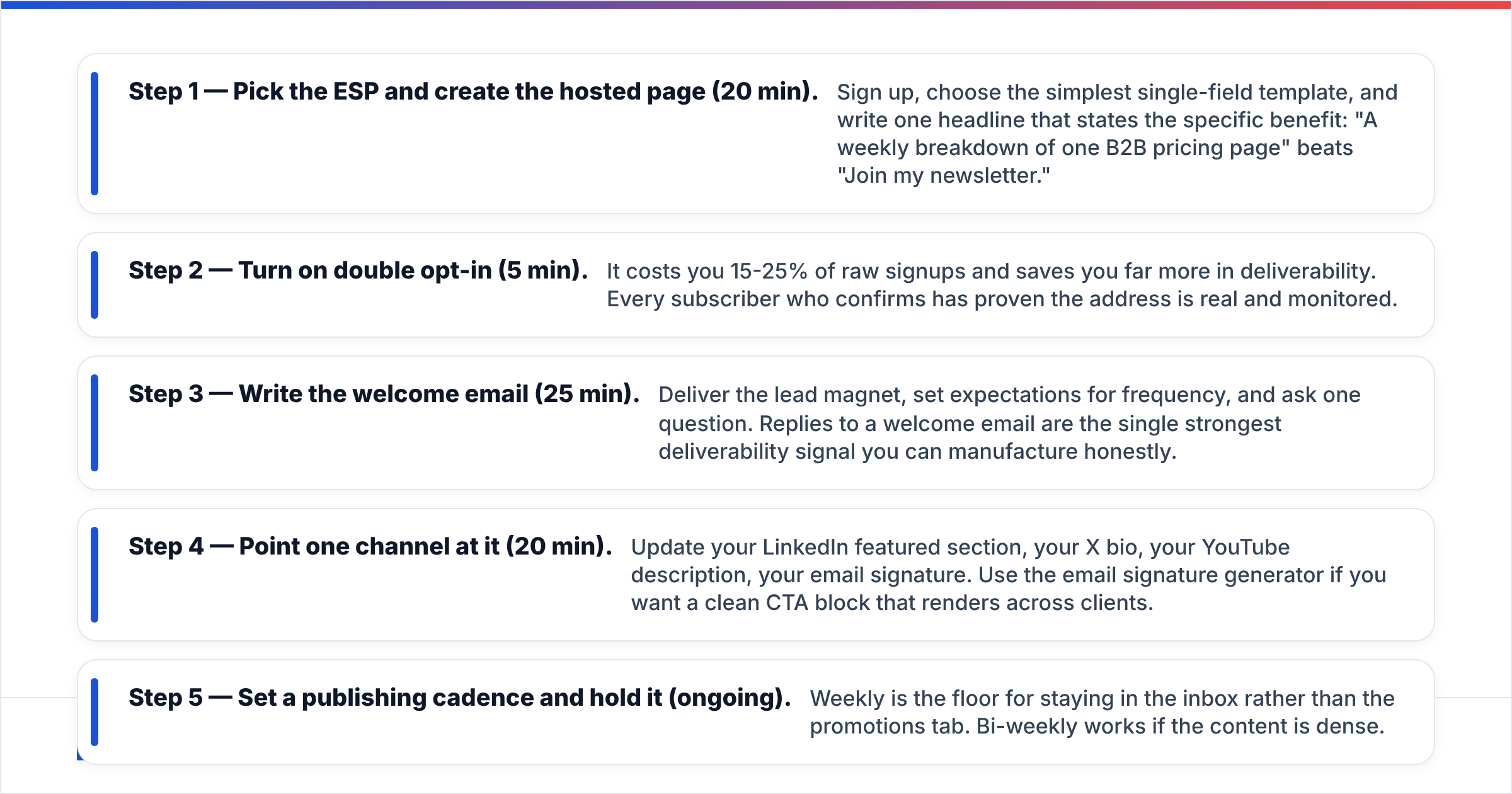
A concrete sequence. Roughly 90 minutes of real work.
- Step 1 — Pick the ESP and create the hosted page (20 min). Sign up, choose the simplest single-field template, and write one headline that states the specific benefit: "A weekly breakdown of one B2B pricing page" beats "Join my newsletter."
- Step 2 — Turn on double opt-in (5 min). It costs you 15-25% of raw signups and saves you far more in deliverability. Every subscriber who confirms has proven the address is real and monitored.
- Step 3 — Write the welcome email (25 min). Deliver the lead magnet, set expectations for frequency, and ask one question. Replies to a welcome email are the single strongest deliverability signal you can manufacture honestly.
- Step 4 — Point one channel at it (20 min). Update your LinkedIn featured section, your X bio, your YouTube description, your email signature. Use the email signature generator if you want a clean CTA block that renders across clients.
- Step 5 — Set a publishing cadence and hold it (ongoing). Weekly is the floor for staying in the inbox rather than the promotions tab. Bi-weekly works if the content is dense.
Skip step 2 at your peril. The most common way a no-website list dies is not slow growth — it is a batch of typo'd or throwaway addresses hard-bouncing on send one, which lands the whole domain in a spam folder before anyone reads the first issue.
Does list building without a website hurt deliverability?#
Not inherently, but two things change and you need to handle both.
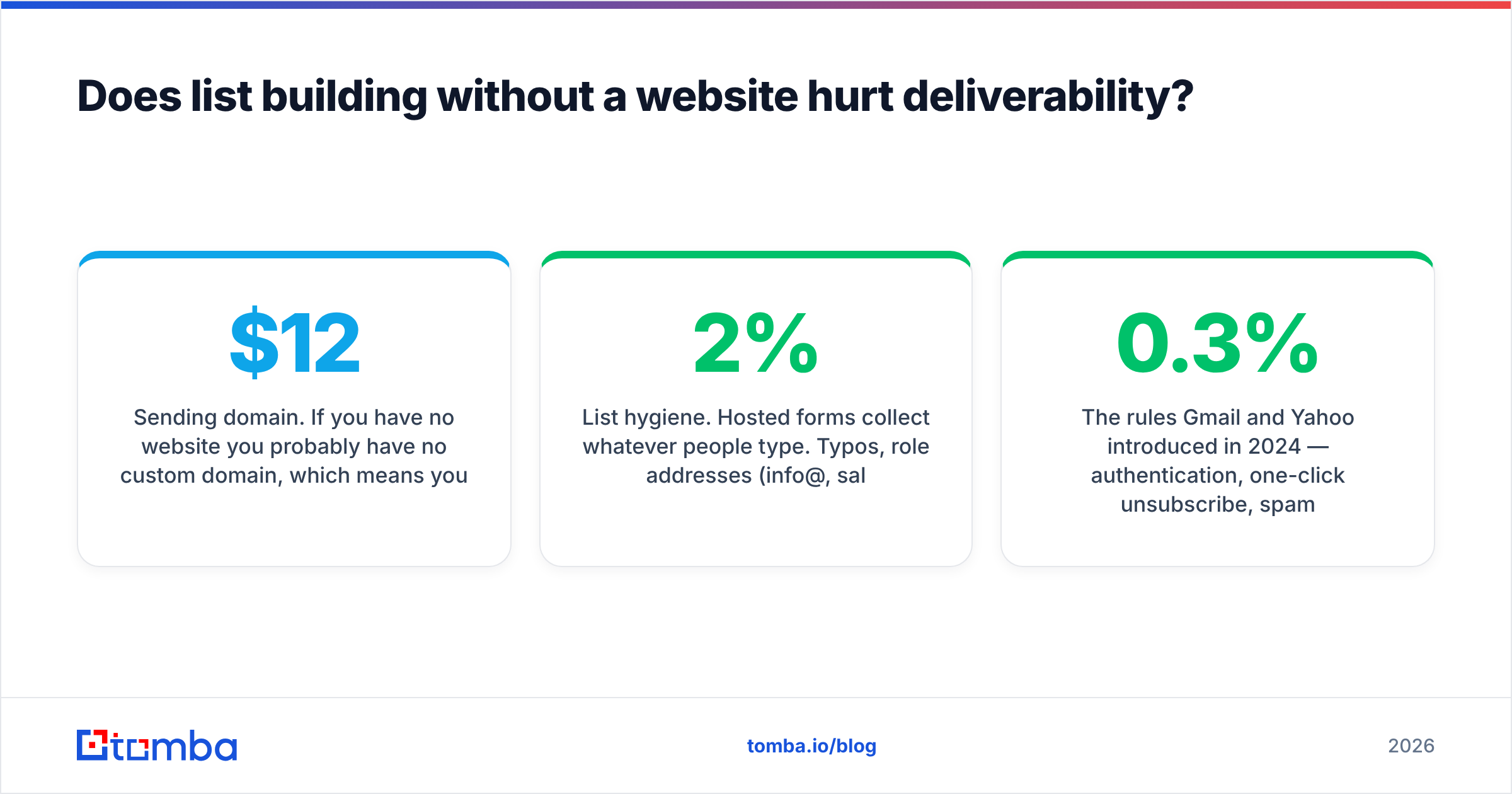
Sending domain. If you have no website you probably have no custom domain, which means your ESP sends from a shared or subdomain sender. That works at small scale. Once you cross a few thousand contacts, buy a domain (about $12/year) purely for email authentication — you still do not need to build a site on it. Point SPF, DKIM, and DMARC records at your ESP and you are done. Check the record with an SPF checker before your first real send.
List hygiene. Hosted forms collect whatever people type. Typos, role addresses (info@, sales@), and disposable domains all show up. Run new signups through an email verifier periodically and drop anything that comes back undeliverable. A bounce rate above 2% is where mailbox providers start throttling you, per Google's bulk sender guidelines.
The rules Gmail and Yahoo introduced in 2024 — authentication, one-click unsubscribe, spam rates under 0.3% — apply to you at 5,000 daily sends regardless of whether you own a website. Plan for them early rather than retrofitting.
How is this different from cold B2B outbound?#
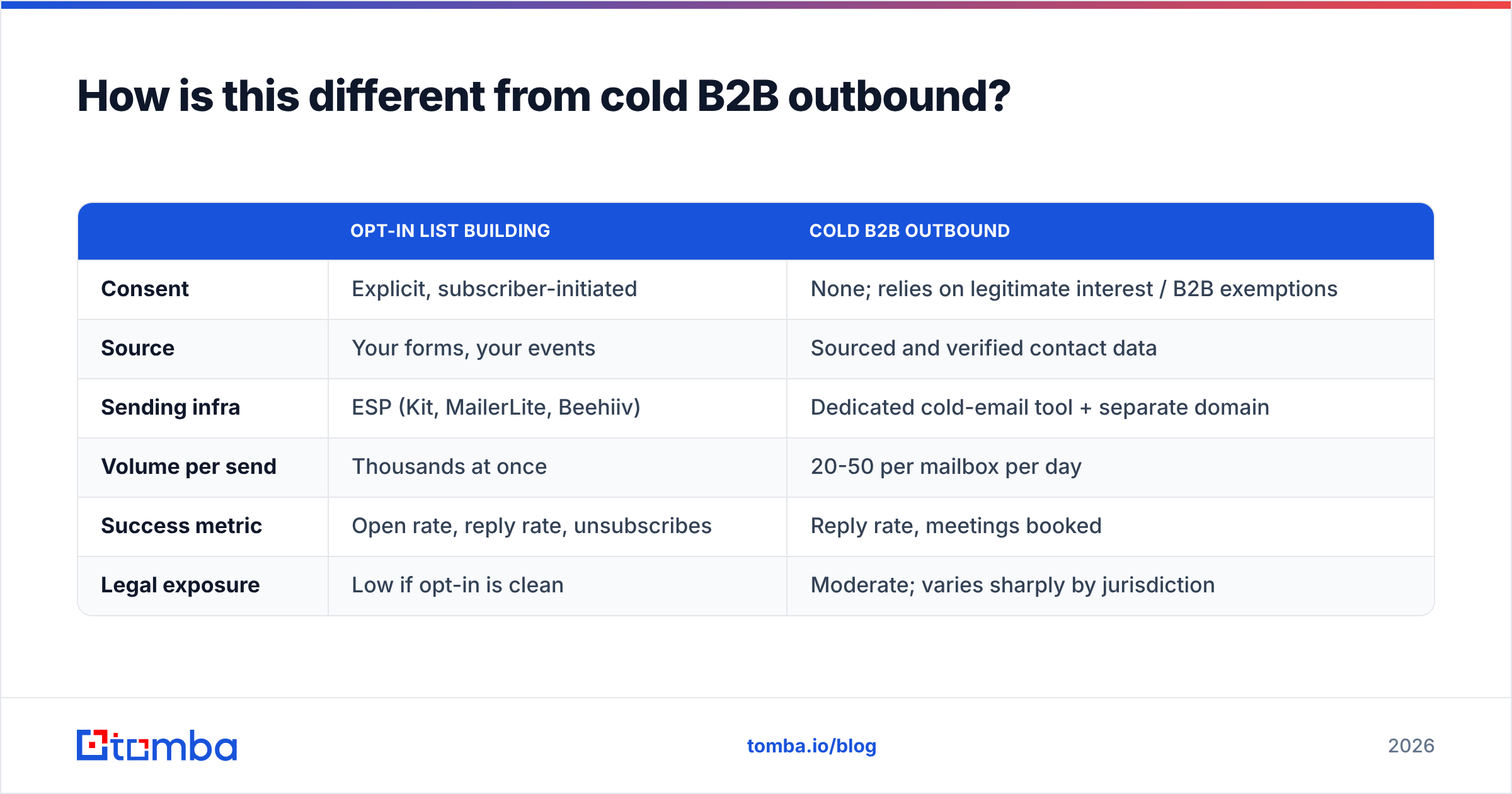
Completely different motion, and conflating the two is the most expensive mistake in this space.
| Opt-in list building | Cold B2B outbound | |
|---|---|---|
| Consent | Explicit, subscriber-initiated | None; relies on legitimate interest / B2B exemptions |
| Source | Your forms, your events | Sourced and verified contact data |
| Sending infra | ESP (Kit, MailerLite, Beehiiv) | Dedicated cold-email tool + separate domain |
| Volume per send | Thousands at once | 20-50 per mailbox per day |
| Success metric | Open rate, reply rate, unsubscribes | Reply rate, meetings booked |
| Legal exposure | Low if opt-in is clean | Moderate; varies sharply by jurisdiction |
Never merge them. Putting cold-sourced contacts into your newsletter ESP is a terms-of-service violation at most providers and will get your account suspended. Keep the newsletter in the ESP and run outbound through separate infrastructure on a separate domain.
Where sourced data legitimately belongs: enriching the people who already signed up. Someone gives you sarah@acme.com on a form — running that through data enrichment tells you her role, company size, and industry so you can segment. That is enrichment of consented data, not cold acquisition, and it is the highest-leverage thing you can do with a small list.
What should you expect in the first 90 days?#
Realistic numbers, assuming one channel worked consistently and no ad spend.
- Days 1-30: 30-120 subscribers. Almost entirely from your existing network and the first channel you activated. Open rates will look great (50-70%) because these people know you.
- Days 31-60: 60-250 cumulative. The channel starts producing strangers. Open rates settle toward 35-45%. First unsubscribes arrive — that is healthy, not a failure.
- Days 61-90: 150-500 cumulative if you added a second channel or a partner cross-promotion. This is where compounding either starts or visibly does not, which is your signal to change the offer rather than the tactics.
If you are under 50 subscribers at day 90 with consistent publishing, the problem is almost never the platform. It is that the promise on the signup page is too vague to be worth an email address. Rewrite the headline to name a specific person and a specific outcome.
For B2B lists specifically, quality beats volume by an enormous margin. Two hundred subscribers who are heads of RevOps at 200-person SaaS companies is a better asset than 5,000 mixed consumer addresses, and it is easier to build. Narrow the promise until it hurts.
How do you know a "shortcut" is actually a trap?#
Four warning signs, all of which appear in the ads that surround this exact search query:
- "Buy 10,000 verified B2B emails." Purchased lists have never been an opt-in list. They are cold data, sold to hundreds of buyers, and mailing them from your ESP ends the account. If you need contact data for outbound, source it fresh and verify it — that is a different tool and a different sending setup.
- "Grow your list with our giveaway widget." Sweepstakes traffic converts to subscribers who wanted the prize. Unsubscribe and complaint rates run several times higher than organic signups.
- "No double opt-in needed, we handle deliverability." Nobody handles deliverability on your behalf. Your list, your sending reputation.
- "Import your LinkedIn connections." Connecting on LinkedIn is not consent to receive a newsletter. It is also the fastest route to a spam-complaint spike, since none of those people asked.
The legitimate version of "get contact data fast" is B2B prospecting for outbound, done transparently. Providers like BookYourData and Tomba operate in that space with verified, source-attributed records — but note that this is outbound data for one-to-one sales email, not fuel for a newsletter. Keep the categories separate and you stay out of trouble.
What tooling helps once the list starts working?#
Once you are past the first few hundred subscribers, three jobs appear that a hosted form alone does not cover.
- Segmentation. You need to know who these people are. Enrich the signup address into job title, company, and headcount so you can send different content to founders than to practitioners.
- Verification at intake. Catch typos and disposable domains before they bounce. A free email checker handles one-offs; an API call handles the flow.
- Reactivating dormant contacts. People change jobs. A contact who went silent may just have a new address at a new company, and a reverse email lookup or a fresh domain search can recover them.
None of these require a website either. They are API calls or spreadsheet operations that sit alongside whatever hosted page you chose.
The bottom line#
You can build a genuine, permission-based email list with zero web development: a hosted signup page from your ESP, one distribution channel you already have access to, double opt-in switched on, and a weekly cadence you can actually sustain. The website, if you ever build one, is an optimization — not a prerequisite.
Where it gets interesting is what you do with the addresses once they arrive. A raw email is a name in a spreadsheet; an enriched, verified contact is a segment you can sell to. When you are ready to turn signups into a real B2B picture — role, company, and reachable colleagues at the same account — Tomba's Email Finder covers it, with a free tier at 25 searches a month and paid plans starting at $49/mo on the Tomba pricing page. Start free, verify what you collect, and grow the list on infrastructure you can actually trust.
Related guides#
Ready to find emails that actually work?
Join 150,000+ professionals who stopped guessing and started sending. Free credits on signup — no credit card required.
Get the Tomba newsletter
Practical outbound tactics and product updates — once every two weeks.
About the author