Lead Generation Advertising: What Actually Works in 2026
Most lead gen ad budgets die in the gap between a form fill and a real conversation. Here's how the channels actually compare on cost, intent, and data quality in 2026.
TL;DR
- Lead generation advertising is paid media bought against a lead event (form fill, demo request, download) instead of a click or an impression — and the reported cost per lead is almost never the real cost per qualified lead.
- LinkedIn Lead Gen Forms produce the best B2B fit but the worst raw CPL; Google Search produces the best intent; Meta produces volume that needs the heaviest qualification layer.
- The biggest leak is not the ad. It's the 48 hours after the form fill: bad or missing contact data, no enrichment, no routing, no second channel.
- Budget rule of thumb for 2026: spend no more than 70% of the program on media. The other 30% goes to data, enrichment, and follow-up infrastructure.
- Run the math on cost per sales-accepted lead, not cost per form fill. The ranking of your channels usually flips.
What is lead generation advertising?#
Lead generation advertising is paid media where the conversion event you buy is a contact record, not a sale and not a visit. You pay Google, LinkedIn, Meta, or a trade publisher, and in exchange you get a name, an email, sometimes a phone number and a job title.
The everyday analogy: it's renting a fishing spot rather than buying fish. You pay for access to a stocked pond and the right bait, but nobody guarantees what comes up on the line. Technically, it's a media buy optimised toward a lead-event conversion signal, where the platform's algorithm learns which users are likely to submit a form rather than which users are likely to buy.
That distinction is the whole game. Ad platforms optimise for the event you report back to them. Report "form submitted" and you get form submitters — including the ones who typed asdf@gmail.com to grab a PDF. Report "sales-accepted lead" or "opportunity created" and the same budget buys a materially different audience.
Three structural facts that shape every decision below:
- The lead event is a proxy, not an outcome. Optimising toward it directly creates volume, not revenue.
- Platform-native forms trade data quality for conversion rate. Prefilled LinkedIn and Meta forms convert 2-4x better than landing pages and produce noticeably more personal-domain emails.
- Attribution windows lie in B2B. A 90-day B2B cycle does not fit a 7-day click window, so most platforms under-report the channels that create demand and over-report the ones that harvest it.
Which lead generation advertising channels actually perform in 2026?#
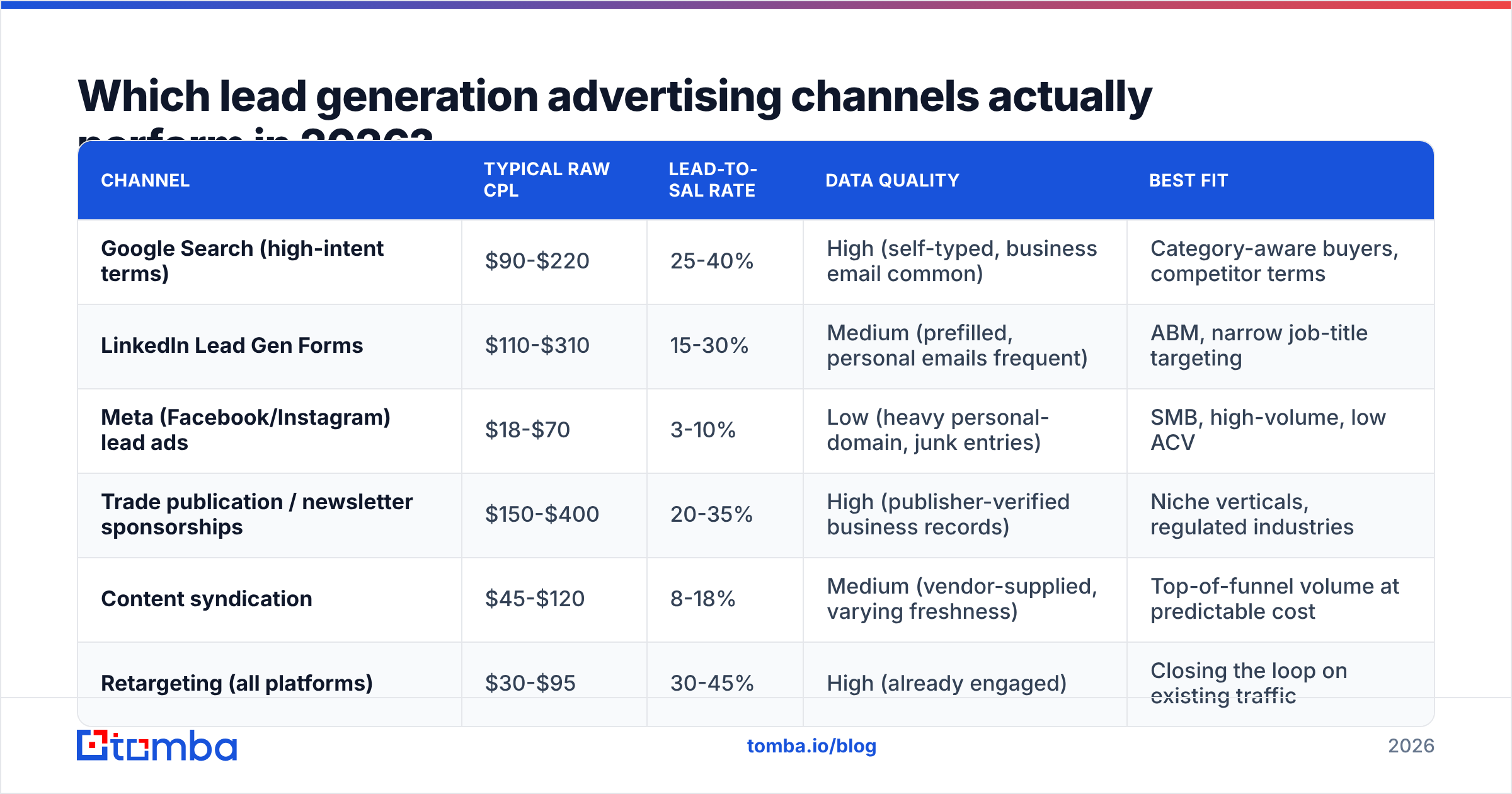
Here's the honest comparison. Cost figures are blended B2B SaaS ranges observed across mid-market programs — your numbers will move with vertical, geography, and deal size, but the relative ordering holds remarkably well.
| Channel | Typical raw CPL | Lead-to-SAL rate | Data quality | Best fit |
|---|---|---|---|---|
| Google Search (high-intent terms) | $90-$220 | 25-40% | High (self-typed, business email common) | Category-aware buyers, competitor terms |
| LinkedIn Lead Gen Forms | $110-$310 | 15-30% | Medium (prefilled, personal emails frequent) | ABM, narrow job-title targeting |
| Meta (Facebook/Instagram) lead ads | $18-$70 | 3-10% | Low (heavy personal-domain, junk entries) | SMB, high-volume, low ACV |
| Trade publication / newsletter sponsorships | $150-$400 | 20-35% | High (publisher-verified business records) | Niche verticals, regulated industries |
| Content syndication | $45-$120 | 8-18% | Medium (vendor-supplied, varying freshness) | Top-of-funnel volume at predictable cost |
| Retargeting (all platforms) | $30-$95 | 30-45% | High (already engaged) | Closing the loop on existing traffic |
Read that table sideways, not down. Meta looks like the cheapest lead in the building at $18. Multiply by a 5% sales-accepted rate and your true cost per qualified conversation is $360. Google Search at $150 with a 32% SAL rate lands at $469 — closer than the raw numbers suggest, but with far better deal sizes attached. LinkedIn at $200 and 22% comes out at $909 per accepted lead, which is defensible only when your average contract value clears roughly $25K.
The channels that consistently disappoint in 2026 are display networks bought on a CPL basis and any programmatic "lead package" where you cannot see the source site list. If a vendor will not show you where the lead came from, assume the worst and price it accordingly.
Is LinkedIn lead gen advertising worth the premium?#
Yes — conditionally. LinkedIn is the only major platform where you can target by job title, seniority, company size, and company list simultaneously with data the users themselves maintain. According to LinkedIn's own advertising documentation, Lead Gen Forms prefill from the member profile, which is exactly why they convert so well and exactly why the email you receive is so often a personal one.
The premium is worth paying when three things are true:
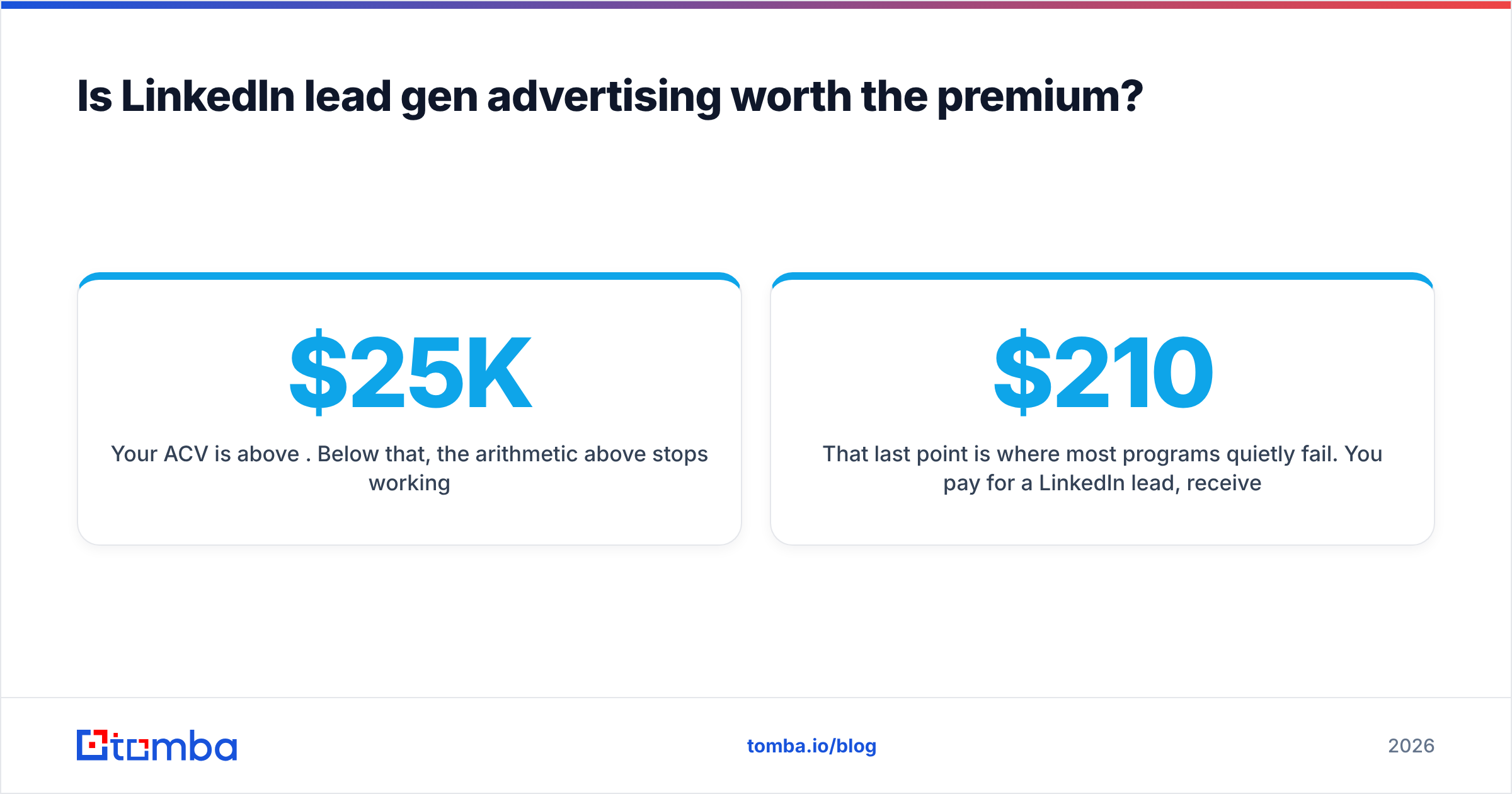
- Your ACV is above $25K. Below that, the arithmetic above stops working.
- You have a named account list. Broad LinkedIn targeting burns money fast; matched-audience targeting against 500-2,000 accounts does not.
- You can enrich what the form gives you. A prefilled form that returns
jsmith@gmail.comis worth very little until you resolve it to a work address at a known company.
That last point is where most programs quietly fail. You pay $210 for a LinkedIn lead, receive a personal Gmail address and a company name, and then the SDR has no business email to sequence. Running those records through an email finder against the stated company domain recovers a usable work address for a large share of them, which turns a dead record into a workable one for a rounding error against the $210 you already spent.
For the accounts that matter most, layering data enrichment on top — firmographics, tech stack, headcount band — lets you route the lead to the right rep with the right context instead of into a generic nurture track.
How do you calculate the real cost per qualified lead?#
Stop measuring CPL. Measure CPQL, and define "qualified" as a lead a salesperson accepted and attempted to contact, not one that merely matched an ICP filter.
The formula that matters:
CPQL = (Media spend + Data costs + Agency/ops costs) ÷ Sales-accepted leads
Four inputs people leave out, every time:
- Data and enrichment costs. Verification, enrichment, and contact discovery are part of the cost of acquiring a usable lead. Excluding them flatters your CPL by 5-15%.
- Rejected and duplicate leads. The same person filling three forms is one lead. Dedupe before you divide.
- Bad-email waste. A lead you cannot email is not a lead. If 18% of a channel's records bounce, that channel's effective CPL is 22% higher than reported.
- Time-to-contact decay. Leads contacted within an hour convert several times better than those contacted the next day — a finding first popularised by the Harvard Business Review lead response study and repeatedly re-confirmed since. Slow routing is a hidden cost.
Run this by channel and by campaign, monthly. The first time a team does it, the usual outcome is that one "cheap" channel gets cut and one "expensive" one gets doubled.
What does the follow-up layer need to look like?#
The ad buys you a name. Everything after that determines whether it becomes revenue. A workable stack has five layers, and skipping any one of them shows up as a CPQL increase somewhere downstream.
- Capture — native lead forms plus a landing page variant so you can compare data quality directly. Always run both for at least one full cycle.
- Verify — every inbound address goes through email verification before it touches a sending domain. One bounce-heavy import can damage sender reputation for weeks and poison the outbound program you paid separately to build.
- Enrich — fill the gaps the form left: work email, direct phone, company size, role. This is where a personal-domain lead becomes a sequenceable one.
- Route — sub-five-minute assignment with the enrichment attached. Speed beats sophistication here.
- Multi-thread — one contact per account is a single point of failure. Use domain search to find the two or three adjacent stakeholders who will actually be in the buying committee.
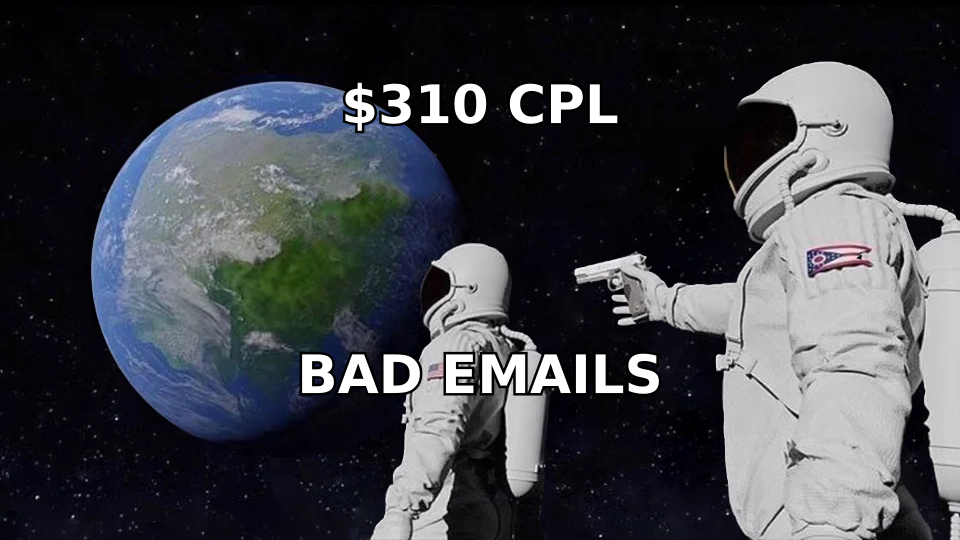
That verification step is not optional hygiene. Platforms like Meta and LinkedIn do not validate the email a user submits beyond format checks, and typo'd or throwaway addresses are common in high-volume lead ads. Marketers who skip verification find out at the worst possible moment: when their cold outreach domain, which had nothing to do with the ad campaign, starts landing in spam because the same sending infrastructure processed a batch of dead addresses.
How should you split a lead generation advertising budget?#
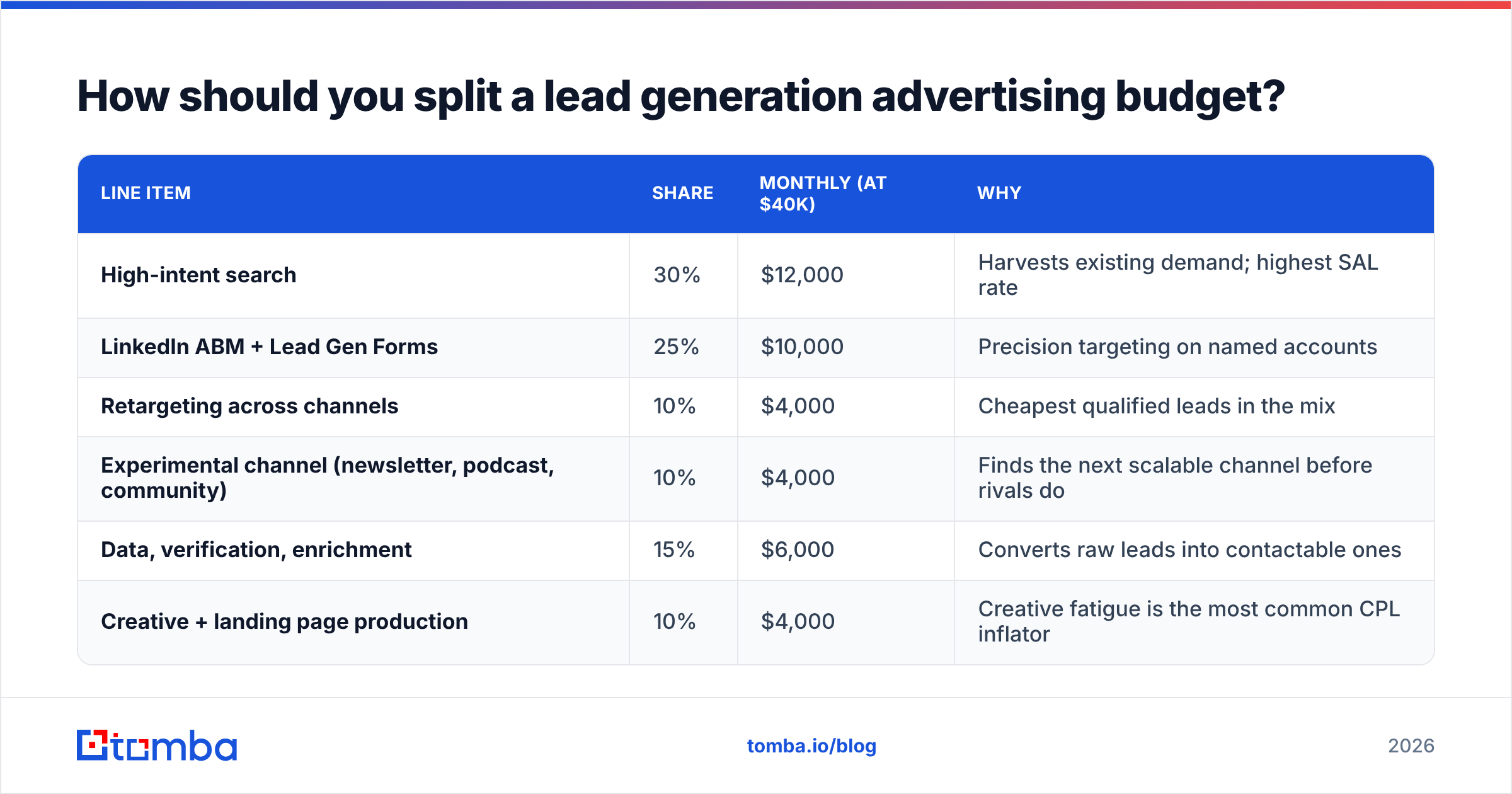
A defensible 2026 allocation for a mid-market B2B program running roughly $40K/month:
| Line item | Share | Monthly (at $40K) | Why |
|---|---|---|---|
| High-intent search | 30% | $12,000 | Harvests existing demand; highest SAL rate |
| LinkedIn ABM + Lead Gen Forms | 25% | $10,000 | Precision targeting on named accounts |
| Retargeting across channels | 10% | $4,000 | Cheapest qualified leads in the mix |
| Experimental channel (newsletter, podcast, community) | 10% | $4,000 | Finds the next scalable channel before rivals do |
| Data, verification, enrichment | 15% | $6,000 | Converts raw leads into contactable ones |
| Creative + landing page production | 10% | $4,000 | Creative fatigue is the most common CPL inflator |
Note that 25% never touches an ad platform. That is deliberate. Programs that push media spend to 90% of budget reliably post better CPL and worse pipeline, because nothing downstream is built to handle what the ads deliver.
If you are early and cannot fund all six lines, cut the experimental channel first and the data line last. You can always find another place to advertise. You cannot recover a lead whose email address you never resolved.
What about buying lead lists instead of advertising?#
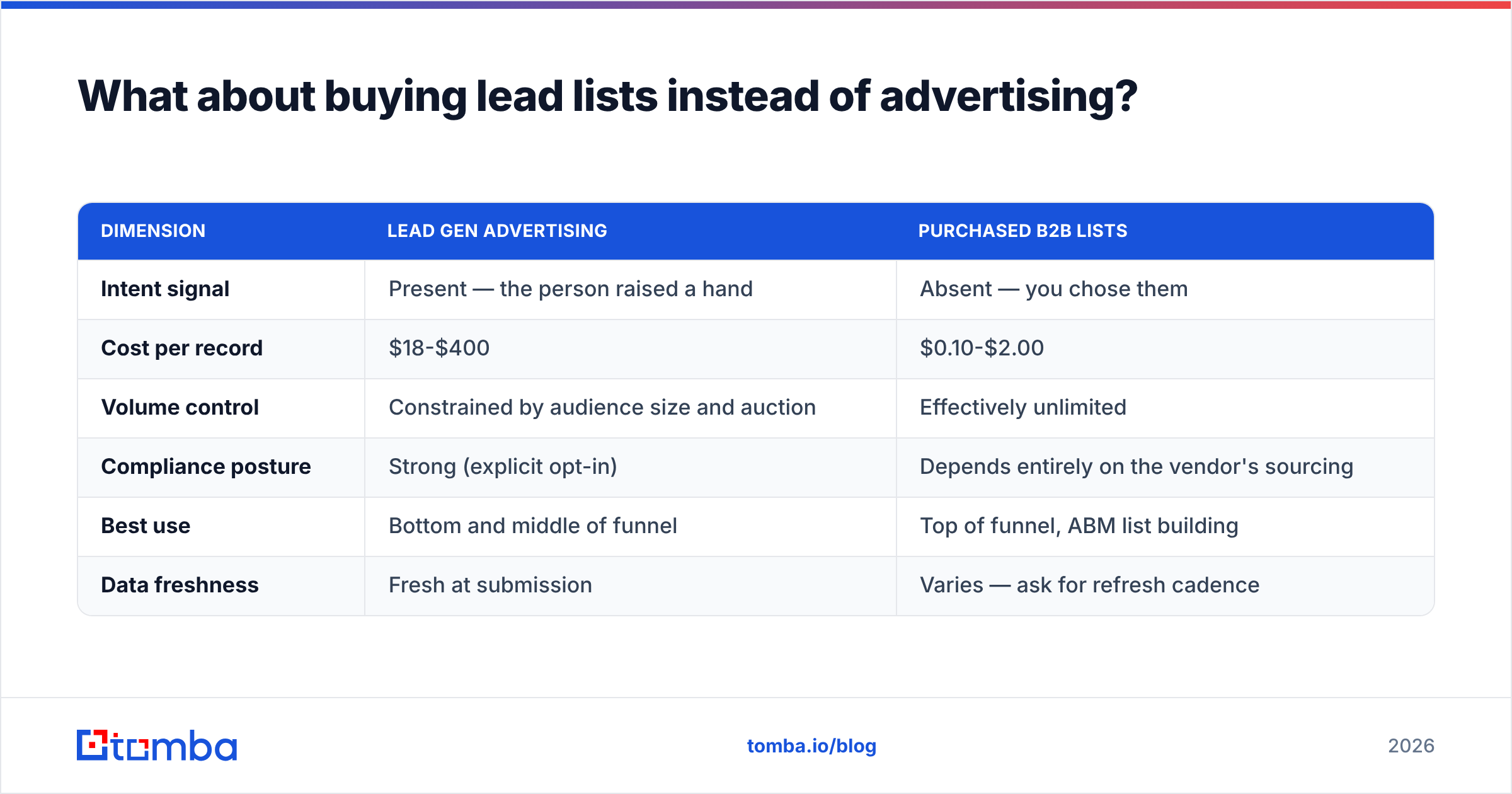
Purchased lists and advertising solve different problems, and the honest answer is that most mature programs run both.
| Dimension | Lead gen advertising | Purchased B2B lists |
|---|---|---|
| Intent signal | Present — the person raised a hand | Absent — you chose them |
| Cost per record | $18-$400 | $0.10-$2.00 |
| Volume control | Constrained by audience size and auction | Effectively unlimited |
| Compliance posture | Strong (explicit opt-in) | Depends entirely on the vendor's sourcing |
| Best use | Bottom and middle of funnel | Top of funnel, ABM list building |
| Data freshness | Fresh at submission | Varies — ask for refresh cadence |
Reputable list providers exist and do real work. BookYourData, for instance, sells pay-as-you-go verified B2B contacts and is a reasonable fit when you need to build an account list quickly rather than wait for inbound to fill it. The failure mode is not "lists are bad" — it's treating a cold list like a warm inbound lead and sequencing it with the same messaging. Intent changes the copy, the cadence, and the offer.
A sensible hybrid: use advertising to identify which segments respond, then use list building and bulk lead generation to go find every other company matching that segment's profile. The ads become market research that pays for itself, and the list becomes the scale layer.
What are the most common lead generation advertising mistakes?#
- Optimising for the form fill. Feed the platform your qualified-lead event via offline conversion import. Both Google Ads and LinkedIn support this, and it is the single highest-leverage change most programs can make.
- One gated asset for eighteen months. Creative and offer fatigue raise CPL by 30-60% over a year. Refresh the asset, not just the ad copy.
- Ignoring the mobile form experience. Most B2B lead ad impressions are mobile. A six-field form on a phone is a conversion tax you're paying voluntarily.
- No negative targeting. Exclude current customers, current opportunities, students, and competitors. Most accounts do not, and pay for the privilege of re-acquiring people they already have.
- Treating the CRM as a dumping ground. If leads land without enrichment, routing rules, or a contactable email, the ad spend was a donation.
- Measuring on a 7-day window. Extend the attribution window to match your actual sales cycle, or you will systematically defund the channels that create demand.
How do you know if the program is working?#
Four numbers, checked monthly, tell you almost everything:
- CPQL by channel — trending down or flat is fine; trending up more than 15% quarter over quarter means creative fatigue or audience exhaustion.
- Lead-to-SAL rate — if this drops while volume rises, the platform has found you a cheaper, worse audience. This happens the moment you loosen targeting.
- Email deliverability on the follow-up — bounce rate above 3% on inbound leads means your capture forms have no validation. Check your email deliverability health before blaming the SDR team's reply rates.
- Median time to first touch — measured in minutes, not days. If this is over an hour, fix routing before you touch the ad account.
Everything else — impressions, CTR, cost per click, engagement rate — is diagnostic detail. Useful for troubleshooting a specific campaign, useless for deciding where the next $10K goes.
Where should you start?#
Pick your single highest-intent channel, run it for one full sales cycle with proper CPQL measurement, and build the verification and enrichment layer before you scale spend. That order matters. Scaling a program whose follow-up infrastructure is broken just buys more expensive disappointment.
The practical first move for most teams: audit the leads you already paid for. Pull the last 500 records from your CRM, check how many have a valid, deliverable business email, and calculate what you spent to acquire the ones that don't. That number is usually large enough to fund the fix several times over.
When you're ready to close that gap, the Tomba Email Finder turns a name and a company domain into a verified work email — exactly the record your ad forms keep failing to capture. The free tier covers 25 searches a month so you can test it against your own lead data before committing; paid plans start at $49/mo for Starter and $99/mo for Growth, with full Tomba pricing available if you need volume. Start with the leads you've already bought. They're the cheapest pipeline you'll find this quarter.
Related guides#
// get started
Find, verify and enrich your first contacts today
Start on the free plan with 25 searches a month, then scale when your team is ready.
Free plan · No credit card required · GDPR & CCPA
Get the Tomba newsletter
Product and data updates
// about the author