Free Email Scraper Tools in 2026: What Actually Works
Free email scrapers pull thousands of addresses in minutes — and most of them bounce. Here is how scraping really works, where it breaks, and when a verified finder beats a free tool.
TL;DR
- A free email scraper extracts addresses that already exist in public HTML, documents, or search results. It does not find the address of a named person — that is a different job, done by a finder with a verification layer.
- Scraped lists typically bounce at 15-40% because scrapers grab role accounts, expired addresses, spam traps, and text that merely looks like an email.
- Free tools are genuinely useful for three things: local-business scraping, one-off contact-page pulls, and enriching a list you already own. They are bad at compliance, at scale, and at accuracy.
- The safest workflow is scrape → dedupe → verify → segment. Skipping verification is what gets domains blacklisted, not the scraping itself.
- If your outreach depends on named decision-makers rather than
info@inboxes, a verified email finder costs less per usable contact than a free scraper plus a burned sending domain.
What is a free email scraper?#
A free email scraper is a tool that reads a web page — or a batch of pages — and pulls out every string that matches an email pattern. Think of it as a metal detector on a beach: it beeps at anything metallic. Some of what it surfaces is a gold ring. Most of it is bottle caps.
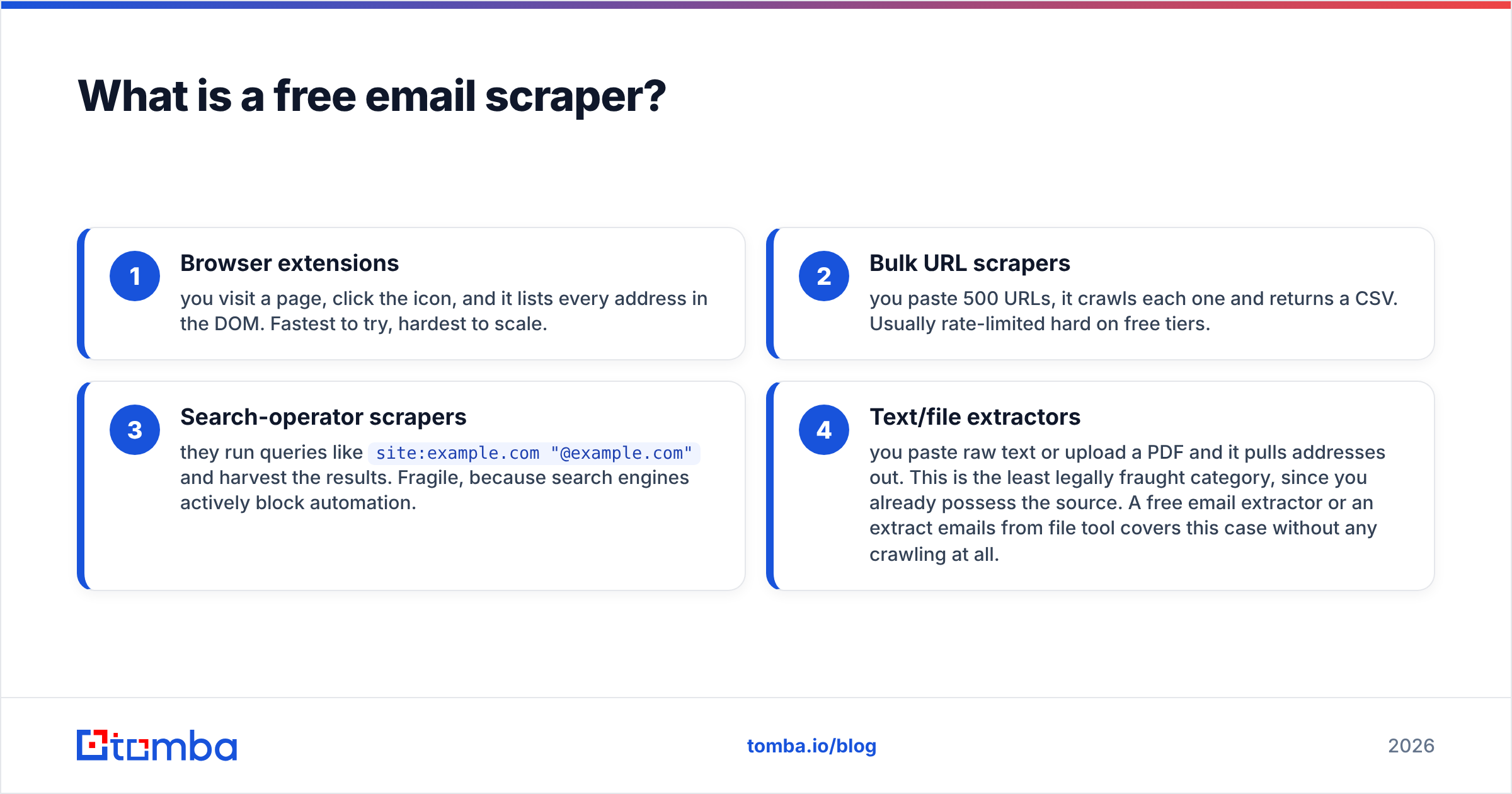
Scrapers come in four common shapes:
- Browser extensions — you visit a page, click the icon, and it lists every address in the DOM. Fastest to try, hardest to scale.
- Bulk URL scrapers — you paste 500 URLs, it crawls each one and returns a CSV. Usually rate-limited hard on free tiers.
- Search-operator scrapers — they run queries like
site:example.com "@example.com"and harvest the results. Fragile, because search engines actively block automation. - Text/file extractors — you paste raw text or upload a PDF and it pulls addresses out. This is the least legally fraught category, since you already possess the source. A free email extractor or an extract emails from file tool covers this case without any crawling at all.
The important distinction, and the one most buyers miss: a scraper is retrieval, not inference. If sarah.chen@acme.com never appears in public HTML, no scraper on earth will return it. A finder infers the pattern from verified company data and then confirms deliverability. Those are different products solving different problems, and half the frustration with free scrapers comes from expecting one to do the other's job.
Sorry — corrected placement below.
How do free email scrapers actually work?#
Under the hood, almost every scraper runs the same four steps.
Step 1 — Fetch. The tool requests the page HTML, either server-side or through your own browser session. Server-side fetching is faster but trips Cloudflare and similar bot walls more often. Extension-based scraping uses your real session, so it looks like normal browsing — which is why extensions still work on sites that block cloud scrapers.
Step 2 — Match. A regular expression scans the raw text for anything shaped like local@domain.tld. This is where most junk enters: image filenames, JavaScript variables, obfuscated addresses like name [at] domain [dot] com, and placeholder text such as you@example.com all get swept up.
Step 3 — Filter. Better tools drop obvious noise (example.com, sentry.io, wixpress.com), strip duplicates, and optionally exclude role accounts. Free tiers often skip this step entirely, which is why raw exports look inflated.
Step 4 — Output. CSV, clipboard, or a Google Sheet. Almost never verified.
That missing fifth step — verification — is the whole story. An address that exists in HTML from 2019 is not an address that accepts mail in 2026. Run any scraped batch through an email verifier before it touches a sending tool, and you convert a liability into a list.
Are free email scrapers legal in 2026?#
Short answer: scraping publicly accessible pages is generally lawful in the US and EU; what you do with the resulting personal data is where the rules bite.
Three things to hold separately:
- The act of collecting. Courts in the US have repeatedly declined to treat scraping of public pages as unauthorized access under the CFAA. Web scraping itself is a mature, legal practice used by search engines, price trackers, and research teams. Terms of service can still create contract exposure, and platforms like LinkedIn enforce theirs aggressively.
- The data you hold. Under GDPR, a work email tied to a named individual is personal data. You need a lawful basis (usually legitimate interest for B2B), a documented balancing test, and a way to honor deletion requests. "I scraped it, so it's public" is not a basis.
- How you contact them. CAN-SPAM allows unsolicited B2B mail with accurate headers and a working opt-out. The EU is stricter; several member states require prior consent for individual mailboxes but allow generic corporate addresses. Canada's CASL is stricter still.
The practical rule most compliant teams land on: scrape business-context data, keep a record of the source URL and collection date, honor unsubscribes at the domain level, and never touch personal or consumer addresses. If your tool cannot tell you where a record came from, you cannot defend it.
Which free email scrapers are worth trying in 2026?#
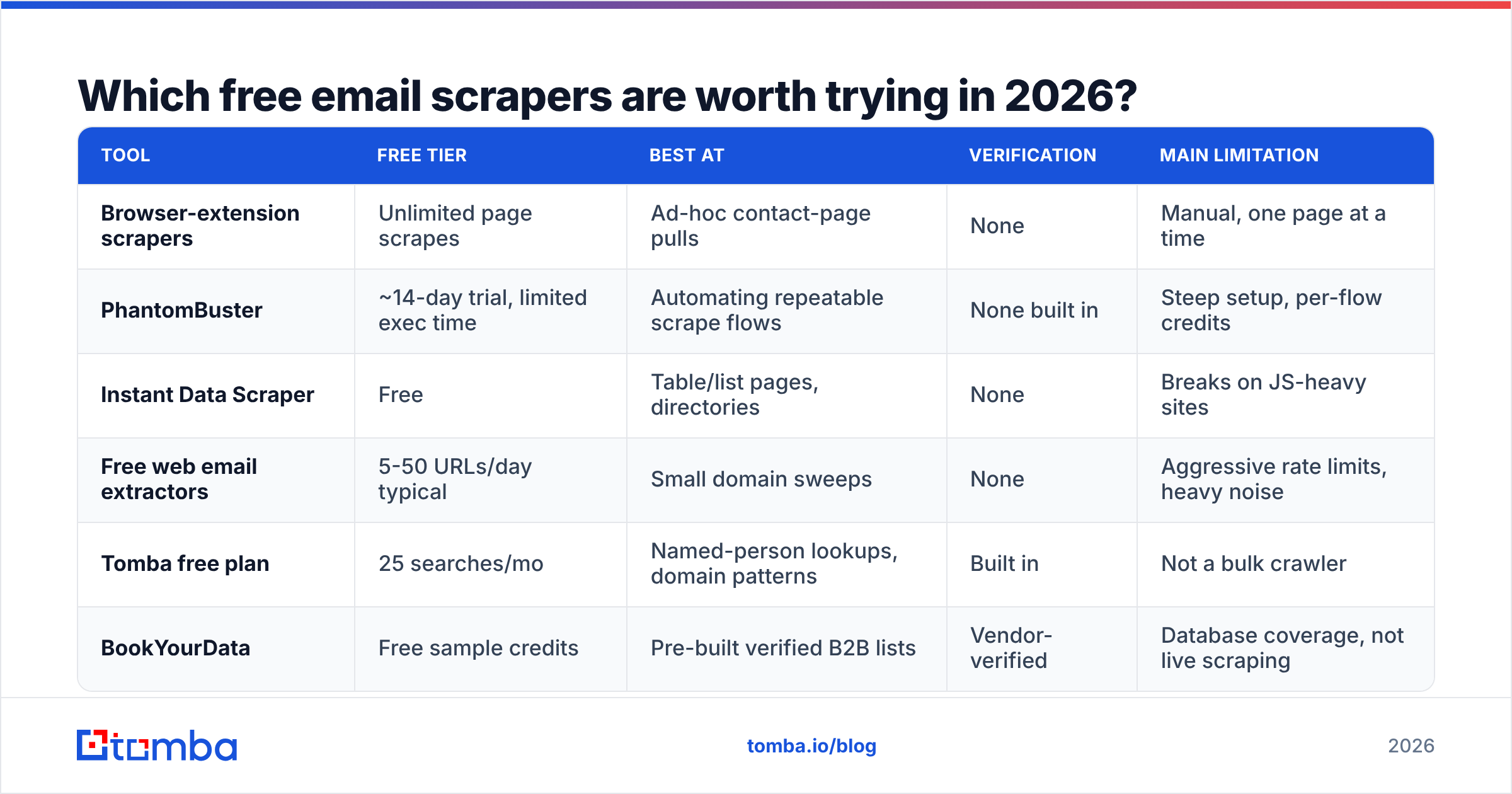
There is no single winner, because the categories solve different problems. Here is the honest landscape.
| Tool | Free tier | Best at | Verification | Main limitation |
|---|---|---|---|---|
| Browser-extension scrapers | Unlimited page scrapes | Ad-hoc contact-page pulls | None | Manual, one page at a time |
| PhantomBuster | ~14-day trial, limited exec time | Automating repeatable scrape flows | None built in | Steep setup, per-flow credits |
| Instant Data Scraper | Free | Table/list pages, directories | None | Breaks on JS-heavy sites |
| Free web email extractors | 5-50 URLs/day typical | Small domain sweeps | None | Aggressive rate limits, heavy noise |
| Tomba free plan | 25 searches/mo | Named-person lookups, domain patterns | Built in | Not a bulk crawler |
| BookYourData | Free sample credits | Pre-built verified B2B lists | Vendor-verified | Database coverage, not live scraping |
A few notes on that table. PhantomBuster is the most capable of the automation tools and its official site documents each flow well, but the free window closes fast and per-flow credits add up. BookYourData sits in a different lane entirely — you are buying pre-verified records rather than harvesting them, which removes the accuracy problem and the compliance ambiguity at the cost of live freshness. For teams that would rather not operate scrapers at all, that trade is often correct.
Cross-check any shortlist against real reviews on G2 before committing; the free-tool space churns constantly and half the "best free scraper" listicles reference products that shut down.
Why do scraped emails bounce so much?#
Because a scraper measures presence, not deliverability. Those are wildly different signals.
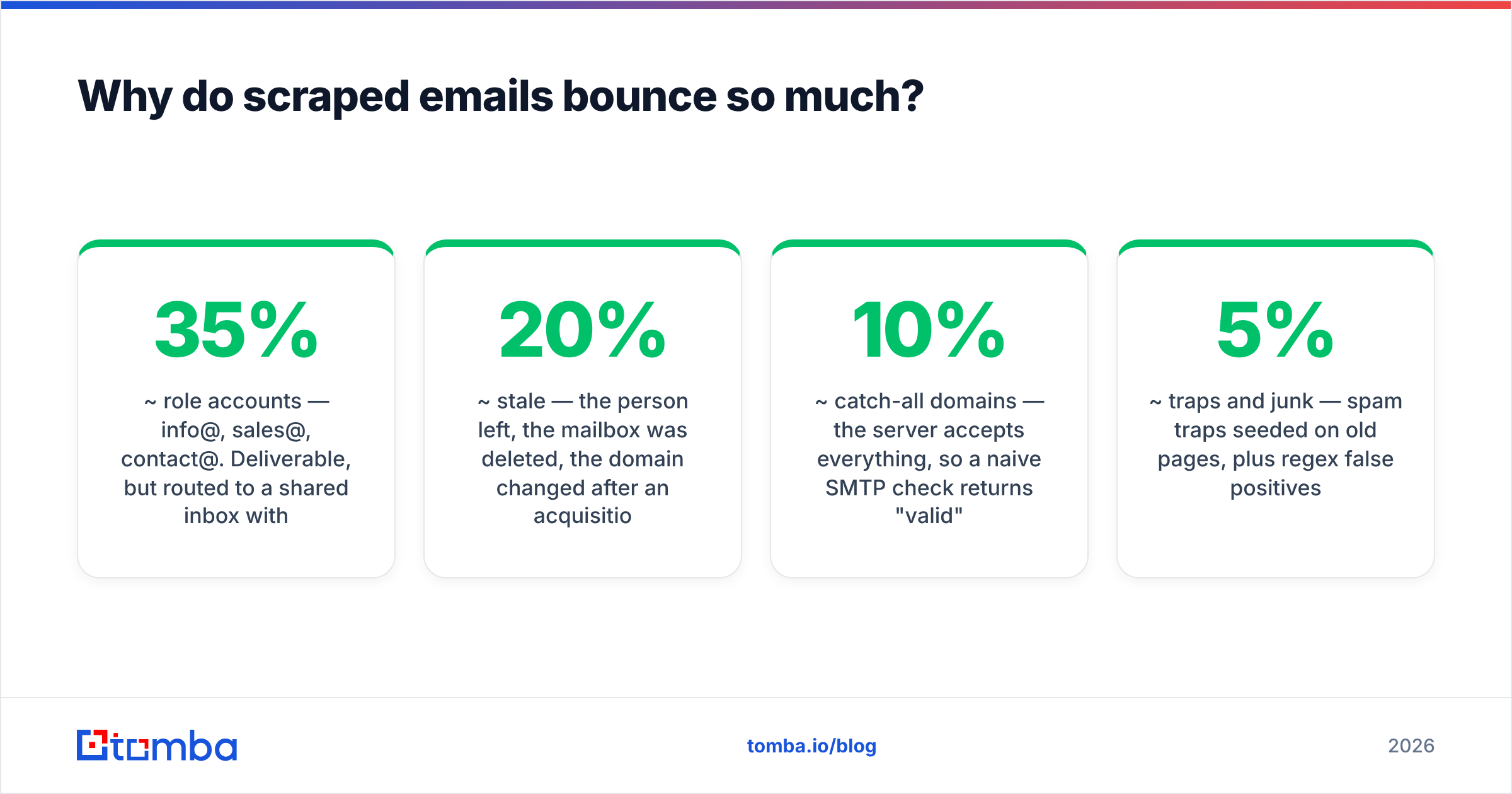
Typical composition of a raw scraped batch from 1,000 company sites:
- ~35% role accounts —
info@,sales@,contact@. Deliverable, but routed to a shared inbox with terrible reply rates. - ~20% stale — the person left, the mailbox was deleted, the domain changed after an acquisition.
- ~10% catch-all domains — the server accepts everything, so a naive SMTP check returns "valid" for addresses that will hard-bounce later. This is the single most expensive false positive in cold email, and it needs a dedicated catch-all verifier rather than a standard check.
- ~5% traps and junk — spam traps seeded on old pages, plus regex false positives.
- The remainder — genuinely useful, deliverable, individually addressed contacts.
Mailbox providers judge you on the aggregate. A 15% bounce rate on a fresh domain is enough to tank sender reputation within a single send, and reputation recovers far more slowly than it degrades.

The accuracy gap above is not a marketing artifact — it is the difference between a tool that returns strings and a tool that returns confirmed mailboxes. When you compare cost, compare cost per deliverable contact, not per row exported.
Free email scraper vs email finder: which do you actually need?#
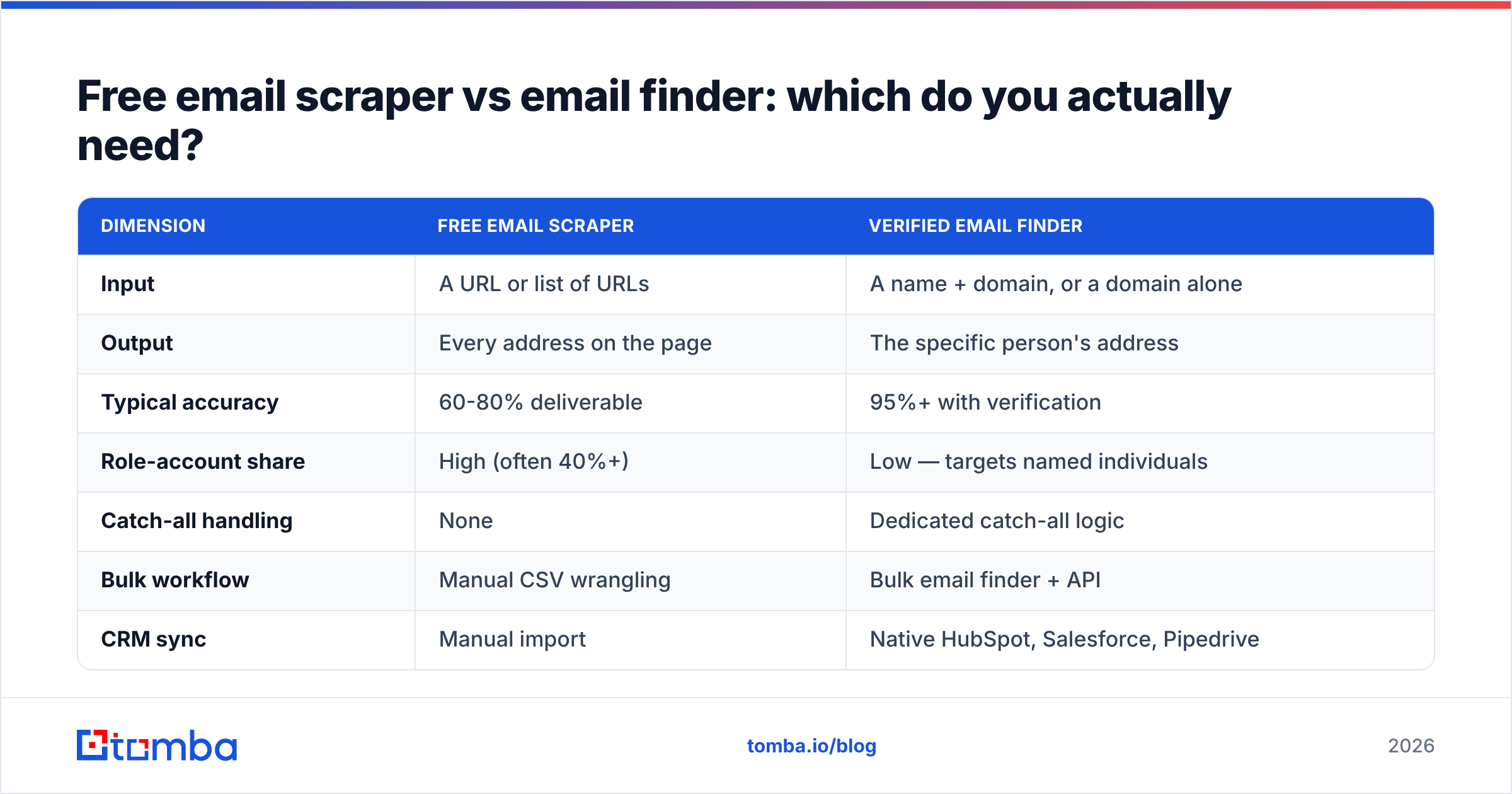
Use this as the decision table.
| Dimension | Free email scraper | Verified email finder |
|---|---|---|
| Input | A URL or list of URLs | A name + domain, or a domain alone |
| Output | Every address on the page | The specific person's address |
| Typical accuracy | 60-80% deliverable | 95%+ with verification |
| Role-account share | High (often 40%+) | Low — targets named individuals |
| Catch-all handling | None | Dedicated catch-all logic |
| Bulk workflow | Manual CSV wrangling | Bulk email finder + API |
| CRM sync | Manual import | Native HubSpot, Salesforce, Pipedrive |
| Entry cost | $0 | Free tier, then $49/mo |
| Compliance trail | You build it | Source attribution included |

The pricing question resolves faster than people expect. Suppose you scrape 2,000 addresses free and 30% are unusable. You now have 1,400 usable contacts, several hours of cleanup, and a bounce risk on the ones you did not catch. A paid finder at $49/mo returning 1,000 verified contacts gives you a smaller, cleaner list that your sending tool will not choke on. Run the math on replies, not on rows. Full Tomba pricing is public if you want to model it against your own volumes.
How do you build a scraping workflow that does not burn your domain?#
Six steps, in order. Skip none of them.
- Define the target list first. Decide the firmographic filter — industry, headcount, geography, tech stack — before you scrape anything. Scraping is cheap; scraping the wrong 5,000 companies costs you a quarter.
- Scrape at the company level, not the person level. Pull domains, then resolve people. Use domain search to get every known address at a company plus the dominant pattern, instead of hoping the contact page lists your buyer.
- Dedupe aggressively. Same person, three domains; same address, different casing. A remove duplicates pass before verification saves credits and prevents double-sends, which are the fastest route to a spam complaint.
- Verify everything, including the ones that look fine. Syntax check, MX record, SMTP handshake, catch-all detection, disposable-domain flag. Anything that comes back "unknown" goes to a hold list, not to your sequence.
- Segment by confidence. Verified-deliverable contacts go into your primary sequence. Catch-all and risky addresses go into a low-volume test send from a secondary domain, or nowhere at all.
- Log provenance. Source URL, collection date, verification date, verification result. Ten minutes of schema work now is your entire answer if a GDPR request arrives later.
Teams that run this loop see bounce rates under 2% on lists that started life as scraped HTML. Teams that skip step 4 see 15% and wonder why their open rates collapsed in week three.
When is a free email scraper the right call?#
There are real cases where free wins, and pretending otherwise would be dishonest.
- Local-business prospecting. Restaurants, clinics, contractors, and trades publish
owner@on their contact page. There is no CRM record to enrich and no LinkedIn profile to match. A scraper is the correct tool. - Event and directory lists. Conference exhibitor pages, association member directories, and trade-show listings are structured, public, and legitimately intended for business contact.
- One-off research. You need the press contact at eleven publications. A browser extension takes four minutes.
- Enriching data you already own. If a lead filled in a form and you need their company's other contacts, you are not really scraping strangers — you are expanding a warm account.
Where free scrapers stop working: enterprise targets whose employees are not listed publicly, any workflow above a few hundred contacts per month, anything requiring a CRM write-back, and anything where a bounce costs you more than a credit. At that point, the email finder plus verification stack is not an upsell — it is the cheaper option once you price your own time.
Frequently asked questions#
Can a free email scraper find someone's personal email? No, and you should not want it to. Scrapers surface addresses already published on public pages, which in a B2B context means work addresses. Tools that claim to surface personal Gmail addresses are usually reselling breach data — a legal and reputational risk that no pipeline number justifies.
Do scraped emails work for cold outreach? They can, after verification and segmentation. Raw scraped lists sent directly to a sequencer are the most common cause of a burned sending domain. Verify, warm your domain properly, and keep daily volume conservative for the first month.
What is the difference between scraping and an email finder API? Scraping reads pages you point it at. An email finder API accepts a name and domain and returns a confirmed address with a confidence score, sourced from a maintained index plus live verification. The API is deterministic and integrable; the scraper is opportunistic.
How many scraped emails are actually usable? Plan for 60-70% after deduplication and verification, lower if you are scraping older or smaller sites. Anyone quoting 95% from raw scraping is counting rows, not deliveries.
Where to go from here#
Start by being honest about which problem you have. If you need every address on a set of public pages, a free scraper plus a verification pass is a perfectly rational stack — just build the verification step in from day one rather than after your first bounce spike.
If you need a specific decision-maker at a specific company, no scraper will reliably get you there. That is what the Tomba Email Finder is built for: give it a name and a domain, or just a domain, and it returns verified addresses with confidence scores and source attribution, with catch-all detection and bulk processing on the same account. The free tier runs 25 searches a month with no card, which is enough to compare its output side by side against whatever scraper you are using now. Run both on the same twenty companies and compare deliverable contacts, not row counts — that test settles the question in an afternoon.
Related guides#
Ready to find emails that actually work?
Join 150,000+ professionals who stopped guessing and started sending. Free credits on signup — no credit card required.
Get the Tomba newsletter
Practical outbound tactics and product updates — once every two weeks.
About the author