GetProspect vs Apollo.io (2026): Which Tool Actually Wins?
GetProspect sells cheap verified emails. Apollo.io sells a full sales platform. We compared credits, accuracy, exports, and hidden costs to show which one fits your team — and when a third option beats both.
TL;DR
- GetProspect is a list-building and email-finding tool. It is cheap, LinkedIn-centric, and its verified-email filter is genuinely good. It is not a sending platform in any serious sense.
- Apollo.io is a full go-to-market platform: 200M+ contact database, sequences, dialer, CRM-lite, intent data. You pay for the bundle whether you use it or not.
- Pricing shape differs more than price: GetProspect starts around $49/mo for 1,000 verified emails; Apollo's Basic is $49/user/mo but gates exports, dialer, and enrichment behind higher tiers.
- Data accuracy is close on generic B2B roles and diverges hard on non-US, SMB, and long-tail domains — where both fall back to guessed patterns.
- If you want data quality without the platform tax, a dedicated finder like Tomba Email Finder plus your existing sequencer usually costs less and verifies harder than either.
What are GetProspect and Apollo.io, actually?#
They get compared constantly, but they are not the same category of product.
GetProspect is a B2B email finder and list builder. You search its database by job title, company, industry, headcount, or location; or you run its Chrome extension over a LinkedIn Sales Navigator search and pull emails from the profiles. Output goes to CSV, Google Sheets, or a CRM. There is a light email-sending feature, but nobody buys GetProspect to send campaigns.
Apollo.io is a sales engagement platform with a database attached. The database is the hook (200M+ contacts, 35M+ companies by Apollo's own count), but the product is the workflow: build a list, enrich it, drop it into a multi-step sequence, dial from the browser, log activity, score leads with intent signals, sync to HubSpot or Salesforce.
The practical translation: GetProspect answers "who do I email and what's their address?" Apollo answers that and "how do I run the whole outbound motion in one tab?"
That difference drives everything else — price, accuracy expectations, and what breaks at scale.
How do GetProspect and Apollo.io compare on price and limits?#
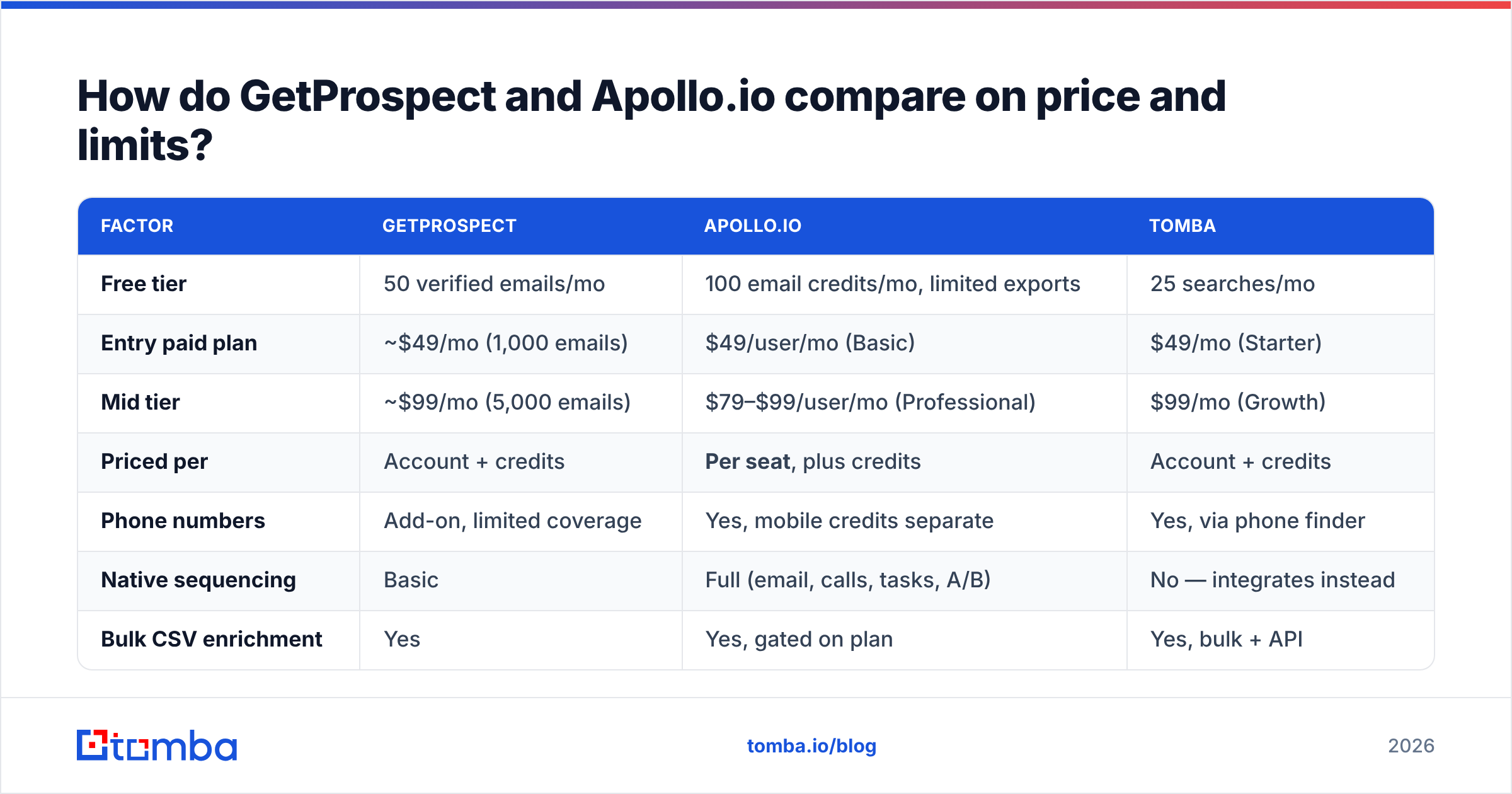
Pricing pages for both tools are written to look cheaper than the bill you actually get. Here's the honest shape as of 2026.
| Factor | GetProspect | Apollo.io | Tomba |
|---|---|---|---|
| Free tier | 50 verified emails/mo | 100 email credits/mo, limited exports | 25 searches/mo |
| Entry paid plan | ~$49/mo (1,000 emails) | $49/user/mo (Basic) | $49/mo (Starter) |
| Mid tier | ~$99/mo (5,000 emails) | $79–$99/user/mo (Professional) | $99/mo (Growth) |
| Priced per | Account + credits | Per seat, plus credits | Account + credits |
| Phone numbers | Add-on, limited coverage | Yes, mobile credits separate | Yes, via phone finder |
| Native sequencing | Basic | Full (email, calls, tasks, A/B) | No — integrates instead |
| Bulk CSV enrichment | Yes | Yes, gated on plan | Yes, bulk + API |
| API access | Yes | Yes, higher tiers | Yes, all paid plans |
| Best for | Cheap targeted lists | All-in-one outbound teams | Accuracy-first finding + verification |
Three cost traps worth naming:
- Apollo is per seat. A five-person SDR team on Professional is roughly $400–$500/mo before add-ons. GetProspect and Tomba both price by account and credits, so adding a teammate costs nothing extra.
- Export credits ≠ email credits. Apollo historically separates "email credits," "mobile credits," and export limits. Teams routinely hit an export ceiling with credits still in the tank.
- GetProspect's "verified" label is a filter, not a guarantee. You will still burn credits on records that bounce — particularly catch-all domains, which most finders quietly mark as "risky" and let through.
Check the vendors directly before you buy: Apollo's pricing page and GetProspect's pricing page both change quarterly, and G2's category reviews are the fastest way to see what current customers complain about. Tomba's own Tomba pricing is flat by account for comparison.
Which one has better data accuracy?#
Neither vendor's headline number survives contact with a real list.
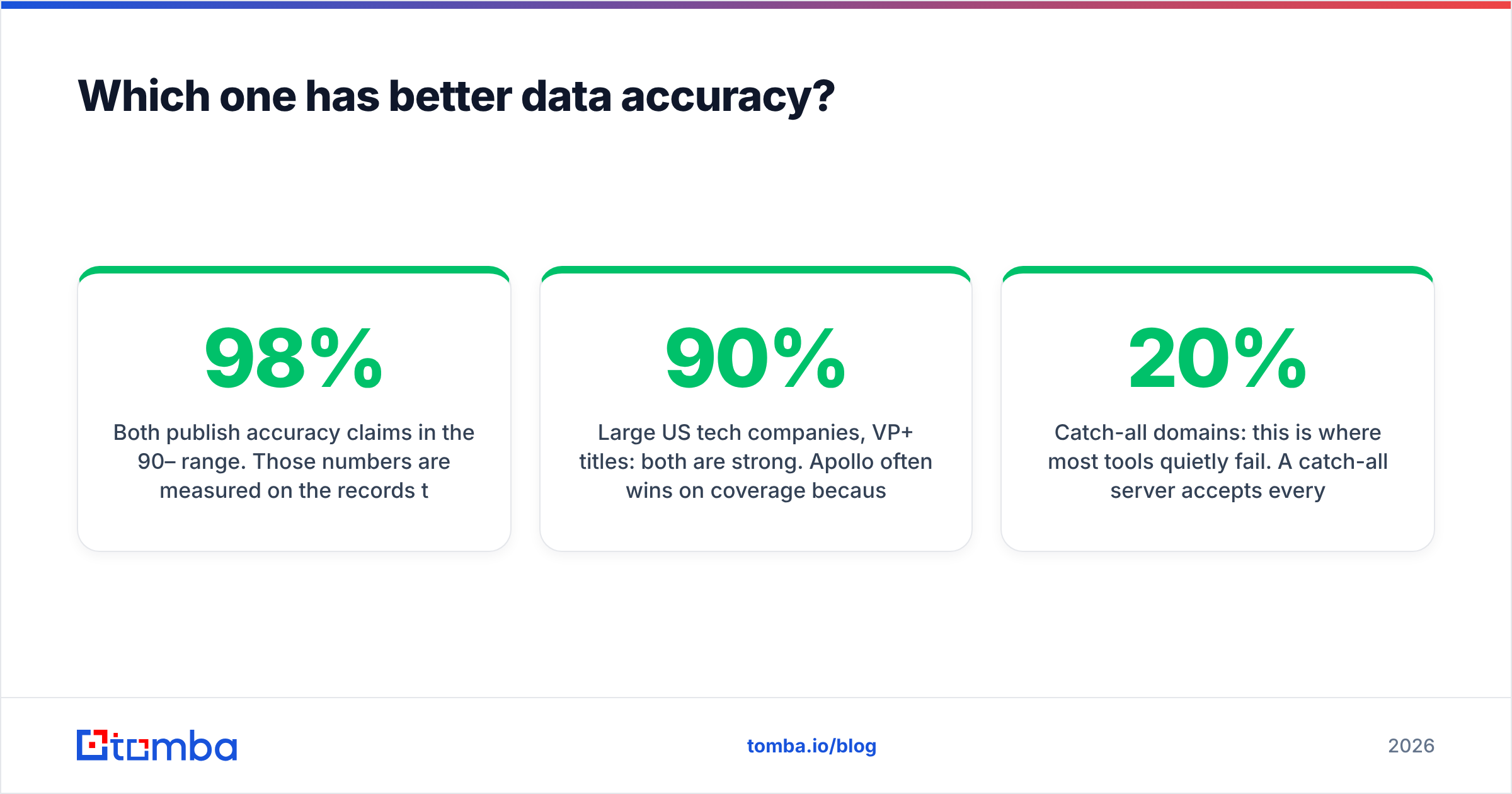
Both publish accuracy claims in the 90–98% range. Those numbers are measured on the records they are confident about — the ones they return. The metric that matters to you is different: coverage × accuracy on your actual target list.
Here's how they typically split:
- Large US tech companies, VP+ titles: both are strong. Apollo often wins on coverage because its contributory database is enormous. Expect 80–90% hit rates.
- SMB, non-US, or non-English domains: both degrade. GetProspect leans on LinkedIn scraping, so it finds the person but often guesses the email pattern. Apollo's community-sourced data ages badly in markets with high job mobility.
- Catch-all domains: this is where most tools quietly fail. A catch-all server accepts every address at SMTP time, so "verified" means nothing. Roughly 15–20% of B2B domains are catch-all. If your tool doesn't have a dedicated catch-all verifier, you're shipping guesses into your sequencer.
- Generic role addresses (info@, sales@, contact@): both return them freely. They inflate the hit-rate stat and tank your reply rate.
Practical test before you commit to either: take 100 known-good contacts from your CRM, strip the emails, and run them through each tool's free tier. Measure three things — how many it returned, how many matched, how many bounced on a verification pass. That's your real accuracy number, and it usually lands 15–25 points below the marketing figure.

Whichever tool you pick, run the output through an independent email verifier before sending. Using the same vendor to find and grade its own data is a conflict of interest baked into your bounce rate.
Is Apollo.io worth it if you already have a sequencer?#
Mostly no — and this is the decision most teams get wrong.
Apollo's value is the bundle. If you're already paying for Instantly, Smartlead, Outreach, or Salesloft, you're buying the sequencing engine twice. You're then paying per seat for a database you could rent per-credit.
Buy Apollo when:
- You want one vendor. Consolidation has real value: one bill, one onboarding, one support thread, one place activity gets logged.
- Your team dials. Apollo's built-in dialer with local presence is genuinely convenient versus wiring up a separate phone stack.
- You use intent and scoring. Website visitor signals and buying-intent topics are Apollo features that a standalone finder does not replicate.
- Your reps live in one tab. Adoption is a real cost. Tools that require four browser tabs get abandoned.
Skip Apollo when:
- You have a sending stack you like. Then you need data, not a platform, and you're paying a large premium for the wrapper.
- You're a solo founder or two-person team. Per-seat pricing punishes small teams less, but the feature surface is wasted.
- You target outside the US. Coverage thins fast, and you'll supplement with another tool anyway — at which point you have two bills.
- You need API-first workflows. If you're enriching inside your own product or data warehouse, a clean email finder API beats a UI-first platform every time.

Is GetProspect enough on its own?#
For list building, often yes. For a complete outbound motion, no.
GetProspect does one job well: turn a LinkedIn search or a filter set into a CSV of names and emails at a low price. Its filters are decent, its Chrome extension is stable, and the per-email cost at the mid tier is competitive with anything on the market.
What it doesn't do:
- Serious sequencing. The built-in sending is basic. You will export to a real sequencer.
- Deep verification. It filters, but it doesn't give you SMTP-level grading, catch-all handling, or risk scoring you can act on.
- Phone data at scale. Coverage exists but is thin compared to Apollo or dedicated providers.
- Intent or scoring. No signal layer. You're picking targets from static firmographics.
The honest framing: GetProspect is a component, not a system. That's fine — components are cheaper and easier to swap. Just budget for the sequencer and the verification pass you'll bolt on. If you want a similar component with harder verification, compare it against a bulk email finder workflow that runs finding and verification in one pipeline.
How do they compare on integrations and workflow?#
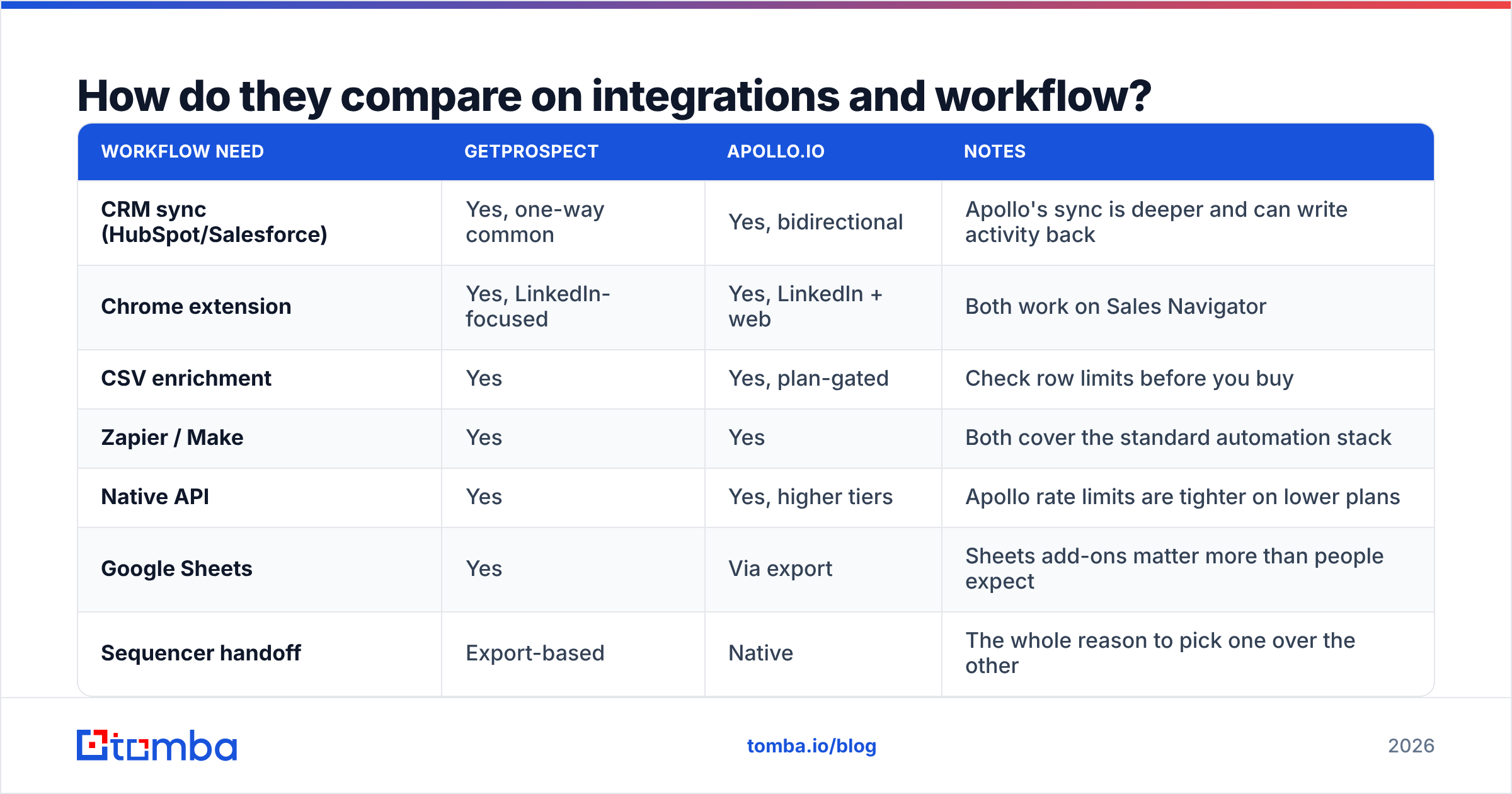
| Workflow need | GetProspect | Apollo.io | Notes |
|---|---|---|---|
| CRM sync (HubSpot/Salesforce) | Yes, one-way common | Yes, bidirectional | Apollo's sync is deeper and can write activity back |
| Chrome extension | Yes, LinkedIn-focused | Yes, LinkedIn + web | Both work on Sales Navigator |
| CSV enrichment | Yes | Yes, plan-gated | Check row limits before you buy |
| Zapier / Make | Yes | Yes | Both cover the standard automation stack |
| Native API | Yes | Yes, higher tiers | Apollo rate limits are tighter on lower plans |
| Google Sheets | Yes | Via export | Sheets add-ons matter more than people expect |
| Sequencer handoff | Export-based | Native | The whole reason to pick one over the other |
If your workflow lives in spreadsheets rather than a CRM, that last row of the table matters more than any accuracy claim. A Google Sheets or Excel add-in that enriches in place removes an entire export-import cycle from your week.
For CRM-native teams, verify how each tool handles duplicates before you connect it. Both can flood a CRM with near-duplicate contacts, and cleaning that up costs more than the subscription. Salesforce's own data management guidance is a useful baseline for what "good" hygiene looks like.

What about deliverability — does the tool choice matter?#
Yes, and more than most buyers realize.
Your data source is your first deliverability control. Every invalid address you send to is a hard bounce, and bounce rate is the single fastest way to damage sender reputation. Mailbox providers tolerate roughly 2% bounces; above 5% you're in filtering territory within days.
Where each tool sits:
- Apollo returns high volume with mixed freshness. Community-contributed records can be years stale. High volume + stale data = bounce risk if you export and blast without a verification pass.
- GetProspect filters harder before delivery, so raw bounce rates are usually lower — but it returns fewer records, so you're trading coverage for safety.
- Neither is a substitute for independent verification. Run a second-opinion check on any list over a few hundred rows, and quarantine the catch-alls into a separate, lower-volume send.
Also worth doing before your first campaign regardless of vendor: confirm your authentication is clean with an SPF checker, and pace your ramp with a warmup calculator. No data tool saves a domain with broken DNS records.
GetProspect vs Apollo.io: which should you pick?#
Decide on workflow, not on database size. Both databases are large enough that coverage on your specific ICP matters far more than the headline count.
Pick Apollo.io if: you're a 3+ person sales team, you want sequencing, dialing, and data on one bill, you sell primarily into US mid-market or enterprise, and you're willing to pay per seat for consolidation.
Pick GetProspect if: you build targeted lists from LinkedIn, you already own your sending stack, you're price-sensitive, and you'd rather have a cheap component than an expensive platform.
Pick neither if: your bottleneck is data quality rather than tooling. If your bounce rate is the problem, adding a platform doesn't fix it — a stricter finding-and-verification pipeline does.
A few other comparisons worth running before you sign anything: peers like BookYourData take a different approach entirely, selling pre-built, pay-as-you-go verified lists rather than a subscription — a strong fit when you need a one-time list without an ongoing seat cost. And if Apollo is on your shortlist mainly for the database, look at a dedicated Apollo alternative that prices by account instead of by seat.
What does a leaner alternative stack look like?#
Three pieces, swappable, usually cheaper than one all-in-one:
- Finding — a dedicated finder with domain-level pattern detection and per-record confidence scores.
- Verification — an independent pass, including catch-all handling, before anything enters your sequencer.
- Sending — whatever sequencer your team already knows, chosen on deliverability features rather than bundled data.
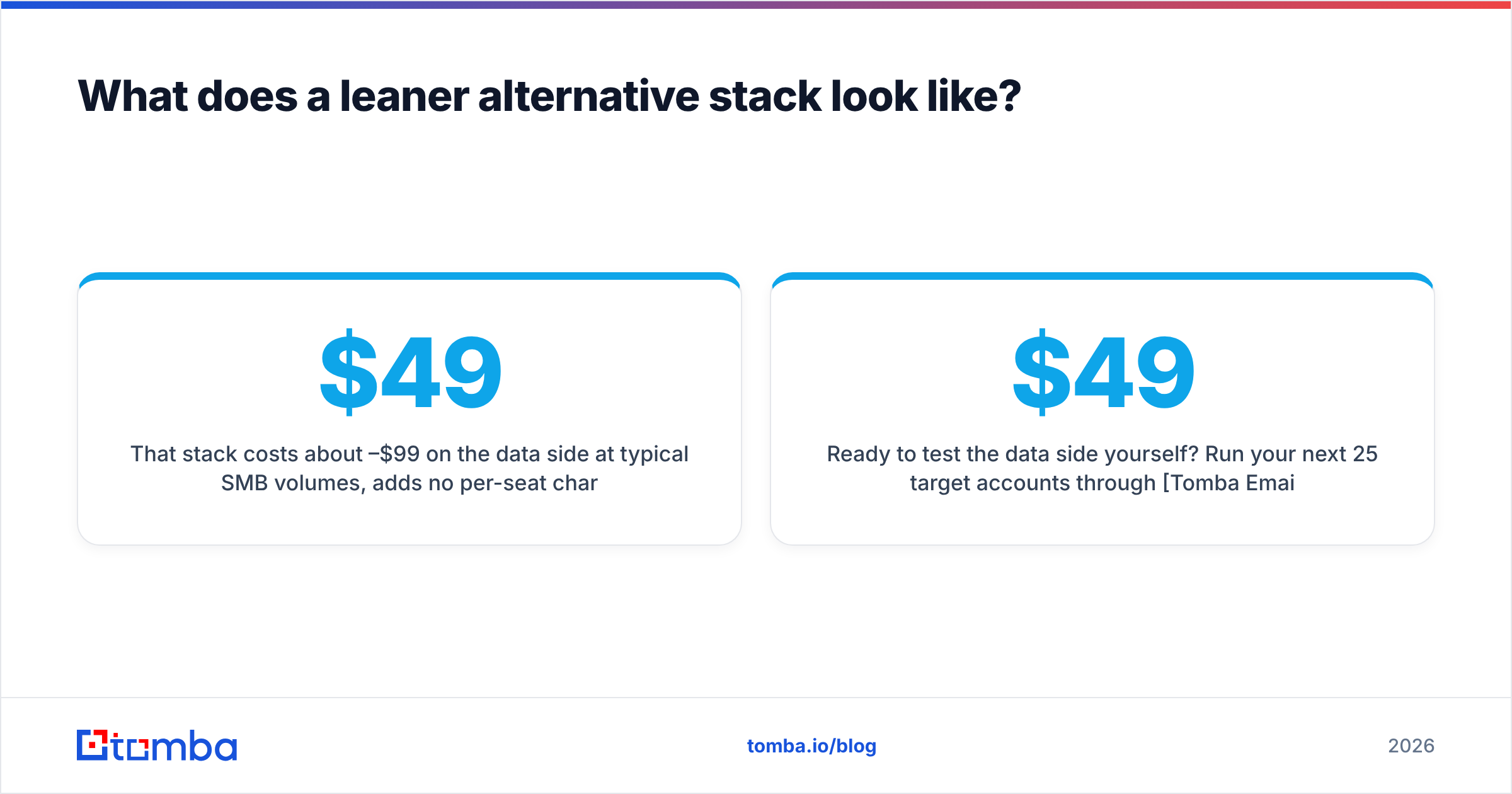
That stack costs about $49–$99/mo on the data side at typical SMB volumes, adds no per-seat charges, and lets you replace any single component without renegotiating the other two. The trade-off is real: you manage three vendors instead of one, and there's no single dashboard. For teams that value data quality over consolidated reporting, it's the better deal.
Ready to test the data side yourself? Run your next 25 target accounts through Tomba Email Finder free — no card, no seat minimums — and compare hit rate and bounce rate against whatever GetProspect or Apollo returns for the same list. Add domain search to map an entire company's email pattern in one call, and pipe it all through the Tomba API when you're ready to automate. Paid plans start at $49/mo with account-level pricing — add teammates without adding cost.
Related guides#
Ready to find emails that actually work?
Join 150,000+ professionals who stopped guessing and started sending. Free credits on signup — no credit card required.
Get the Tomba newsletter
Practical outbound tactics and product updates — once every two weeks.
About the author